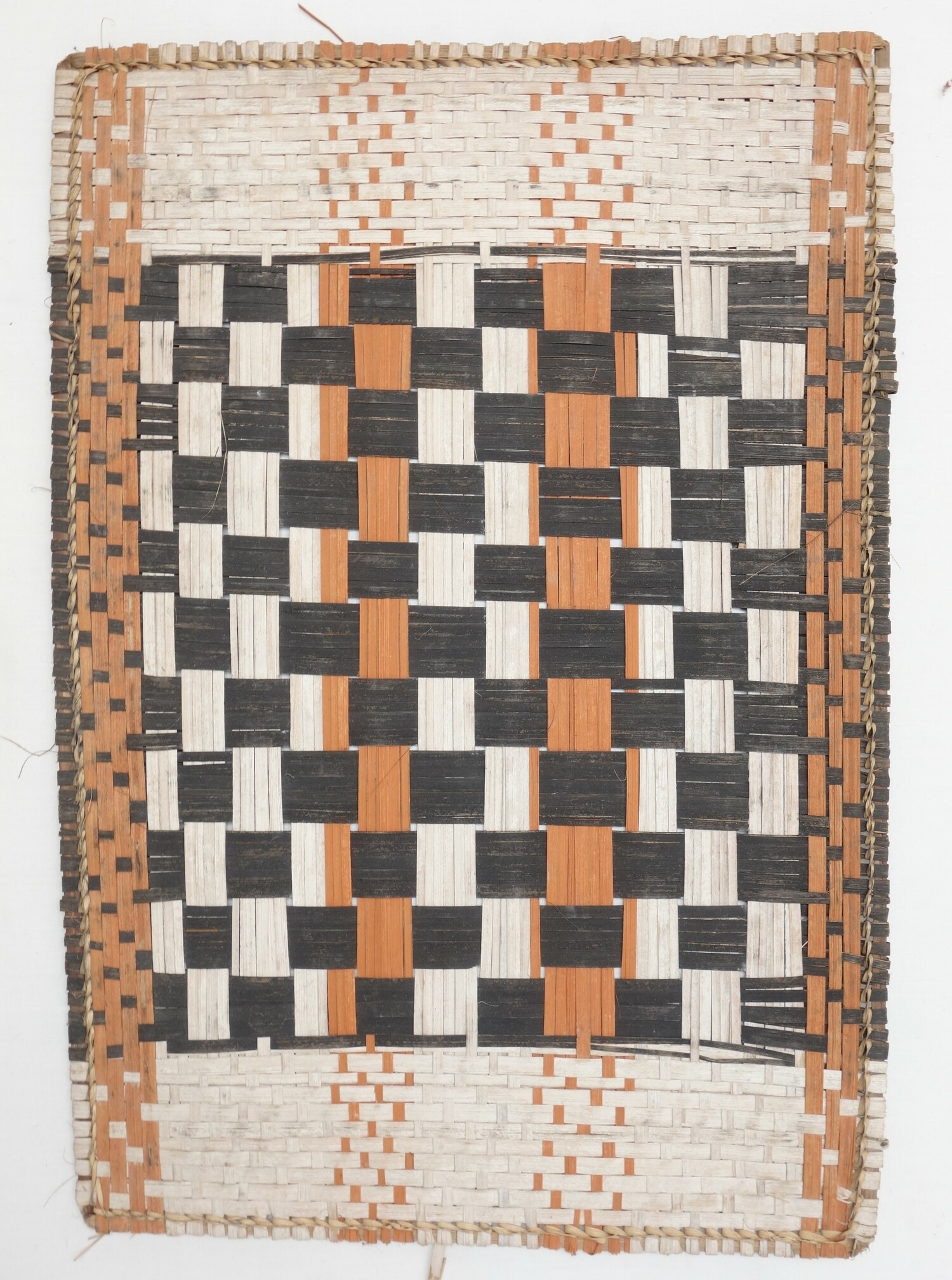
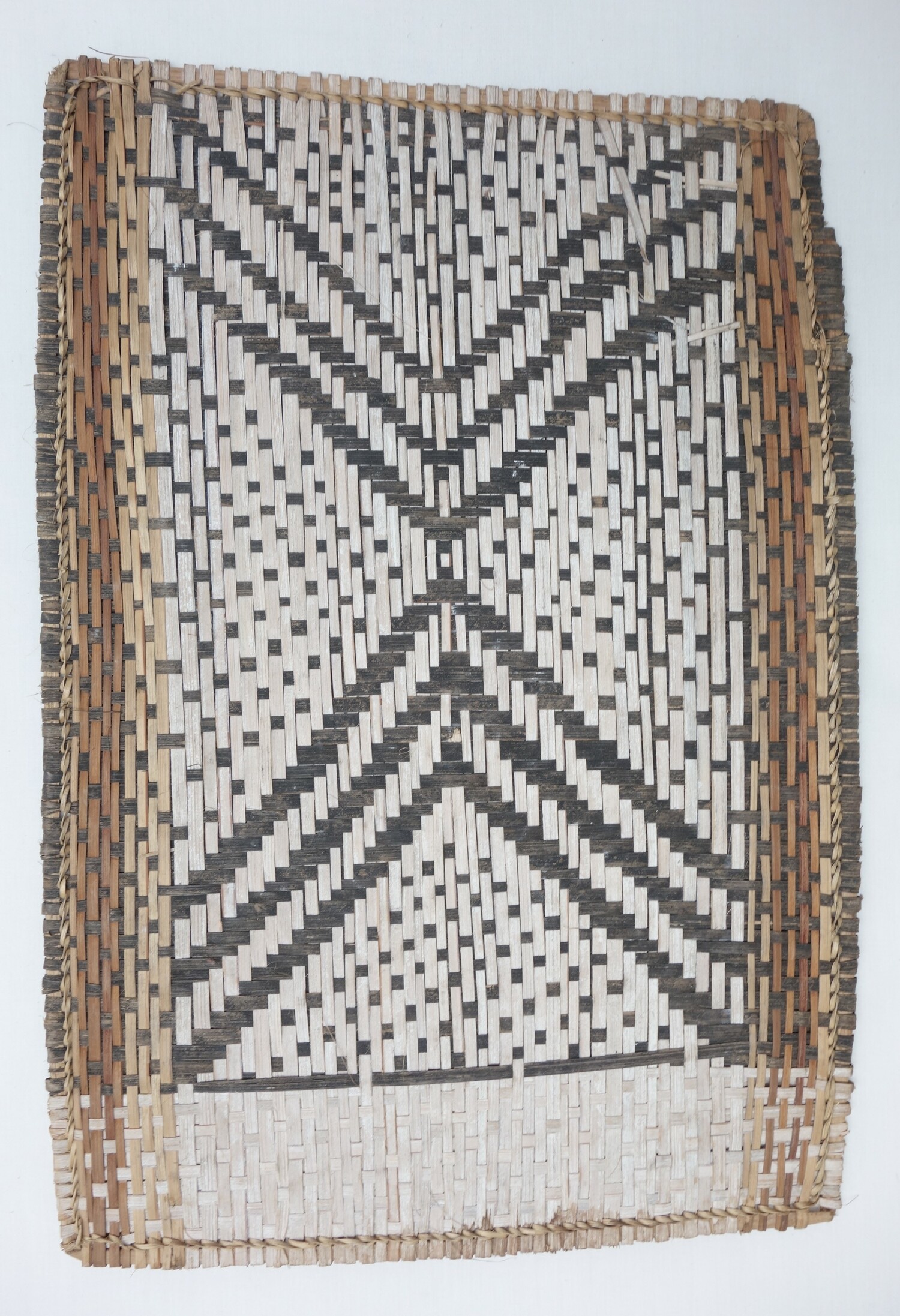
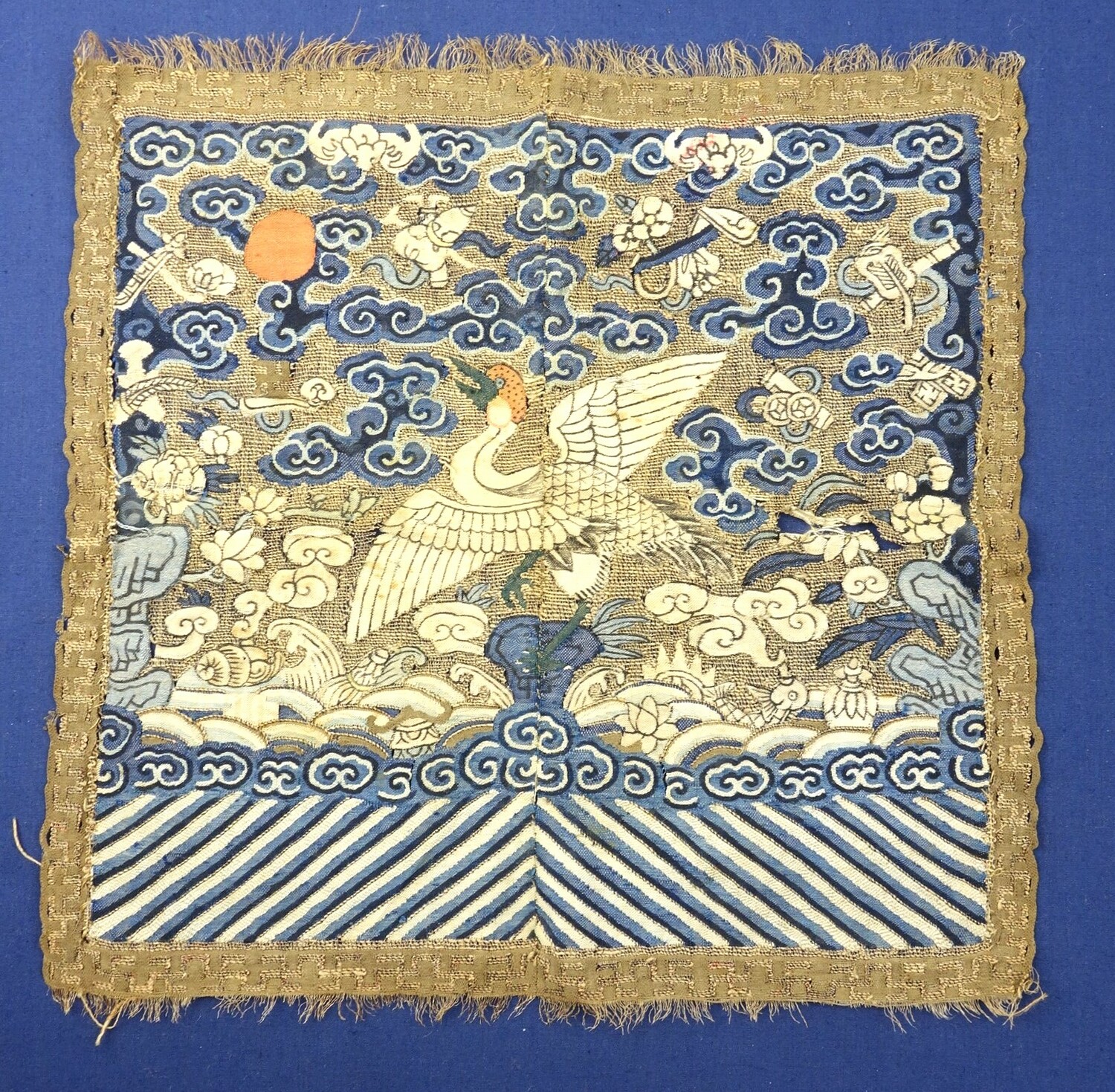
• F2
  • F4
  • F1
  • F3

Fig. 1. Plain weave with selvedge to the right.Fig. 1. Plain weave with selvedge to the right.Why bother about selvedges? Who cares? These are just a few of the comments I heard when I said that the TRC has a reference box for all sorts of selvedges.

To be short: Selvedges are important. They are an essential part of a piece of woven cloth. Below there are some thoughts of Alice van Duijnen, the TRC’s indefatigable weaving and knitting specialist.

Fig. 2. Brown hessian cloth with selvedge to the right, with a narrow purple selvedge stripe and double warps (TRC 2023.0849b).Fig. 2. Brown hessian cloth with selvedge to the right, with a narrow purple selvedge stripe and double warps (TRC 2023.0849b).Selvedge is the term for the two self-finishing sides of a normal piece of woven fabric. It is the edge where the weft threads return in the opposite direction into the warps of the weave (Fig. 1). A 'normal' piece of hand woven cloth has two selvedges and two borders.

A selvedge occurs 'naturally'. But it also prevents the cloth from unraveling and fraying along two of its sides. It may have extra strengthening or embellishment. A sample in the TRC collection (Fig. 2. TRC 2023.0849b) has a coloured thread, for embellishment, and doubled warp threads for strengthening).

The TRC has just received its first Roman fibulae! It is a gift from Sytske Wijnsma in Wormer, who has also donated in the past a large collection of books, textiles and clothing. These bronze fastenings were typically used for securing a variety of outfits and later transitioned into the more decorative brooch. Many cultures used similar fastenings, before and after the Romans. However, Roman fibulae are the most famous.

Fig. 1. Roman-period, 'trumpet'-type bronze fibula (TRC 2025.0464).Fig. 1. Roman-period, 'trumpet'-type bronze fibula (TRC 2025.0464).A variety of shapes and decorations were used to signal various social factors, such as profession, military rank or marital status. The donation consists of three fibulae, each at first glance very similar but with a little research and a closer look during the cataloguing process I realised that they are very different from one another.

Still, all three are bronze, bow fibulae (as opposed to plate and penannular types). Note that the terminology is not standardised, and below I refer mostly to terms used in the NumisWiki website, which is a useful source regarding terminology and typology. The context of these finds is unclear, but by assigning them a particular typology and time period they are useful for archaeological references.

Fig. 1. The first fibula (TRC 2025.0464) matches descriptions of a ‘trumpet’ typology which dates to 75-175 AD, the earliest of the three. These are distinguished by their wide spring pin, high arch and flared base.

Shelves in the TRC Library.Shelves in the TRC Library.At the moment I am writing this, we have a library at TRC consisting of 6282 books. This is not including the books from new donations that have come in and are yet to be registered, or the immense magazine collection we still have in the depot; we are getting these ready to be registered.

Since December 2022 I have been the librarian of the Textile Research Centre. My main focus has since then been to get through the backlog of the hundreds of books that are donated yearly.

Every Monday I spend most of my time cataloguing new books and placing them in the library. In 2024 I have managed to get through most of the backlog and started putting away the newer donations. In 2024 this amounted to some 1200 books.

Besides registering the backlog and new books, I have also spent my time in 2024 on researching how to restore books, mainly torn pages or loosened spines. The reason for this is that during the course of 2024, we have received a considerable number of books from the mid- and late 1800s. Most have been in excellent state, but some have seen their fair amount of use. Since it’s unlikely that we will receive duplicates of these books.

Another ‘quiet’ week at the TRC Leiden! We have been involved in giving the 5-day Intensive Textile Course, which as many of you will know, is a basic and yes, intense, introduction to textiles.

In just a short time, a wide variety of subjects are discussed and actually practised, ranging from fibre identification to what is embroidery via weaving (including velvet making), not to mention natural dyeing, resist-dyeing, leather and printing….. a tiring week but fun to be immersed in textiles for a short period of time.

Fig. 1. Sample of Siberian, woolly mammoth hair (Mammuthus primigenius) (TRC 2023.1510).Fig. 1. Sample of Siberian, woolly mammoth hair (Mammuthus primigenius) (TRC 2023.1510).The course wants to help people to understand and be able to ‘read’ a textile and its practical, social, economic and cultural significances. For a participant's impression of the December 2024 version, click here.

This week’s course participants included museum curators, academics, commercial world people, students, as well as people who are ‘simply’ interested in textiles. It was noticeable that they all ended up at the café around the corner, some with a beer, celebrating the week (or was it their survival?) and making new textile friends.

A highlight moment? It must be when we discussed a sample of Siberian mammoth hair from the TRC collection (Fig. 1). The fibres had been analysed, DNA’ed and dated by the National Forensic Institute in a joint project with the TRC.

The TRC exhibition on haori (a Japanese garment worn as a short jacket) is a wonderful banquet of colour and design. What I find most intriguing however, are the linings of the jackets, which often display designs not meant for outsiders to see. These for-your-eyes-only designs raise tantalizing questions. What does it feel like to carry these hidden pictures? What do these designs mean to the wearer?

Man's haori with a lining that has a woven design of Mount Fuji. Japan, 20th century (TRC 2024.1052).Man's haori with a lining that has a woven design of Mount Fuji. Japan, 20th century (TRC 2024.1052).

These questions make the dozen or so black haori (TRC 2024.1051 to 2024.1066) in the TRC collection so interesting. The haori are mostly made for men, but there are a few for women. These garments are a monochrome black on the outside, sometimes with small, discrete family crests on the back and sleeves.

The linings, however, are another story. Inside are beautiful woven or painted pictures, like two boats sailing in front of Mount Fuji (TRC 2024.1052); or a dragon curved around a volcano (TRC 2024.1054); or a colourful mountain scene and a curled, sleeping cat (TRC 2024.1065). Why did the wearer select these scenes?

Man's haori from Japan, 20th century, with on the lining a painted design of a volcano (TRC 2024.1054).Man's haori from Japan, 20th century, with on the lining a painted design of a volcano (TRC 2024.1054).

Many of these haori were acquired last year, when the TRC conducted a crowdfunding campaign to purchase them. TRC supporters are a generous group of people, so the campaign was a success. As a thank-you, many funders, including myself, received a lovely cotton furoshiki.

My orange coloured furoshiki had a lovely repeating fan motif. But I had never heard of a furoshiki before. What was this squarish-shaped cotton cloth used for? I looked up furoshiki in the TRC’s on-line collection to see two further examples. One had a delicate geometric pattern (TRC 2009.0421), while the other was a green cloth with a rather non-Japanese looking paisley, or buteh, pattern (TRC 2021.2150).

Fig. 1. Cotton woman's plastron, hand woven and hand embroidered. Vergina, Greece, 20th century (TRC 2025.0221).Fig. 1. Cotton woman's plastron, hand woven and hand embroidered. Vergina, Greece, 20th century (TRC 2025.0221).I am happy to share my first post for the TRC. My name is Paul Cochet, and I am a Master's student in Design Cultures at the Vrije Universiteit, Amsterdam. Since early February, I have been an intern at the TRC.

Shortly after my arrival, I learned that the TRC had recently received a collection of garments and textiles from the former Yugoslavia. This immediately piqued my interest, as my grandmother was Slovenian.

However, I found the term 'former Yugoslavia' somewhat unsatisfactory—while the region shares many cultural similarities, national and regional identities remain strong. On Gillian Vogelsang's suggestion, I set out to identify the precise origins of each piece, secretly hoping to find some Slovenian artifacts among them.

This collection of 58 items, which included complete garments, but also embroidered panels meant to be added to such garments, as well as cords used to fasten them, was generously donated by Annelies van Eijk-Kuiper.

Fragment of a block-printed cotton cloth dyed with a resist technique. India, 14th cenury, excavataed in Quseir al-Qadim, Red Sea coast, Egypt (TRC 2020.0272).Fragment of a block-printed cotton cloth dyed with a resist technique. India, 14th cenury, excavataed in Quseir al-Qadim, Red Sea coast, Egypt (TRC 2020.0272).During the last few weeks I have attended two international meetings about archaeological and historical textiles, clothing, and how to present them to different audiences.

Göttingen meeting

The first meeting was held on the 6-8 March 2025 in the Dept. of Archaeology, University of Göttingen, Germany and was organised by Dr. Berit Hildebrandt, a Classicist. The theme of the meeting was the Silk Road and had the title: The spread of sericulture and fine plant fibres along the Silk Roads in Antiquity, with outlooks on later epochs.

The Göttingen meeting was inter-disciplinary in nature and included linguists, classicists, historians, archaeologists, museum curators and conservation groups. Trying to understand ancient references to textiles, and in particular cotton, dominated the 1.5 day meeting.

There was an interesting range of short talks given about textiles, techniques, tools and uses from Egypt, India, Central Asia, China, etc. These included a short lecture about excavated textiles from Bukhara, Uzbekistan, and about the use of Chinese sources to work out where textiles were being made and how they were distributed. I also enjoyed a presentation about the history and role of the Krefeld Textile Museum (Germany) and learning about the origins of the museum as a teaching institute for textile techniques and design.

Small fagment of silk cloth (warp-faced compound cloth), China/Silk Road, c. 2nd century AD (TRC 2000.0009).Small fagment of silk cloth (warp-faced compound cloth), China/Silk Road, c. 2nd century AD (TRC 2000.0009).

Over the last few months we have been looking at presenting more information about specific textiles or groups of objects to the public. In this context, we have been talking with various groups about a range of scientific analysis techniques that can be carried out at the TRC or elsewhere.

A slightly domed metal button with an alpha-type shank, with flowers within flowers inside a dotted border on the front. The Netherlands, 15th-16th century (TRC 2024.2582).A slightly domed metal button with an alpha-type shank, with flowers within flowers inside a dotted border on the front. The Netherlands, 15th-16th century (TRC 2024.2582).We are already working with various techniques. Emilie Lambert, a TRC volunteer and archaeology student (Leiden University), for example, is examining a group of 15th to 19th century metal buttons that were found in the Netherlands. She wrote a separate blog on the subject, published on 16th October 2024.

Emilie is studying the buttons with XRF (X-ray Fluorescence). This non-destructive technique sends radioactive signals through an object, and quickly provides precise ratios of its elemental components.

The knowledge gained is often used for provenancing. With respect to the TRC buttons, this work is being carried out in order to identify what exactly they are made from and perhaps determine their provenance, but also to see if there are similarities that might indicate  if any have the same profile, suggesting they might even have been made in the same workshop. The aim is to have some of the metal analysis results appearing in the TRC Database from May onwards.

Search in the TRC website

Contact

Boerhaavelaan 6
2334 EN Leiden.
Tel. +31 (0)71 5134144 (office hours)  
office@trcleiden.org 

The TRC is open every day from 10.00 to 15.00

facebook 2015 logo detail 

instagram vernieuwt uiterlijk en logo


Bank account number

NL39 INGB 0002 9823 59, in the name of the Stichting Textile Research Centre.

Donations

The TRC is dependent on project support and individual donations. All of our work is being carried out by volunteers. To support the TRC activities, we therefore welcome your financial assistance: donations can be transferred to bank account number (IBAN) NL39 INGB 000 298 2359, in the name of the Stichting Textile Research Centre. BIC code is: INGBNL2A.

 You can also, very simply, if you have an iDEAL app, use the iDEAL button and fill in the amount of support you want to donate: 


Since the TRC is officially recognised as a non-profit making cultural institution (ANBI), donations are tax deductible for 125% for individuals, and 150% for commercial companies. For more information, click here