• F3
  • F4
  • F2
  • F1


A Karen women in northern Thailand, along the border with Myanmar/Burma. Photograph by Dries Touw, 1965.A Karen women in northern Thailand, along the border with Myanmar/Burma. Photograph by Dries Touw, 1965.

Skirt made from a hand woven, hand dyed (ikat), and hand embroidered cloth. Purchased in 1965 in Thailand from among the Karen (TRC 2023.0189).Skirt made from a hand woven, hand dyed (ikat), and hand embroidered cloth. Purchased in 1965 in Thailand from among the Karen (TRC 2023.0189).A few weeks ago we were approached by Ria Snoek, Leiderdorp, about an outfit for a married Karen woman living in Thailand, which was originally acquired by her husband, Dries Touw (1935-2021), a bryologist (a specialist in mosses).

The Karen are an indigenous ethnic group from eastern Myanmar (Burma) and western Thailand. A complete outfit is always welcome, but details emerged that make the story of this donation even more interesting.

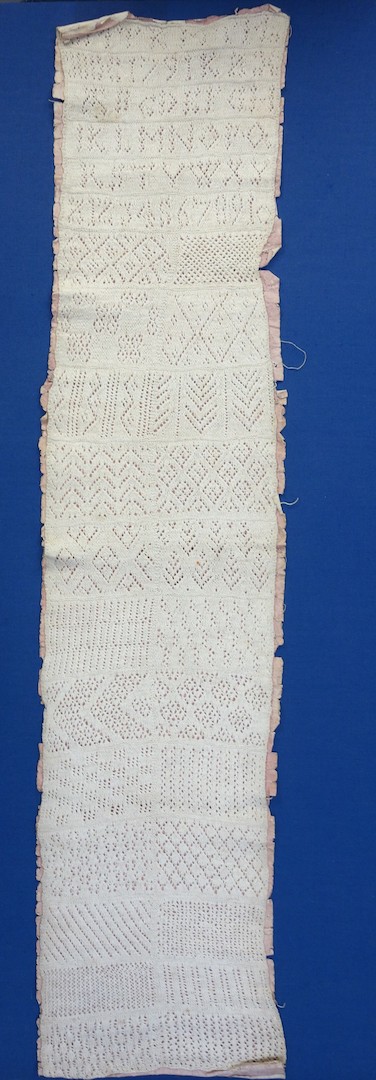
The TRC recently acquired a small, linen and cotton sampler (TRC 2023.0185), 31 x 31 cm in size, which mentions the name of D.W. Kolman, aged 9, and the year 1867. The sampler came as part of a larger collection of textiles that were donated by a member of the Dekker family. She also kindly gave us some background infomation about the collection.

A Dutch sampler worked by D.W. Kolman aged nine, in 1867 (TRC 2023.0185).A Dutch sampler worked by D.W. Kolman aged nine, in 1867 (TRC 2023.0185).

Painting by the Portuguese artist Samão César Dórdio Gomes (1890-1976), showing two women embroidering the famous Arraiolos carpets. Photograph by the author.Painting by the Portuguese artist Samão César Dórdio Gomes (1890-1976), showing two women embroidering the famous Arraiolos carpets. Photograph by the author.Various volunteers of the TRC have just been to Lisbon, Portugal (thanks to Erasmus+ funding) for a three-day workshop on the role and position of museums and other cultural institutions in society. My TRC colleagues left on Monday, but I stayed on for an extra day to go to Arraiolos, a small town east of Lisbon famous for its textiles, in particular its hand-embroidered carpets.

Arraiolos, Portugal.Arraiolos, Portugal.Last Tuesday, we  had a busy and very interesting day at the TRC, and I suspect we are going to have many more of these!

We have been host to a group from Portugal who are setting up a textile institute in Arraiolos, a city which lies about one hour drive from Lisbon, Portugal. The visitors were Filipe Rocha da Silva (artist), Cristina Maria Barrocas Dias (chemist, University of Évora), Rui Lobo, director of the Centro Interpretativo do Tapete de Arraiolos (CITA), and Silvia Pinto, the mayor of Arraiolos. It was a group with deliberately diverse backgrounds, all of whom are pushing to bring back textiles to the historic town of Arraiolos.

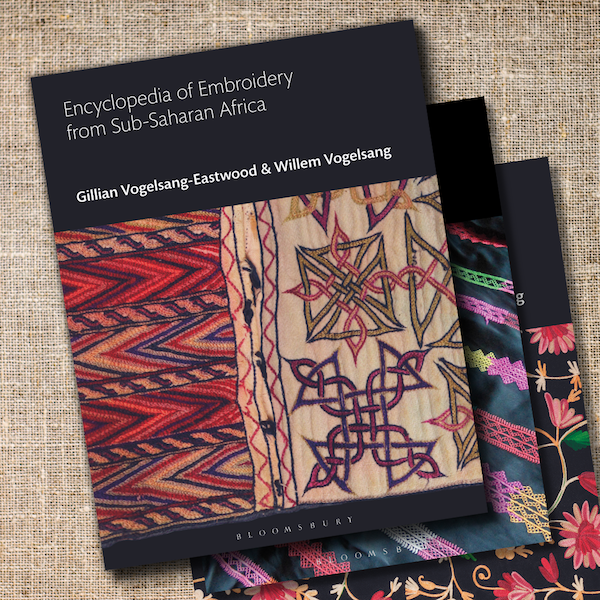
More specifically, they are particularly interested in the famous embroidered carpets (Tapete de Arraiolos) from the town that have been made there for over five hundred years. In the 20th century the production of these floor coverings just about died out and there is now a movement to bring them back, both as historic items and in a new (commercially viable) form. In fact, Rui Lobo is writing the entry on the Arraiolas embroidered floor coverings in volume 4 of the Bloomsbury World Encyclopedia of Embroidery, written and edited under the aegis of the TRC.

KLM Christmas jumper, 2022 (TRC 2023.0176).KLM Christmas jumper, 2022 (TRC 2023.0176).(Leiden, 1 February 2023) Last December, Willem and I flew with KLM to Rome for a brief holiday (and to do some textile hunting). We travelled on Christmas Day, and we were amused to see the festive clothing of the onboard KLM staff. One of the stewardesses even did a little twirl for us. Back in Holland we wrote to KLM asking whether we could have one of their Christmas garments for the TRC Collection.

The answer was positive, and yesterday we received a parcel containing a KLM Christmas jumper (TRC 2023.0176). We also received some information about the jumper, which provides some interesting details, not only about the jumper itself, but also about the process that led up to its production. The text below was written by Manon Leeuwerink, Operations Engineer at the Crew Service Hub.

Greet Verschatse and author in the Trezoor in Kortrijk, Belgium, discussing the chasuble in the foreground, attributed to Thomas Becket. Photograph by Willem Vogelsang.Greet Verschatse and author in the Trezoor in Kortrijk, Belgium, discussing the chasuble in the foreground, attributed to Thomas Becket. Photograph by Willem Vogelsang.Willem and I have just come back from a visit to Kortrijk (Courtrai) in southwestern Belgium, a town with a long and fascinating medieval and later history. More specifically, we were there to see a late 12th century chasuble that is directly associated with the cult of Saint Thomas Becket, the British archbishop murdered in Canterbury on 29 December 1179 on the implied orders of King Henry II of England (reign: 1154-1189), which led to the famous Canterbury Tales by Geoffrey Chaucer.

Last year we went to see another collection of Thomas Becket garments, namely in Sens in France. As a result of our examination of the Sens pieces, we were kindly invited by Greet Verschatse of the local Museum Texture to come and see the chasuble in Kortrijk. Their Becket chasuble is actually stored at Trezoor, a large municipal storage depot and study centre for cultural heritage, on the outskirts of the city.

Greet Verschatse is a Becket ‘fanatic’ who has been investigating for many years Becket textiles and related items that spread all around Europe as part of a huge, medieval cult of the saint. All of this resulted in an exhibition at the museum called Thomas Becket in Vlaanderen: Waarheid of legende ('Thomas Becket in Flanders: Truth or Legend') in 2000. There is a book with the same title edited by Raoul Bauer, which gives a wide range of historic and technical details.

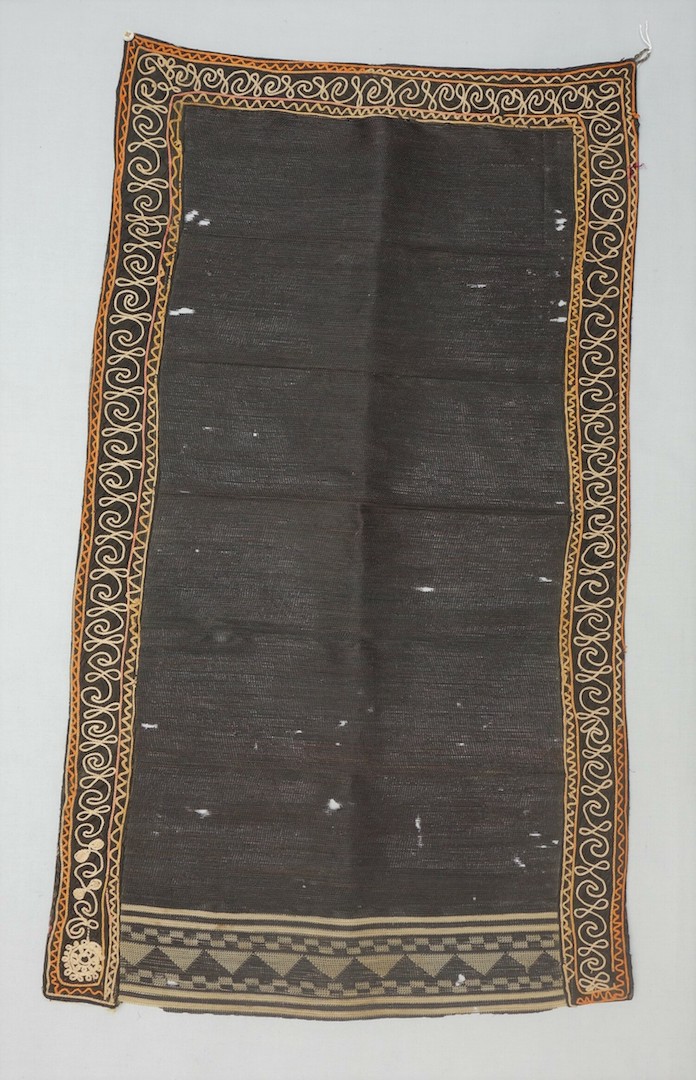
Partial Palestinian shawl from Hebron, c. 1900 (TRC 2023.0064).Partial Palestinian shawl from Hebron, c. 1900 (TRC 2023.0064).Among the textiles and garments recently donated to the TRC Leiden by the Dool family, Dordrecht, is an embroidered cloth (obviously damaged) that has since been identified as part of a Palestinian embroidered shawl (TRC 2023.0064). More specifically it is very likely that it comes from Hebron, in what is now the southern West Bank and about 19 km south of Jerusalem. In the Hebron region such a shawl is called a ghudfeh. Furthermore, the piece appears to date to c. 1900. But how did we come to these conclusions? In other words, what did the embroidery tell us?

There are various clues:

The ground cloth is hand woven and is made up of three lengths of cloth that are each about 36 cm in width and have slightly ‘wobbly’ selvedges (not the 'perfect' selvedges associated with machine made cloth). The width of the cloth is an indication that the cloth was probably woven on a horizontal loom (normal for the Levant) worked by one person. Such a three-piece shawl is common for Hebron shawls. The Hebron element is also suggested by the type of fringing at one of the transverse ends.

Notebook published by the Gingham Girl Flour Company, with the gingham-design also printed on their feed sacks (TRC 2018.0002).Notebook published by the Gingham Girl Flour Company, with the gingham-design also printed on their feed sacks (TRC 2018.0002).A few days ago we were talking with people of the Leidse Deken foundation, who want to re-establish the weaving of woollen blankets in Leiden, as part of the growing world-wide attention and interest in sustainability in all its many forms.

I started to wonder if there was a textile printing works in the Netherlands, or indeed elsewhere in Europe, which are involved in producing printed cotton bags that can be up-cycled into garments, toys or other items such as cushions and curtains, rather than plastic bags that cause huge environmental problems.

In other words, a modern version of the feed sack textiles that were so popular in northern America between 1925 and 1965! Ironically, these cotton feed sacks went out of production as a result of the increased use of paper and plastic bags.

Search in the TRC website

Contact

Boerhaavelaan 6
2334 EN Leiden.
Tel. +31 (0)71 5134144 (office hours)  
office@trcleiden.org 

The TRC is open every day from 10.00 to 15.00

facebook 2015 logo detail 

instagram vernieuwt uiterlijk en logo


Bank account number

NL39 INGB 0002 9823 59, in the name of the Stichting Textile Research Centre.

Donations

The TRC is dependent on project support and individual donations. All of our work is being carried out by volunteers. To support the TRC activities, we therefore welcome your financial assistance: donations can be transferred to bank account number (IBAN) NL39 INGB 000 298 2359, in the name of the Stichting Textile Research Centre. BIC code is: INGBNL2A.

 You can also, very simply, if you have an iDEAL app, use the iDEAL button and fill in the amount of support you want to donate: 


Since the TRC is officially recognised as a non-profit making cultural institution (ANBI), donations are tax deductible for 125% for individuals, and 150% for commercial companies. For more information, click here