• F1
  • F3
  • F4
  • F2

Winter is coming and I am thinking of blankets, and the warmth and comfort that woollen blankets provide. Blankets such as the beautiful hand woven red, black and white Dine (or Navajo) tapestry blanket (TRC 2022.1719) from the late 20th century, or the Nepali felted woollen blanket (TRC 2019.0543) from the TRC's Susi Dunsmore collection, that ingeniously folds into a hooded cape for rainy weather.

Late 20th century Navajo tapestry blanket, USA (TRC 2022.1719).Late 20th century Navajo tapestry blanket, USA (TRC 2022.1719).

Last Thursday (28th September 2023) the TRC’s latest exhibition was officially opened. Gillian Vogelsang (director) welcomed everyone and was followed by the curator, Augusta de Gunzbourg. She explained the ideas behind the exhibition and how it was built up and added extra details about various outfits and garments.

Yvonne van Delft (left), wethouder Cultuur Gemeente Leiden, and Augusta de Gunzbourg (right), curator of the exhibition. Photograph by Maria Linkogle.Yvonne van Delft (left), wethouder Cultuur Gemeente Leiden, and Augusta de Gunzbourg (right), curator of the exhibition. Photograph by Maria Linkogle.

Augusta de Gunzbourg tells about 1920s fashion. Photograph by Maria Linkogle.Augusta de Gunzbourg tells about 1920s fashion. Photograph by Maria Linkogle.

The recent London Fashion Week (15-19 September 2023) included various young designers that caught the attention of the press. One of them was Kazna Asker from Sheffield, who has a Yemeni background and whose parents migrated to Britain many years ago.

Last week the BBC published an article about her work called: "London Fashion Week: The British Muslim designer trying to be the future."

For the last few weeks mammoths have been at the forefront of interest at the TRC!

Initially this was due to a kind donation of some mammoth hair (TRC 2023.1510) in May 2022 by Erica Prus, who had earlier attended the TRC five-day intensive textile course. She had bought the hair online and it came with a certificate of authenticity, but was it actually mammoth hair or not, how can you tell?

Plastic bag with mammoth hair (TRC 2023.1510).Plastic bag with mammoth hair (TRC 2023.1510).

So we contacted friends at the Nederlands Forensisch Instituut (NFI), The Hague, asking if they could help. Was the hair genuine or not? It was a win-win for us, if genuine, how interesting, if a fake, how interesting!

For the NFI, however, it was of another, more immediate interest. One of the lesser known results of climate change is the increased availability of mammoth products, especially bone and ivory, from the melting permafrost in Siberia and Alaska. More and more complete bodies of mammoths are being revealed. This is becoming a problem for customs, police and other related institutes, because since 1989 there has been a global ban on the importation and use of elephant ivory, but mammoth ivory, due to the extinction of mammoths thousands of years ago, is legal. But how do you tell them apart?

From Monday, 2 October, the TRC presents a new exhibition that focuses on what people were wearing in the 1920s at various times of the day and on different occasions. We will show Western fashion from the 1920s, mostly for women, for daily, afternoon and evening wear, but there will also be underwear and pyjamas, sports wear, and a ceremonial outfit for a parliamentarian.

TRC exhibition "The 1920s from head to toe: Fashion from 100 years ago". From Monday 2 October 2023. Photograph by author.TRC exhibition "The 1920s from head to toe: Fashion from 100 years ago". From Monday 2 October 2023. Photograph by author.

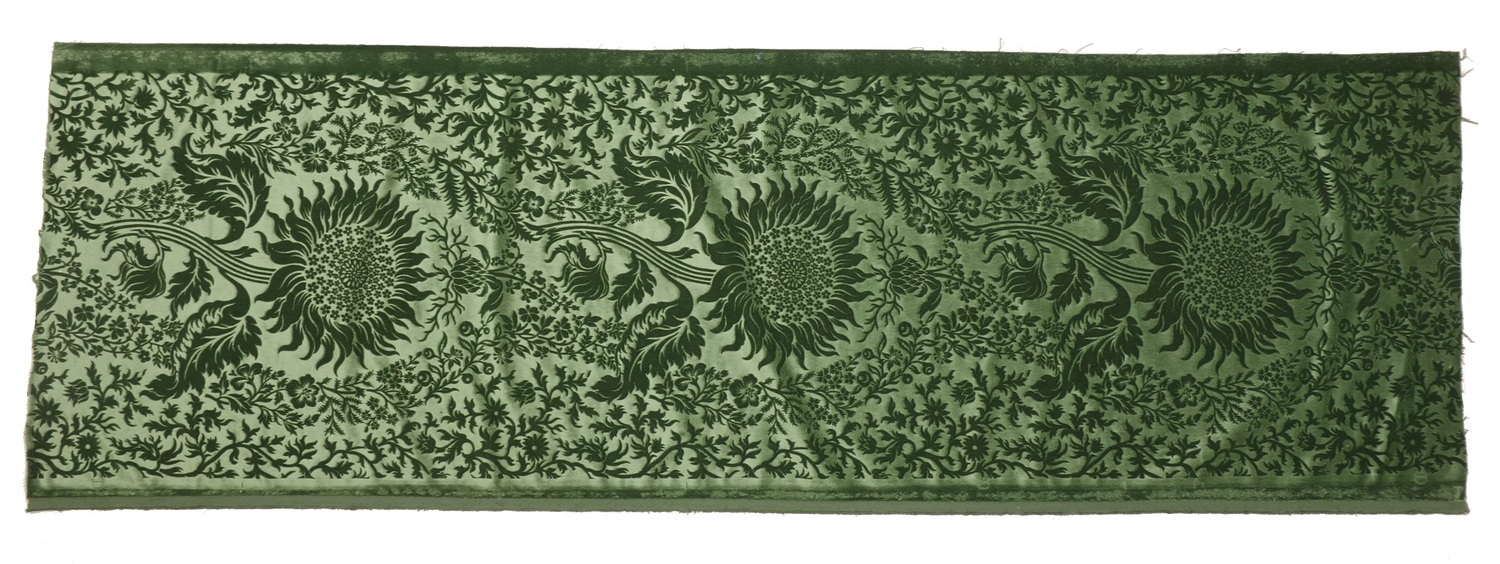
Printed silk sample, 1920s (TRC 2023.1471).Printed silk sample, 1920s (TRC 2023.1471).Some weeks ago we published a blog about the preparations of the upcoming TRC exhibition: The 1920s from head to toe, which is about 1920s fashion. It looks at daily, afternoon, evening and sportswear, as well as accessories such as hats, bags and shoes. All of the items come from the TRC’s collection of textiles and dress. The blog indicated that we are still actively looking for prints, images and photographs dating from the period to make the garments come ‘alive’.

As a result, we have just been given by the Dool family a collection of 23 printed silk textiles that date from the 1920s (TRC 2013.1469 - TRC 2023.1477). We are working on how to include these pieces in the exhibition. The textiles were left by Diane Joubert, wife of the artist Rein Dool. She originated from the Caribbean. She was an artist and deeply involved with textiles and featured in a recent TRC blog about some Frieda Kahlo style clothing.

Here at the TRC we are busy working on our next big exhibition: about 1920s fashion in the Western world! The emphasis lies on women’s clothing and outfits, but we have not forgotten men’s wear, and we are including various men's outfits including an official uniform for a Dutch politician, as well as evening wear. All the items are based on garments and accessories in the TRC Collection.

 Exhibition in progress: The 1920s from head to toeExhibition in progress: The 1920s from head to toe

Sample of Irish crochet lace (TRC 2007.0674).Sample of Irish crochet lace (TRC 2007.0674).Citizen Culture has been active again at the TRC!

Last Saturday, 26 August, we had the first of a series of sessions with the aim of sorting out the TRC’s collection of hand and machine made lace. And by lace we mean “a textile patterned with holes which are created by the manipulation of threads” (Earnshaw 1984:91;  see below), which is a very broad definition that includes a wide range of techniques, from needle forms and bobbin laces to crocheted, knitted, knotted and tatted techniques, not to mention machine made examples!

The TRC Reference Lace Collection currently stands at over 1000 pieces of lace. Some are small samples, others are complete items such as collars, lappets and shawls. They range in date from the early 19th century to the present day. The collection not only includes samples of lace, but also the tools and patterns required for lace making, such as bobbins, threads and pillows, crochet hooks, netting and tatting shuttles, as well as discs for making Tenerife lace.

Search in the TRC website

Contact

Boerhaavelaan 6
2334 EN Leiden.
Tel. +31 (0)71 5134144 (office hours)  
office@trcleiden.org 

The TRC is open every day from 10.00 to 15.00

facebook 2015 logo detail 

instagram vernieuwt uiterlijk en logo


Bank account number

NL39 INGB 0002 9823 59, in the name of the Stichting Textile Research Centre.

Donations

The TRC is dependent on project support and individual donations. All of our work is being carried out by volunteers. To support the TRC activities, we therefore welcome your financial assistance: donations can be transferred to bank account number (IBAN) NL39 INGB 000 298 2359, in the name of the Stichting Textile Research Centre. BIC code is: INGBNL2A.

 You can also, very simply, if you have an iDEAL app, use the iDEAL button and fill in the amount of support you want to donate: 


Since the TRC is officially recognised as a non-profit making cultural institution (ANBI), donations are tax deductible for 125% for individuals, and 150% for commercial companies. For more information, click here