• F2
  • F3
  • F4
  • F1

One of the most enjoyable days for me during the TRC’s Intensive Textile course has always been dye day. Dozens and dozens of glass jars are lined up on a long table, reflecting a rainbow of colours, which participants get to play –oh, sorry, I meant to write practice—dyeing different fabrics with.

The history of dyes and mordants is fascinating, as is the whole process of dyeing. The quality of the water used, the temperature it's boiled, the type of pan used (copper or iron or steel)—any variation in any of this can change the hue. I have to marvel at how our ancestors discovered the different dye qualities of so many plants, leaves, roots, barks, nuts, insects and molluscs.

“Guernica de la Ecologia” by Claudy Jongstra. Photograph by Shelley Anderson.“Guernica de la Ecologia” by Claudy Jongstra. Photograph by Shelley Anderson.

Bamberg Cathedral, 2 July 2023. Photograph by Willem Vogelsang.Bamberg Cathedral, 2 July 2023. Photograph by Willem Vogelsang.On our way to Czechia, last Sunday 2nd July, Willem and I passed the beautiful medieval city of Bamberg. We came to this place in June 2016 (see a blog of 11 June 2016), and we simply wanted to visit the Bamberg Diocesan Museum again and see its amazing collection of medieval garments, such as  the Star Mantle of Emperor Heinrich II and the Byzantine Gunthertuch.

We also needed some extra information for the fourth volume of the World Encyclopedia of Embroidery (covering Western Europe and Scandinavia), which we plan to send to the publishers in manuscript form later this summer. We decided to stay in Bamberg for a day and really take the time to have a close look at the textiles.

As we said in our 2016 blog, the museum is located next to the Bamberg Cathedral and is home to two significant collections of elite, medieval textiles and garments, both dating to the 11th century, as well as numerous other textiles and garments dating as late as the 19th century. Many of these garments and textiles are embroidered, and they present a marvellous picture of mid-medieval needlework.

Author standing in front of Fulda cathedral, 2 July 2023. Photograph by Willem Vogelsang.Author standing in front of Fulda cathedral, 2 July 2023. Photograph by Willem Vogelsang.A few months ago we were contacted by Liz Kelcey about a collection of Czech, Hungarian and Romanian outfits that she and her husband had acquired over the years.

Sadly, John died recently and Liz is now sorting out their house and its contents in Czechia.

She heard about the TRC here in Leiden, the Netherlands, and about our work in building up an extensive collection of European regional dress and offered twenty outfits as a donation.

The one snag? We had to pick them up in some manner.

We have just had a very busy and interesting few days at the TRC! We hosted a group from Britain who were in the Netherlands to visit the Kunstmuseum, The Hague, the Lakenhal in Leiden as well as the Leidse Deken, where the weaving of blankets in Leiden is being re-introduced, and they also came to the TRC, twice!

Woven sample of striped camletee from the Norwich area, England, 18th century. Camletee was a worsted cloth exported in large quantities to the Netherlands (TRC 2021.3328).Woven sample of striped camletee from the Norwich area, England, 18th century. Camletee was a worsted cloth exported in large quantities to the Netherlands (TRC 2021.3328).

The British group included Mary Schoeser (textile historian and author), Michael and An Nix (textile historian and author), Meg Andrews (antique textile and costume dealer), Pat Frost (Christie's Auction Costume and Textile department consultant), Bridget Long (university lecturer and former Quilters Guild director), Keren Protheroe (Liberty's archivist), Anna Buruma - curator at the Central St Martins Museum & Study Collection, and Frank Gardiner (former film costumier and textile historian), all of whom are joined together by a deep knowledge and love of textiles and dress in all their many forms.

A group of women with a Middle Eastern background discussing Syrian garments. Photograph by Maria Linkogle.A group of women with a Middle Eastern background discussing Syrian garments. Photograph by Maria Linkogle.We are happy to draw attention to the latest project at the Textile Research Centre, Leiden, with the title 'Engaging Textile Heritage Communities through Citizen Culture'. It is co-funded with the sum of 20,000 euros by the national Fonds voor Cultuurparticipatie (The Cultural Participation Fund), and runs from April 2023 until October 2024.

For this particular TRC project we invite three groups of women from a variety of textile heritage communities to share knowledge about the textiles and textile related objects from their respective communities, included in our TRC collection. Each group meets various times to discuss textiles and garments from their respective communities. They organise a workshop of their choosing, plan a small presentation and set up the presentation itself.

The project is aimed at supporting heritage activities of groups with different cultural backgrounds, thereby stimulating closer cooperation among and between these groups. Participants will develop multiple perspectives on the value and meaning of their textile heritages, and participants will have a voice in the interpretation, appreciation and representation of that heritage.

When the groups have completed their mini presentations, the three groups will come together to share the knowledge of their respective heritages. They will choose a theme that ties the textile groups together and prepare for an exhibition and a workshop, lecture or study day based on the theme chosen by all participants.

Kotomisi jacket from Suriname, 1930s (TRC 2006.0259c).Kotomisi jacket from Suriname, 1930s (TRC 2006.0259c).

Kotomisi skirt, Suriname, 1930s (TRC 2006.0259d).Kotomisi skirt, Suriname, 1930s (TRC 2006.0259d).The celebration of Keti Koti seems a good time to review the TRC’s collection of textiles from the South American country of Suriname. But first, what is Keti Koti? Keti Koti, celebrated on 1 July, marks the day the Dutch abolished slavery in 1863. The words mean “Broken Chains” in Sranan Tongo, a language from Suriname, where the day is also called Dag der Vrijheden ('Emancipation Day'). It’s celebrated in Suriname, a former Dutch colony, and in the Netherlands with concerts, commemorations, and, of course, by dressing in festive clothing.

Such festive clothing includes a traditional women’s ensemble called kotomisi, from the word ‘koto’ (skirt) and ‘misi’ (woman). While the word originally referred to the woman who wore the garment, over the years it has come to refer to the garment itself. The garment is mentioned in colonial accounts from the 18th and 19th century.

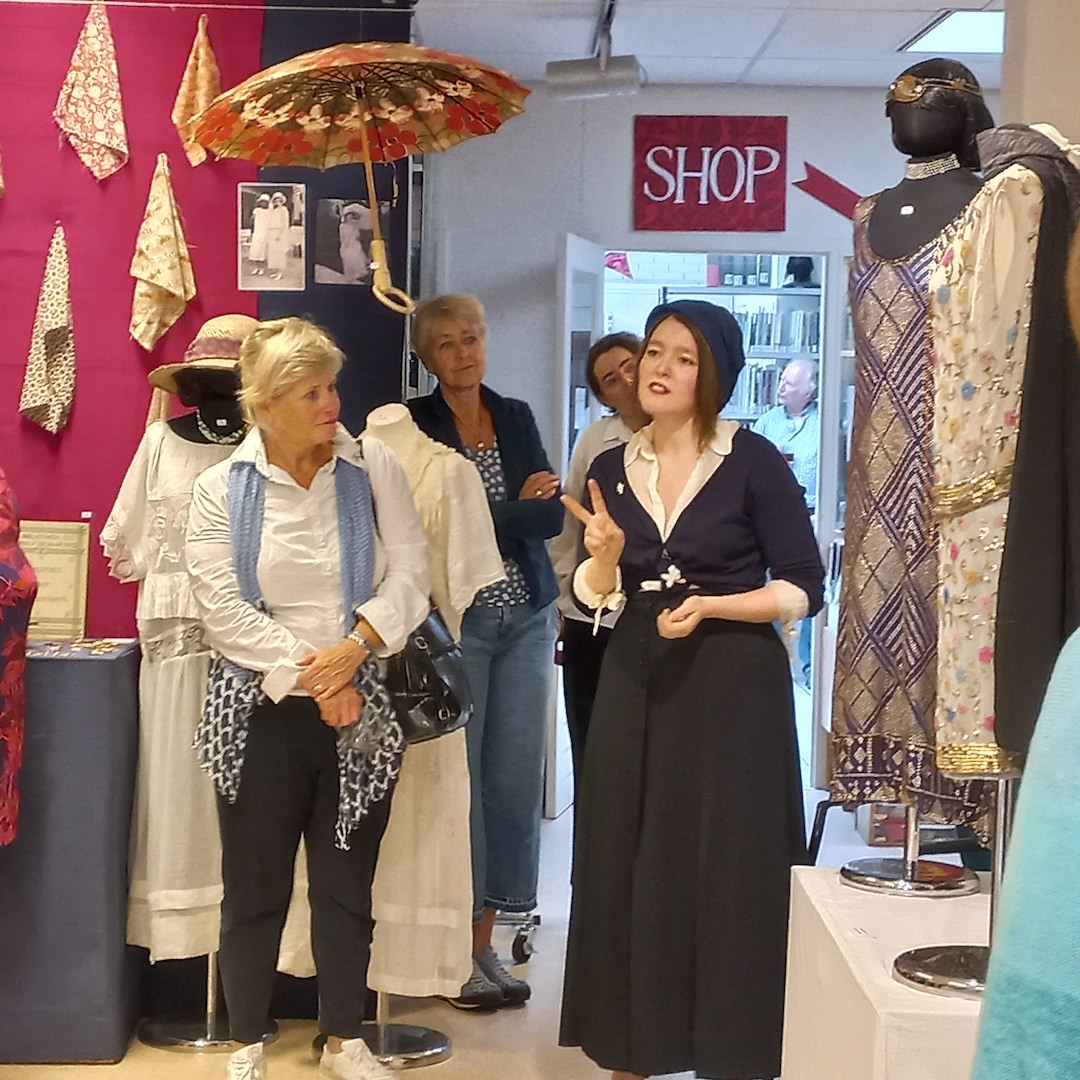
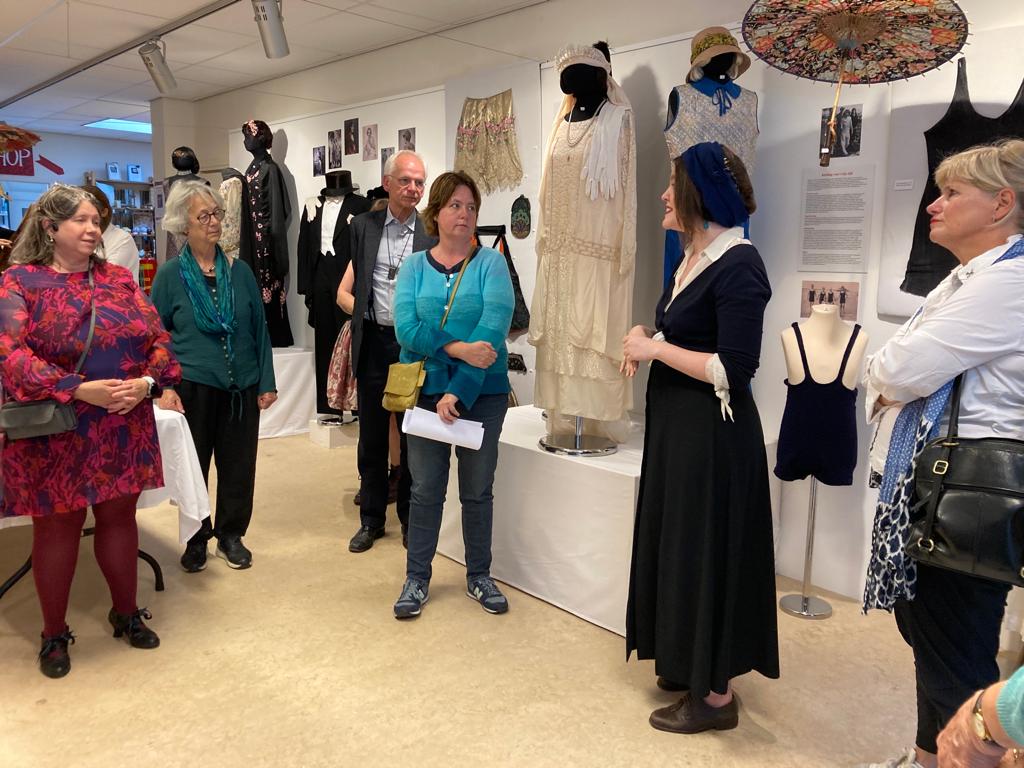
Clothing of the 1920s. The Costume Museum, Avallon. Photograph: Willem Vogelsang.Clothing of the 1920s. The Costume Museum, Avallon. Photograph: Willem Vogelsang.Last Sunday, 11th June, Gillian and I visited the Costume Museum in Avallon, France. It was like stepping back in time.

The museum is run by two sisters, Agnès and Sylvie Carton, who have managed, with their mother Pauline, over many years to fill a large 17th century building (some 1000 square metres) in the centre of town with an amazing collection of paintings, garments and textiles (including some 3000 complete costumes), four-poster beds, glass work and porcelain, and anything else that you may associate with domestic material culture in France from the 18th to the 20th century.

Medieval statue of the Virgin Mary being taught by St Elizabeth (?). Troyes Cathedral. The statue  shows the rich garments of Mary and her teacher. Photograph by author.  Medieval statue of the Virgin Mary being taught by St Elizabeth (?). Troyes Cathedral. The statue shows the rich garments of Mary and her teacher. Photograph by author. Develop an interest (translation: obsession) in textiles and see the world! Well, perhaps not the whole world, but the study of textiles and building up the TRC Collection are certainly taking me to a variety of different countries and more is to come over the next few years.

This blog is being written during a trip to France, more specifically Troyes. Willem and I are en route to some friends who are making a donation of textiles, clothing and looms from the Philippines, Indonesia and Belgium! More about the donation in another blog.

Search in the TRC website

Contact

Boerhaavelaan 6
2334 EN Leiden.
Tel. +31 (0)71 5134144 (office hours)  
office@trcleiden.org 

The TRC is open every day from 10.00 to 15.00

facebook 2015 logo detail 

instagram vernieuwt uiterlijk en logo


Bank account number

NL39 INGB 0002 9823 59, in the name of the Stichting Textile Research Centre.

Donations

The TRC is dependent on project support and individual donations. All of our work is being carried out by volunteers. To support the TRC activities, we therefore welcome your financial assistance: donations can be transferred to bank account number (IBAN) NL39 INGB 000 298 2359, in the name of the Stichting Textile Research Centre. BIC code is: INGBNL2A.

 You can also, very simply, if you have an iDEAL app, use the iDEAL button and fill in the amount of support you want to donate: 


Since the TRC is officially recognised as a non-profit making cultural institution (ANBI), donations are tax deductible for 125% for individuals, and 150% for commercial companies. For more information, click here