


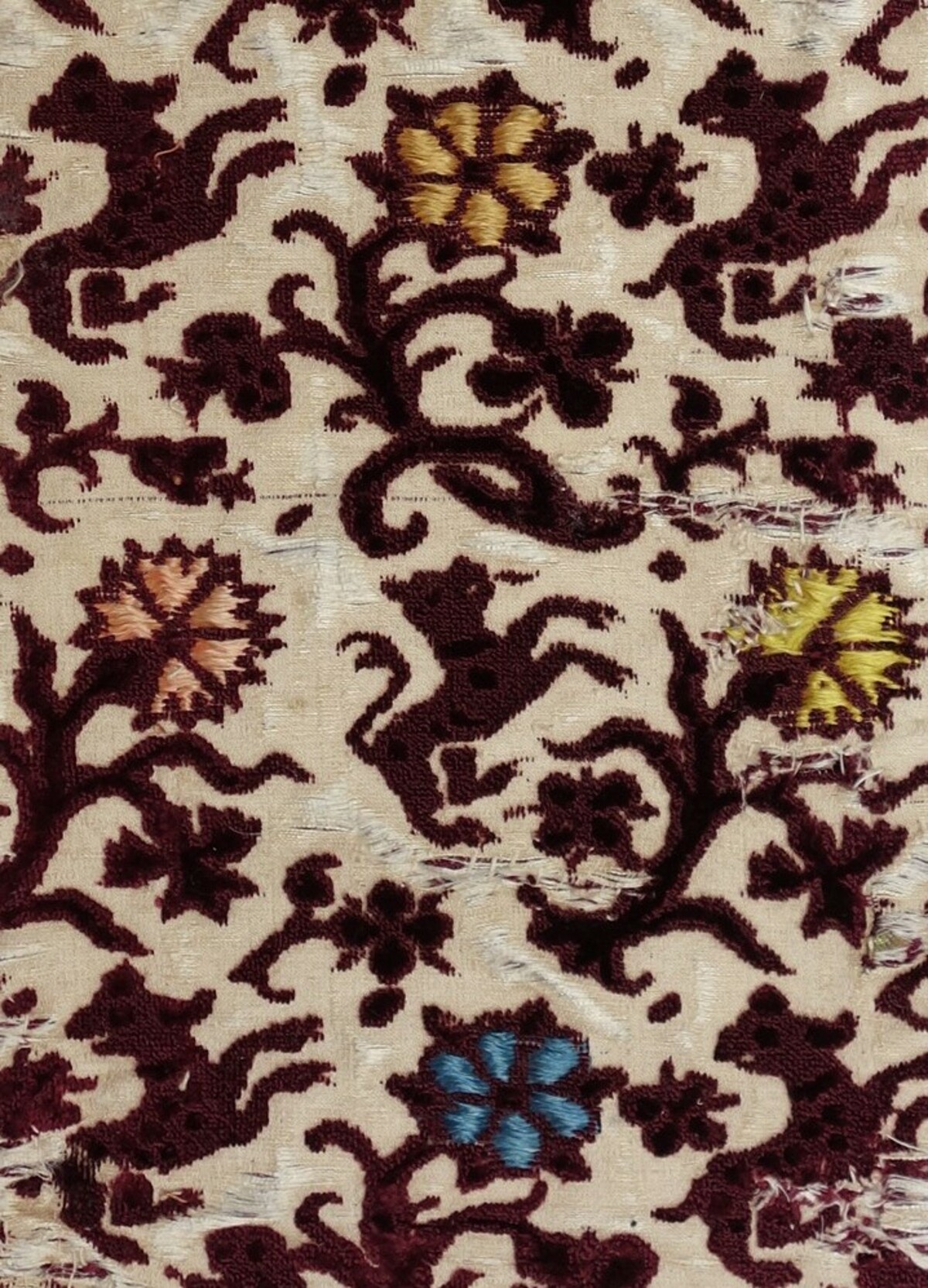
 Mid-17th century ciselé velvet sample with huinting dogs, from Italy (TRC 2011.0385).In 2011 the TRC Leiden was given a collection of early European velvets by Ms. Van Gerwen. They came from her father's private museum of medieval art. These pieces have intrigued me ever since. Although I specialise in hand embroidery, I have long wanted to go deeper into the history of velvets and to gain a better understanding of the various different types. Not so much as how exactly each form was made and the (many) technical and mechanical intricacies that were involved, but in more general terms to try and follow the history of the designs associated with them as well as the function of these luxury textiles.
The Van Gerwen collection includes thirty examples of early velvets that probably date back to at least the fourteenth century with most of the pieces dating to the seventeenth and the eighteenth centuries (with a few nineteenth century copies of earlier forms). There are also examples of plain, chiselé (cut and uncut), and voided textiles, and some that include silver and gold threads in the main designs and in the backgrounds.
But enough of the technical details! How were these textiles used and the designs developed? One of the most useful sources of information about these velvets are early Italian Renaissance paintings, and so for the last few years we have been visiting various museums and institutions, as well as online collections to try and (re)establish a chronology for the TRC items as well as to understand them a little better.
It would appear that many of the TRC velvets were used for soft furnishings, such as wall hangings, curtains, and stool coverings, but some may also have been used for clothing as well. While looking at the paintings I fell in love with how some of the Renaissance artists were able to portray the rich shine of silk velvets, especially those garments worn by the Virgin Maria. Forget about how hands were portrayed, look at the velvets, to paint them really takes skill!
So which painting collections can we recommend?
- The Metropolitan Museum of Art
- The Victoria and Albert Museum
- The Louvre Museum, Paris
- The Uffizi Museum, Florence
- The Palazzo Pitti, Florence
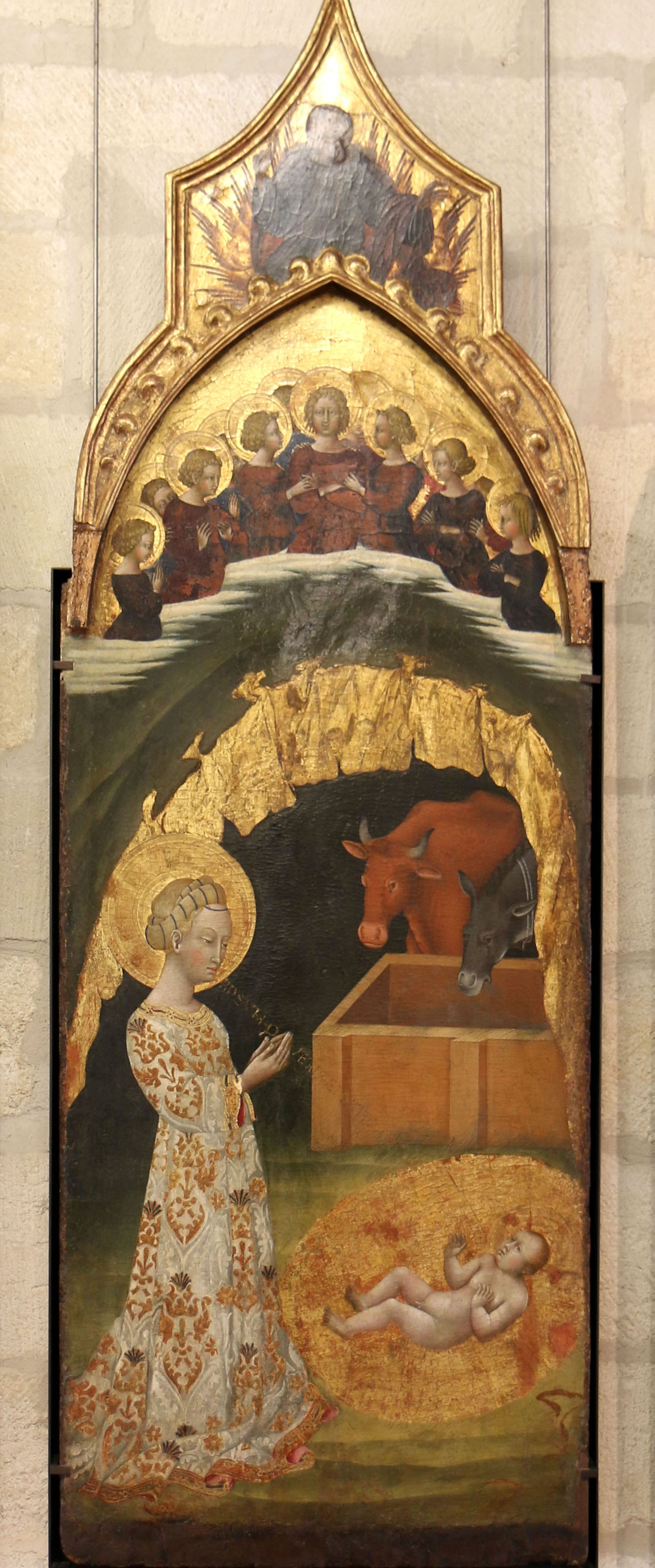 Detail of a painting by Giovanni di Paolo from Sienna (c. 1420-1480), which depicts the Virgin Mary wearing a polychrome, voided velvet gown. Photograph courtesy Petit Palais, Avignon.All have extensive collections of relevant paintings, but perhaps one of the more intimate collections where you can spend time really looking at the paintings is in the Petit Palais, Avignon, in southern France. The Petit Palais collection is based on one made in the early part of the nineteenth century by the Italian collector, Giampietro Campana (1808-1880), who amassed one of the largest private collections of Classical and historical art (of all types). His career (in all senses of this word) came to an abrupt end in 1857 when he was accused and convicted of embezzlement and his collection was put up for sale by the Pontifical State.
Items from his collection were sold to many museums, including the Victoria and Albert Museum (London), the Louvre Museum (Paris), the State Hermitage (St. Petersburg), as well as the Metropolitan Museum of Art, (New York). In the same context, the city of Avignon acquired one of the most amazing collections of early Italian Renaissance paintings, which are a treat to see in general.
And my favourite velvet from this collection? A painting by Giovanni di Paolo from Sienna (c. 1420-1480) that depicts the Virgin Mary wearing a polychrome, voided velvet gown, on which the details are truly breathtaking. It is on display in the Petit Palais, Avignon.
I should add that the TRC has been increasing its collection of velvets over the last few years and at intervals we hold a study day about the identification of the basic types of velvets. The next study day is on the 2nd December 2020. Registration in advance is required due to the limited number of places available.
An earlier blog about velvet and the problems of its identification, can be found here.
Gillian Vogelsang, 7th August 2020


