


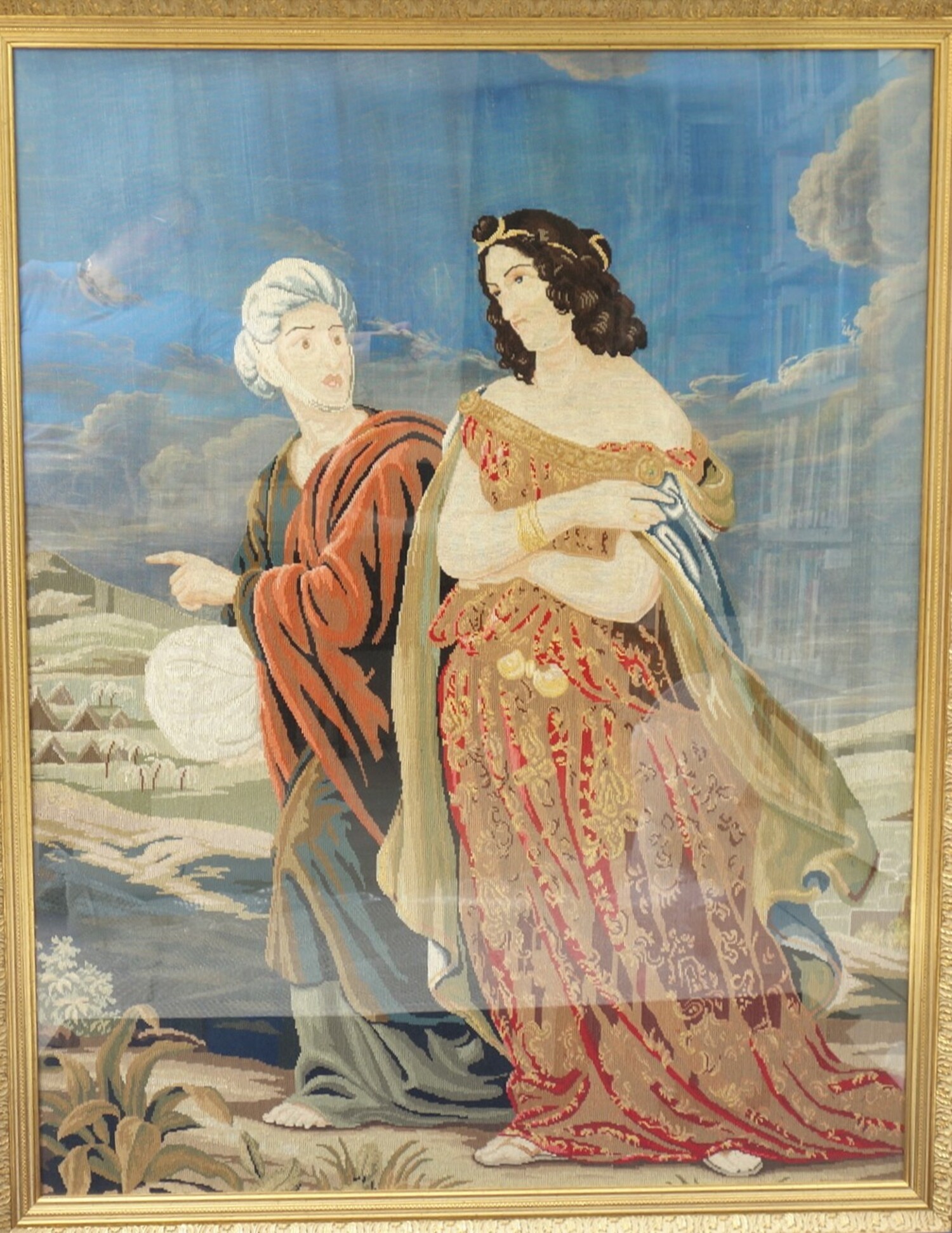
 Embroidered picture from the mid-nineteenth century, showing Judith and her servant; The Netherlands (?) (TRC 2020.3320).The TRC Leiden has recently been given a number of embroidered pictures by the Bijbels Museum, Amsterdam. We wrote a separate blog about this donation. One panel is especially large (135 x 105 cm) and depicts a lady in a low cut, ornate dress with an elderly woman carrying a white bag (TRC 2020.3320). The woman is pointing to a city on a hill top and a series of tents just below the city walls.
The panel was described as reflecting the Biblical story of a Moabite woman called Ruth who was married to Mahlon, one of the sons of Naomi, a Hebrew woman originally from Bethlehem (Book of Ruth).
Following the death of Naomi’s husband and her son Mahlon, the two women agree to return to Bethlehem together. Ruth changes her religion, family and people, thereby completely giving up her Moabite identity, in order to follow and be with her mother-in-law, Naomi. Ruth later marries the Hebrew, Boaz, and becomes the ancestor of King David and ultimately of Jesus.
But back to the embroidery. Somehow the imagery, the style of clothing and the relative status of the two women as depicted in the embroidery do not fit with the idea of a modest, dutiful daughter-in-law and her ‘mother’. Does the embroidery reflect another story?
After looking at some early Swiss embroideries while preparing the next volume of the Bloomsbury Encyclopedia of Embroidery (Vol. 3, Scandinavia and Western Europe), the penny dropped! It was not Ruth and Naomi being depicted, but two protagonists from another Biblical story, namely Judith and her servant.
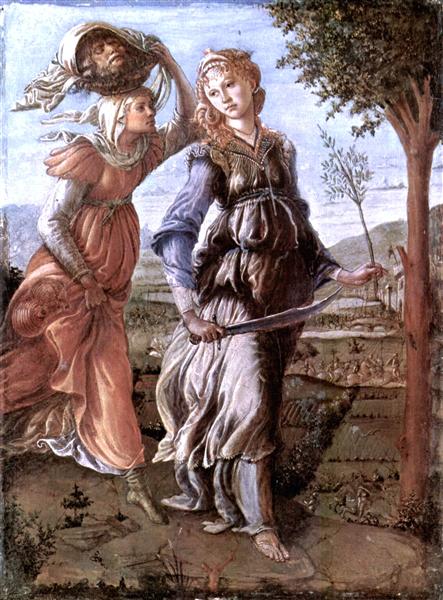 The return of Judith to Bethulia, by Sandro Botticelli (c. 1470). Courtesy Uffizi Gallery, Florence.The story of Judith and her servant (called Abra) can be found in the apocryphal Book of Judith. It tells how Judith, a beautiful (but chaste) widow, uses her charms to enter the tent of Holofernes, an Assyrian general who is about to destroy the city of Bethulia, in what is now Israel, and Judith’s home town. Judith’s (personal) mission was to kill Holofernes and save the city. She does so by getting him drunk and then beheading him with his own sword. She then returns to Bethulia with her servant, who is depicted in many medieval and later paintings as carrying a basket or bag containing Holofernes's head.
The imagery in the TRC embroidery now makes more sense. There is Judith in her finest, seductive apparel, and her servant carrying a white bag with the head of Holofernes. The servant is also pointing to a town on the hill top, apparently Bethulia, and to the tents below the city walls, which would refer to the Assyrian army of Holofernes who was besieging the place. The same subject was very popular in Renaissance paintings from Florence. A good example is a small painting by Sandro Botticelli (1445-1510), now housed in the Uffizi in Florence. Another painting, actually showing the beheading of Holofernes, is by Caravaggio, painted c. 1600 and now in the Galleria Nazionale d'Arte Antica, Rome.
The embroidered picture in the TRC Collection is not about Ruth and her modest self-denial, as first suggested, but about an action woman prepared to do anything to help her city and its people! A very different interpretation!
Gillian Vogelsang, 8th August 2020.


