


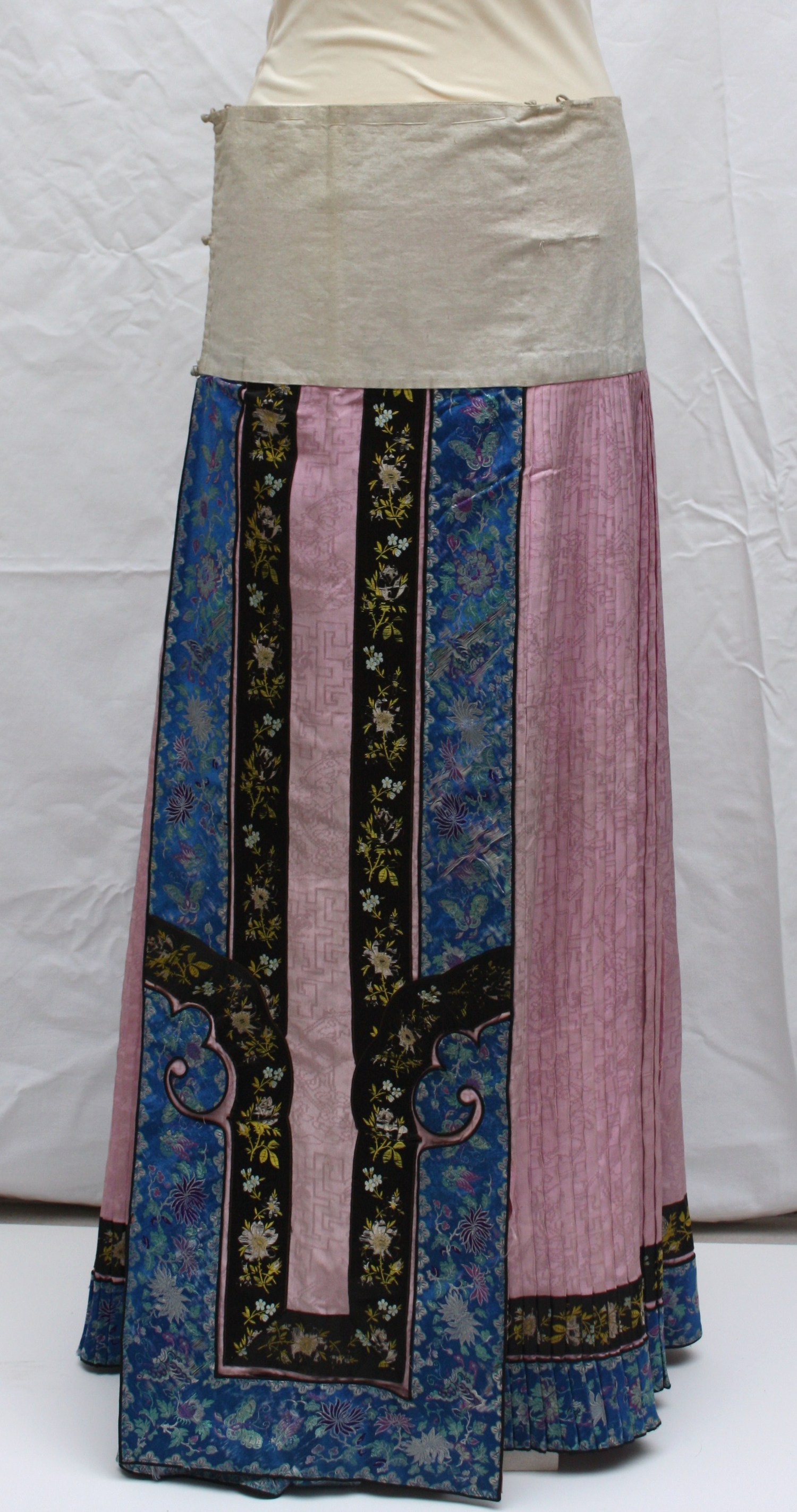
 Chinese-Indonesian skirt, pre-1930s (TRC 2012.0077).TRC volunteer Mengying Zhang writes:
I was looking for traditional Chinese garments at the TRC Leiden and found a skirt that combines elegance and horse riding. How intriguing! It is the 馬(ma)面(myan)裙(tsyun), or mamianqun, when spelled out in the Latin alphabet.
Long wrapping skirts have been worn by Chinese men and women under a long tunic for more than 600 years, up to the mid-20th century. The occasions on which they were worn and their gender code have changed through time, and their form has slowly evolved. The skirt in the TRC Collection (TRC 2012.0077) is typical of a mamianqun and is made up of a series of overlapping panels with symmetrical pleats. At the centre front, a split is created by two identical panels that are attached to the skirt’s waistband. These two panels are separate from each other, but come together when the waistband is fastened. A second split is formed by wrapping and fastening the skirt around the wearer’s waist, leaving an overlapping area at the centre back. Meanwhile, the pleats lay symmetrically to the sides of the wearer.
Imagine how the pleats would swing with every movement of the wearer and bring into mind the general position of traditional Chinese women, we suggest that these skirts have an elegant aura!
However, there is much more to these skirts. A number of contemporary Chinese and non-Chinese researchers believe – based on excavations – that the symmetrical pleats and overlapping splits have very practical functions. Both elements were originally meant to make it easier to ride a horse. It is easier to bend the knees, and the splits allow the two side panels to hang along the horse’s back instead of piling up on it. We could therefore suggest that the horse riding elements of the mamianqun reflect the presence and influence of the horse riding societies along the northern borders of China, clearly attested in Chinese and Mongolian sources.
The skirt from Indonesia in the TRC collection was worn by a woman of Chinese origin. She may never have seen a horse, let alone have ridden one, but her dress reflects the age-long interchange between the Chinese and the northern nomads from Mongolia and beyond.
There are actually three of these skirts in the TRC collection, all of which feature not only traces of intercultural exchange, but also elaborate decoration and structure. Should you come to the Netherlands, do not hesitate to take a look at these amazing skirts in our collection and allow yourselves to be inspired!
Mengying Zhang, 30th July 2018


