


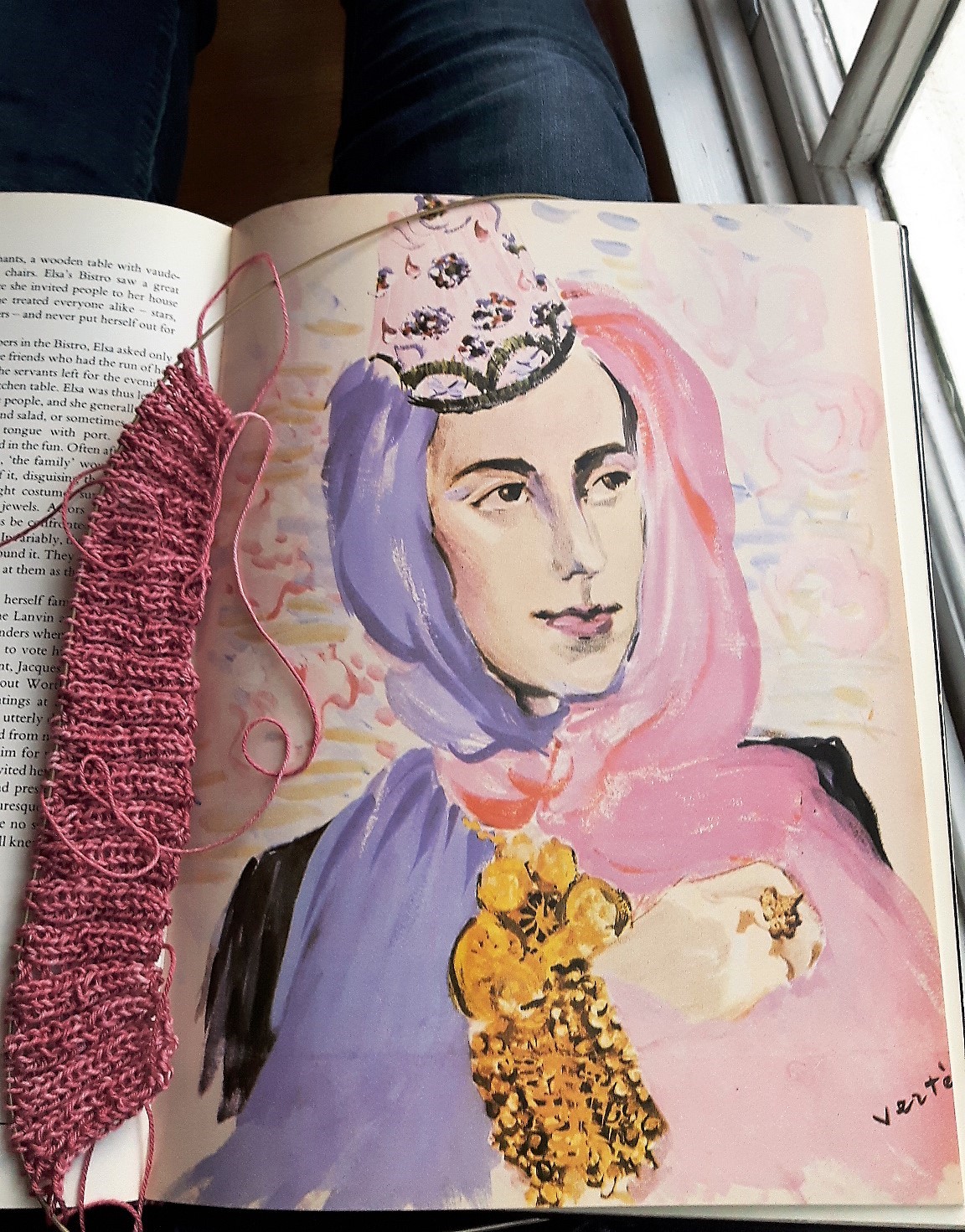
 Multitasking: Reading a book on fashion designer Elsa Schiaparelli while knitting a jumper from a 1940s pattern. Photograph: Nelleke Honcoop.Nelleke Honcoop, a former TRC volunteer, writes about her MA studies in London:
In January 2016 I became a volunteer at the Textile Research Centre. Although my undergraduate course was in Religious Studies, I have long been fascinated by dress and textiles from the early twentieth century. As a young teenager, I enjoyed spending time at my grandmother’s attic rummaging through the late 1960s, early 1970s clothing worn by my mother and aunts when they were my age. I started to collect and wear clothing from these decades, and subsequently developed this love for dress from bygone times via the 1950s, 1940s, and 1930s, back to the 1920s...
Working as a volunteer at the TRC, I started to realise it is my vocation to continue in the field of dress and textile history. Therefore, I applied to a postgraduate History of Art course at the Courtauld Institute of Art in London. The special option I enrolled into is called ‘Documenting Fashion: Modernity, Film and Image in Europe and America, 1920-1960’. Obviously, the focus and timeframe could not be more perfect to me!
During nine busy months in London, I followed theoretical and thematic classes in dress history and fashion studies, visited the dress collections and archives of, among others, the Museum of London and the Victoria and Albert Museum, and spent hours at the British Library leafing through Vogue and other (fashion) magazines. My first assessed essay focused on home dressmaking and the advertisement of ‘Simplicity’ sewing patterns in Harper’s Bazaar, while my second essay addressed the promotion of rayon as a modern fabric in the interwar period.
Finally, I wrote my dissertation on the London-based, female-run textile printing workshop called ‘Footprints’ and its retail outlets in London’s fashionable West End during the 1920s and 1930s (You can read more about my dissertation on Documenting Fashion’s dress history blog (download here). After a formative, inspiring academic year in London, I graduated with distinction. However, I am not quite done with studying and working with dress and textile objects and hope to continue developing my knowledge and skills in the future.
Nelleke Honcoop, 25th July 2018


