


On Tuesday, 21 April, Beverley Bennett and Susan Cave wrote in connection with the current TRC exhibition on American Quilts about the introduction of the so-called Crazy Quilts in the late nineteenth century:
By the last decade of the 19th century, cosmopolitan women began abandoning their familiar quilt patterns. The simplicity and order of the Log Cabin quilt gave way to the disorder and complexity of the Crazy Quilt. It was all about adorning their Victorian parlours in a new aesthetic era where design became the major focus rather than the traditional utility. Oriental rugs, exotic jardinières, bric-a-brac, stuffed animals and talking budgerigars cluttered up their interiors along with heavily carved dark furniture.
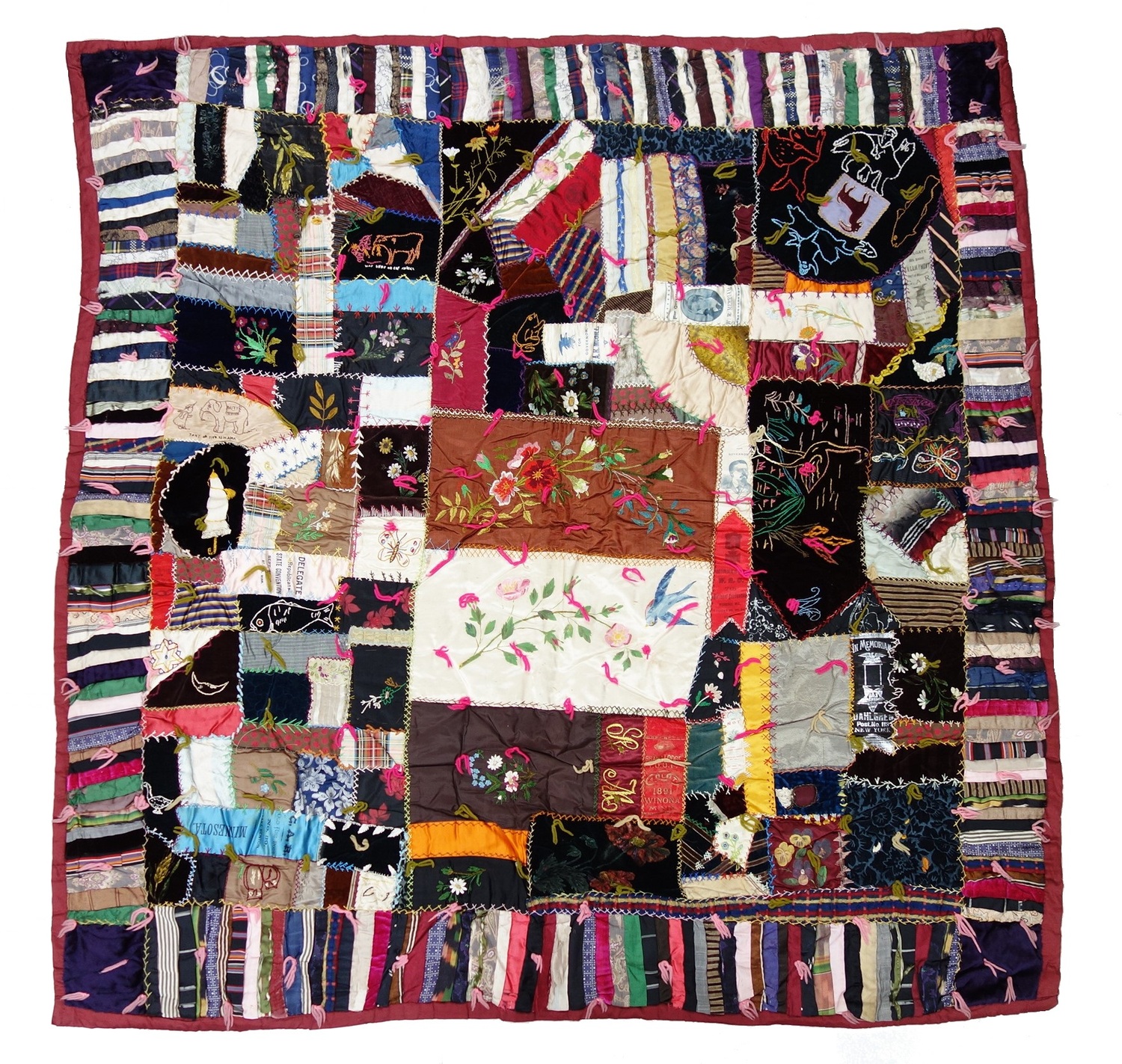 American crazy quilt, late 19th century (TRC 2019.2925).
The 1876 Centennial Exhibition in Philadelphia welcomed exhibits from all over the world (including embroidery from Holland!), but many of the ten million visitors were most fascinated with the exotic of the Orient, namely the Japanese Pavilion. Fans, paper lanterns, ceramics, painted birds on velvet textiles were embraced by quilters, artists and designers alike who found the asymmetrical designs fresh and exciting. Within a few years, those designs were embroidered all over Crazy Quilts.
Heavily embroidered, a Crazy was quite useless as a quilt or even a cloth for a parlor table was a stretch in the hygiene department. Most makers included an abundance of the new fabric choices, including delicate silks, satins and lace which, compared to the traditional robust cotton and wool fabrics used in earlier quilts, did not stand the test of time as many of the silks rotted and cleaning was well-nigh impossible.
In the new society, people were often nostalgic and many Crazies reflect historical events, family happenings and cryptic messages in the same way as a written journal or an autograph book. It might have been a lace collar of great-auntie, a Masonic banner of father, a political candidate’s publicity ribbon, a piece of Grandad’s tie, an embroidered apron. The TRC has an amazing example of such a nostalgic textile in a Crazy Quilt from Minnesota which depicts the life and times of the last years of 19th century America (TRC 2019.2925).
This impressive crazy quilt arrived at the TRC shortly before the exhibition began, so we have not yet had a chance to examine it in as much detail as we would like. The quilt seems to be quite fragile and also fairly heavy, which is why we chose not to display it on the wall, but to support it’s weight on a table.
It has a crazy centre, with a ‘piano key’ border of strips. It is tied with pink wool rather than quilted as it is bulky and quilting would have been very difficult. The centre looks as if it was possibly made as two ‘panels’ which were later joined – this would have made it easier to work with. There are two large floral panels in the centre, the one with the bird is painted and the other is embroidered. There are several embroidered animals including a frog, an elephant and a fish – there are also a number of political and other ribbons, some of which are dated, including ‘Winona 1891’.
The patches in the quilt are of many fabric types, including silk and velvet, and are many shapes and sizes, as is typical with crazy quilts, and are all embroidered around the edges with an array of different types of stitches.
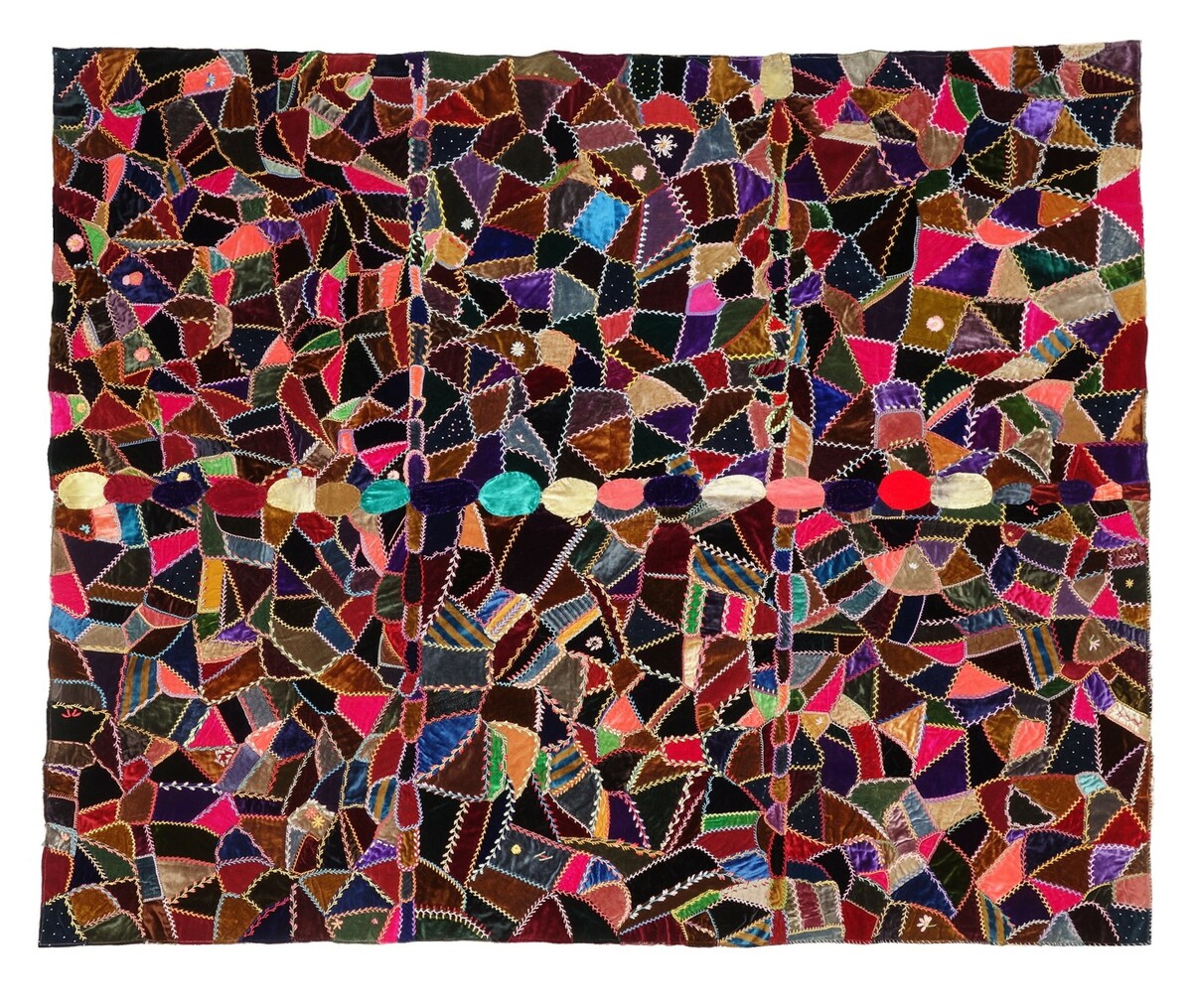 American crazy quilt, late 19th century (TRC 2018.2407).
It is possible that they are first stitched to a ‘foundation’ fabric to secure them, as this was a common construction method for these quilts. The TRC has another example of an 1890’s unfinished crazy quilt (TRC 2018.2407) which shows this quite clearly as the stitches can be seen on the reverse. This one has been made as separate panels, which have been joined at a later date and the embroidery within the patches has just been started. In the earlier, finished example, some of the embroidered parts must have been made before being included in the quilt as parts of them seem to be cut off.
Interest in traditional quilts, including the Crazies, waned with the beginning of the 20th century. Although ‘modern’, they were symbols of the old order and women were keen to embrace on-rushing technology buying bedcovers from department stores. The frenzy of quilt making of the previous century did not reappear until the calamitous Depression years of the 1930’s.


