


On Friday, 16 April 2020, Beverley Bennett and Susan Cave wrote:
The Log Cabin pattern is one of the two most popular patchwork designs of the nineteenth century. The other is the Crazy Quilt which we will deal with next week. The Log Cabin is a family of patterns rather than one single design. It is simple to construct and there are an infinite number of variations. The TRC has several examples of this quintessential American design, but only one from the 1880’s era (TRC 2019.2404). The more recent TRC examples show a continuum from this early time, always reflecting when they were made by the fabric used.
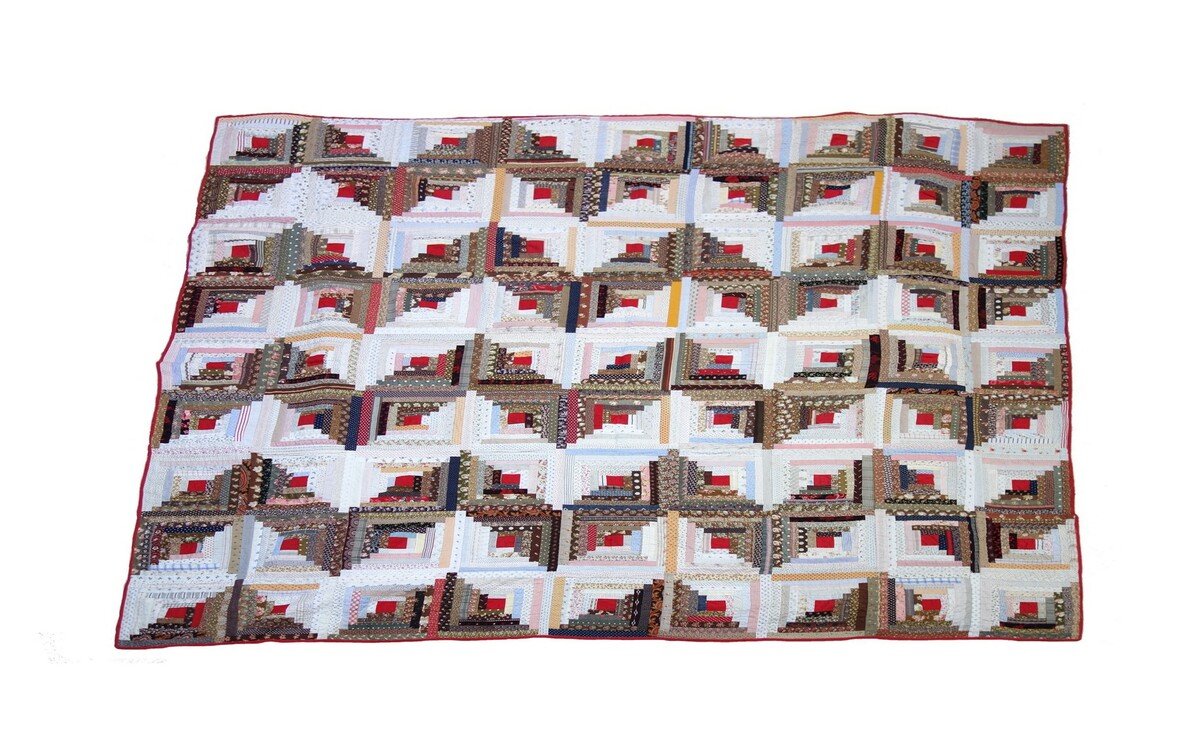 Log cabin coverlet, USA, 1880's (TRC 2019.2404).
The actual design evokes the spirit of Abraham Lincoln, who promoted the pioneering values of the American frontier. The logs, stacked around the central fire of the household, signify a land built from hard work, humility and freedom. Millions were made in the late 19th century as the blocks were easy to construct. Women who could neither read nor write could easily work out patterns based on the light and dark of their fabric. Some women dyed fabric with leaves, berries or vegetables to get tone. The fabric scraps might have come from pyjamas, dressing gowns, or old shirts and dresses.
Our 1880’s example is a ‘coverlet’ rather than a quilt, since it does not contain an inner layer of batting. It is made up of 81 ‘Log Cabin’ blocks made from strips of light and dark calico and shirting fabrics pieced in a clockwork fashion around a central square. Lots of variations of this block can be made by altering the width and number of the strips (commonly called ‘logs’), the size of the central square (or maybe piecing a square for the centre) or by playing with the arrangement of the light and dark fabrics.
The TRC example shows the most recognised version of a log cabin block, with a red centre, said to represent the hearth of the home, and with the logs on two adjacent sides being darker fabrics and those on the other being light, giving rise to a strong diagonal feel to the block. It is this diagonal that allows many designs to be made from the same block – here we see what is called a ‘Streak of Lightning’ set, but they could also have been arranged as ‘Straight Furrows’ with diagonal dark and light bands, or a ‘Barn Raising’, where dark and light diagonal bands radiate from the centre. There are many more sets possible with this versatile block.
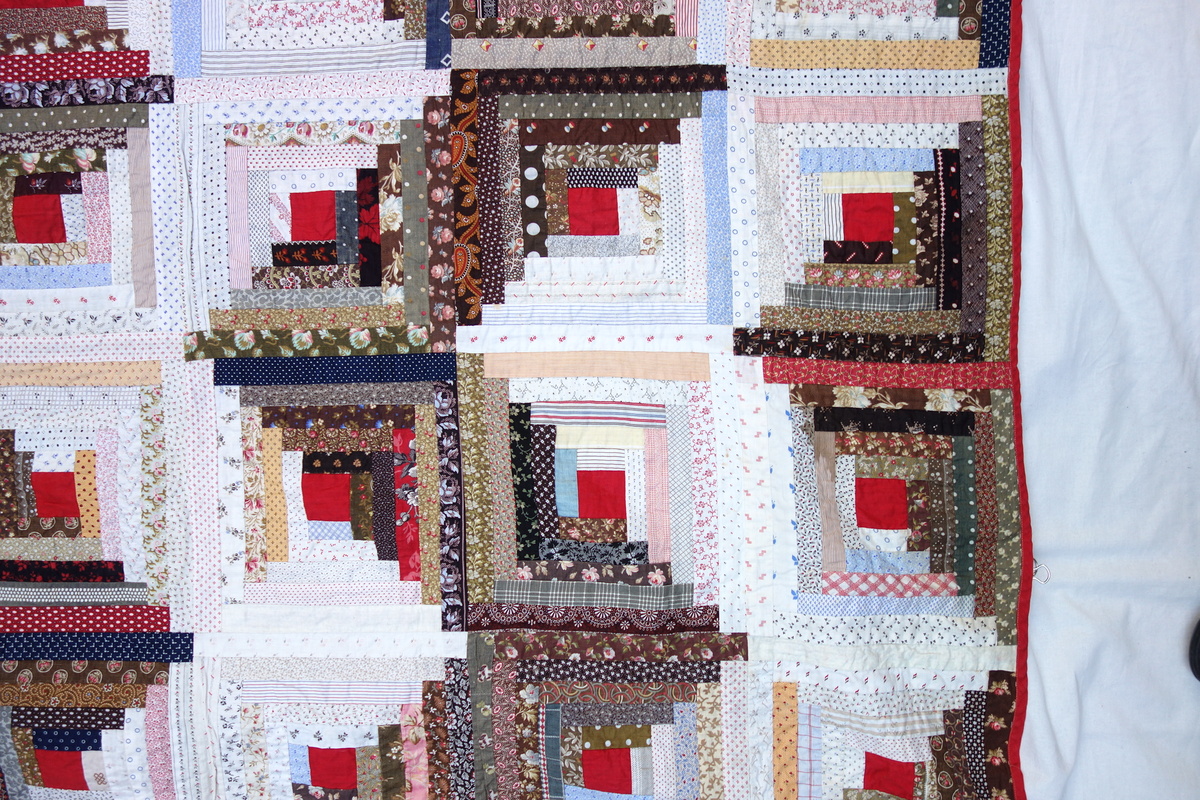 Detail of Log Cabin coverlet, USA, 1880's (TRC 2019.2404).
The lack of batting allows us to see clearly how the coverlet was constructed. It has been made by machine, each block being individually sewn on a foundation square of cotton. The red square is centrally placed and then each strip attached in turn and then flipped before the next was added. The stitches are clearly visible on the back and the seams are only secured by being crossed by the next seam to be sewn.
The blocks are joined together on the front by machine and the backing/ foundation fabrics are hemmed and finished by hand in a technique we recognise as ‘quilt-as-you-go’ today when a batting is used. This means that the backing shows a pattern of squares making it reversible if required. Despite the lack of batting, it is still quite heavy, due to the number of seams in the construction and so would still have been quite warm.
The indefatigable Log Cabin is perhaps the one pattern that was used by all sectors of American society, in the grand homes of the East, the poorer homes of the prairies, the Wild West, among the African American communities, the American Indians and Amish and the Mennonites. Today it is as fresh as it was well over a century ago and modern quiltmakers are still playing with its possibilities.


