• F2
  • F1
  • F3
  • F4

As part of the TRC research for the Encyclopedia of Embroidery from Scandinavia and Western Europe (London, Bloomsbury), TRC recently acquired a very fine cotton shawl (TRC 2021.0114), which was described by the previous owner as being late nineteenth century in date. It measures 210 x 60 cm. When we studied the shawl, it became more and more likely that the shawl is much older than first thought.

The TRC Gallery exhibition Textile Tales from the Second World War includes a number of war-time Mennonite quilts with a special history. Monika Modersitzki, a German quilter, has written the following blog:

In 1987 they emerged out of nowhere – quilts with the label „GIFT OF CANADIAN RED CROSS“. Some of them showed up at a flea-market in Munich, Germany, others for sale in bulk at a farmhouse nearby. It was pure chance that someone happened to identify these gifts. Obviously the sellers had no idea what to do with the old „stuff” and knew nothing about its possible value – not to speak of the historical dimension.
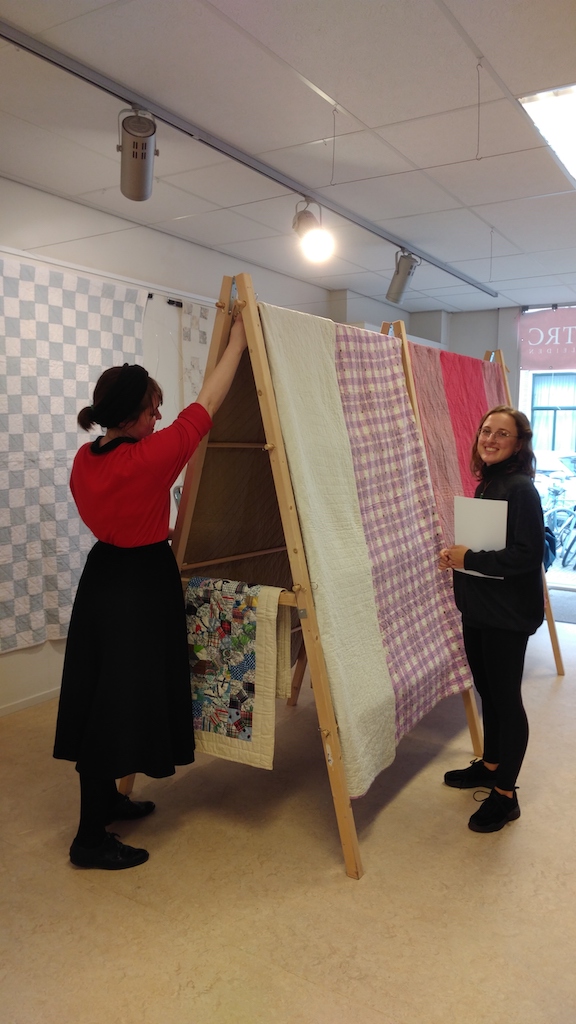
Canadian relief quilts being displayed at the TRC. Photograph by Monika Modersitzki.Canadian relief quilts being displayed at the TRC. Photograph by Monika Modersitzki. 

During and after the Second World War, the Canadian Red Cross had organised the shipments of quilts to Europe, but somehow not all of the quilts were distributed in Europe to people in need. Many of them were apparently stowed away and forgotten.

When the quilts turned up in 1987, yet unidentified, many of them were very dirty or damaged. When Christl Tumat, a quilter in Munich, found one of these quilts, she immediately informed her quilting friends in nearby Groebenzell about discovering those “Canadian Red Cross quilts” near Munich. The “Groebenzeller Quiltgruppe” bought about twenty of them that were still in a reasonable condition. The quilters are still using them in their own homes.

Elisabeth Greil remembers:

“What a touching gesture! Canadian women made thousands of quilts for the suffering population of war-torn Europe - even for their former enemies during WW II, Germany and Austria. The quilts warmed and comforted many during the harsh winters of the 1940s. Sadly, some of the quilts were forgotten in a freight wagon at the Vienna train station. They were found decades later during a clean-up. A dealer offered them for sale at an antique market at the Nockherberg. My assumption is that he didn’t know what a treasure he had, given that some of the quilts were in poor condition.
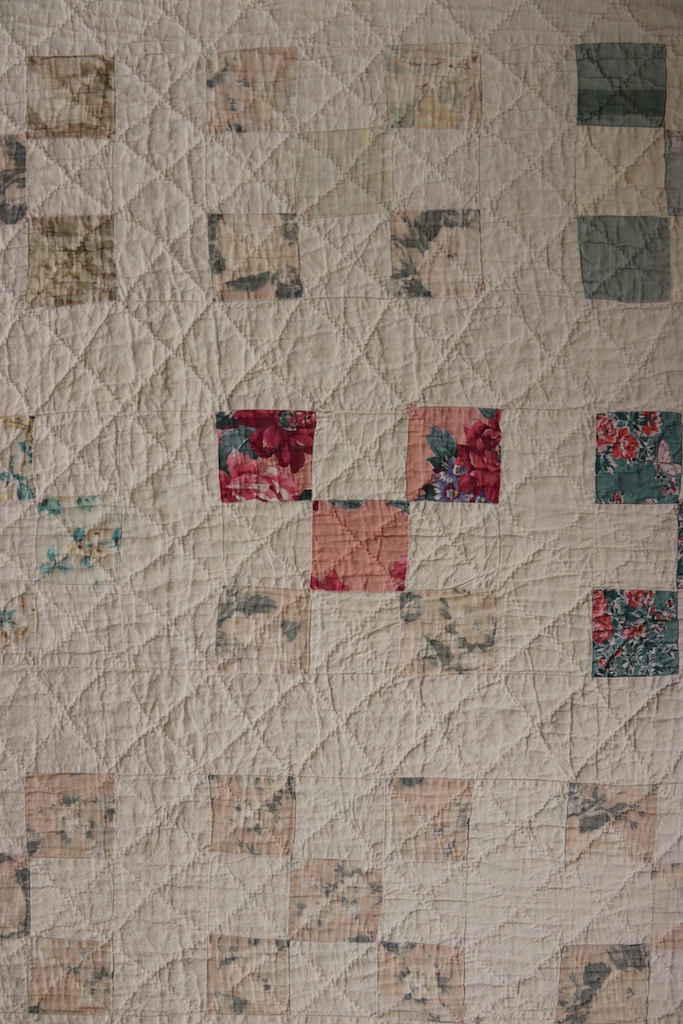
9-patch quilt, donated via the Canadian Red Cross in mid-1940s. Photograph by Monika Modersitzki.9-patch quilt, donated via the Canadian Red Cross in mid-1940s. Photograph by Monika Modersitzki.

Fortunately, Mrs. Tumat, one of the quilters in the Munich area, discovered the quilts at the market. She convinced the dealer to offer the entire collection of quilts he stored in a barn in Alling for sale. It was 1987. The Groebenzeller quilters jumped at the chance to purchase these special quilts. The quality varied greatly. Some were wholecloth quilts, with only one seam in the middle printed with flowers or checks. Others were real works of art.

I bought an especially nice 9-patch of lovely fabrics. Unfortunately many of the colours had faded over the years. All the quilts were made traditionally: the top of cotton, loose cotton as wadding and with cotton backing, hand-quilted. The prices varied in the beginning. I paid 220 Marks for my 9-patch and fifty for plain ones. I own five of these historical quilts. I am grateful to own a bit of this peace offering. It would be wonderful if the descendants of the Canadian quilters hear that the work of their mothers, grandmothers or aunts still exists and is admired.”

Monika Modersitzki, 25 September 2020

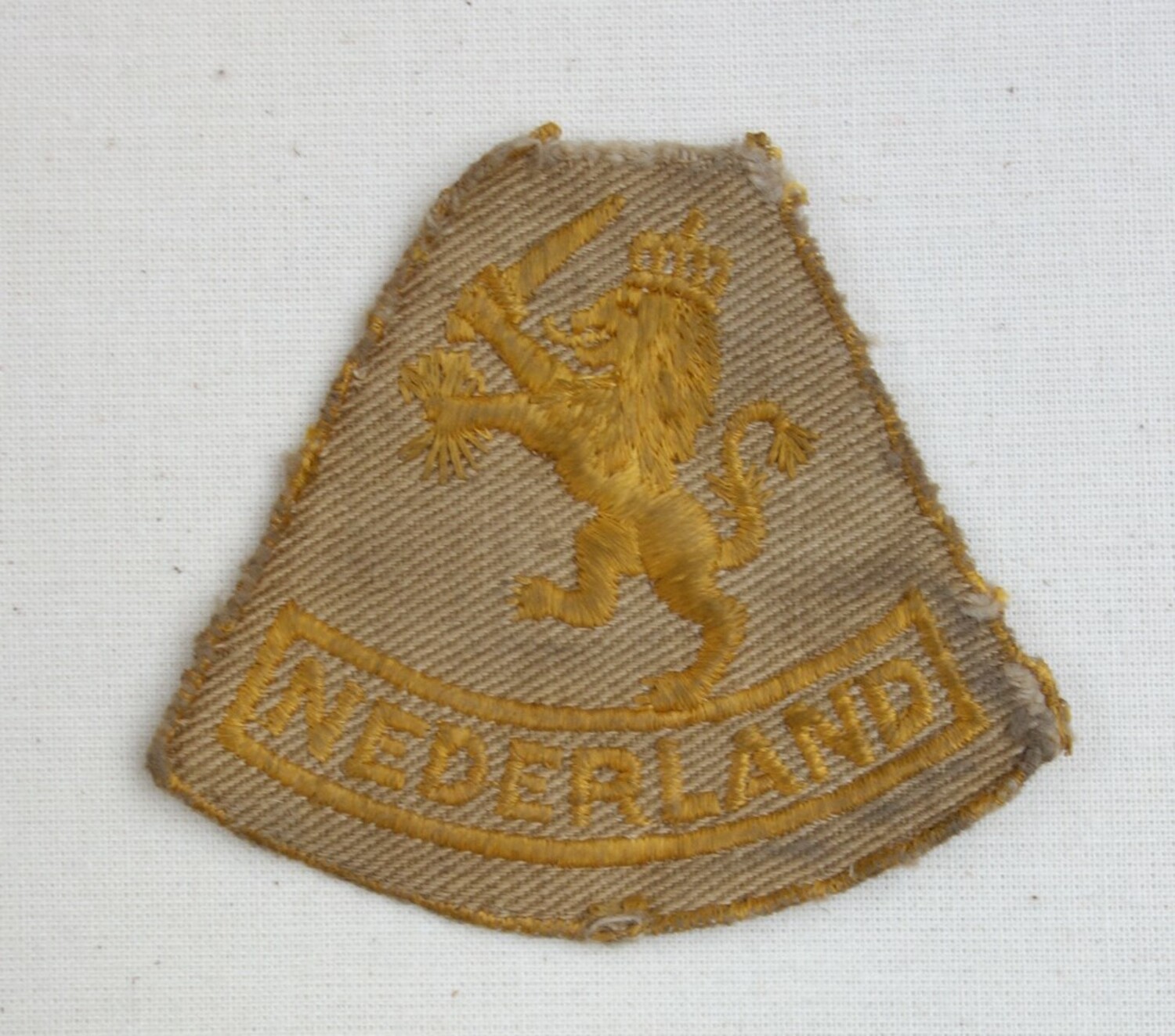
Badge of the Prinses Irena Brigade, which was set up in 1941 in the UK for mainly Dutch military fighting Nazi Germany (TRC 2020.0476). The badge displays the Dutch rampant lion.Badge of the Prinses Irena Brigade, which was set up in 1941 in the UK for mainly Dutch military fighting Nazi Germany (TRC 2020.0476). The badge displays the Dutch rampant lion.I had a bit of a shock yesterday at the TRC. We had the opening of the new exhibition on Wednesday (“Textile Tales from the Second World War”). Yesterday morning there was a very positive and encouraging article in the Leidsch Dagblad (click here), with a photograph on the front page and an additional brief column about the need for municipal and other support for the TRC. Thanks to this article, and the many blogs and other PR, we received quite a few phone calls and emails making appointments to see the display.

Yes, textiles is a subject that particularly attract women, although over the years we've got many men interested in various (often technical) aspects. But lo and behold, and yes, it was a bit of a shock and my knees almost gave way: yesterday at one point in the afternoon there were three men in the gallery keenly looking at the exhibition – without their wives present!!! Normally men sit quietly in the hubby's corner with a book or magazine, cup of coffee and a biscuit.

The corona virus is certainly changing the world: Men publicly enjoying textiles and the tales they represent. What will ever happen next?

Gillian Vogelsang, 18 September 2020

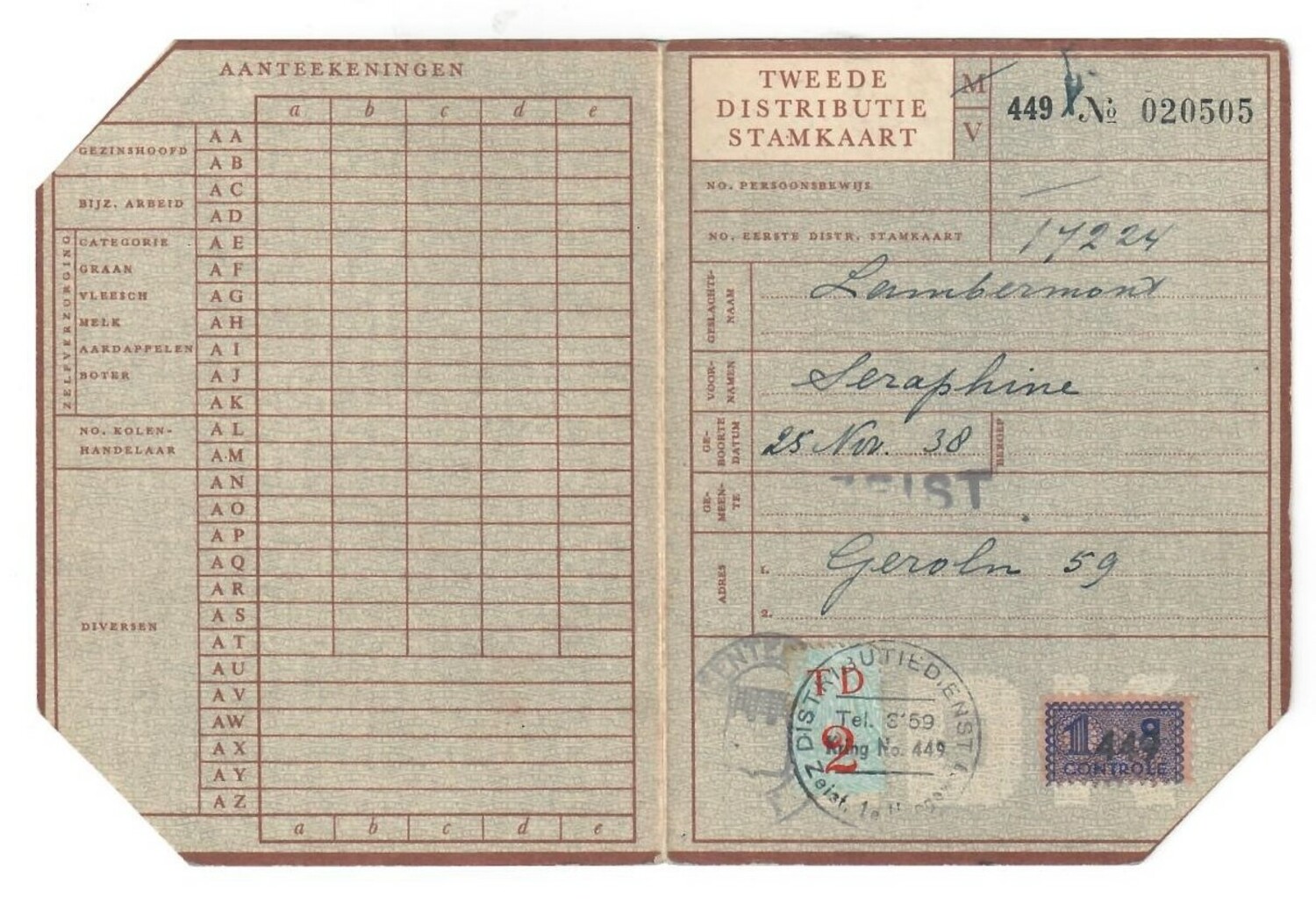
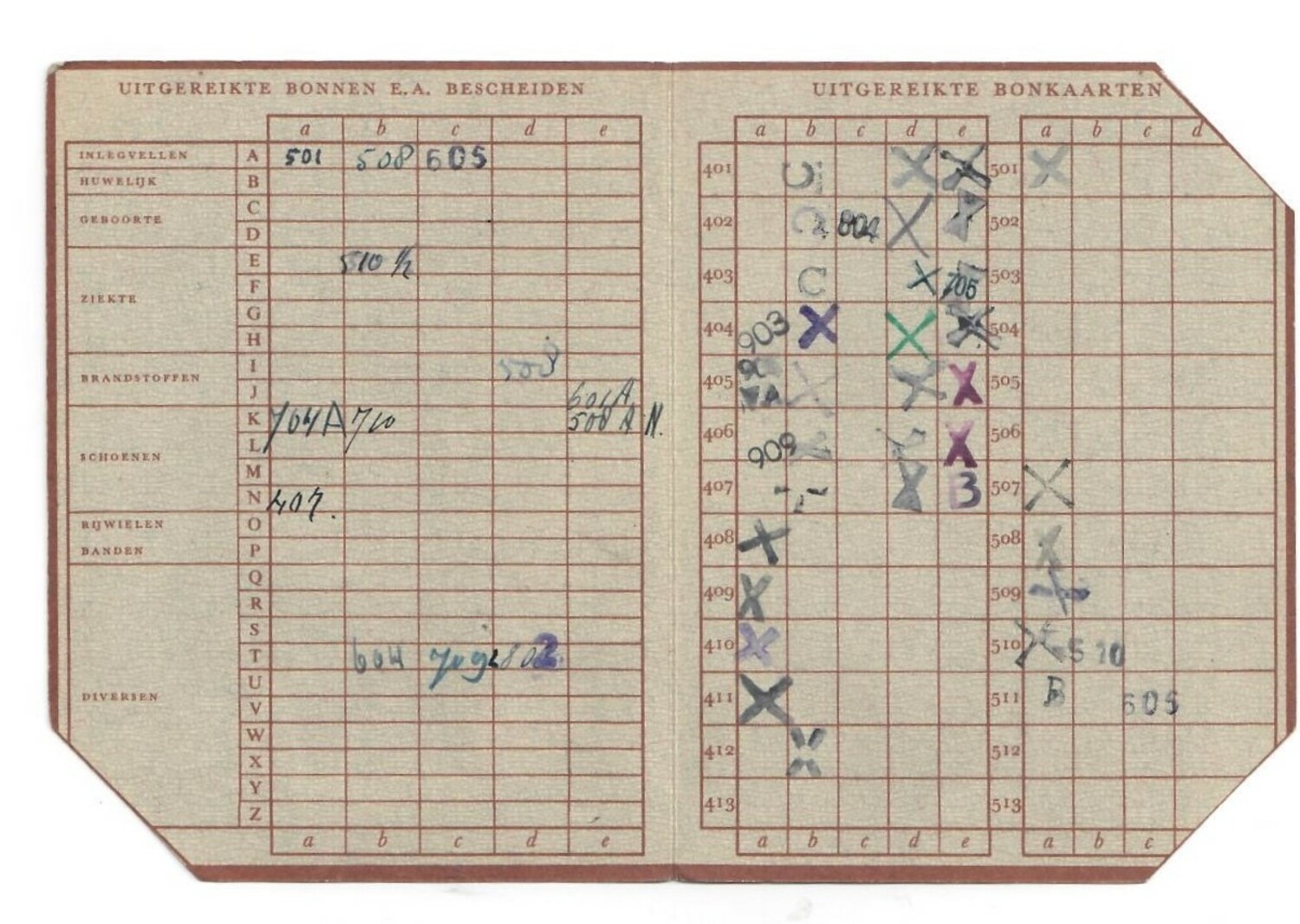
On the occasion of the TRC Gallery exhibition: Textile Tales from the Second World War, we publish a series of blogs about some specific objects in the exhibition. Today we include a short, personal story written by Ms Pien Lambermont, who donated some ration cards ('Stamkaart') from the Second World War to the TRC (TRC 2020.3463a, TRC 2020.3463b, TRC 2020.3463c). These cards were needed in order to obtain ration coupons for food, garments, shoes, etc:

Ration card ('Stamkaart') issued in 1944, belonging to Seraphine (Pien) Lambermont (TRC 2020.3463c).Ration card ('Stamkaart') issued in 1944, belonging to Seraphine (Pien) Lambermont (TRC 2020.3463c).

Reverse of the ration card of Seraphine Lambermont (TRC 2020.3463c).Reverse of the ration card of Seraphine Lambermont (TRC 2020.3463c).

The ration cards belonged to my parents and myself. I am Pien Lambermont and nowadays live along the Hogewoerd in Leiden [the same street as the TRC], but I spent my childhood, and the war, in the village of Zeist, near the city of Utrecht. On my ration card you can see a symbol that notes that I was frequently ill and allowed extra rations, and my parents were consequently able to buy me shoes twice.

I remember from my illness that I was often unable to keep food down and that I was frequently sick. What I also remember from the war was the enormous effort to obtain food, especially during the last few months of the war. For example, I remember that as children we had to take turns grinding rye in the hand coffee grinder and then making it into porridge. This rye porridge had to cook for a long time and stood on the back of the wood stove for hours, so we could eat it in the evening. I still remember the awful (for me at least) smell that I couldn't handle.

Another reminder is that my mother went three times with either my father or one of my much older sisters on the bike to the Achterhoek in the neighbouring province of Gelderland, to exchange some of their possessions for food. It took days for them to return and I remember that in particular, because I was always afraid that they wouldn't come back. A ray of hope was that I was allowed to sleep in my parents's bed during their absence.

Pien Lambermont, 11 September 2020.

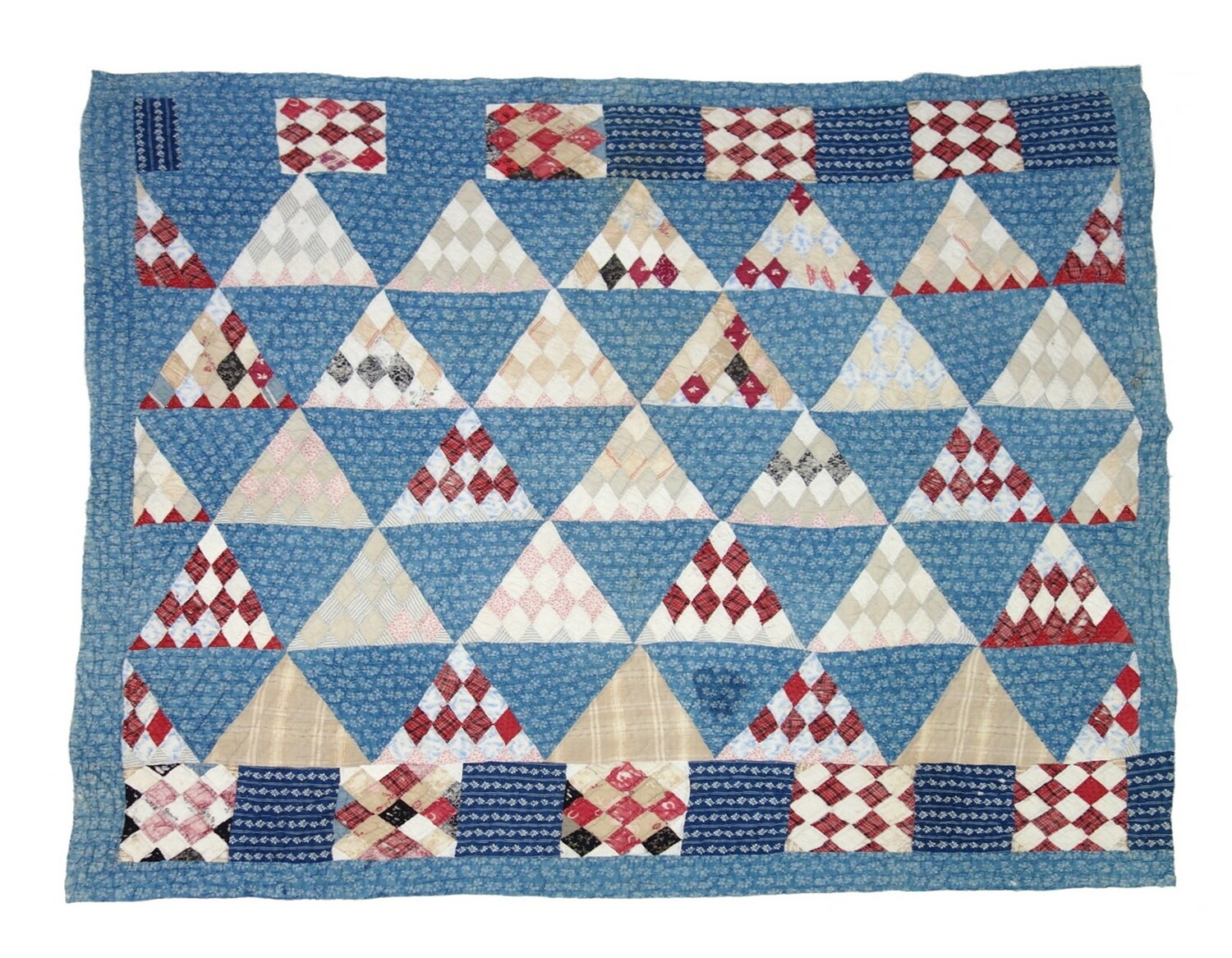
American quilt from the mid-nineteenth century (TRC 2019.2651).American quilt from the mid-nineteenth century (TRC 2019.2651).As part of the Textile Festival to be held in Leiden from the 12-15th May 2021, the TRC Leiden will be having a quilt and quilting week. This will involve a series of workshops and lectures on the history of quilts and quilting, basic quilting techniques, as well as the investigation of individual quilts.

American quilt historian Linzee McCray, along with Susan Cave, Beverley Bennett and Gillian Vogelsang-Eastwood will be presenting the various events.

The TRC activities will run from Sunday, 9th May t/m Saturday 15th May. There will also be the opportunity to explore the planned TRC’s exhibition about the history of the Paisley (buteh) motif and its influence on 19th and 20th century Western textiles and garments.

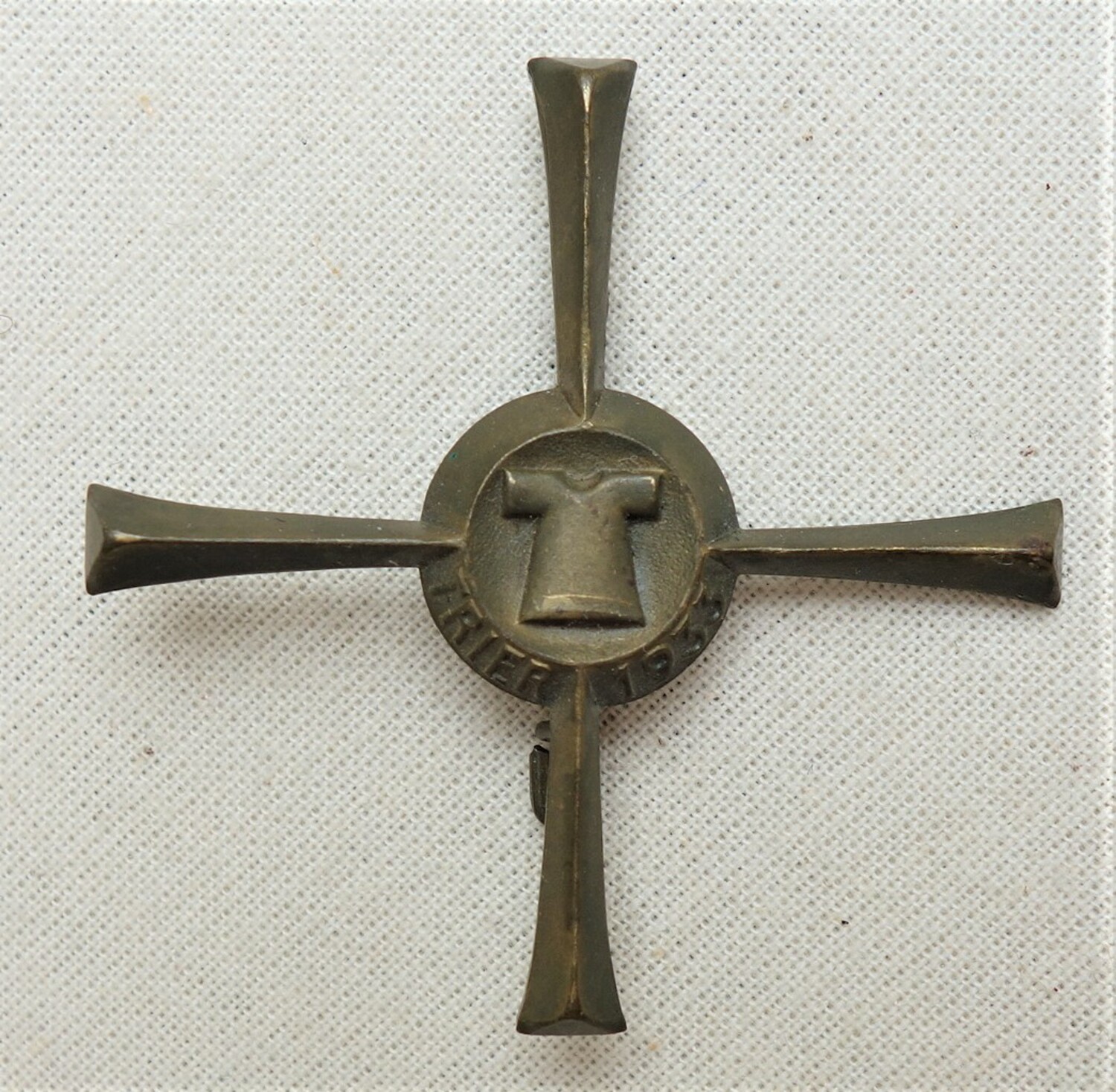
A metal pilgrim's badge to commemorate the 1933 viewing of the Holy Mantle, Trier (TRC 2020.3574).A metal pilgrim's badge to commemorate the 1933 viewing of the Holy Mantle, Trier (TRC 2020.3574).On the 4th July 2020, we published a TRC Blog about a medieval pilgrim's badge that commemorates the wearer's pilgrimage to Santiago de Compostela (TRC 2020.3387). It represents a fascinating story about people's lives and Christian beliefs some 500 years ago in Spain and other parts of Europe. Indeed, the story still reflects upon many people's lives to the present day.

In this blog I want to look at another, related item that has just been added to the TRC Collection in Leiden (TRC 2020.3574). It is a pilgrim's badge from Germany. It has the shape of an equal-armed Byzantine cross and is made out of metal. In the centre of the cross there is a disc with the image of a tunic and TRIER 1933 around the edge.

Trier is an ancient city in western Germany with many Roman remains. At some time it was even the residence of a Roman emperor. It is known for its cathedral, namely the Hohe Domkirche (‘High Cathedral’), which is dedicated to Saint Peter. Parts of the cathedral date back to the fourth century AD, making it the oldest church in Germany.

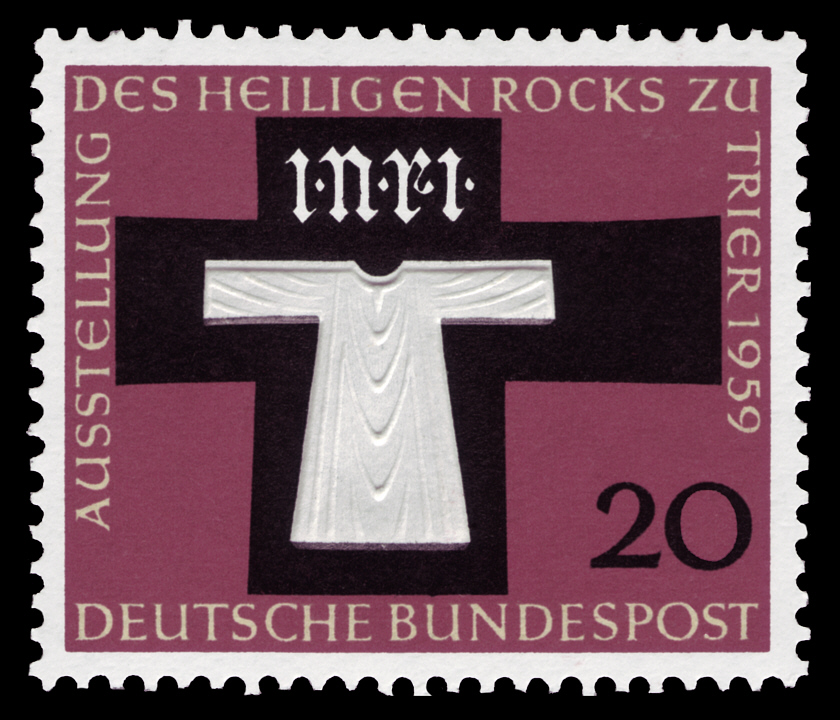
1959 German postage stamp, with a depiction of the Holy Mantle.1959 German postage stamp, with a depiction of the Holy Mantle.As with many Catholic religious establishments it houses relics that represent particular events and people, notably saints, important to the Church. In the case of Trier High Cathedral, it has a very special relic, namely a seamless tunic that was believed by many to have been the garment (chiton) worn by Jesus Christ just before his Crucifixion (John 19:23-24). It is also known as the Seamless Robe of Jesus, the Holy Robe, the Honourable Robe and the Chiton of the Lord.

It is a linen garment that has been repaired and added to over the centuries. In particular, it was conserved with rubber in the 19th century (this would never happen nowadays!), so it is now impossible to carbon date it and to give a more accurate date to the object.

Trier, however, is not the only Cathedral that claims to have the Seamless Tunic of Christ. There are other examples, namely in the Basilique Saint-Denys, in Argenteuil, France and the Svetitskhoveli Cathedral in Mtskheta, Georgia.

In 1933 there was a major pilgrim's event in Trier, and the highlight was the veneration of the tunic. This is an event that only happens occasionally. Since the 16th century, for example, it has only been displayed eighteen times, including in 1933 and 1959 - the last time was in 2012. Pilgrims who visited the Trier Cathedral and saw the Holy Robe were given a badge to commemorate their pilgrimage. The TRC in Leiden is very pleased to include an original badge in its collection.

Gillian Vogelsang, 9th August 2020.

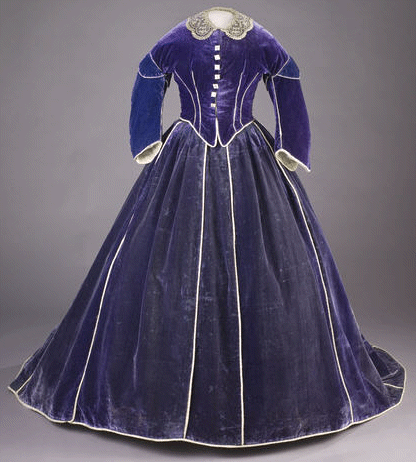
First Lady Mary Todd Lincoln’s dress, made by Elizabeth Keckley.First Lady Mary Todd Lincoln’s dress, made by Elizabeth Keckley.Sewing has meant many things, from drudgery to inspiration, to many people. For one 19th century woman, it meant freedom. Elizabeth Keckley (1818-1907) was born enslaved on a plantation in Virginia (USA). When she was four years old, her mother taught her to sew. At 14 she was sent to work in another state, where she was repeatedly beaten and whipped for her “stubborn pride”.

She was hired out as a seamstress in order to make money for her owner. She saved her money and tried to buy her freedom and that of her young son, but was refused. Finally the family accepted USD 1,200 (about $33,000 dollars in today’s money), and in 1855 signed a deed of emancipation for her and her son. She wrote: “Free! The earth wore a brighter look and the very stars seemed to sing with joy. Yes, Free!” She moved to Baltimore and taught young African-American women her method of cutting and fitting dresses. She then moved to Washington, DC and gained a reputation as an excellent seamstress and modiste.

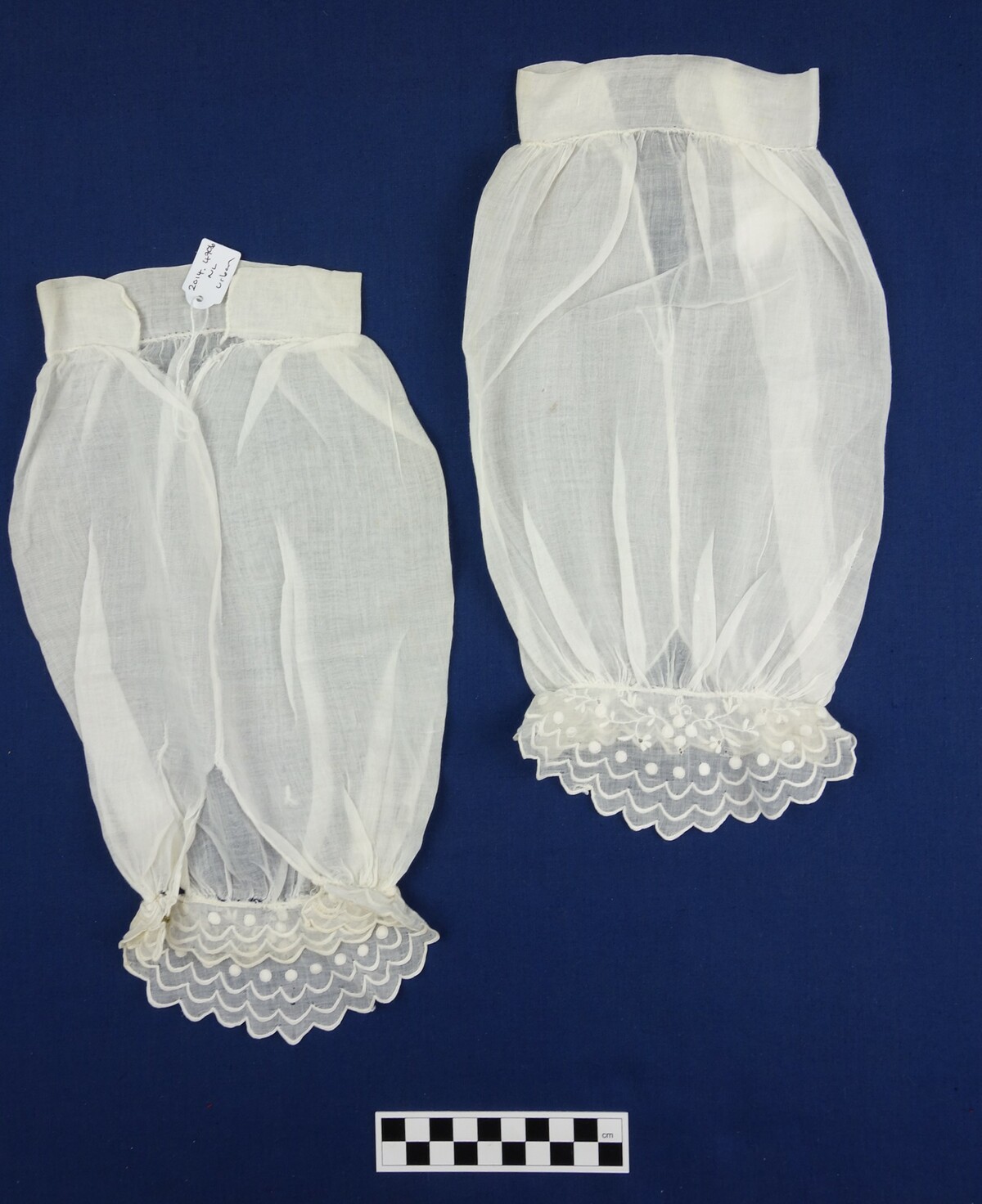
Pair of engageantes, mid-19th century (TRC 2014.0470a b).Pair of engageantes, mid-19th century (TRC 2014.0470a b).The TRC Collection houses some notable types of dress, some of which no longer worn and now completely forgotten. One of these is a type of false sleeve, worn by fashionable ladies until at least the mid-nineteenth century. These were the so-called engageantes.

Engageantes is not a word that is now used on an everyday basis, yet over a 150 years ago, it was an important element in the wardrobe of any fashionable lady in Europe, the Americas and elsewhere. The word engageantes derives from the French word engageant, meaning 'engaging' or 'attaching'. But what are they?

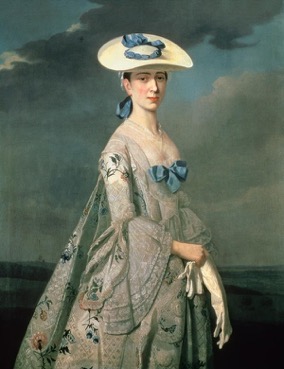
Engageantes are detachable sleeves that were worn underneath the wider sleeves of a women’s bodice or dress. They did not form part of an undergarment such as a chemise, but were independent items. They are sometimes called fake or false sleeves by modern authors, but this is incorrect.

Lady Eleanor Frances Dixie, painted by Henry Pickering, c. 1753. She is wearing elaborate engageantes with three layers of lace. The engageantes reach from underneath the short pagoda sleeves of her bodice.Lady Eleanor Frances Dixie, painted by Henry Pickering, c. 1753. She is wearing elaborate engageantes with three layers of lace. The engageantes reach from underneath the short pagoda sleeves of her bodice.

Search in the TRC website

Contact

Boerhaavelaan 6
2334 EN Leiden.
Tel. +31 (0)6 28830428  
office@trcleiden.org 

facebook 2015 logo detail 

instagram vernieuwt uiterlijk en logo


Bank account number

NL39 INGB 0002 9823 59, in the name of the Stichting Textile Research Centre.

TRC closed until 4 May 2026

The TRC is closed to the public until Monday, 4 May 2026, due to our move to the Boerhaavelaan. The TRC remains in contact via the web, telephone and email. For direct contact and personal visits, please contact the TRC at office@trcleiden.org, or by mobile, 06-28830428.

Donations

The TRC is dependent on project support and individual donations. All of our work is being carried out by volunteers. To support the TRC activities, we therefore welcome your financial assistance: donations can be transferred to bank account number (IBAN) NL39 INGB 000 298 2359, in the name of the Stichting Textile Research Centre. BIC code is: INGBNL2A.

 You can also, very simply, if you have an iDEAL app, use the iDEAL button and fill in the amount of support you want to donate: 


Since the TRC is officially recognised as a non-profit making cultural institution (ANBI), donations are tax deductible for 125% for individuals, and 150% for commercial companies. For more information, click here