• F1
  • F3
  • F4
  • F2

Clare Waight KellerClare Waight KellerWe are very happy to announce that international Fashion Designer and Creative Director, Clare Waight Keller, has very kindly agreed to become a member of the TRC Board.

Clare has worked as a designer for various fashion houses, including Calvin Klein (New York), Ralph Lauren, and Gucci. She was also artistic/creative director for Pringle of Scotland, Chloé, and Givenchy. More recently she has taken on the role of Global Creative Director of Uniqlo.

Clare has sent the following message about this amazing new development:

"I’m thrilled to join the Board of the TRC and to be part of helping Dr Gillian preserve the future of historic textiles. This knowledge is vital and an incredibly important part of our collective cultural history. What has been achieved so far has already contributed significantly to the prevention of the loss of ancient and unique textiles and clothing for future generations. In my role I hope to bring even more significant value and support to ensuring this expertise is not lost and its value is protected. I’m truly looking forward to contributing to the long term future of the TRC and highlighting its unique importance to our social history and society."

Clare’s knowledge of textiles and fashion will be a great boon for the current and future work and development of the TRC.

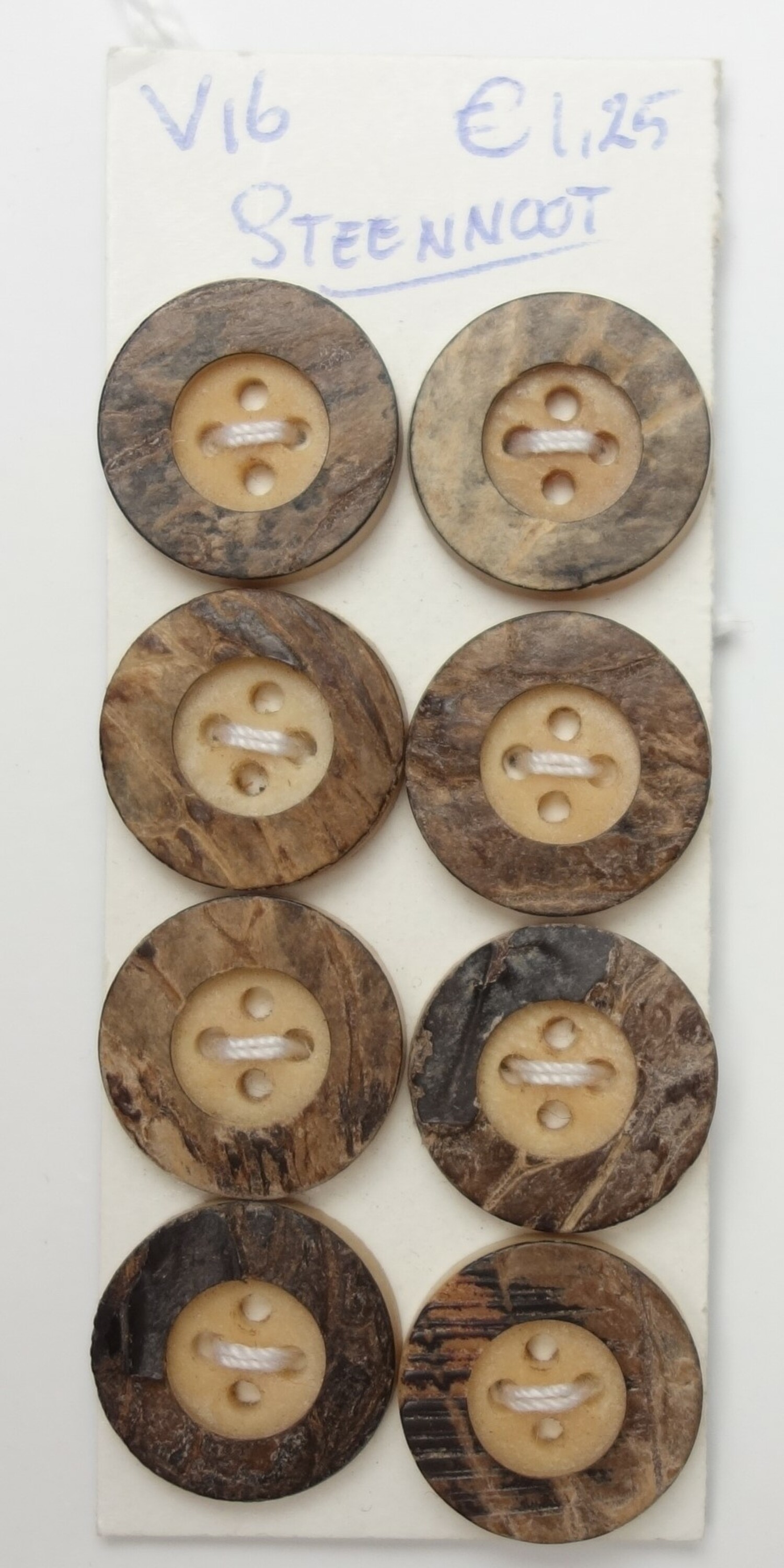
Sheet of buttons made from corozon nuts, Europe, 20th century (TRC 2025.0851).Sheet of buttons made from corozon nuts, Europe, 20th century (TRC 2025.0851).We have recently been sorting through a collection of buttons that were part of a large donation (c. 6,000 items) by Hennie Stevan-Bathoorn and Sjoerd Stevan and formed part of the former Museum voor Naaldkunst in Winschoten.

Over the last year we have been (slowly) adding more and more Winschoten items to the TRC Collection and we are now looking at the various boxes of buttons.

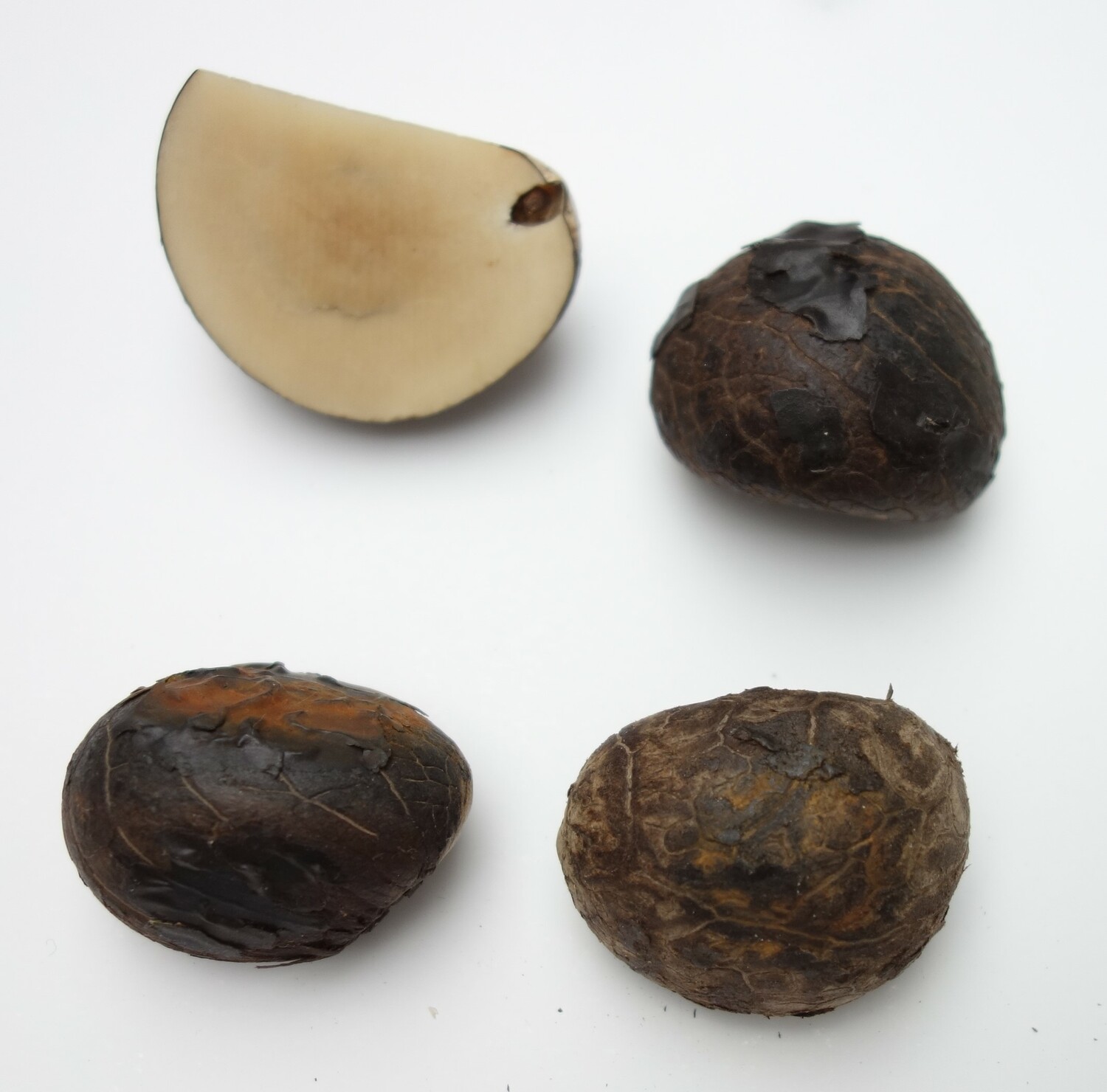
Among these boxes there are several examples that look as if they were made of bone or ivory, but are in fact made of slices of corozon nut (TRC 2025.0851 to TRC 2025.0855). Equally interesting, there are some of the actual nuts themselves (TRC 2025.0856a-d).

Corozon nuts

Corozon nuts come from the tagua palm trees of the Arecaceae family, which grow in Central and South America. More specifically, they grow in southern Panama, Ecuador, Columbia, Bolivia, in parts of Brazil and Peru. Based on the information that came with the nuts, the examples now in the TRC Collection derive from Ecuador (P. aequatorialis).

Four corozon nuts from Equador, 20th century (TRC 2025.0856a d).Four corozon nuts from Equador, 20th century (TRC 2025.0856a d).The nuts are also known as palm ivory, ivory nuts and vegetal ivory. These terms refer to the white kernel (endosperm) that is nutrient-rich and can be found in many types of seeds from flowering plants, such as the white layers from the coconut, wheat and rice).

The seeds are harvested when ripe. The outer layer (pericarp) is removed and then the kernels are allowed to dry. With respect to the corozon nut, once the kernel (endosperm) has thoroughly dried, they become very hard, scratch-free, water proof and durable and can be used for a variety of objects, including buttons.

Corozon nuts, ballast and buttons

It would appear that dried corozon nuts were first introduced to Europe in the late 18th and early 19th century as ballast (rather than sand) on some wooden sailing ships, in particular, for the ships sailing between South America and Germany.

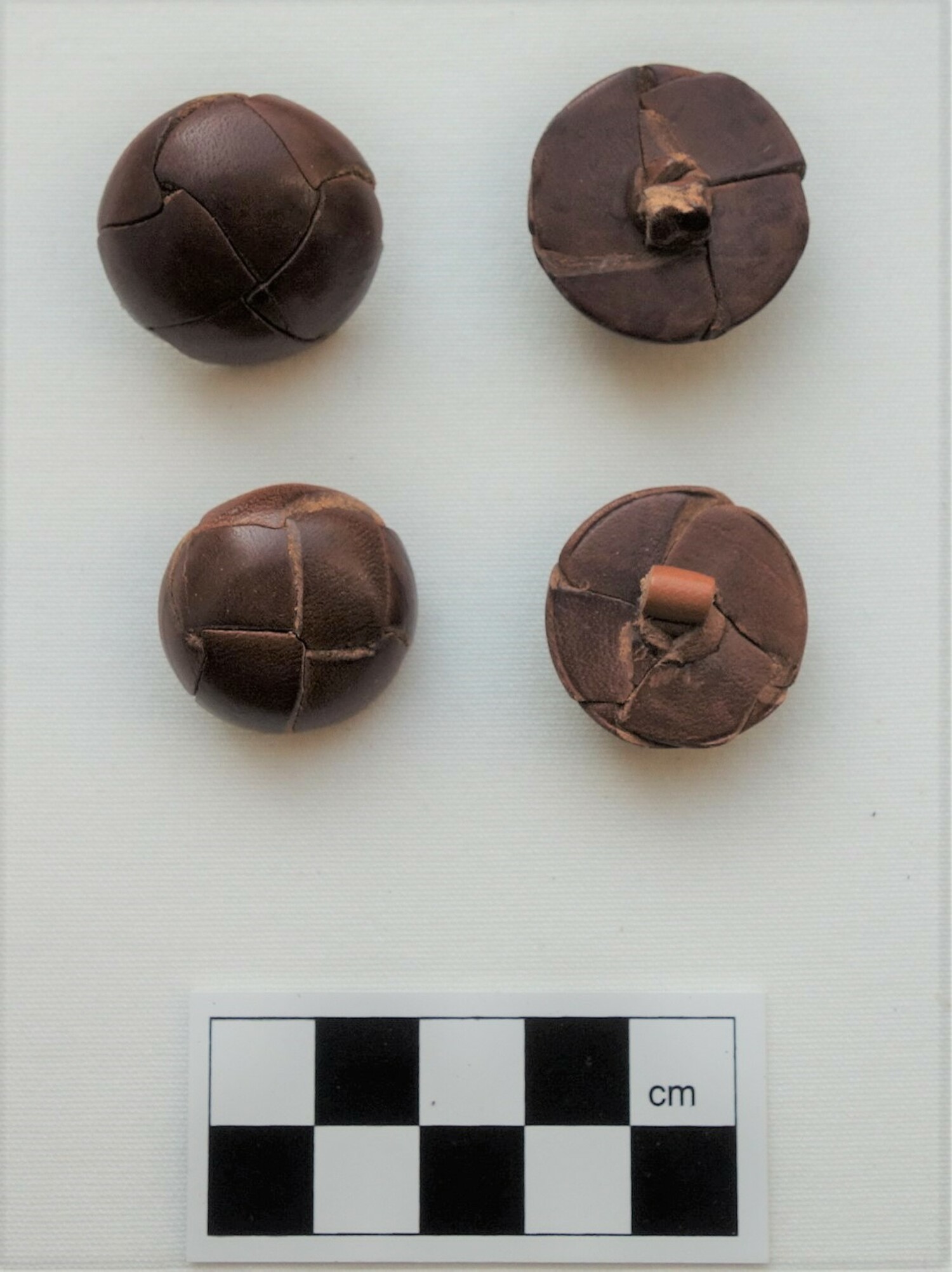
Pair of buttons made from the corozon nut, with a carved leather design. The Netherlands, 1930s (TRC 2018.1768a b).Pair of buttons made from the corozon nut, with a carved leather design. The Netherlands, 1930s (TRC 2018.1768a b).It would seem that someone in Germany saw the potential of these hard nuts to make a range of small items, such as needles and buttons.

Ivory nut buttons started to be manufactured in various countries in Europe by the mid-19th century. In general they are flat disc forms with two to four sewing holes. Some also have a dark brown layer around the outer edges (TRC 2025.085).

The TRC Collection includes other examples of ivory nut buttons, which come from the USA and date to the 1930s. One set of buttons is dome-shaped and they were carved to imitate buttons made from strips of leather (TRC 2018.1768a-b, compare TRC 2018.2197a-d).

Set of leather buttons. Europe, 1930s (TRC 2018.2197a d).Set of leather buttons. Europe, 1930s (TRC 2018.2197a d).Nut buttons stopped being industrially produced in the 1930s with the advent of cheaper, plastic buttons.

There has been a trend to re-introduce corozo nut items in order to replace small, elephant-ivory products (including parts for bagpipes!). There is a movement among some bespoke clothing groups to re-introduce corozo nut buttons, bearing in mind that they are more expensive than modern plastic buttons, but they are of vegetable-origin and sustainable.

Gillian Vogelsang-Eastwood, 14 July 2025

USA-based donors can make tax-deductible contributions to the "Friends of the TRC Leiden" at Myriad USA. Because Myriad USA is a public charity, within the meaning of Sections 501(c)(3) and 509(a)(1) of the IRC, donors may claim the maximum tax benefits allowed by USA tax law for their contributions. Myriad USA works closely together with Every.org (San Francisco).

For the dedicated TRC site on Every.Org, click here.

If you wish to support us, here is how to proceed:

  • Gifts by check: Address your check to Myriad USA, write "Friends of the TRC Leiden" in the memo section of the check, and send it to Myriad USA at 551 Fifth Avenue, Suite 2400, New York, NY 10176
  • Gifts by credit card, bank transfer, Paypal, etc, via Every.org: click Myriad button above.
  • Gifts by wire transfer or to contribute other types of property: Contact Myriad USA via email at This email address is being protected from spambots. You need JavaScript enabled to view it. or phone (212) 713-7660. 

The TRC Board has recently approved the Annual Report for 2024. We are very pleased to present an overview of what happened in the last year and in particular to highlight all the TRC blogs that were published and represent the diverse nature of all the many activities that take place at the Hogewoerd 164.

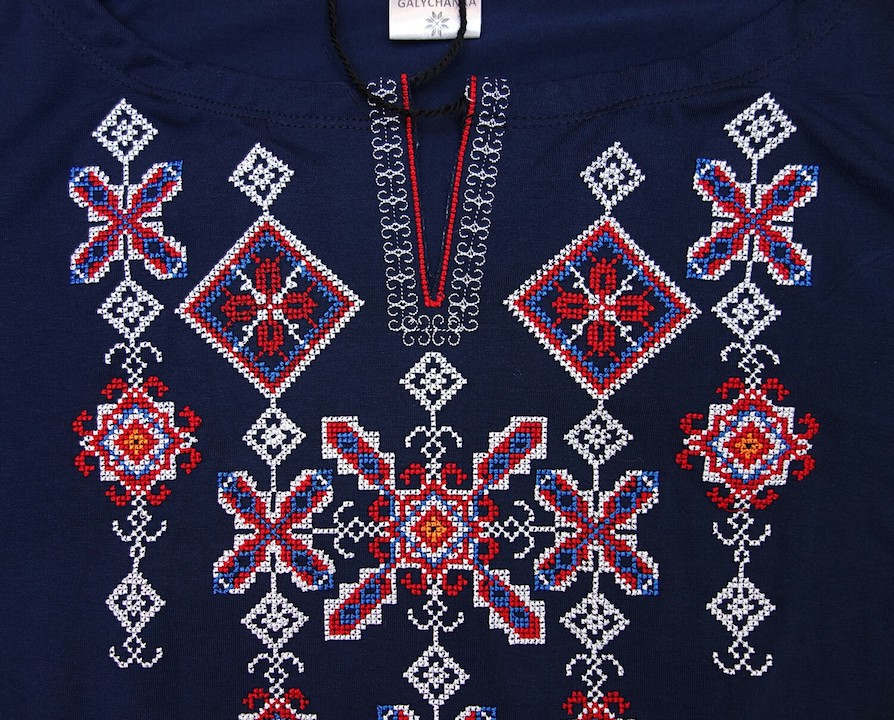
Detail of an embroidered top for a Ukrainian woman, early 21st century. Acquired in 2024 (TRC 2025.0149).Detail of an embroidered top for a Ukrainian woman, early 21st century. Acquired in 2024 (TRC 2025.0149).

Many changes have taken place and many more are due to take place. it is clear from the report that we may be small space wise, but we are big in activities and in our support of textile and dress studies in all their myriad of different forms.

The TRC Annual Report 2024 can be accessed here.

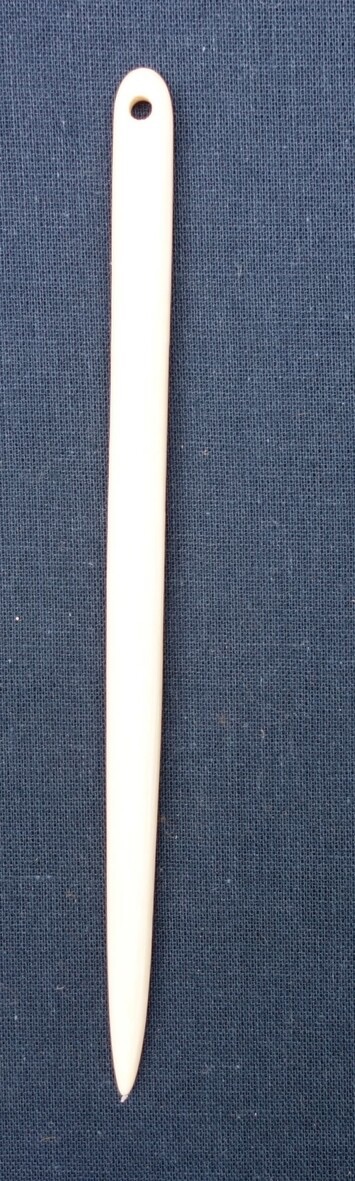
Fig. 1. Needle made from mammoth ivory (modern!). TRC 2023.1681.Fig. 1. Needle made from mammoth ivory (modern!). TRC 2023.1681.by Emilie Lambert – collection manager TR

Today, we take wearing clothes for granted – but when did it actually start? This blog looks at when and why humans first began wearing clothing, and what it might have looked like. Even there are only rare finds of clothing from thousands of years ago  scientists can still piece together clues using indirect evidence.

Clothing’s main purpose is to keep us warm. Around 1.6 million years ago, humans began to lose most of their body hair., and as natural insulation disappeared covering the body with other means became a necessity - especially in colder environments.

For a long period people wore what is referred to as simple clothing. This is in essence a single layer of minimally worked material draped over the body. Scientists believe humans wore such covewrings for at least 190,000 years. Most of these forms of clothing would have been animal furs and skins. They were treated with stone scrapers, separating the fat layers from the skin and then burnishing the material with antler lissoirs. Basic stitching can also be seen, with holes made through the thick skin with bone awls or stone burins, and a thread of twisted sinews or plant fibres.

Complex clothing, meaning tailored, fitted coverings, is first recorded from around 40,000 BC. This is around the time the Neanderthals were disappearing, leaving Homo sapiens as the only species of our genus. Complex coverings, although still made from animal hides and skins, would have allowed our species to inhabit climates otherwise too cold to bear, as close-fitted, layered clothing can insulate far better than draped coverings.

Indirect evidence for fitted clothes, such as eyed needles (compare a needle made from mammoth bone, Fig. 1), are found from 35.000 years ago and these tools are uniquely associated with Homo sapiens, although some evidence may point to earlier examples.

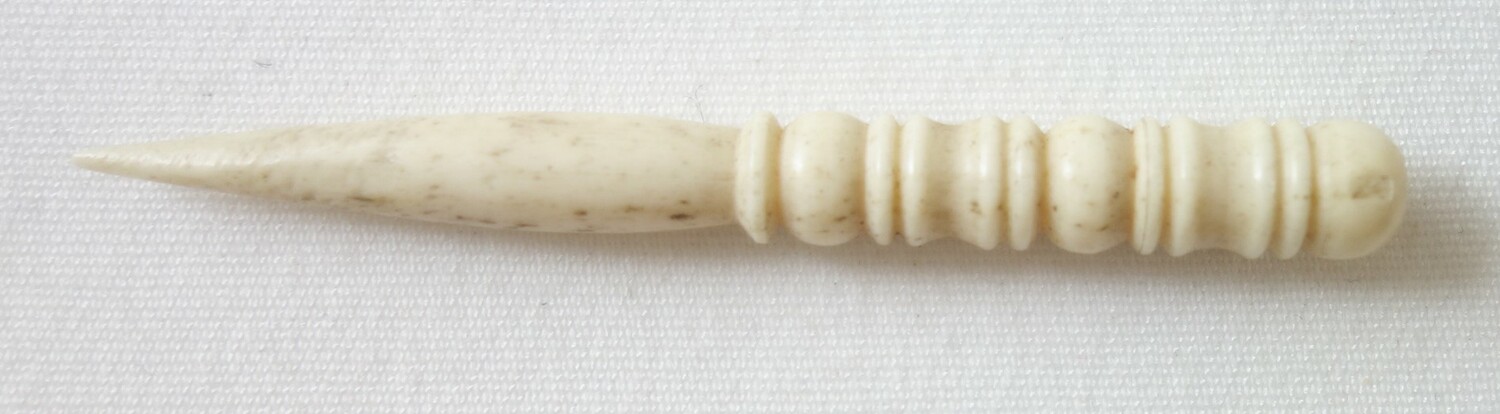
Dress would only move into its next phase at the start of the Holocene, some 12,000 years ago, when, because of climatic shifts, woven textiles were introduced which  were preferred to hides and pelts. The TRC houses a bone awl with a decorated handle (Fig. 2; TRC 2020.0934). This item dates to the early 20th century, but comparable tools were used for the sewing of garments in the ancient past.

 Fig. 2. Small bone tool with bone handle. The Netherlands, early 20th century (TRC 2020.0934).Fig. 2. Small bone tool with bone handle. The Netherlands, early 20th century (TRC 2020.0934).

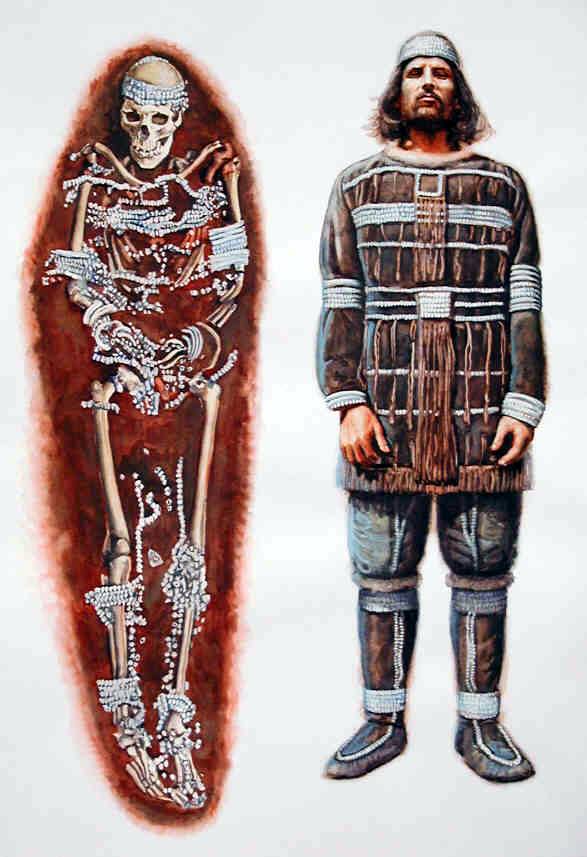
When furs and skins were the main clothing materials, decoration already seems to have been everywhere. There are plenty of reports of head and body coverings sewn with teeth or shells. In burials, the placement of these items can even tell us how the decorations were arranged. The Aurignacian site of Sunghir in Russia is a classic example: its 30–34,000-year-old burials are exceptionally rich, with thousands of ivory beads preserved on the skeletons, revealing multiple layers of highly decorated clothing (Fig. 3)..

Fig. 3. Sunghir. Aurignacian clothing reconstructed from the layout of ivory beads in a burial. © Libor Balák (https://donsmaps.com/sungaea.html)Fig. 3. Sunghir. Aurignacian clothing reconstructed from the layout of ivory beads in a burial. © Libor Balák (https://donsmaps.com/sungaea.html)

Early evidence for clothing can also be drawn from art and figurines. In the Upper Palaeolithic (particularly around 25,000 years ago), many of the famous Venus figurines are interpreted to be wearing clothing of various sorts. These include netted hats, skirts and aprons, which appear to be made primarily from cordage and narrow woven bands.

A ‘bast-culture’ was prominent throughout the Mesolithic and Neolithic (i.e. from 20.000 years ago onwards), with scarce but undeniable evidence for basketry, cordage, netting and twining.

Although we know that woven textiles were introduced with the Holocene around 10,000 years ago, there was still a significant use of non-woven clothing well into the Bronze Age. A good example is the famous Ötzi the Iceman, from the Central European Copper Age (ca. 3.200 BC), whose clothing was made entirely of leather and plant fibres.

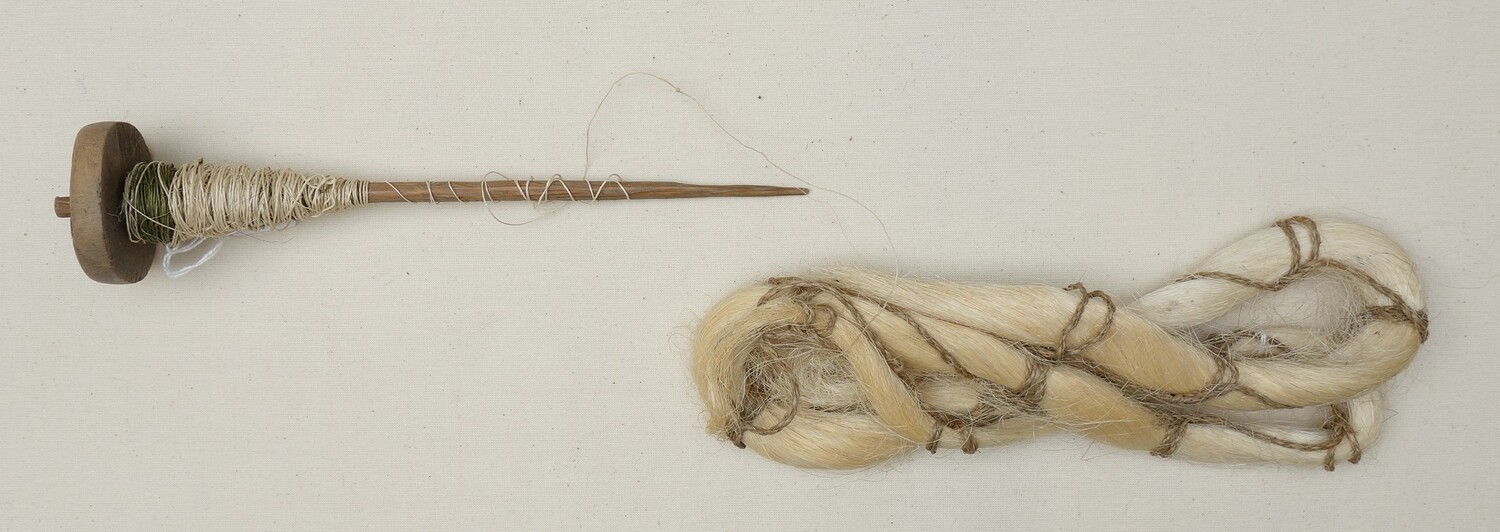
 Fig. 4. TRC 2020.2796a Spindle with a stick shaft and a disc whorl. There is a spun, bast thread ('hanna') wrapped around the spindle shaft. Sri Lanka, 20th century (TRC 2020.2796a).Fig. 4. TRC 2020.2796a Spindle with a stick shaft and a disc whorl. There is a spun, bast thread ('hanna') wrapped around the spindle shaft. Sri Lanka, 20th century (TRC 2020.2796a).

All this goes to show how knowledge of body coverings was crucial for survival, and early people were skilled in various forms of the relevant crafts. Tanning of leather, basketry, knotting, spinning and weaving techniques, were essential for human survival and development. Many ofd the tools developed thousands of years ago, were, or still are bing used (compare a 'modern' spindle from Sri Lanka, Fig. 4).

Further reading:

  • Gilligan, I. (2019). Climate, clothing, and agriculture in prehistory: Linking evidence, causes, and effects. Cambridge University Press. https://doi.org/10.1017/9781108555883
  • Marangou, C. (2020). Neolithic anthropomorphic figurines: Clothing, dress and costume. Revue de l'Archéologie du Vêtement et du Costume (ISSN 2728-0896), 1, 27-56.
  • Rast-Eicher, A. (2005). Bast before Wool: The first textiles. In P. Bichler, K. Grömer, R. Hofmann-de Keijzer, A. Kern, H. Reschreiter (Eds.), Hallstatt textiles : Technical Analysis, Scientific Investigation and Experiment on Iron Age Textiles. (pp. 117-131). BAR International Series 1351. Archaeopress.
  • https://www.iceman.it/en/clothing/

In 2024 the TRC organised many workshops and other events, welcomed individuals and groups of people from all over the world, and in general propagated interest in the fascinating world of textiles. Various blogs were written afterwards that reported on the meetings, such as a study day on frivolité (12 March), a visit by students from the Royal Academy of Arts in The Hague (13 March), and a special day dedicated to an essental element of almost all textiles, namely the thread (15 March). All three visits are reported in a blog by Gillian Vogelsang and can be downloaded here. A group of TRC volunteers visited Finland in the spring of 2024 to study teaching initiatives (click here). There was also a special day on ikat, on 11 June (click here to download a report). Below we want to highlight some of the other TRC activities in 2024.

TRC project: Engaging Textile Heritage Communities through Citizen Culture

by Maria Linkogle

In 2024, TRC finished an Erasmus+ project which began in 2022. In total, there were two training events, one study trip for the volunteer staff and three study trips for adult participants in the project Engaging Textile Heritage Communities through Citizen Culture.

erasmus logoerasmus logoThe first training was in Portugal and was aimed at increasing cultural participation for those who are at risk of social exclusion. The second training event, which took part on Cyprus, was for teambuilding.

This project also allowed for us to give an opportunity to fifteen of our adult education participants to explore textiles and their connection to culture in Berlin, Venice and Brussels. This project was 100% funded by Erasmus+.

We were able, for example, to welcome a group of Turkish women from Stichting Guney, and an international group of women, now living in Leiden, from Huis van de Morschwijck, which is an embroidery group of women from Syria, Jordan, Iraq, Iran and Afghanistan now living in Leiden. They study and practise embroidery. from their homeland.

They came to the TRC to discuss cultural textile heritage and look at items form their particular places of birth. The group from Stichting Guney gave a presentation of the traditional Henna party, held for a bride just before her wedding. Two other individuals, a Palestinian woman from Syria and a woman from Indonesia, worked together on the exhibition VERBINDING displaying textiles that evoke memories and emotions.
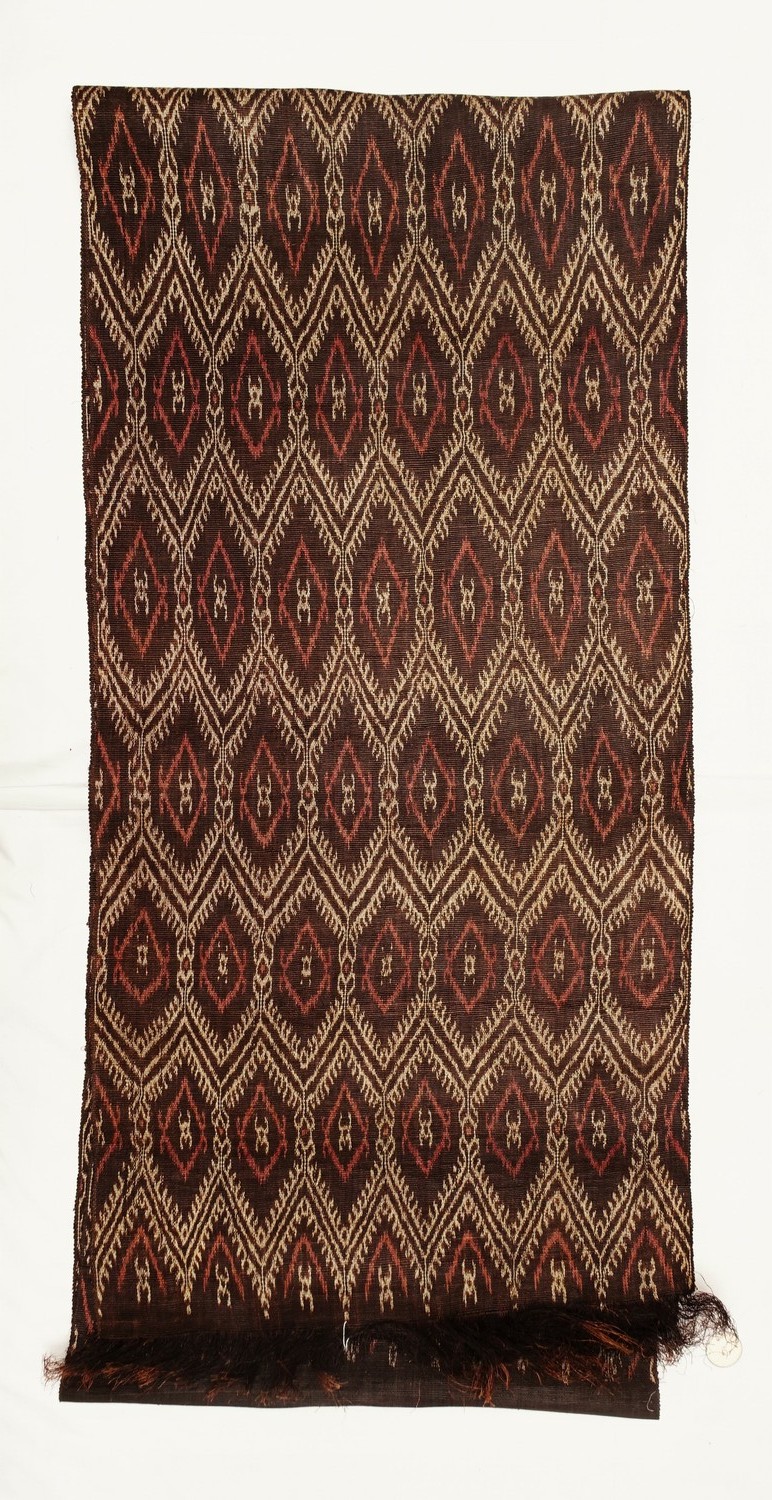
Ikat cloth from Mindanao, Philippines, 20th century (TRC 2022.2914).Ikat cloth from Mindanao, Philippines, 20th century (TRC 2022.2914).Visit by HE J. Eduardo Malaya, the Ambassador of the Philippines 

On Saturday, 22 April 2024, the TRC welcomed HE J. Eduardo Malaya, the Ambassador of the Philippines to The Hague, together with Dr Stephanie Coo and Carlos González.

They are interested in the Philippine collection that was given to the TRC a few years ago by Ruurdje Laarhoven, a Dutch academic living in the US, who worked for many years in the Philippines (click here).

Stephanie Coo is interested in the idea of setting up a regional dress institute and collection in the Philippines and is visiting various institutes to get ideas. We have offered the assistance of the TRC in giving practical advice in how to set up and run a small knowledge centre of this type.

The idea was also raised of being able to offer a ‘Researcher in Residence’ position for one to four weeks. This is a very appealing concept and would mean we could add depth to the TRC Collection by being able to have specialists look at various aspects of our textiles, dress and accessories collection.

Visit of representatives of the Department of Industrial Design, Eindhoven University of Technology

On 5 June 2025 the TRC had a special visit from the Department of Industrial Design, Eindhoven University of Technology. Dr. Kristina Andersen and Dr. Bruna Goveia da Rocha came to Leiden to talk about the setting up of a textile archive in Eindhoven, in order to help designers and students at the university.

During the discussions it was noted that many modern textiles are becoming flatter, as physical weaving skills (especially of textured forms) are not passed on to the same extent as before – they are regarded as too difficult by some!

Furthermore, the use of computer screens to design particular weaves and printed textiles means that many designers are no longer used to handling 'real' textiles. So textile archives, such as the TRC Collection, are needed to provide more data and inspiration, and people are coming to the TRC to see our collections and learn how to set up their own collection.

The idea of the TRC as an international hub for textile knowledge in all the depth and width of this huge, thematic subject is basically no longer a pipe-dream, as far as we are concerned, it is the TRC’s reality! More meetings will be held with colleagues from Eindhoven in due course to discuss further ways of working together. One of the more concrete plans is to set up a joint exhibition about samplers and their design histories and uses!

What have these diverse groups, such as the delegation from Eindhoven, have in common? Simply, an interest ( in some cases bordering on obsession) in textiles. These meetings are important to the TRC, not only to 'give' information, access to the collection, etc., but also to 'absorb' the sometimes priceless knowledge that our visitors are happy to share, and we are more than willing to listen to them and include their knowledge into our blogs, databases and other forms of communication. No knowledge should ever go wasted!
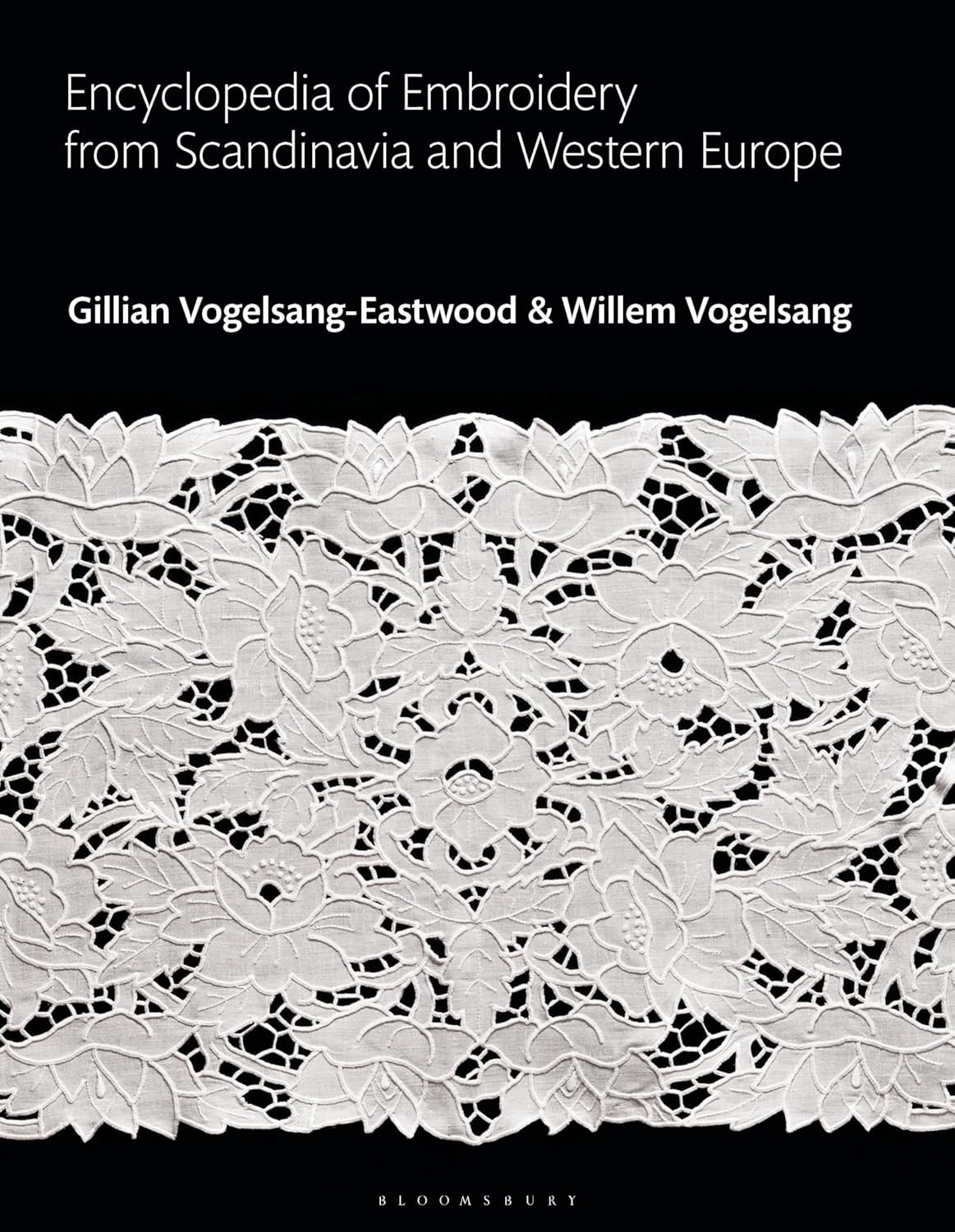
Bloomsbury's Encyclopedia of World Embroidery

In December 2024, Bloomsbury (London) published the fourth volume of Bloomsbury's World Encyclopedia of Embroidery:  Embroidery from Scandinavia and Western Europe, composed under the aegis of the Textile Research Centre (TRC).  Authors: Gillian Vogelsang-Eastwood and Willem Vogelsang.

This is the first reference work to describe the history of embroidery throughout Scandinavia and Western Europe from the Bronze Age to the present day. It offers an authoritative guide to all the major embroidery traditions of the region and a detailed examination of the material, technical, artistic and design aspects of the subject, including its modern-day uses.

With 76 chapters and 634 illustrations (554 in colour) of clothes, accessories and decorated soft furnishings (floor coverings, wall hangings, curtains, bed linen), this Encyclopedia is an invaluable resource for students and scholars of the subject.

This volume is part of the Bloomsbury's World Encyclopedia of Embroidery series. The first volume, on embroidery from the Arab World, won the 2017 Dartmouth Medal, awarded by the American Library Association for a reference work of outstanding quality and significance. The second volume covered Central Asia, the Iranian Plateau and the Indian subcontinent, and was published in 2021. The third volume, on Sub-Saharan Africa, appeared in 2023.

See also:

The TRC is an independent foundation (Stichting) that is exclusively run by volunteers. Please support us by transferring your donation to: (IBAN) NL39 INGB 0002 9823 59, in the name of: Stichting Textile Research Centre. BIC code is: INGBNL2A. Since the TRC is a recognised ANBI (Cultural Institution), your donation, if you pay taxes in the Netherlands, is tax deductible for up to 125%.

You can also, if you have the iDEAL app on your computer/IPhone, use the iDEAL button below and fill in the amount of support you want to donate:

The November 2024 TRC Newsletter can be downloaded here. This issue contains information about upcoming events and workshops, a list of TRC blogs published since January this year, and much more interesting information, of course with plenty of illustrations of (recently acquired) textiles and garments.

Search in the TRC website

Contact

Boerhaavelaan 6
2334 EN Leiden.
Tel. +31 (0)6 28830428  
office@trcleiden.org 

facebook 2015 logo detail 

instagram vernieuwt uiterlijk en logo


Bank account number

NL39 INGB 0002 9823 59, in the name of the Stichting Textile Research Centre.

TRC closed until 4 May 2026

The TRC is closed to the public until Monday, 4 May 2026, due to our move to the Boerhaavelaan. The TRC remains in contact via the web, telephone and email. For direct contact and personal visits, please contact the TRC at office@trcleiden.org, or by mobile, 06-28830428.

Donations

The TRC is dependent on project support and individual donations. All of our work is being carried out by volunteers. To support the TRC activities, we therefore welcome your financial assistance: donations can be transferred to bank account number (IBAN) NL39 INGB 000 298 2359, in the name of the Stichting Textile Research Centre. BIC code is: INGBNL2A.

 You can also, very simply, if you have an iDEAL app, use the iDEAL button and fill in the amount of support you want to donate: 


Since the TRC is officially recognised as a non-profit making cultural institution (ANBI), donations are tax deductible for 125% for individuals, and 150% for commercial companies. For more information, click here