• F3
  • F4
  • F2
  • F1

We are tidying up at the TRC Leiden in anticipation of various large donations that will shortly be coming to Leiden. As a result we came across some first-day covers and postage stamps in the collection, all with a textile theme, and this led to another look at these small, but sometimes very interesting objects. We already discussed the subject of stamps and textiles in an entry for TRC Needles, but we acquired new items since writing and, let's face it, there is nothing wrong with reminding people of yet another aspect of textile studies.

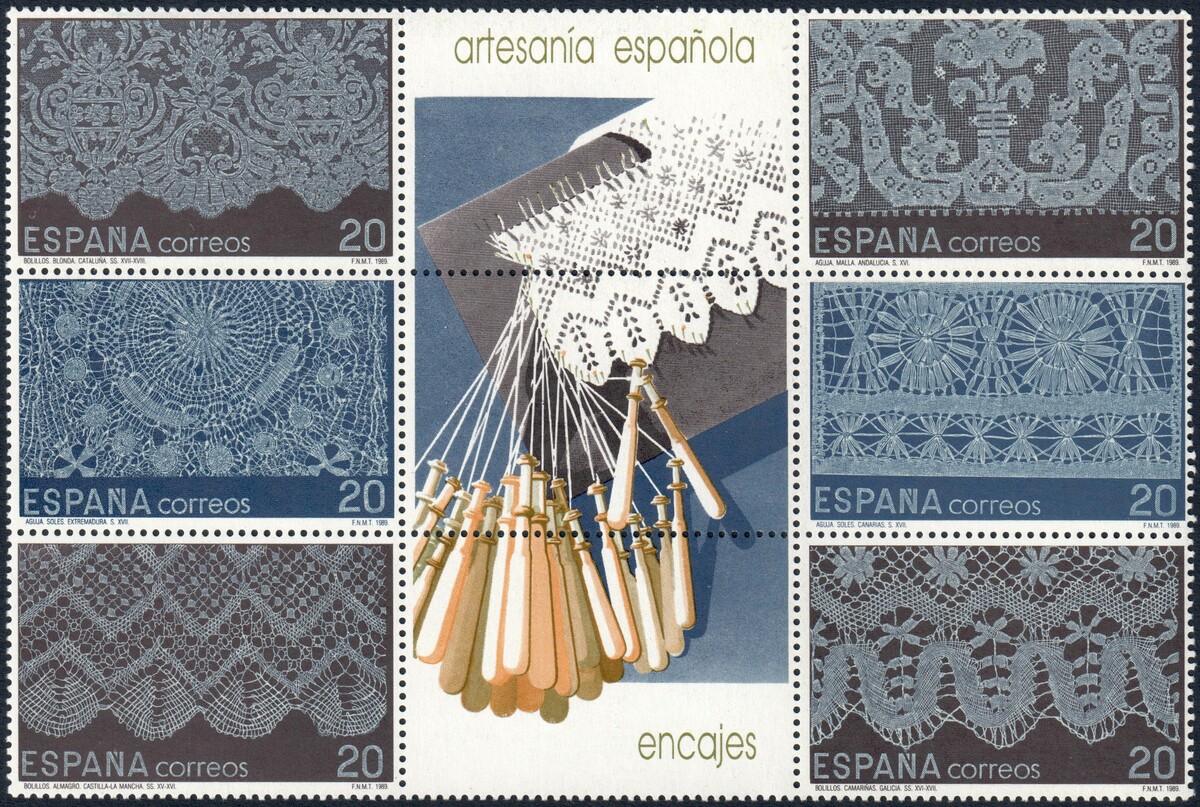
Sheet of six stamps depicting types of lace and tools (Spain, 1989). The lace dates from the XVth-XVIIIth century and come from the regions of Catalonia, Estremadura, Castilla la Mancha, Andalusia, Canary Islands and Galicia (TRC 2016.0284).Sheet of six stamps depicting types of lace and tools (Spain, 1989). The lace dates from the XVth-XVIIIth century and come from the regions of Catalonia, Estremadura, Castilla la Mancha, Andalusia, Canary Islands and Galicia (TRC 2016.0284).

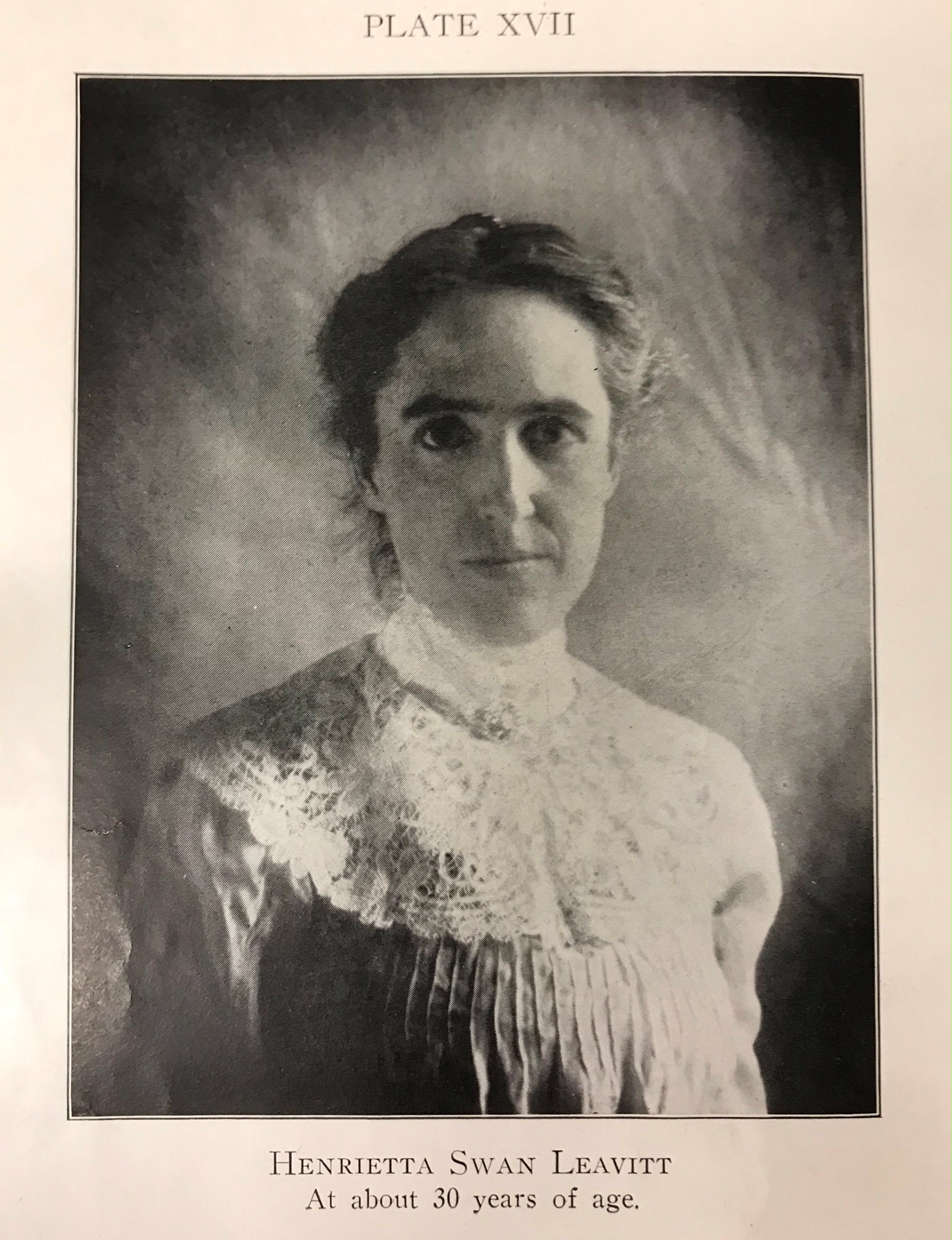
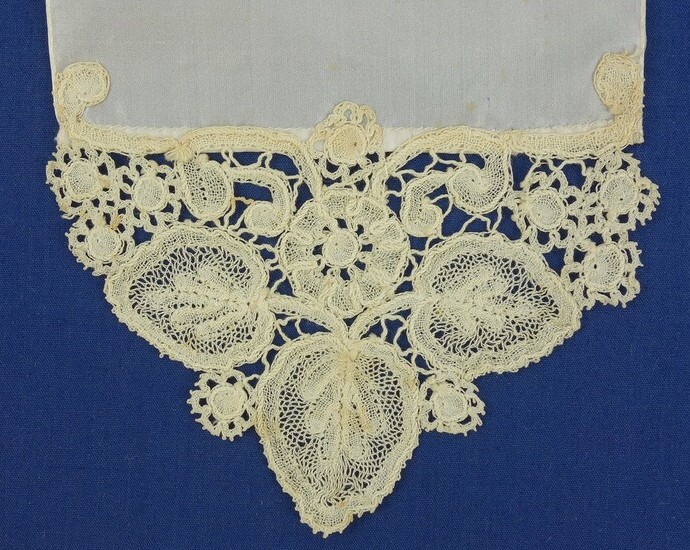
Photograph of the astronomer, Henrietta Swan Leavitt (1868-1921), with a Brussels duchess lace collar.Photograph of the astronomer, Henrietta Swan Leavitt (1868-1921), with a Brussels duchess lace collar.Since writing about the meeting of lace makers at the TRC on the 23th October (read here) we have had several lace related ‘events’.

These include an email from America with a photographic portrait of a late 19th century woman who is wearing a large lace collar. According to the TRC lace specialist, Olga Iermomina, the collar was made from (Brussels) duchess bobbin lace. There are several, similar examples of lace in the TRC Collection, such as TRC 2007.0673, TRC 2007.0845TRC 2015.0287, and TRC 2015.0288.

In addition, there was the offer of three lace collections. One will be brought to the TRC in a few weeks time and consists of general samples, equipment and books, the others will be donated later and mainly consist of equipment, lace samples and examples of different types of Dutch lace caps. Lots of potentially interesting items!

Detail of a silk sash with Duchesse (bobbin) lace at the ends, Belgium (TRC 2007.0845).Detail of a silk sash with Duchesse (bobbin) lace at the ends, Belgium (TRC 2007.0845).

For the last few years the TRC has been slowly building up a collection of lace forms and equipment, such as lace bobbins and lace pillows, as well as items of clothing made out of lace. We currently have over 2000 lace related items, which includes many items in the general collection as well as the more specific, lace reference collections.

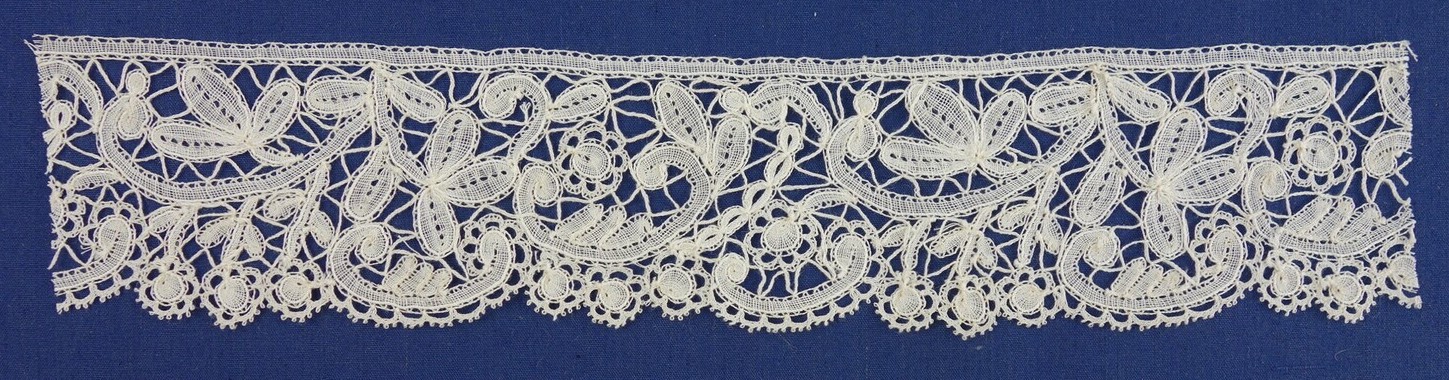
Sample of Duchess bobbin lace, 1920s (TRC 2015.0287).Sample of Duchess bobbin lace, 1920s (TRC 2015.0287).

So what does the TRC want to do in the long run with all this lace and related items? We have two ‘routes’. Firstly, various items are needed to support a series of lace classes as part of providing artisan lessons at the TRC and for this we need equipment, patterns and books. Secondly, we are also a knowledge centre for techniques and have an international-level collection with a wide variety of textile types from throughout the world.

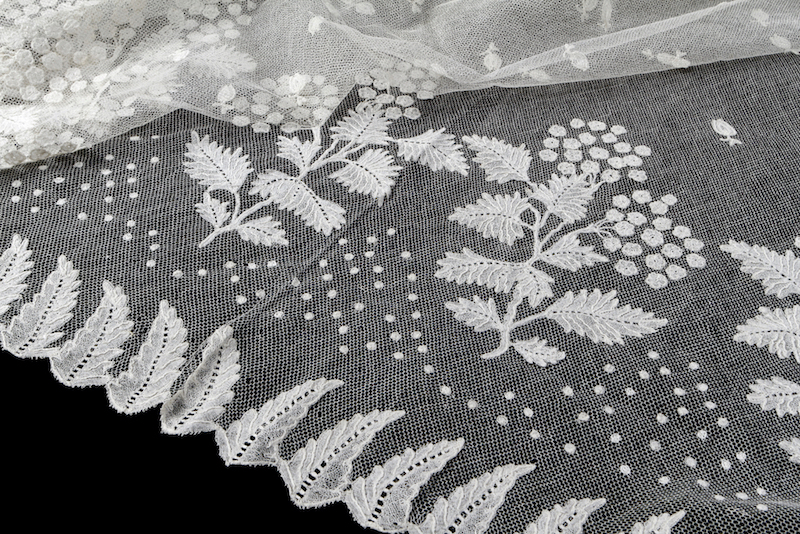
Detail of a shawl with Brussels lace. It once belonged to Queen Anna Paulowna (1795-1865), wife of King Willem II of The Netherlands, and a daughter of the Russian Czar Paul I (TRC 2014.0831).Detail of a shawl with Brussels lace. It once belonged to Queen Anna Paulowna (1795-1865), wife of King Willem II of The Netherlands, and a daughter of the Russian Czar Paul I (TRC 2014.0831).

As part of the main collection we want to expand on the five basic lace reference collections that we have set up, namely:

  • Named samples of the basic types of lace, which will be used for identification purposes, including the many types of bobbin, needle and looped forms (the latter include tatted, crocheted, knitted and knotted forms).
  • Different types of pillows, bobbins, pins, hooks, shuttles, rings, etc, required for making various types of lace.
  • A range of lace patterns
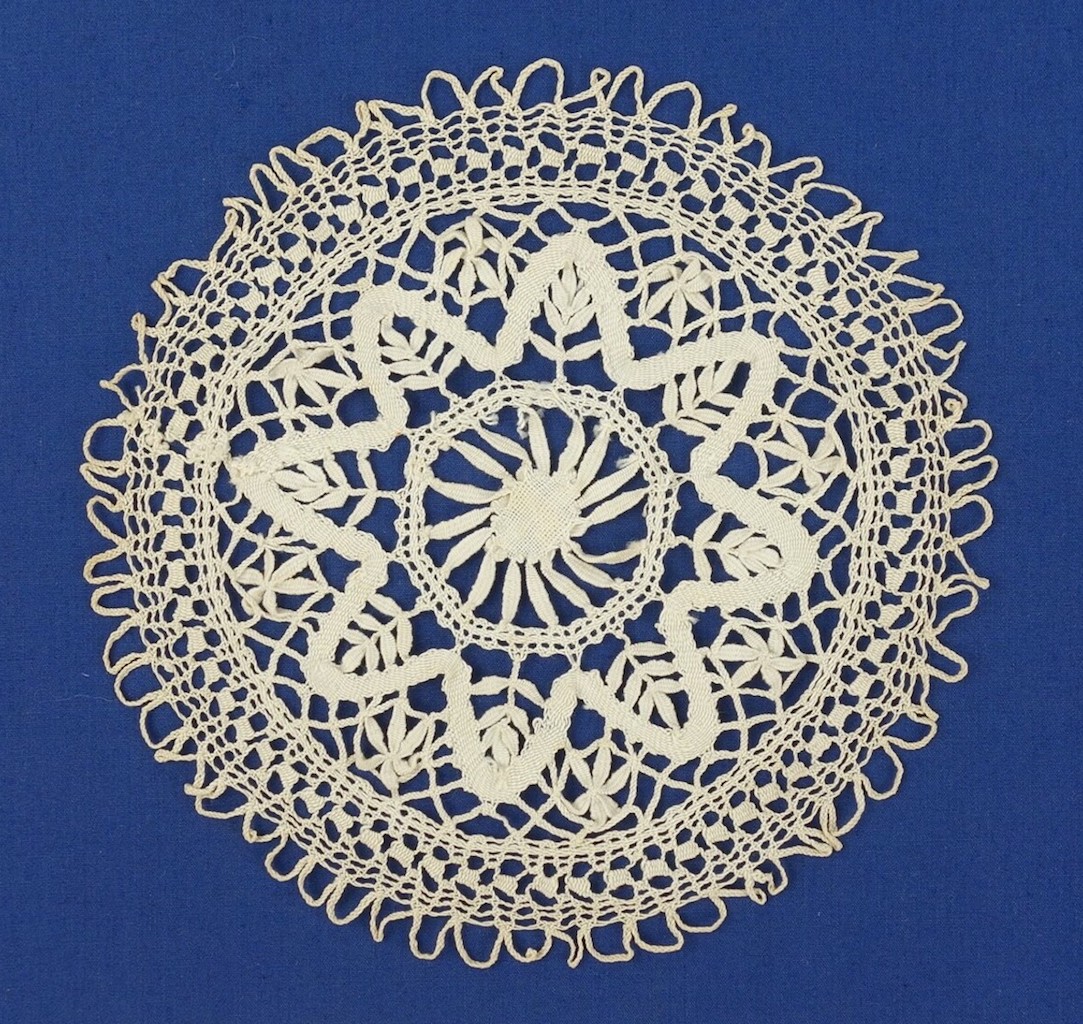
  • A range of uses for lace, such as collars, cuffs, doilies, etc.
  • A collection of machine lace samples to show the difference between hand and machine forms, as well as the developments of the machine forms (this is helpful in dating items)

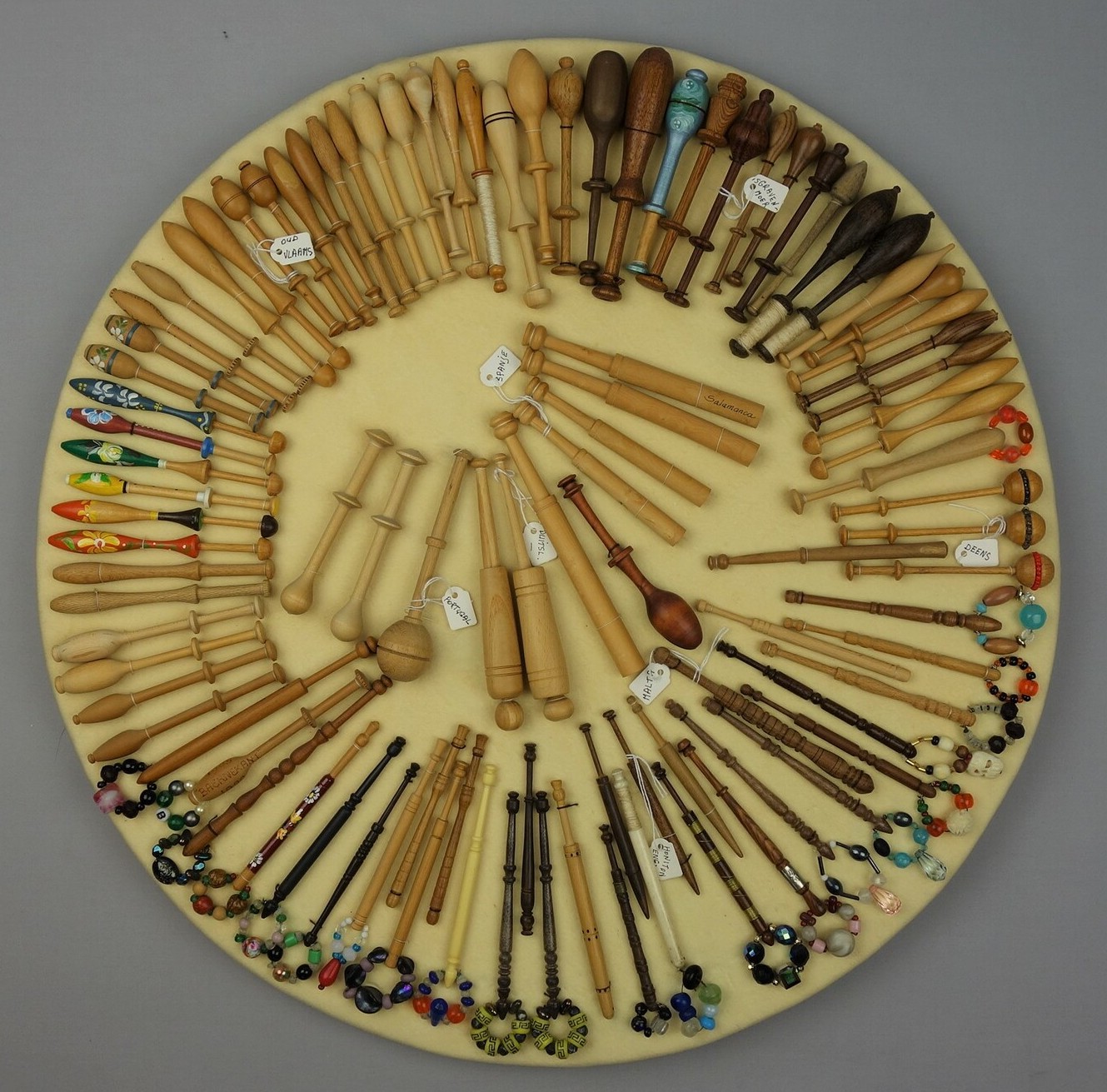
Board with a group of lace bobbins from various countries (TRC 2007.0494).Board with a group of lace bobbins from various countries (TRC 2007.0494).As part of this work we are also making a collection of lace types that were used for making the very diverse forms of lace caps worn in various parts of the Netherlands. This week, for example, will see the arrival of samples of all the main types of lace associated with Rijnland lace caps. These include various types of Rijsselse lace (point de Lille), ‘s Gravenmoer lace (a torchon lace) and Lier lace (tambour embroidered net).

There will also be various examples of typical lace patterns associated with the caps such as gebloemde kant (flower lace), bloempot kant (lit. Flower pot lace, i.e. flowers in ornate vases ) and lyre lace with motifs similar to the musical instrument. These samples will be on display in February 2022 as part of an exhibition of lace caps from the Leiden (Rijnland) region.

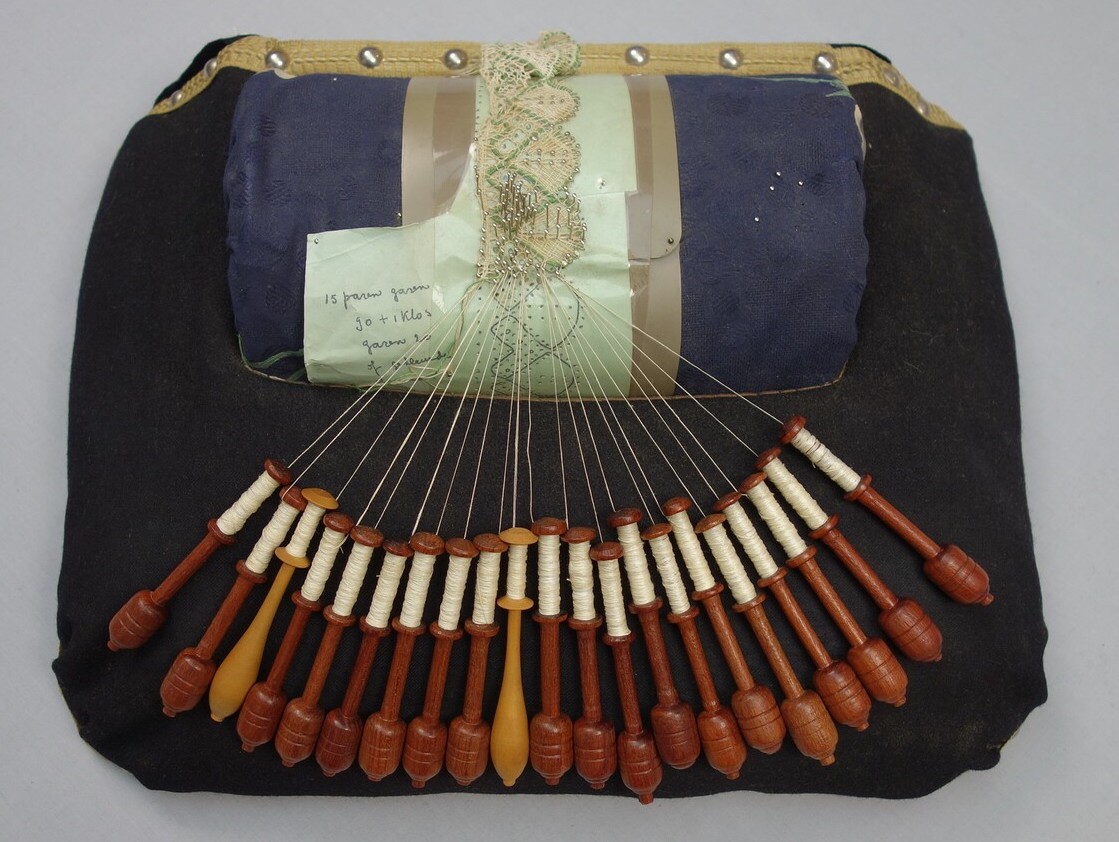
Lace pillow with bobbins and sample of torchon lace, Belgium (TRC 2012.0009).Lace pillow with bobbins and sample of torchon lace, Belgium (TRC 2012.0009).In addition to the Rijnland exhibition, we have plans for a series of workshops and courses on lace identification, looking at specific types of lace techniques, as well as one on the difference between hand and machine made laces (it is not not always easy to spot the difference!).

The latter subject has also already led to an online exhibition on the same theme. Another, relevant digital lace exhibition is about silk lace from Malta. More exhibitions are planned. We are also planning a course on the making of oya, also known as Turkish lace.

All in all, lots to think about and to organise - Lace in Leiden is becoming a reality!

Gillian Vogelsang, 2 November 2021

We are currently photographing and cataloguing a donation of stylish garments that were influenced by the fashion house of Chanel and especially by the garments that were worn by Princess Diana (1961-1997).

The pieces were donated by Ms van Dijk, a Leiden resident, and come from her personal wardrobe. They were worn at the end of the 1980s and until the mid-1990s. The donation consists of items mostly sewn by the donor's mother and a friend, supplemented with a few ready-to-wear pieces.

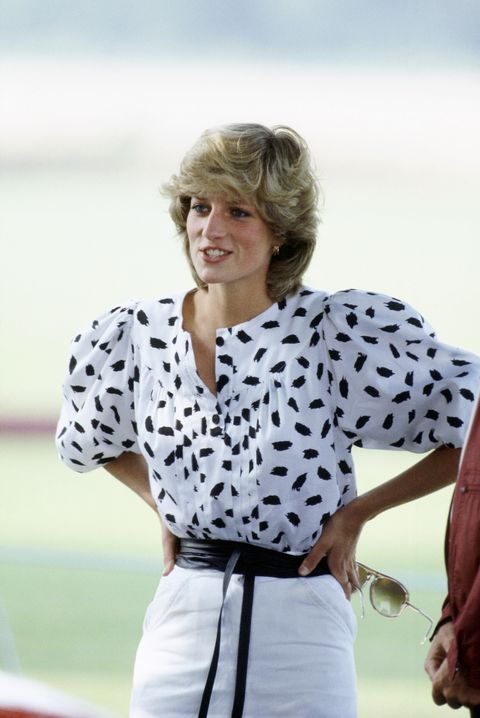
Princess Diana watching a polo match in Cirencester, in 1983. She is wearing a blouse with black spots, and a white skirt.Princess Diana watching a polo match in Cirencester, in 1983. She is wearing a blouse with black spots, and a white skirt.

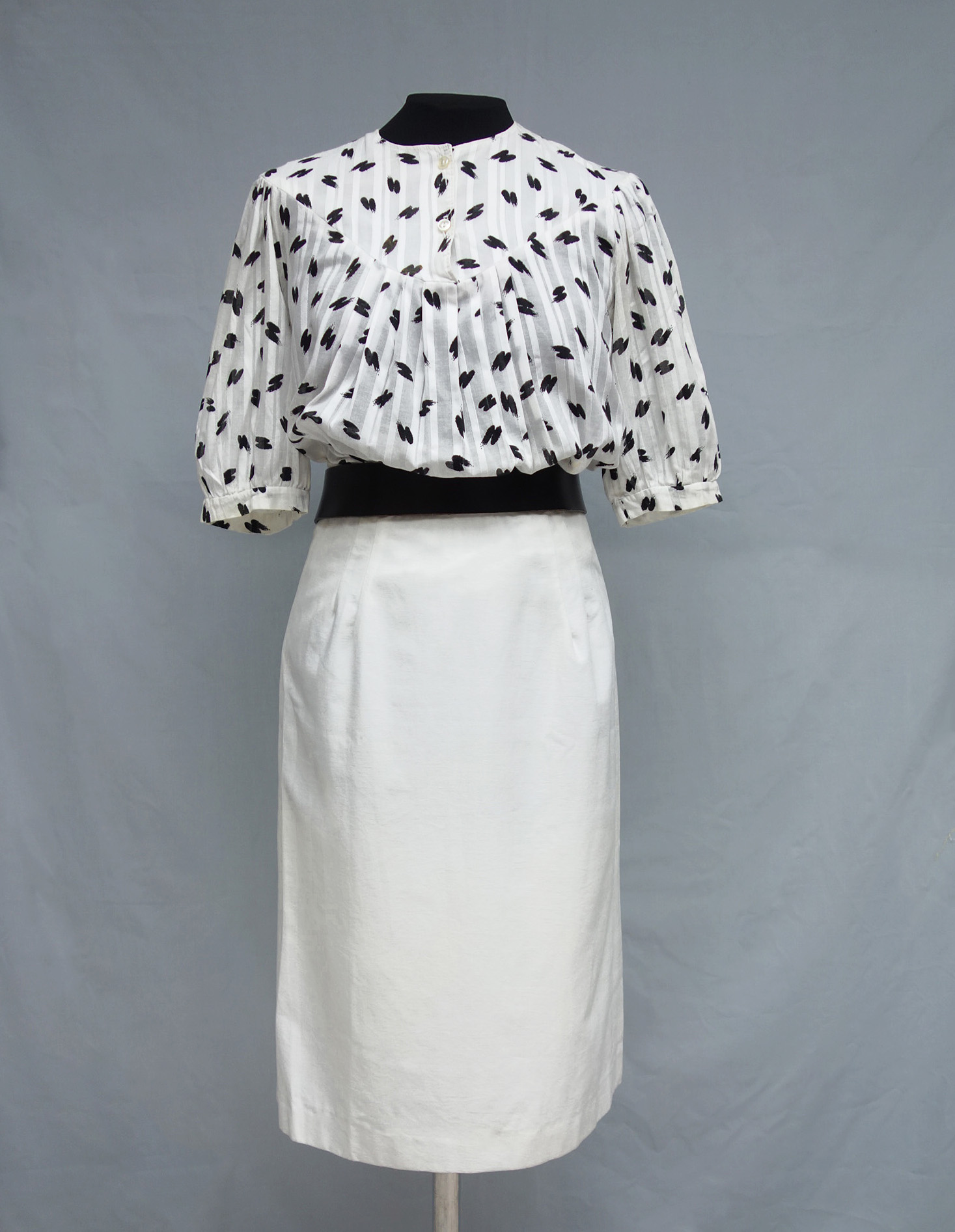
White blouse with black spots (TRC 2021.2983b), made in imitation of Princess's Diana blouse that she wore at Cirencester, 1983.White blouse with black spots (TRC 2021.2983b), made in imitation of Princess's Diana blouse that she wore at Cirencester, 1983.

By the 1980s Ms van Dijk had just started a professional career and she felt she had to dress accordingly. At the time, suitable business clothing was difficult to find for women, especially as she was petite.

Ms van Dijk admired Diana’s style because it was traditional, but often with a dramatic twist, especially with respect to the choice of colour, colour combinations and cut. She felt that Princess Diana was never boring, so she decided that if the British princess could wear this type of clothing, so could she!

One of the outfits given to the TRC consists of a white blouse (TRC 2021.2983b) with black spots. This is based on an outfit worn by the princess in August 1983 to a polo match. The blouse was then worn by the princess on various occasions, sometimes with a white skirt, on other occasions with a black one.

The clothing donated to the TRC also includes both black and white pencil skirts that were suitable for wearing with the blouse.

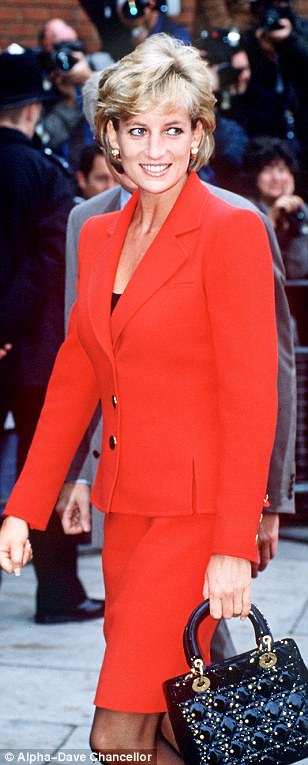
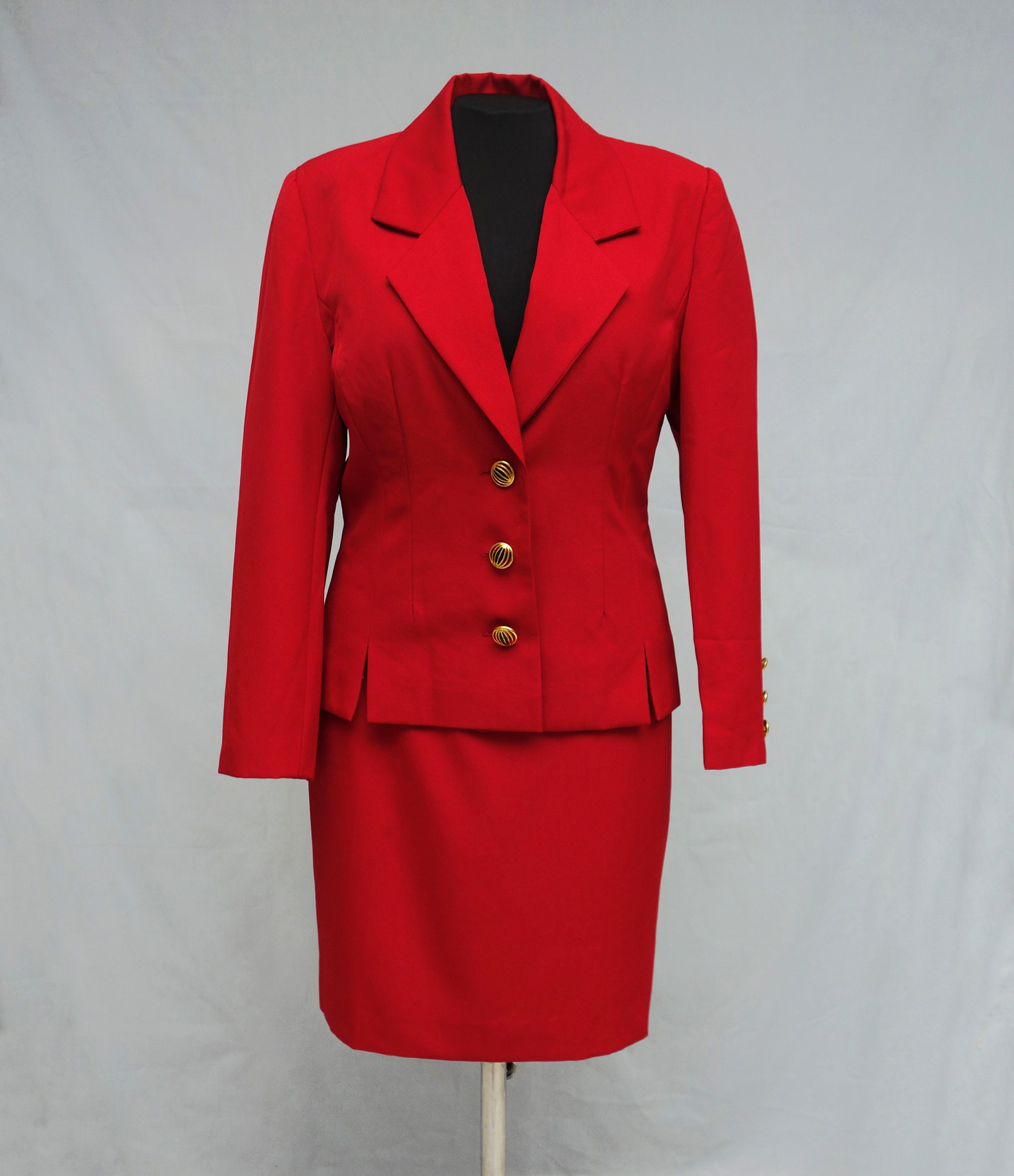
Princess Diana wearing a red suit designed by Catherine Walker, mid-1990s.Princess Diana wearing a red suit designed by Catherine Walker, mid-1990s.Red jacket and skirt made in imitation of a jacket and skirt worn by Princess Diana in mid-1990s (TRC 2021.2970a-b).Red jacket and skirt made in imitation of a jacket and skirt worn by Princess Diana in mid-1990s (TRC 2021.2970a-b).A second outfit is more formal and consists of a tailored jacket (TRC 2021.2970a) with a flat collar, three large buttons down the front and short splits at the hem. The jacket was worn with a pencil skirt (TRC 2021.2970b) in the same material.

The original suit was designed by Catherine Walker (who remains a popular designer with the British royal family) and was worn in the mid-1990s for various events, including an Aids charity meeting. The outfit was worn with black tights and plain court shoes.

The entire donation will be photographed and added to the TRC Collection over the next few weeks. The collection can then be accessed online through our website

Is there someone who inspired you in the way you dress?

Joshua Verkerk and Augusta de Gunzbourg, TRC volunteers, 30 October 2021

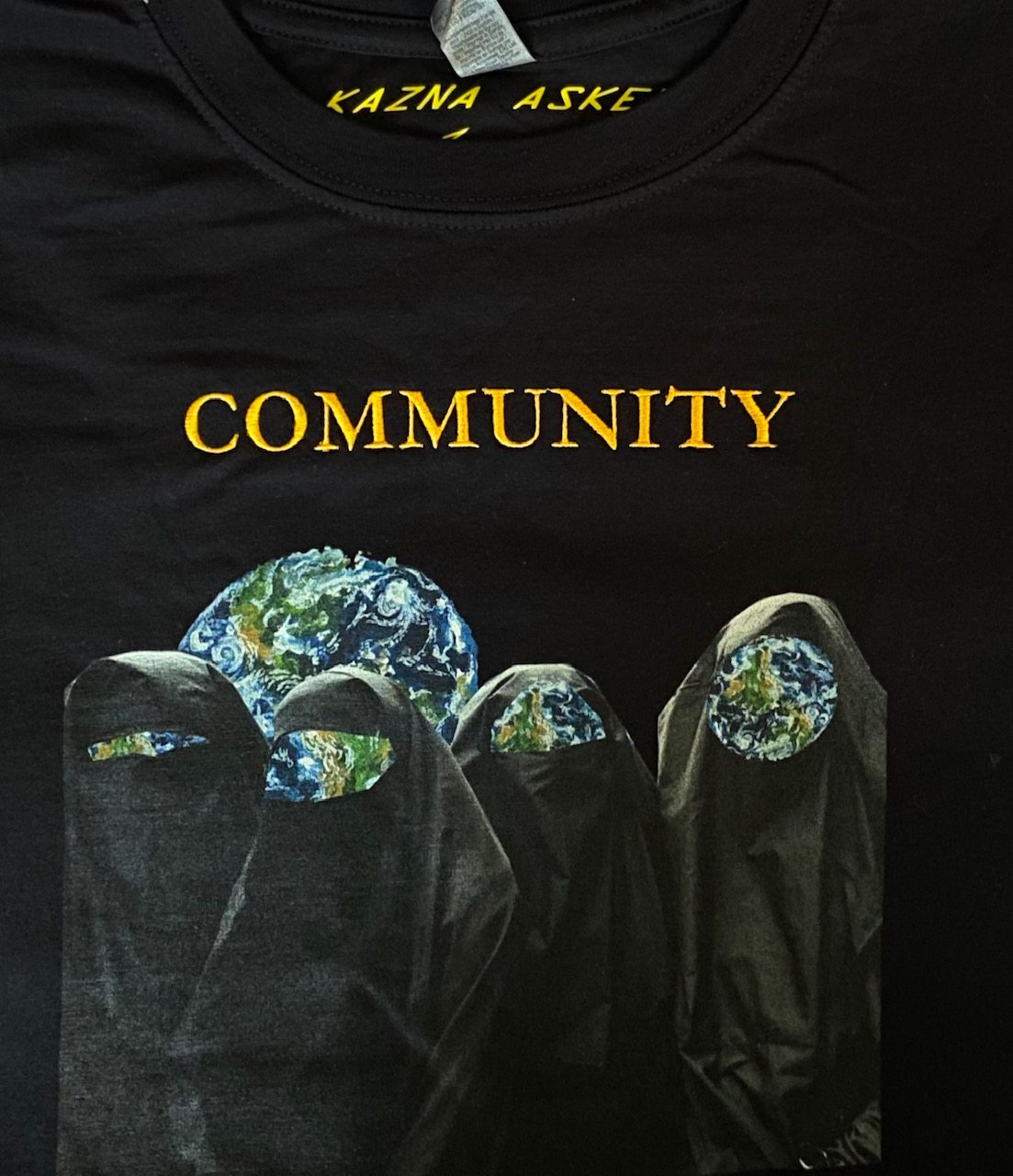
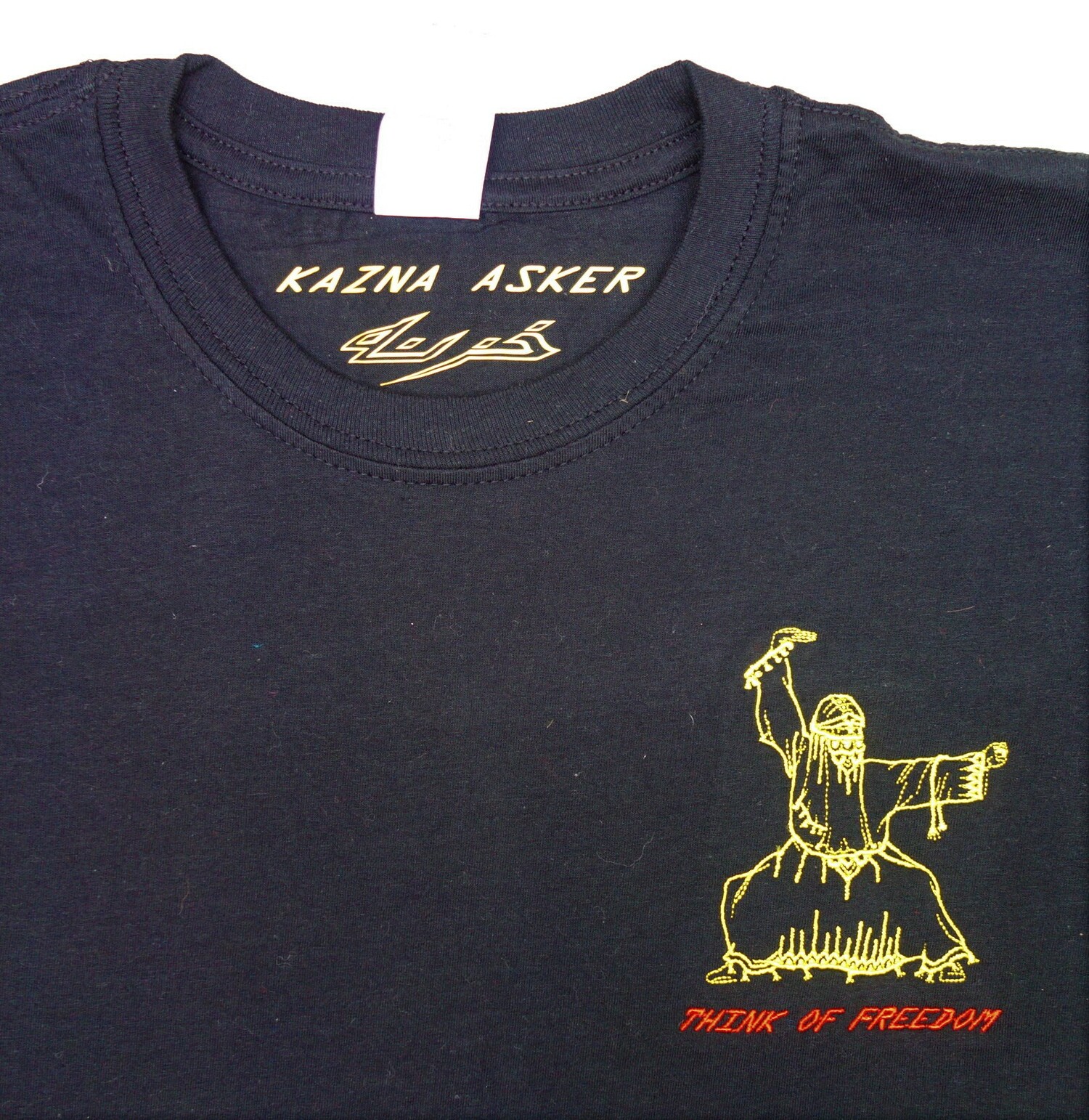
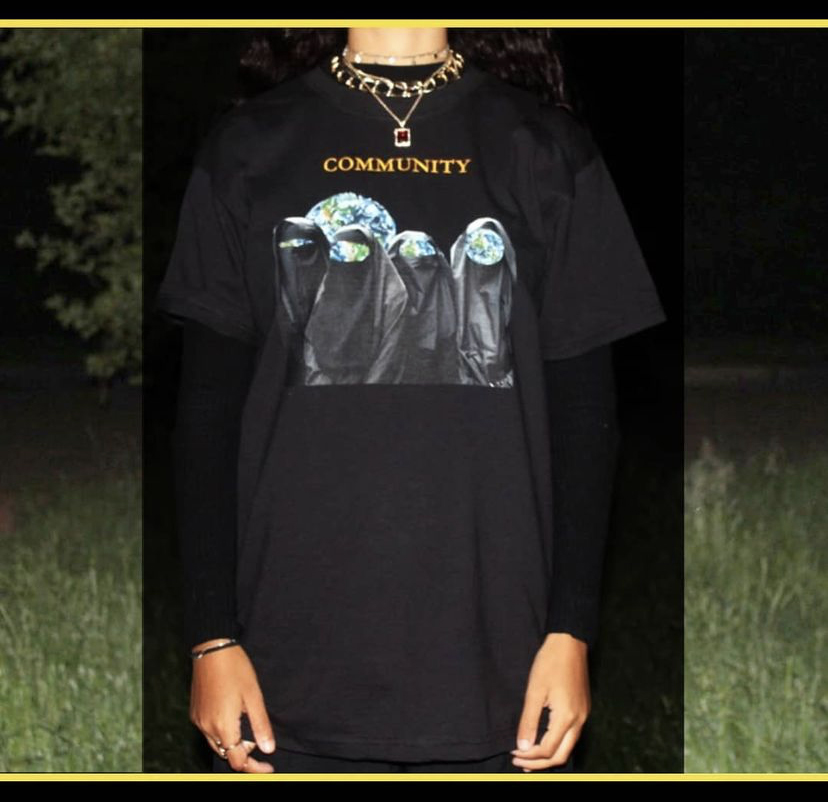
T-shirt designed by Kazna Asker.T-shirt designed by Kazna Asker.The blog below was written by Kazna Asker, a young designer from Sheffield in the UK with deep roots in Yemen, who was trained in Manchester at the Metropolitan University and in 2019 spent three months as an intern at the TRC.

***

When viewing the Yemeni collection at the TRC, I was amazed at the wide array of garments that were worn all over Yemen and not just in the village where my family originated. It allowed me to look at Yemeni culture through a much wider perspective, from a distance. I was also able to separate myself from Yemeni clothing traditions and be inspired by the textiles in the large TRC Collection.

Detail of a T-shirt designed by Kazna Asger (TRC 2021.2654).Detail of a T-shirt designed by Kazna Asger (TRC 2021.2654).

When I returned to my Yemeni community in Sheffield, I was deeply inspired as I could see beauty in how we have adapted our Yemeni culture to modern life in Britain. We are the next generation! I used this theme as a source of inspiration for my final collection. My final BA collection linked cultural and religious silhouettes to Western garments. It was later showcased at the Graduate Fashion Week in London and the International Youth Design Competition in Beijing, where it came second place.

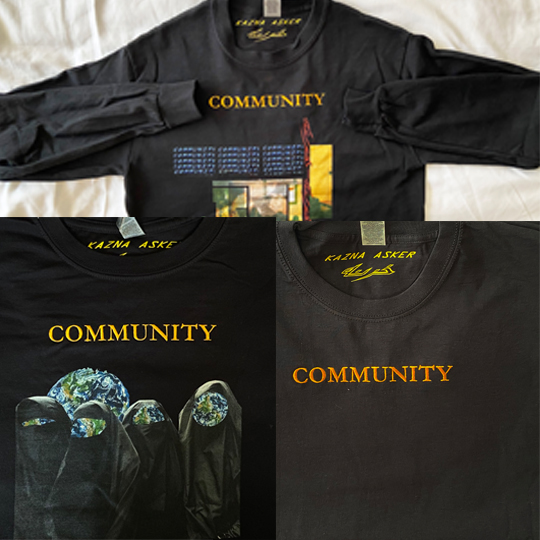
Various T-shirts designed by Kazna Asker.Various T-shirts designed by Kazna Asker.I have designed several graphically embellished and embroidered T-shirts, of which I have donated 100% of the profits to charity. I was initially inspired to combine Fashion and Charity when I was fundraising for Restless Development Nepal. This is a youth-led charity which helped me to work in the community of Tikabhairab, Nepal, to educate young people on a range of subjects, including social enterprise, saving and education.

In order to raise more money, I later designed three T-shirts with a focus on the theme of community. The graphics refer to my family, culture and faith alongside the embroidered text ‘COMMUNITY’ on the top of the T-shirt.

When I went back to Yemen, the situation had deteriorated drastically.  I met many families that were severely affected by the pandemic, alongside the terrible civil war. As a result, I continued to sell the T-Shirts, but decided to donate the money to Yemen – including independent British Yemeni charities that work directly on site in Yemen, such as Isra UK and Saba Relief UK.

Model wearing a T-shirt designed by Kazna Asker.Model wearing a T-shirt designed by Kazna Asker.As the designs continued to sell out, I added other forms of graphics and embroidery to my T-shirt range and included embroidered caps and printed tote bags.

My largest supporters have been the Yemeni community in Sheffield and my friends and family! My dad would take a pile of T-shirts and sell them to his friends and I would continue to sell them online via Instagram, Etsy, Facebook and at local community and charity events. We have managed to sell over 500 T-shirts and raised over £5000 profits for charity.

This initiative has been my most rewarding project and I plan on continuing the journey of combining Community, Charity and Fashion for my next projects! I have made a film about my community where you can see directly where my references and inspiration come from. The film focuses on the Muslim diaspora in the UK, in order to change narrative and break stereotypes!

For the film, click here.

You can buy a T-Shirt from my Etsy page and you can view my work on Instagram or Facebook.

Kazna Asker, 11 October 2021

Postcard of the 1960s showing a Protestant woman from Zuid-Beveland, Zeeland, wearing regional costume (TRC 2018.0409).Postcard of the 1960s showing a Protestant woman from Zuid-Beveland, Zeeland, wearing regional costume (TRC 2018.0409).Willem and I have just been to the southern Dutch city of Goes in Zuid-Beveland, in the province of Zeeland. This former island was until recently relatively cut off from the rest of the country as it was one of many islands in the delta region of several large rivers entering the North Sea.

The city of Goes dates back to the 10th century and was long involved in the textile industry of the region. Some of the street names in the centre of the city are reminders of its textile past – Vlasmarkt (flax market), Bleekveld (bleaching field), and Bleekerstraat (Bleacher’s Street).

The local museum in Goes, the Historisch Museum de Bevelanden (see its website) is home to a well-displayed series of regional dress from Zuid-Beveland which clearly explains the characteristics of this dress and the difference with traditional dress from other parts of Zeeland. There is extra information in the form of a lovely film and many text boards, but just being able to see the complete costumes with the accessories such as necklaces and, in the case of men’s costumes, the elaborate buttons, made it well worth the visit.

Late 19th century postcard showing two women from Zuid-Beveland wearing regional costume (TRC 2018.0404).Late 19th century postcard showing two women from Zuid-Beveland wearing regional costume (TRC 2018.0404).There is also a temporary exhibition (until the 27th November 2021) called Europa is hier: Zo zagen zij Zeeuws Meisje ('Europe is here: This how they saw the Zeeland girl'; see the website, in Dutch) about various 19th century painters who came to Zuid-Beveland and painted men and women in regional dress.

The painters included Cecil Jay (1883-1954), an Anglo-American painter, and Adolphe-Alexandre Dillens (1821-1877) from Belgium. These paintings provide invaluable information about the material and colour combinations of the period, something that is lost in the contemporary black and white, and sepia images of the period. One element that fascinated the painters is the local variations of lace caps that were popular in many parts of the Netherlands, as well as Belgium and northern France.

Zuid-Beveland is particularly known for the lace caps worn by both Protestant and Catholic women on a daily basis until comparatively recently. Their headdress consists of an under-cap, a middle cap and then on Sundays and festive days, the elaborate and embroidered lace caps that were worn with a series of oorijzers and spelden, some of which have large balls in gold-coloured metal at the end.

Festive cap for a Catholic woman from Zuid-Beveland, 20th cenury (TRC 2008.0483).Festive cap for a Catholic woman from Zuid-Beveland, 20th cenury (TRC 2008.0483).Another feature of the Zuid-Beveland dress is the use of a bodice called a beuk, together with a shawl. The beuk is often decorated around the front neck opening with embroidered and beaded panels.

By the end of the 20th century "burger" (of the burgers, or middle class citizens) clothing had become the normal dress of the community and the regional forms (called "boers", 'of farmers') had entered the twilight world of folklore.

We actually came to the Museum to see an exhibition of samplers called Nieuwe Oude Lappen ('new old cloths'; see website, in Dutch). For many years the Steven family ran the Museum voor Naaldkunst ('Museum for Needlework') in Winschoten, in Groningen in the northeast of the Netherlands. The needlework museum closed a few years ago and the Historisch Museum de Bevelanden was fortunate in acquiring an extensive collection of samplers.

Bodice ('beuk') for a woman from Zuid-Beveland, Zeeland, the Netherlands, 1960s (TRC 2018.2753).Bodice ('beuk') for a woman from Zuid-Beveland, Zeeland, the Netherlands, 1960s (TRC 2018.2753).The exhibition emphasises the 18th-19th century examples and includes both darning forms, school samplers with alphabets, as well as elaborately worked examples depicting Adam and Eve in 18th century dress (but complete with snake), the Canaanite spies with their large bunch of grapes (see a blog of 1 September 2020), as well as stylised flowers, trees, animals and birds. One particular example from 1803 includes a wide range of motifs, including an elaborately embroidered house. There are also examples of late 19th century samplers worked with aniline dyes.

The exhibition includes c. 50 examples of samplers and a very good display of circa 200 years of this particular type of embroidery. The exhibition runs until the 29th January 2022.

Gillian Vogelsang, Director TRC, 24 July 2021

Detail of an embroidered pair of trousers from Guatemala (2021.1971).Detail of an embroidered pair of trousers from Guatemala (2021.1971).A few days ago a box arrived from Charles and Carolyn Knobler, Los Angeles, and it was opened with great anticipation, because for the last three years they have been sending a diverse range of Guatemalan and Mexican garments to the TRC.

Each garment comes with its own label that often includes details of where it comes from, the local name, dates, and in some cases with information on what sort of occasion it would have been used, namely all the things a curator loves to know about.

And this new box was not disappointing! There are some lovely huipil (tops) for women worked in various techniques, including woven (with supplementary wefts) and embroidered (both hand and machine) forms. Many of these garments are made from cloth woven on back strap looms. The plan is to display about one hundred of these and similar items in a TRC Gallery exhibition about textiles and garments from Guatemala in the autumn of 2022.

But I have to admit, one of my favourite items in this latest box is a pair of men’s trousers (TRC 2021.1971) from Santiago Atitlán in southern Guatemala. The trousers are made from two lengths of white cloth with dark red stripes.

The lengths are sewn together to create the waist and leg sections. The lower parts of the trouser legs are heavily embroidered with rows of stylised birds of various types in a wide range of contrasting, vibrant colours using satin stitch, Romanian stitch and stem stitch. I thought you might enjoy detailed images of the birds, what they look like, how they were made, etc.

What a difference from men’s trousers that are worn here in the Netherlands, even in the summer time! Can I please make a plea to Dutch men to wear more colour and embroidery?

Detail of an embroidered huipil from Guatemala (TRC 2021.1970).Detail of an embroidered huipil from Guatemala (TRC 2021.1970).An embroidered women's top (huipil)

In addition to the trousers, there is a women’s top (huipil; TRC 2021.1970) from the same area of Guatemala and this garment is also embroidered with rows of birds. It is made from lengths of white cloth with multicoloured stripes in both the warp and weft, as well as being embroidered around the neck opening with rows of colourful, stylised birds worked in satin stitch, Romanian stitch, long stem stitch as well as running stitch.

Gillian Vogelsang, Director TRC, 21 June 2021.

Sample from Friesland, the Netherlands, ca. 1900 (TRC 2020.1633).Sample from Friesland, the Netherlands, ca. 1900 (TRC 2020.1633).Nelleke Ganzevoort wrote the following blog:

Last weekend, while Gillian and Willem travelled to Friesland in search of Akke Scheepsma from Schettens (TRC 2021.1805; see the blog), I took a trip on my computer to find another girl. It took me to a small village in Friesland, even smaller than Schettens.

TRC 2020.1633 is a small sampler worked on a white ground with cross stitch, double running stitch and eyelets. In Dutch, I would not call it a merklap but rather a naailap – a piece of cloth on which sewing techniques are practised. It has no date, but lots of initials and these initials make it possible to date it.

The main initials in the centre are CvdZ, LJH and SvdZ,  whereby LJH is worked in red, and the other two in white, square eyelets. CvdZ may be read as GvdZ. Three sets usually mean the girl and her parents. VD usually means 'van de', 'van der' of 'van den', and the fact that two of the three have the combinations VDZ means that these two will be father and daughter. So, I went looking for a girl called S* van de/der/den Z, whose mother was called L* H*.

I found Sjoukje van der Zwaag, daughter of Gabe Louws van der Zwaag (1856-1925), a farmer, and his wife Lutske Jogchums Haakma (1860-1929). Sjoukje was born 10-04-1892 in Akkerwoude, a very small village that is now part of Damwoude.

Nelleke Ganzevoort wrote the following blog about a sampler in the TRC collection and a comparable example in the Rijksmuseum in Amsterdam.

In September 2020 the TRC in Leiden acquired an intriguing sampler (TRC 2020.3682). It is marked with numerous initials, but it still proved difficult, but not impossible, to identify the girl who made it. The sampler measures 30 x 29 cm and made with silk threads on a linen ground. It is not dated, but a late 18th century origin seemed likely, but now we know much more.

Linen and silk sampler from the Netherlands, c. 1800 (TRC 2020.3682).Linen and silk sampler from the Netherlands, c. 1800 (TRC 2020.3682).

The linen is reasonably fine (16 threads/cm). The embroidery includes what look like lines of text, all around the edges, but by now nearly illegible: tiny stitches in badly faded threads. I took many photographs, enlarged them and puzzled it out, stitch by stitch. In the end the apparent texts were two alphabets and two lines of initials, some of them in cartouches. Many of the initials are joined together, which makes them difficult to read. The embroidery also includes lines of crowns and other symbols, along the four edges. Most of the embroidery is worked in cross stitch, but the initials without cartouches are worked in square eyelets.

By coincidence, I came across a sampler in the Rijksmuseum Amsterdam (BK-1959-142-A) that shows some clear correspondences with the TRC example. It includes initials and symbols along the edges, just like the TRC example. In fact, there are so many similarities that they were clearly made in the same tradition, perhaps in the same school, under the same teacher, or perhaps even from the same pattern book. There is at least one difference that also marks a similarity: the initials inside cartouches are worked in square eyelets, while those without cartouches are in cross stitch (exactly the opposite from the Leiden TRC example).

The Rijksmuseum notes provide further information about this sampler: it was made bij A.C. van Duuren. There is actually a darning sampler, also in the Rijksmuseum collection, with the name of A.C. van Duuren written in full (BK-1959-142-B). I suggest both names refer to the same person.

Sampler worked by A.C. van Duuren c. 1805/1806 (Rijksmuseum Amsterdam, 1959 142 A).Sampler worked by A.C. van Duuren c. 1805/1806 (Rijksmuseum Amsterdam, 1959 142 A).

The initials ACVD in a cartouche of the Rijksmuseum sampler obviously refers to this person. The rows of smaller initials start with AvD and IMvL, and I guessed these were her parents. Searching the archives for a woman named A.C. van Duuren (Dueren, Duren) with a father called A. van Duuren soon helped me to her full name: Adriana Cornelia van Dueren, baptized 17-11-1793 in Leiden. Her parents were Abraham/Abram van Duuren/Dueren en Joanna/Johanna Maria van Loon.

Other initials in the Rijksmuseum sampler refer to her grandfather Willem van Duuren (WvD), her grandmother Grietje van Belle (GvB), her maternal grandfather Isaac van Loon (IvL), her eldest brother Willem van Duuren (WvD), and his wife Maria Elisabeth Broekkerken (EMB). Other initials include IvD (for her sisters Johanna and Jacoba and/or her brother Isaac), GvD (for sister Grietje and/or brother Gerardus), and MvD (for sister Maria). Adriana was married to Abraham Theodorus Beausar, a vicar, and died in 1869 in Willemstad, aged 75.

Linen and silk sampler from the Netherlands, c. 1800 (TRC 2020.3682), with the initials CHD.Linen and silk sampler from the Netherlands, c. 1800 (TRC 2020.3682), with the initials CHD.The TRC sampler has large initials AMHD, in eyelets (but without cartouches as is the case with the Amsterdam example), which clearly refer to the maker, and several cartouches with the initials CHD, ICVB, CHD with an i underneath it, AVH, and in the corner AD. I assume CHD to be the father. Because both have the combination HD, and because these letters are so often paired in this sampler, I assume both to belong to the surname, the first half beginning with H and the second half with D. The mother could be ICVB, AVH or AD.

It took me some time to identify the girl. AMHD is Aletta Margareta Hoogendorp (or Hogendorp), born 27-05-1790 in Haarlem. Her parents were Cornelis Hoogendorp (CHD) and Johanna Christina Valbracht (ICVB). Other large initials refer to her paternal grandparents, Cornelis Hoogendorp (CHD) and Alida Double (AD) and her stepmother Ariaantje/Ariana van Hulst. Her mother’s parents may be AMVB and HP, in the rows of smaller initials, but I could not find their names in the archives.

Date

The samplers are not dated, but both girls embroidered their age. Adriana van Dueren was twelve years old (OUDT 12 IAAR) when she made her sampler. As she was born in 1793, this must have been in 1805 or 1806. Aletta Hoogendorp was born in 1790 and she made her sampler when she was nine years old, in 1799 or 1800. The place where they made them must have been in Holland: Adriana was from Leiden, Aletta from Haarlem. Adriana’s sampler shows the coat of arms of the city of Amsterdam, but the link between the girl and Amsterdam remains unclear.

I am not clear about the social status of the two families. Cornelis Hoogendorp was a country policeman (a ‘veldwachter’), Aletta married a working man (a ‘werkman’) and there were cobblers and carpenters in the family, but one of her father’s brothers was a vicar. Abraham van Dueren was a baker, but one of his sons went to university and Adriana married a vicar. Anyway, there must have been money to pay for schooling.

Motifs

Detail of linen and silk sampler from the Netherlands, c. 1800 (TRC 2020.3682).Detail of linen and silk sampler from the Netherlands, c. 1800 (TRC 2020.3682).Chart of detail of sampler TRC 2020.3682. Click on illustration for a PdF file.Chart of detail of sampler TRC 2020.3682. Click on illustration for a PdF file.


Adriana’s sampler, in the Rijksmuseum, has many crowns and cartouches, the Amsterdam coat of arms and two trees. Aletta’s sampler is more interesting. In the first place, there are two butterflies. They appear to be identical, but I worked out the pattern and found many small differences. Maybe the girl was inexperienced at pattern reading, or maybe she did not have a pattern. Perhaps the butterfly was just drawn or stamped on the linen?

Detail of linen and silk sampler from the Netherlands, c. 1800 (TRC 2020.3682).Detail of linen and silk sampler from the Netherlands, c. 1800 (TRC 2020.3682).Chart of detail of sampler TRC 2020.3682. Click on illustration for a PdF file.Chart of detail of sampler TRC 2020.3682. Click on illustration for a PdF file.


And then there are those two buildings: Is it a house, a church, a castle, a large gate, or simply an ornate dovecote? The chequered area in the middle suggests a balcony. And the white constructions (?) on which the birds are sitting: are there towers? Chimneys? I have no idea.

I tend to think there must be more samplers of this type around. If you have seen them, please tell us! Knowing more of them may make it possible to find out where they were made.

Nelleke Ganzevoort, 10 May 2021

Search in the TRC website

Contact

Boerhaavelaan 6
2334 EN Leiden.
Tel. +31 (0)6 28830428  
office@trcleiden.org 

facebook 2015 logo detail 

instagram vernieuwt uiterlijk en logo


Bank account number

NL39 INGB 0002 9823 59, in the name of the Stichting Textile Research Centre.

TRC closed until 4 May 2026

The TRC is closed to the public until Monday, 4 May 2026, due to our move to the Boerhaavelaan. The TRC remains in contact via the web, telephone and email. For direct contact and personal visits, please contact the TRC at office@trcleiden.org, or by mobile, 06-28830428.

Donations

The TRC is dependent on project support and individual donations. All of our work is being carried out by volunteers. To support the TRC activities, we therefore welcome your financial assistance: donations can be transferred to bank account number (IBAN) NL39 INGB 000 298 2359, in the name of the Stichting Textile Research Centre. BIC code is: INGBNL2A.

 You can also, very simply, if you have an iDEAL app, use the iDEAL button and fill in the amount of support you want to donate: 


Since the TRC is officially recognised as a non-profit making cultural institution (ANBI), donations are tax deductible for 125% for individuals, and 150% for commercial companies. For more information, click here