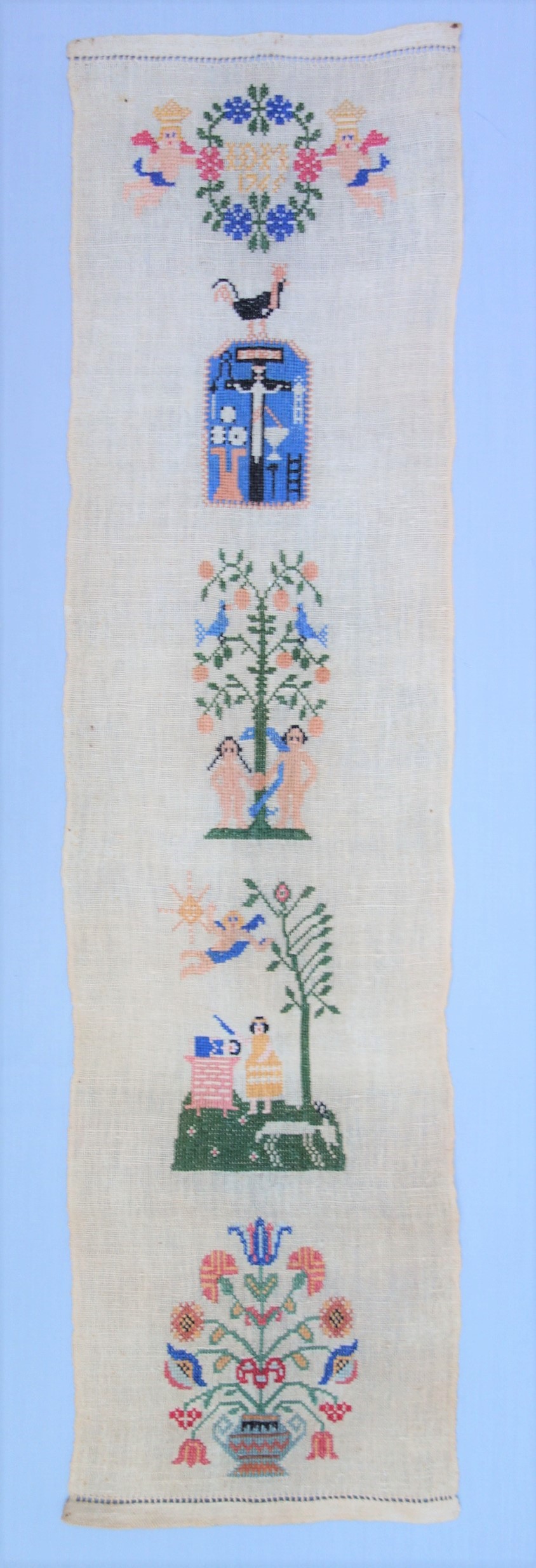
 A and sampler in pristine condition from 1765 (TRC 2019.2921).On Friday, 20th December 2019, Gillian Vogelsang wrote:
I have been cataloguing various sets of objects that have recently come in for the TRC Collection, including Guatemalan and Portuguese garments, as well as American feed sack quilts and toys.
But most interestingly, there was a piece of embroidery I had put on one side because my initial thought was that it was a 1970’s copy of an eighteenth century band sampler (TRC 2019.2921). How wrong you can be!
On closer inspection it turned out that the linen cloth of the sampler was made from hand spun yarn. It is a narrow band of 20 cm wide, hand woven. The embroidery threads are 2-ply silk yarns in a variety of colours. The whole of the embroidery was worked in cross stitch.
What is most remarkable is that the ground cloth is still starched and the colours of the silk have not faded. It would appear that the embroidery was worked and then for some reason it was put away and never saw the light (literally).
The embroidery consisted of five individual designs (from top to bottom):
a) a floral wreath enclosing the initials IDM (presumably the initials of the embroiderer) and the date 1765. Flanking the wreath are two winged figures wearing crowns.
b) the Crucifixion and related objects, including a ladder, a cross, a tunic, and a grail. On top of this design there is a cockerel. The Crucifixion (the representation of Jesus on the Cross would indicate that the sampler was made within a Catholic setting).
c) a depiction of the naked Adam and Eve in front of the Tree of Knowledge, with the snake climbing up the tree (Genesis 1-11). Eve is shown giving Adam an apple, as recounted in the Bible.
d) Abraham about to sacrifice his son, Isaac. A ram (?) is shown under the tree, conform the Biblical story that God provided a ram when he saw that Abraham was indeed ready to sacrifice his son (Genesis 22).
e) a vase with stylised flowers, including carnations and tulips.
In conclusion, this is an original band sampler from 1765 in a perfect condition. An exceptional find indeed!
Postscript: see also a blog dated 8th September 2020, in which some doubts are expressed as to the date of the sampler


 Embroidered crown of a woman's cap from Denmark, c. 1860 (TRC 2012.0465). For more information, click on the illustration.The TRC is working on the Nordic/ Scandinavian section of Vol. 3 of the Encyclopaedia of Embroidery (Bloomsbury, London). The TRC Collection unfortunately houses relatively few examples of Nordic work. We are therefore looking for examples of embroidery from Denmark, Finland, Iceland, Norway and Sweden.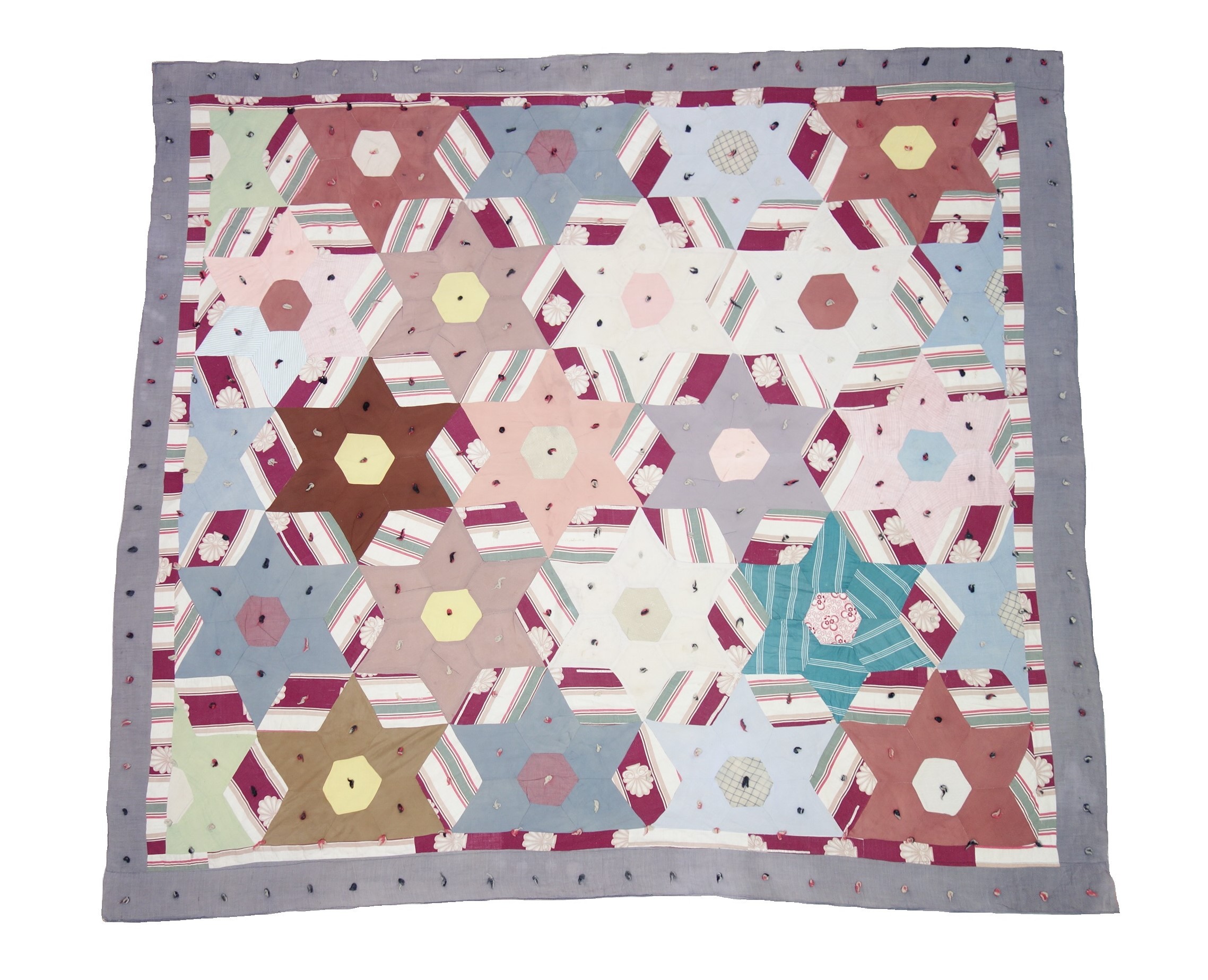





,_f.93v_-_BL_Cotton_MS_Nero_D_IV.jpg)