


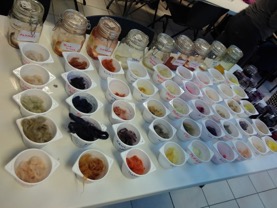
 TRC Intensive Textile Course October 2019: Fibres dyed with a range of natural dyes and mordants. Photograph: Anna Novitzky.Anna Novitzky attended the TRC Intensive Textile Course last October. She works for the British journal Nature and she sent us the following blog:
I’m a textiles hobbyist. I knit, crochet, spin — anything involving fibres, I want to try. I’ve dabbled in many techniques, but never done much systematically, or covered much theory. I wanted to change that, to know how things work. The TRC course seemed the ideal opportunity to learn.
I arrived not knowing what to expect, but found exactly what I needed. We dived straight in, identifying fibres through our senses, the burn test, dyes and microscopes, interspersing hands-on experience with theory linked to our observations.
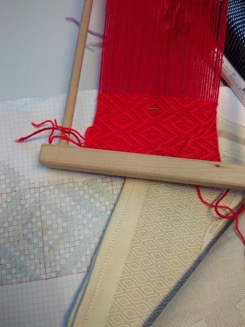 TRC Intensive Textile Course October 2019: A textile from the collection, with my chart of the pattern and my attempt to recreate it. Photograph: Anna Novitzky.Over the week, we moved on to fibre preparation, spinning with various tools, dyeing, ‘inventing’ the loom, weaving, exploring non-woven fabrics from leather to lace and examining printing and embroidery. Fibre dyed with a range of natural dyes and mordants. We applied what we’d learnt by handling objects from the collection, a unique and rewarding experience.
It was a whirlwind of information and encounters that left me exhausted but exhilarated each day. A textile from the collection, with my chart of the pattern and my attempt to recreate it. I did things I’d long wanted to try: combing fibre; spinning on a charka. Others, I’d never dreamed of, such as examining 3000-year-old mummy cloth. Identifying, charting and recreating a woven pattern gave me a huge thrill.
Through it all, Gillian’s incredible expertise and depth of knowledge blew me away. I left with a renewed commitment to studying, understanding and experiencing textiles — and with my mind whirling with possibilities.
Anna Novitzky (This email address is being protected from spambots. You need JavaScript enabled to view it.)


