


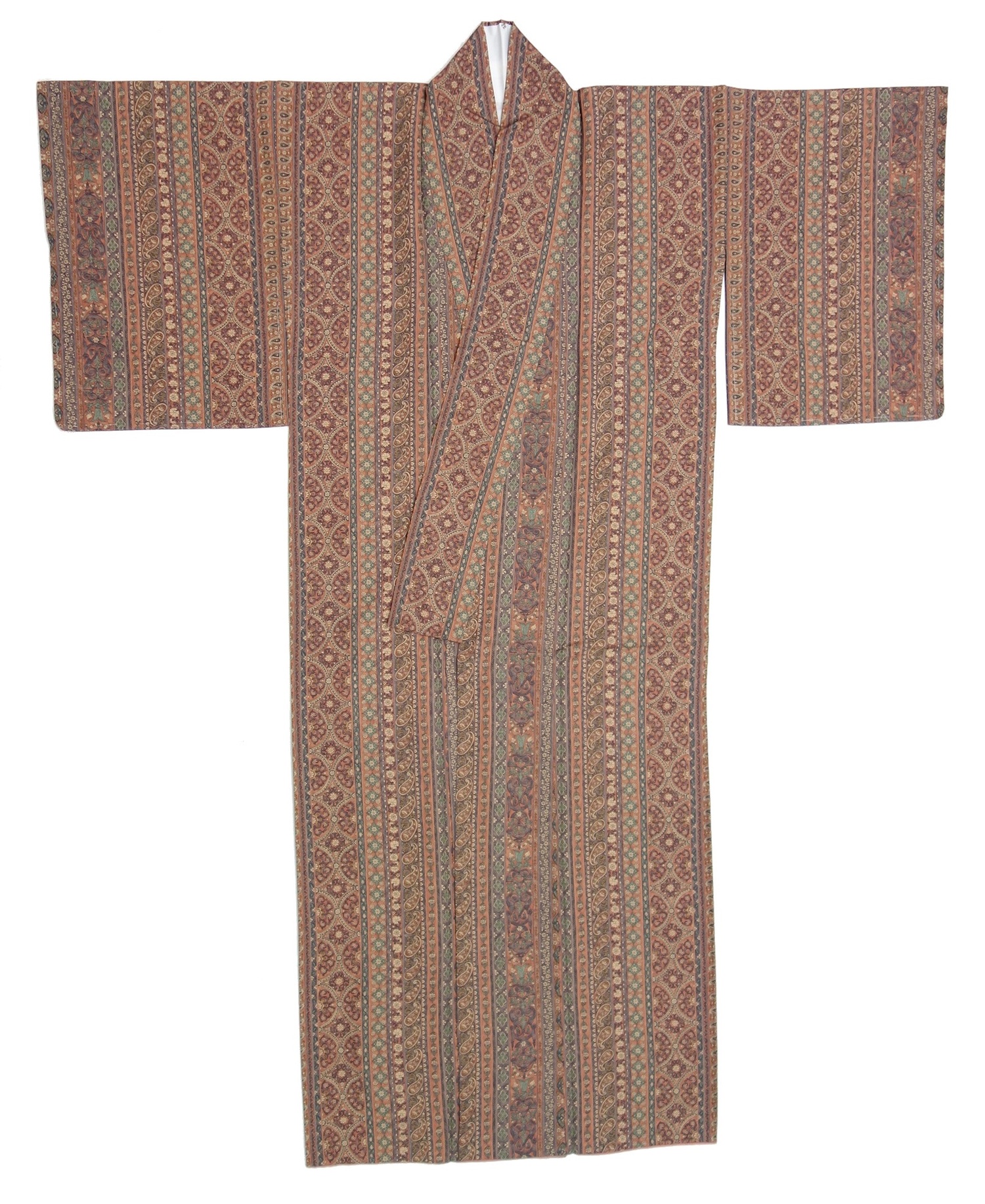
 Kimono decorated with the paisley motif (TRC 2021.0062).For the last year or so the TRC Leiden has been very busy researching and collecting items for an exhibition on the history and world-wide popularity of the paisley (buteh) motif. One of the people who is helping with the work is Naoko Kikuchi, who is a former TRC volunteer who returned to Japan some seven years ago, but who has never really ‘left’.
Naoko has just written a short blog about a kimono (TRC 2021.0062) that she donated to the TRC Collection and which has a printed design that includes the paisley motif. Here is her report about the kimono and the background to the paisley motif used in Japan:
This is a casual kimono of the type that could be worn by a woman on a daily basis while at home or going out for shopping. It has a printed design that includes a mixture of Western patterns, including the paisley motif, which have been modified to fit modern Japanese taste.
The paisley motif in Japan is officially called shoukyu (pine cone) -moyo (pattern) or, sometimes, magatama (after a precious stone for centuries used for necklaces and bracelets). But by 2021, Japanese people generally simply call it ‘Paisley’. It is also regarded as being very similar to one side of the (originally Chinese) ying-yang pattern, as well as being comparable to a depiction of wind-blown sacred trees.
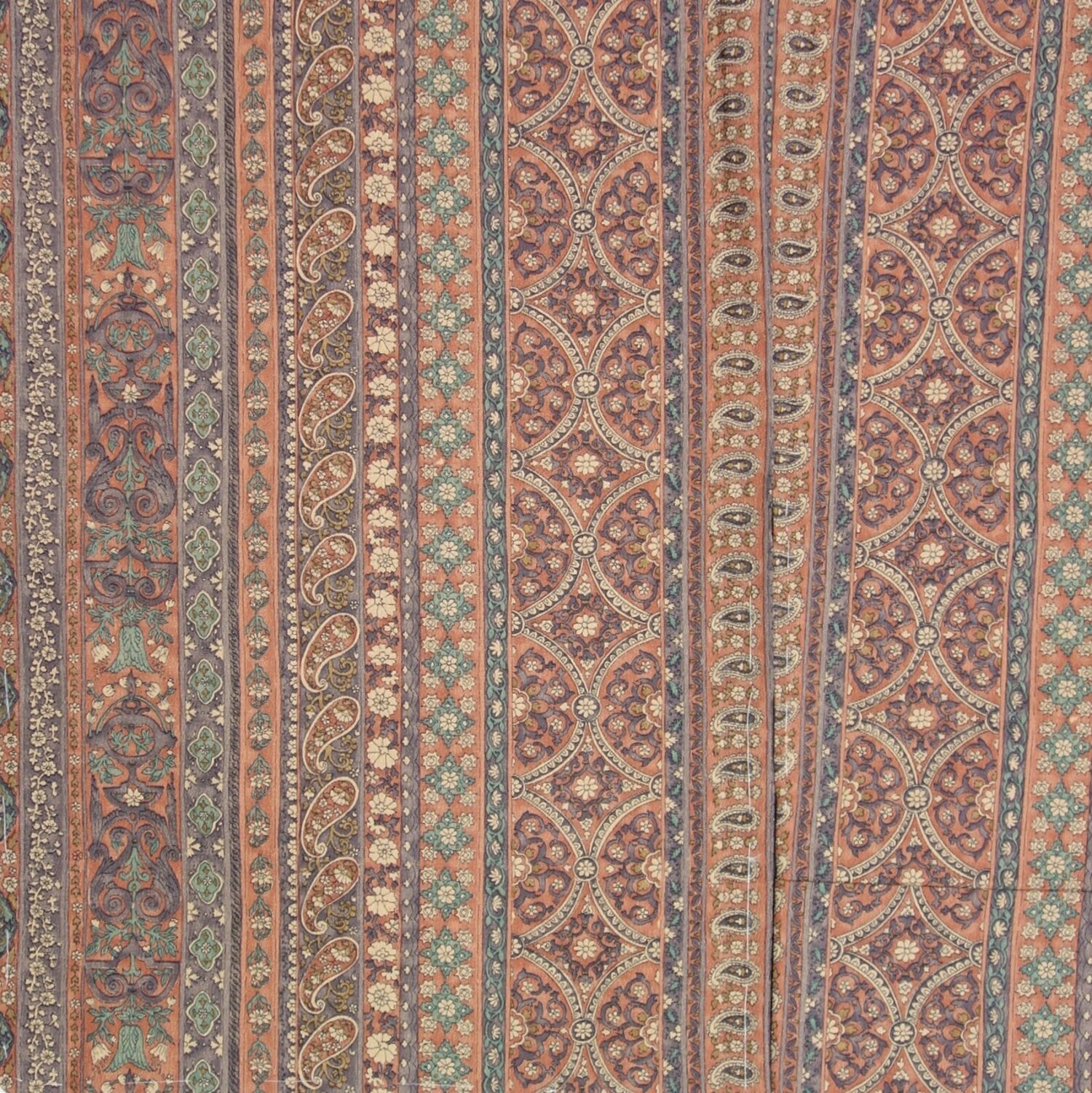 Detail with the paisley motifs, on a Japanese kimono (TRC 2021.0062).Although academics, kimono enthusiasts and those interested in the history of patterns and designs are aware that the paisley motif originates in Iran and India, there are still many Japanese who think that the pattern is typically British, or more specifically Scottish, as it is associated with the Scottish town of Paisley south of Glasgow, where the 'paisley' motif was widely used for woven shawls in the 19th century, in imitation of Kashmir versions (with the corresponding buteh motif) from India. But the paisley motif in Japan may have a much older history, and be directly linked with India.
Textiles with Iranian, Indian and Southeast Asian motifs were taken to Japan from the sixteenth century onwards by Portuguese, and later, by Dutch merchants. In this way they may also have introduced the buteh, which is the origin of the paisley motif.
The general Japanese term for such textiles is sarasa. It is thought that this word, generally translated as chintz, originates from the Portuguese word saraça, which means cotton. This was a relatively new type of fabric in Japan; until the mid-16th century, most of the fabrics used in Japan were made of silk or ramie (very similar to linen).
Sarasa textiles were highly valued, for their quality and their decoration, and called one of the meibutsu-gire (‘famed textiles’) along with other imported textiles, and used for items such as cloths for wrapping objects and small bags that cover tea containers at tea ceremonies.
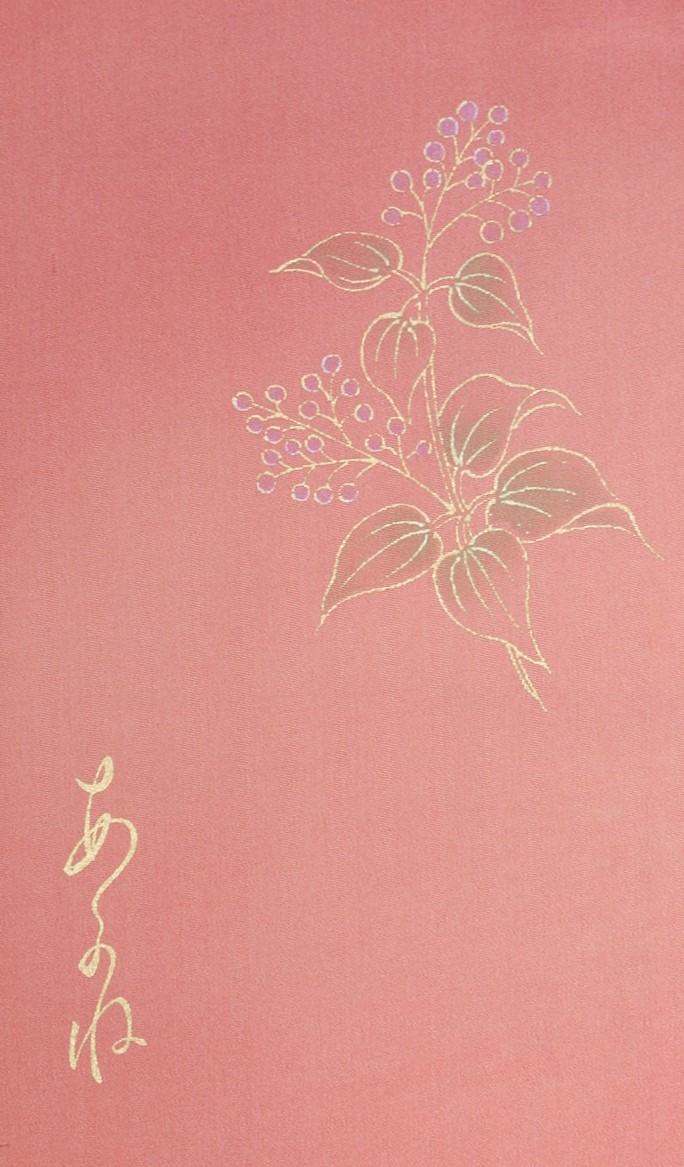 Nanten tree and the hiragana symbols, on the inside of the left hand panel of a Japanese kimono with paisley motifs (TRC 2021.0062).Later, textiles with sarasa motifs (including the buteh or paisley motif) were also being produced in Japan and they became widely available. Some people started to use sarasa fabrics for 'between-wear' (aigi or juban, namely a garment worn between the underwear and outer gowns).
Sarasa was manufactured with a variety of patterns that were adapted to answer Japanese tastes and markets. By the late 19th century, sarasa fabrics were used for a range of products, including obi (sashes) and kimonos. In fact, sarasa remains popular to the present day!
But this kimono is also special for other reasons: On the inside of the left hand panel (called the hakkake) there is a small, painted plant design of a nanten tree (see illustration), which represents auspiciousness, as the pronounciation of nanten is also a shortened form of nan wo tenjiru, which means turning a problem into something positive.
Close to the nanten tree, there is also a text in hiragana script, meaning anone, which is a phrase that you say when trying to talk to someone in the manner of “My dear (or Well, …..), I want to tell you”. It is the adopted 'signature' of the artist who designed the kimono. It is painted on the inside of the left hand panel, where it can be shown to the outside world when playfully flicking open the kimono. Normally, the name of the artist is written on the inside of the right hand panel, where it cannot be seen as it is covered by the left hand panel.
The hiragana on this kimono can be seen from the outside and this was intended to be a bit of fun.
14 January 2021


