


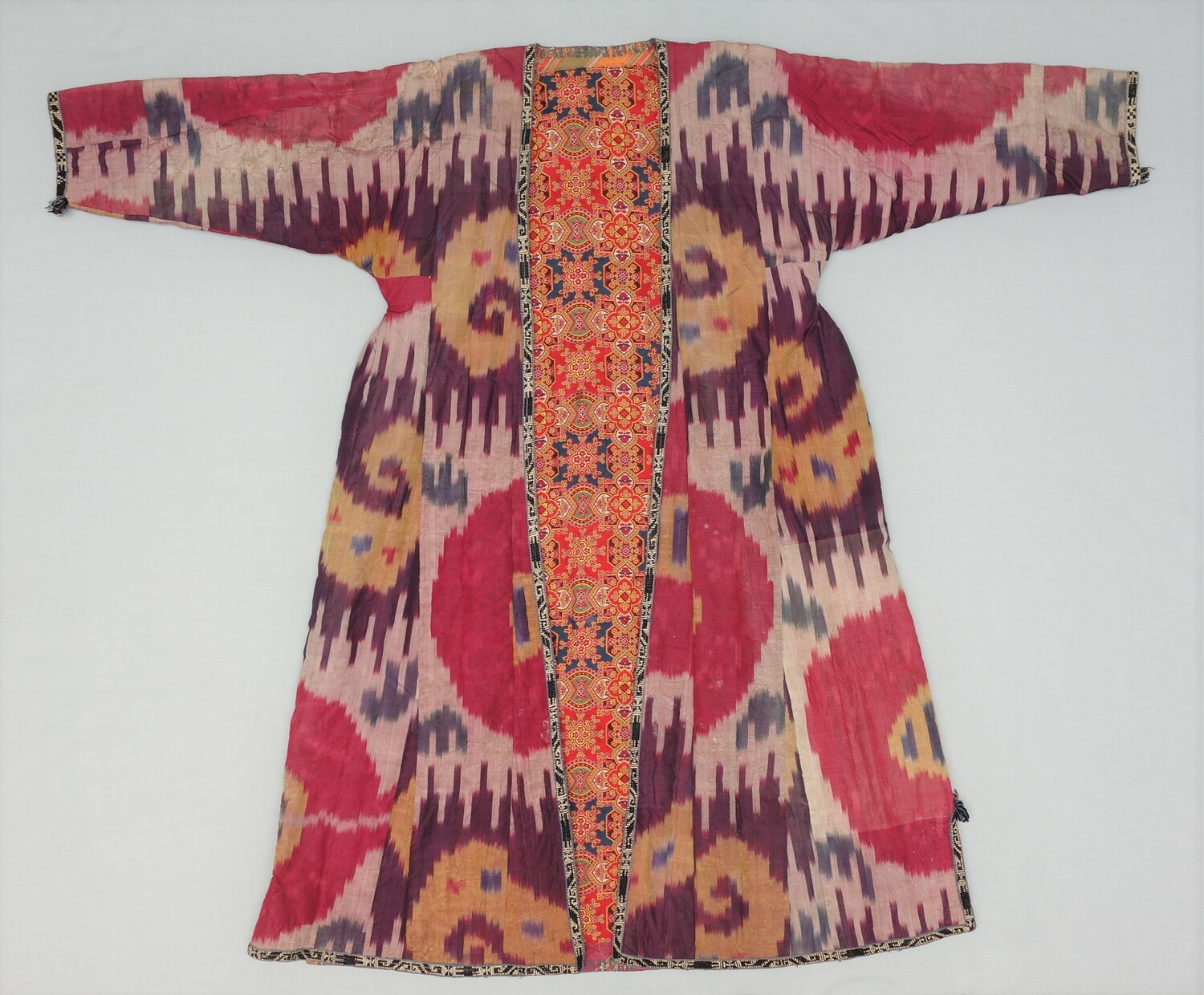
 Woman's ikat coat from Uzbekistan, early 20th century (TRC 2017.0932).The only travel I can enjoy lately is via books, thanks to the lockdown. I’ve been enjoying Christopher Aslan Alexander’s A Carpet Ride to Khiva: Seven Years on the Silk Road (2010). In it, Alexander writes about falling in love with the city and crafts of Khiva, once a trading stop on the ancient Silk Road, in modern-day Uzbekistan. There are many wonderful details as he describes setting up a carpet weaving workshop, then another workshop for suzani embroiderers.
Wanting to learn more about Uzbek textiles, I started exploring the TRC’s on-line collection. The TRC collection includes some stunning silk Uzbek ikat garments, such as TRC 2007.1125 and TRC 2017.0932. Even better is a whole on-line exhibition called “Dressing the 'Stans': Textiles, dress and jewellery from Central Asia”, with more beautiful textiles.
The Silk Road cities of Bukhara and Samarkand have long been famous for the producition of ikat, a dyeing technique that creates a patterned textile by tightly binding individual yarns or bundles of yarns, and then dyeing them. Frequently it’s the warp threads that are tied, but weft threads can be, too, and in the most intricate patterns both warp and weft threads are tied and dyed.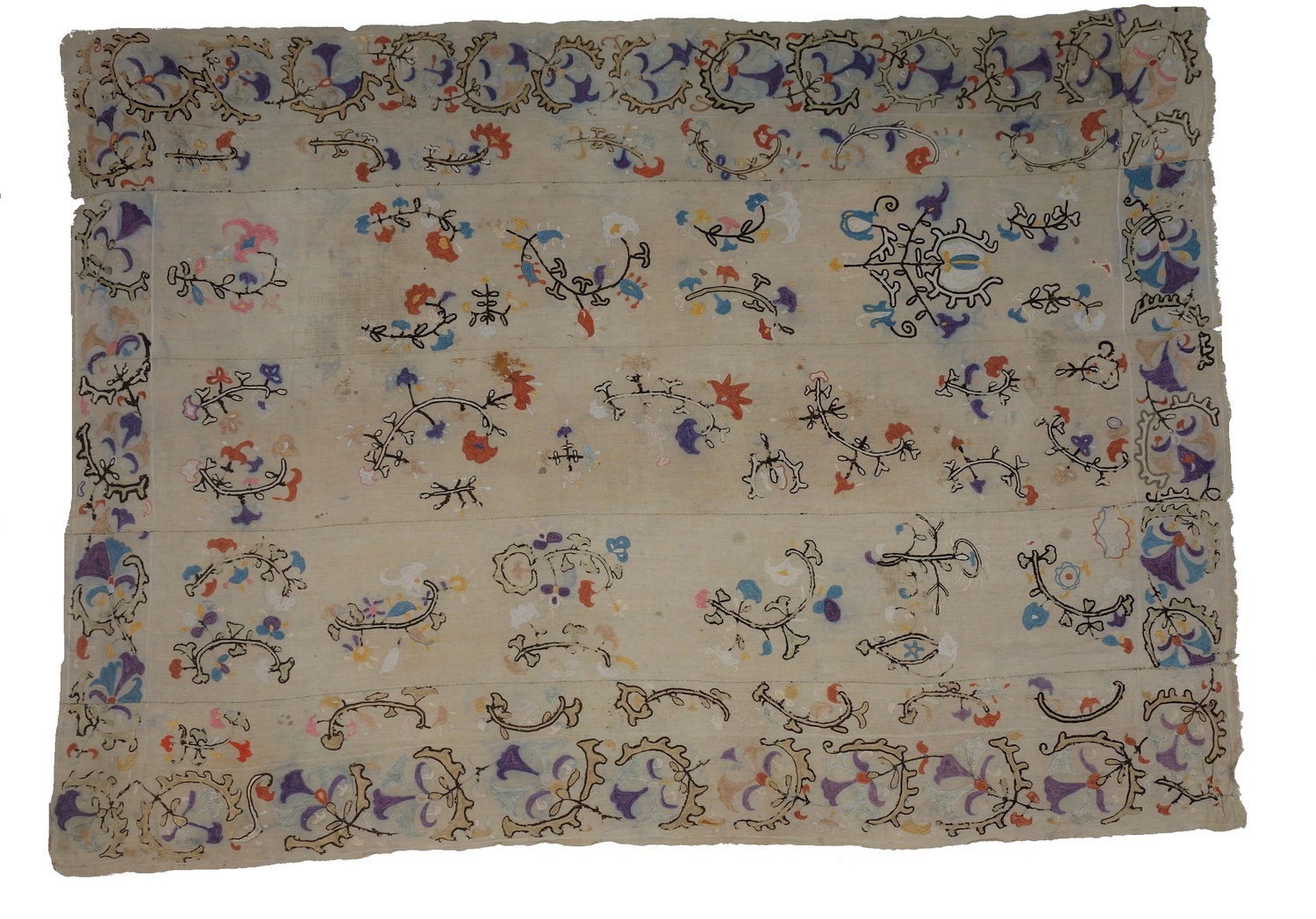 Suzani from Uzbekistan, early 20th century (TRC 2012.0399).But what about suzanis? From the Persian word for ‘needle’, suzanis are embroidered wall hangings and coverlets, most often seen at weddings. Large suzanis, for example for an awning for a bride and groom, might include one design drawn over several cloth panels, with each panel embroidered by a different woman. Common motifs are flowers and pomegranates, or protective symbols like rams’ horns or solar symbols.
The TRC collection includes a machine-embroidered suzani from Tashkent that has a floral pattern on a black background (TRC 2012.0398), and another hand-embroidered example with a smaller floral motif on a white background (TRC 2012.0399). A diagonal worked stitch called Bukhara couching is frequently used to fill the flower and leaf motifs.
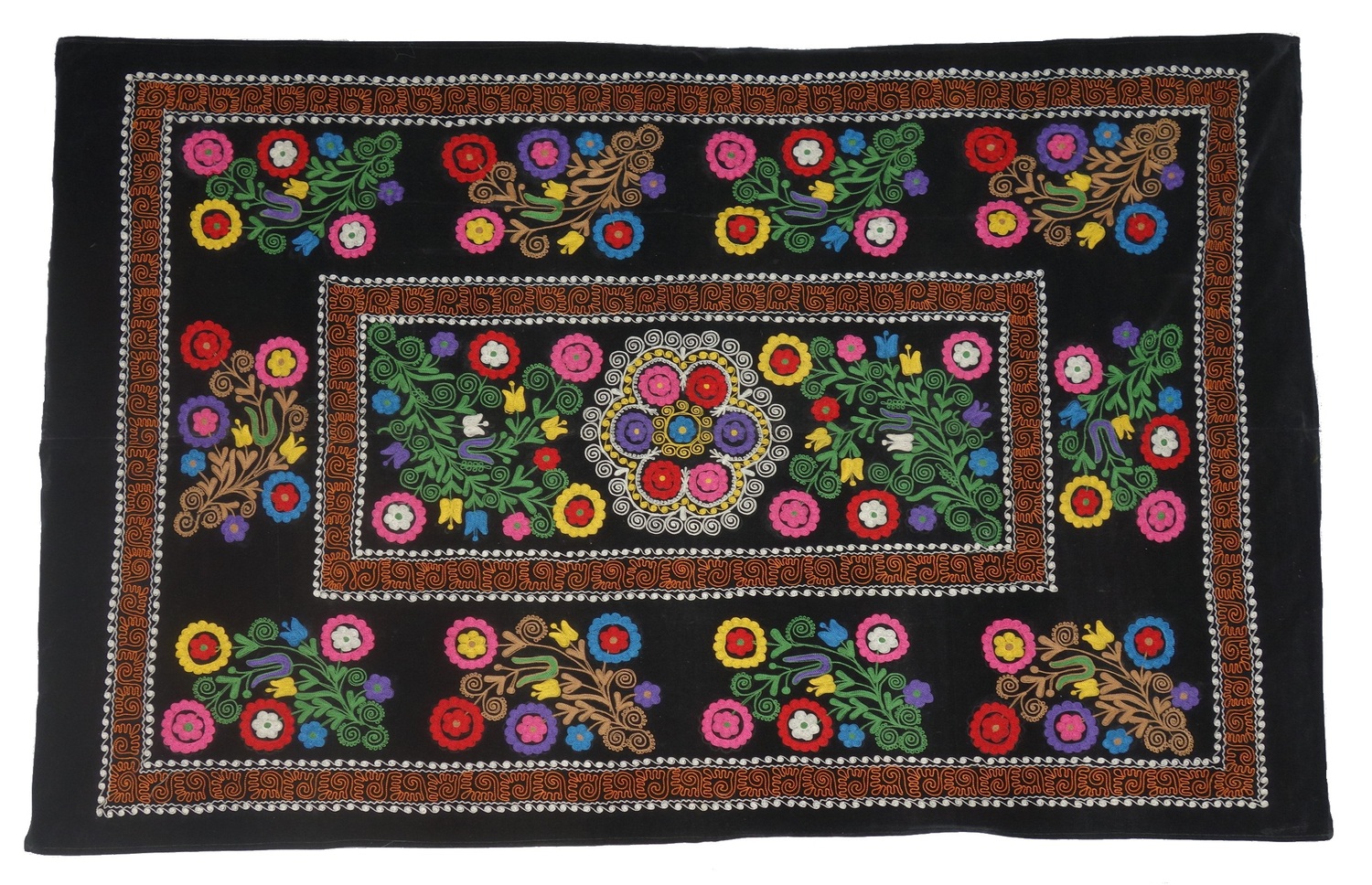 Suzani from Uzbekistan, late 20th century (TRC 2012.0398).It’s a far cry from wandering through a market bazaar, but I’m happy I can sample some of the beauty of Uzbek textiles, if only digitally for now.
Shelley Anderson, 10 January 2021


