


On Tuesday, 28 April 2020, Willem Vogelsang wrote about a particular hair style of Pashtun women in nineteenth century Afghanistan:
I have long been fascinated with 19th century illustrations of Afghanistan. They tell a lot, not only about Afghanistan itself, but also about the artists and their backgrounds. Many of these depictions were made by British artists that accompanied the so-called 'Army of the Indus', which in 1838/1839 invaded the country, only to be defeated in January 1842 in the mountain passes east of Kabul.
Some of the drawings illustrate an unusual type of hair decoration for unmarried women from among the Pashtun (Pathan) nomads, in the east of the country. It is a tuft of hair, mixed with gum, mud or dung, which hangs down the forehead and covers the nose.
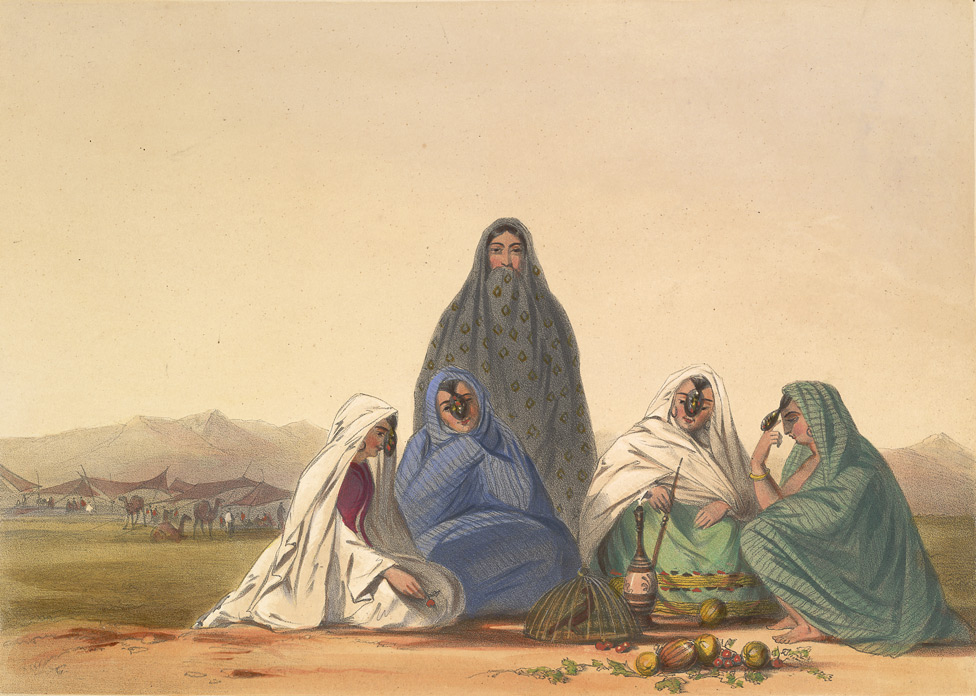 "Ghiljie women in the lower orders.” Coloured lithograph by Robert Carrick, after James Rattray. Plate VI in Rattray 1847/1848. Original size: 17,9 x 25.1 cm
One particularly interesting illustration is a lithograph published in 1847/1848, and is based on the work of the British officer and artist, James Rattray. According to the accompanying text, the women were "[bringing] the whole of their hair to the front of their face, and kneading it into a compact cake with an admixture of dung and mud, ornament it with beads, bits of metal and coloured glass." Some of the young women were very pretty, Rattray observed, but others were squint-eyed from peering around the sides of their "odious distinction".
An Indian traveller from the early 1830's, Mohan Lal, adds that the Ghiljai [Pashtun] women “cannot boast of beauty, which they strive to supply by ornament. The girls, from the age of eight to twenty, are not much veiled, but they twist their hair, and tie it like a cake, which hangs over their forehead, and a little below their eyebrows. The centre of the lock (or hairy cake) is adorned by a gold or silver coin, which, in black hair, shines very beautifully, like the moon springing suddenly from black clouds. This is the sign of virginity amongst the Ghiljais. The women allow their twisted locks to hang upon their ears, and even as far as their arms.”
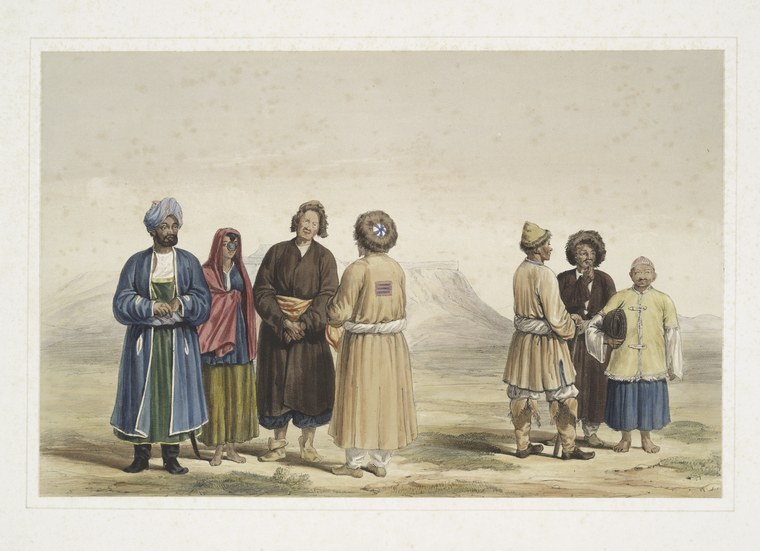 “Fort of Kelat-e-Giljee, a Chieftain and Female of the Giljee Tribe and Huzzareh Peasants.” Lithograph by Charles Haghe, after James Atkinson. Plate VII in Hart 1843 (coloured edition). Original size: 25.5 x 38.5 cm.
Another illustration, based on the work of the artist James Atkinson and published by Lockyer Hart in 1843, shows a group of Pashtun and Hazara from eastern Afghanistan. The woman to the left also shows the braid of hair hanging down her forehead. The accompanying text says: “The dress of the Giljee [Pashtun] female ..... is that of the poorer class. It is remarkable for the peculiar manner in which their hair is made to act as a partial veil, by being brought over the forehead, plastered with gum, and then wound in a flat circle round a piece of green grass.”
Henry Raverty, another British scholar from the mid-nineteenth century, refers to the “totakai”, which he describes as a knot of hair that is worn on the forehead by unmarried girls. He tells that it used to be the custom among all Pashtuns that a young girl would plait her hair on her forehead, sometimes reaching to the nose and covering the eyes. It was removed when the girl was married.
I don't know whether this typical form of decoration is still being worn; I simply never saw it, but then I never saw many women in the Afghan countryside. One of my Pashtun friends told me that he remembered his grandmother wearing such a tuft of hair, but since the hair lock was typical for unmarried women, this piece of information may not be correct. It is more likely that the tuft is a cheap form of a more costly piece of glass or jewelry worn along a chain down the forehead by women in Afghanistan and South Asia. On the other hand, many 19th century illustrations of Afghan women show a curl of hair hanging down the forehead. Admittedly, it is not as large as the hair tufts illustrated by Rattray and others, but perhaps still within the same tradition.


