


On Sunday, 26 April 2020, Beverley Bennett and Susan Cave wrote about a particular quilt in the TRC collection that was made in the USA against the backdrop of WW2:
The quilts at the TRC are windows into the lives of everyday women. As well as being functional, they are social documents giving context to what was happening at the time. We have no doubt that during this period of the COVID-19 global lockdown, with the prevailing complex emotions and situations, quilts will be made reflecting this historic phase.
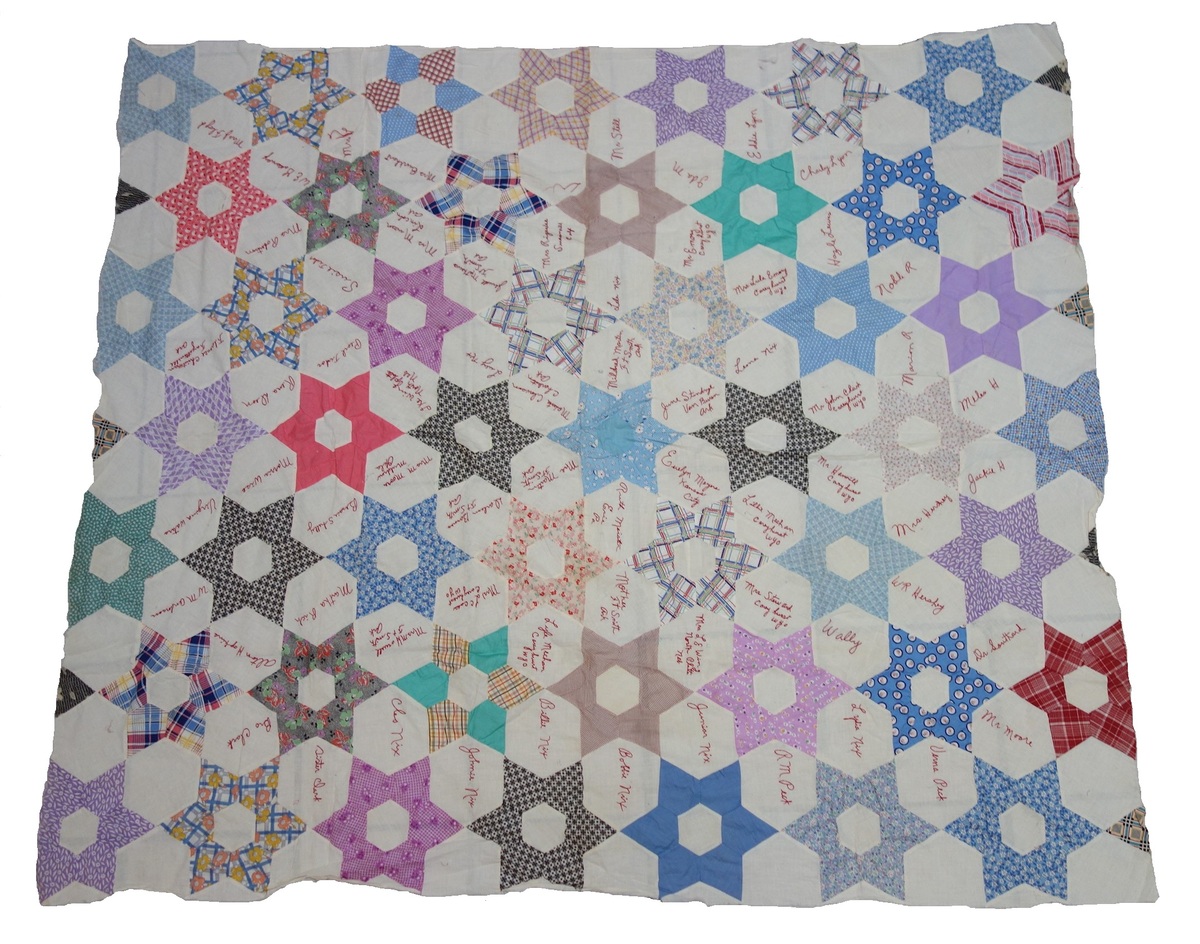 An autograph quilt top, USA, mid-20th century (TRC 2017.3366).
Social change has been a powerful influence on quilts and quilters. Both women (and some men) quilters have been associated with anti-slavery, suffrage, missionary work, as well as with fund raising for temperance, only to name a few. For centuries, women have gathered in religious and community groups for a common cause, and during the Civil War in America, great ‘Sanitary Fairs’ were organized in the northern states to raise money for hospital relief.
Hundreds of booths sold everything, from Turkish smoking divans to Ladies ‘Fancy” work of quilts and embroideries to floral art. The fairs represented one of the most successful humanitarian and philanthropic events in American history, raising over 43 million in today’s dollars for the health service. Is this sounding familiar?
The United States Sanitary Commission was established in 1861 by a group of patriotic and self-sacrificing civilians. This was just a few years after the Siege of Sebastopol, where Florence Nightingale experienced the extent and mortality of ‘constant sickness’ in the army. She used statistics to evaluate hospitals, fought for more hygienic conditions and captured the imagination of the world ever since. Is it any wonder that quilters wanted to assist in further fundraising for similar causes?
The TRC is fortunate enough to have a quilt top (TRC 2017.3366) that supports the noble cause of fundraising for, we think, the Red Cross. In December 1917, a popular women’s magazine, Modern Priscilla, featured an article suggesting a charge for embroidering names on quilt blocks, the finished quilt to be auctioned off later. Another article in the September 1918 issue with the caption “Calling the Quilts into Service for our Country” provided four patchwork patterns, all with empty squares for embroidery, and one design for machine quilting.
The TRC quilt top probably dates nearer WW2 rather than the end of WW1. It is an autograph, Hexagon Star quilt, which is hand pieced with the star points featuring predominantly feedsack fabrics and the central white hexagons bearing different signatures. They have been embroidered in red stem stitch. The stitching is consistent enough to suggest one person may have done all the embroidery, supporting the theory that the names are of people who paid an amount to have them embroidered, so raising funds for a particular cause. Several of the patches also have names of States embroidered with the name, such as Arkansas, Pennsylvania, California, Wyoming, to name a few.
Either many people travelled to a specific event, or the quilt (or maybe the specific blocks/patches) were either posted or taken around these states over a period of time. Several of the names have the same surname and remarkably similar writing – maybe one family member (see the ‘Nix’ group in the photo) included everyone. Remarkably, the quilt arrived at the TRC with a still-threaded needle in one unfinished patch!
There are already initiatives from quilters all around the world to raise awareness and assist those in need during the current corona pandemic. In fact, in Texas, there are many 'Quarantine Quilt' projects currently running, including the Texas Quilt Museum/ Houston Quilt Festival, which may have a display in November.
And we know of one small medical practice in a mountain village in Switzerland (population 1300) that sent out the call for patchwork masks to cover a desperate shortage. They sell for 2 Swiss francs (slightly less than 2 Euros), are made with love, and all the villagers are wearing them. We will make sure that the TRC gets one for the collection so the women in the window of COVID-19 are recognized by future generations.


