


TRC volunteer Shelley Anderson continues her blog about her recent visit to China and the Silk Road: Famen Temple lies some 100 kilometres outside the busy city 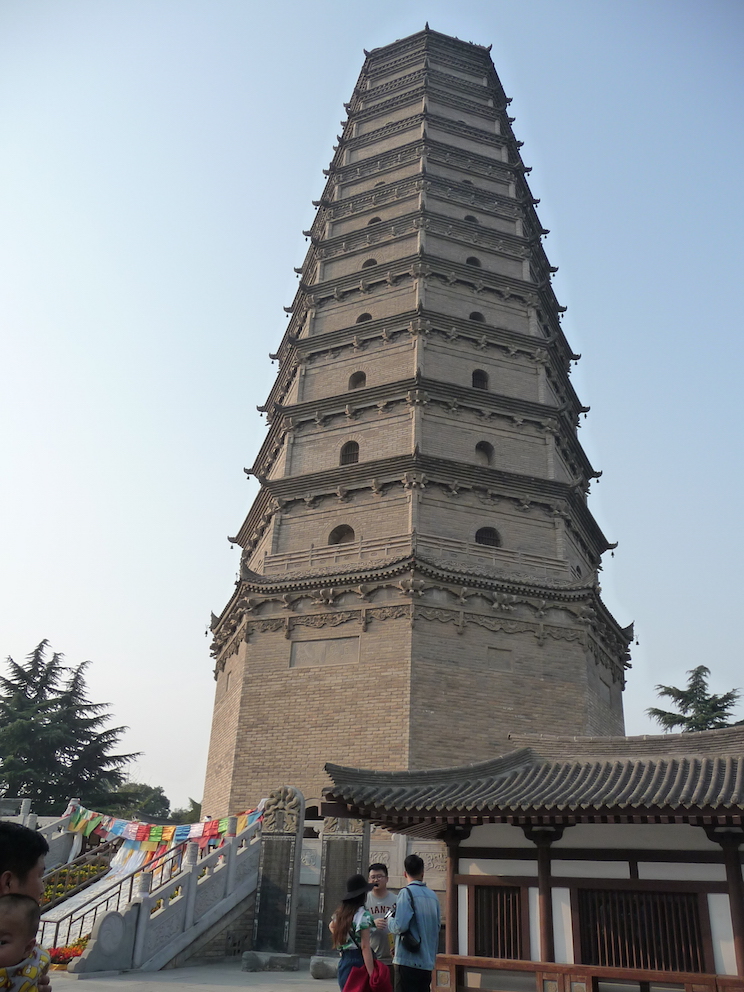 The Famen pagoda, south of Xi'an, China. Photograph Shelley Andersonof Xi’an, China. It is a huge complex of modern-day Buddhist temples, a college and conference centre. It also includes a restored ancient pagoda, or Buddhist temple, that was first founded during the Eastern Han dynasty (25-220 CE). This pagoda has been destroyed and rebuilt many times in its history. During the Tang dynasty (618-907 CE) it enjoyed royal patronage, as the imperial capital was based in Chang’an, now modern-day Xi’an. Chang’an is considered the starting point westward for the Silk Road, where the huge international trading network for textiles, especially silk, and other valuable commodities began their journeys to India, Persia, Damascus and Rome. Thanks in no small part to this trade, China during the Tang dynasty was one of the most powerful and richest countries on earth.
A chance discovery in the ancient Famen pagoda helps to illustrate just how wealthy the kingdom was. In April 1987, during the pagoda’s rebuilding, a remarkable archaeological discovery was made. A forgotten underground chamber was discovered, full of Tang-era treasures, including glassware imported from the Middle East, over 100 gold and silver objects — and over 700 silk textiles. Many of the textiles had been folded and bundled together. Due to the damp inside the stone chambers, the textiles in the outer layers were decomposing and in very poor condition. There were damasks, leno, gauzes, brocades, plain silks and embroideries, all over 1,000 years old. A small silk blouse (6.5 cm in length, with 4.1 cm long sleeves), made to adorn a statue, was found with couched gold embroidery. The average diameter of the gold thread (made of extremely fine gold foil, wrapped around silk fibres) was 0.1 mm.
Also discovered was the reason for the collection of goods. A relic, a finger bone of the Buddha, was discovered in a niche in the last chamber. The bone was found inside a series of nested boxes, the last a small box of white jade. There were traces of gold thread from the embroidered silk cloth the box had been wrapped in. The rich goods were all offerings by worshippers to the Buddha, in order to ensure good luck and to gain merit for future lives. Two stone steles were also in the chambers, one of which was an inventory with a list of all the textiles, their names and weight, and the names of their donors on it.
The silks can be divided roughly into two categories: silk garments that had been offered by members of the imperial court (including an embroidered skirt given by the Empress Wu Zetian [624-705 CE], China’s only female ruler), and silks used to wrap other precious objects. Some of the silk fragments and other artifacts are on display at the nearby Famen Pagoda Museum. The bundles, however, are still being separated, layer by layer, at the Shaanxi Provincial Institute of Archaeology.
It was a privilege to meet Associate Researcher Lu Zhiyong, head of the Institute’s Scientific Research Management Department, in a special laboratory for the silks built in collaboration with a German institute. “This is a unique case,” he said of the find. “The textiles were folded layer on layer and were most tightly packed. Our first job was to refrigerate the silks, to preserve them and to deal with a heavy mould problem. There were gold threads, samite, twills and tabbies. There were also a leather boot and lots of coins. We tried to X-ray the bundle but it was too thick—only the boot or coins or bamboo could be seen. So there was no new information from that.”
According to the stone stele, the Buddha relic was removed from the chamber every thirty years and taken by ceremonial procession to Chang’an. On its three-day journey back to the pagoda, offerings were presented. People were probably still trying to catch glimpses of the relic as the chamber was being shut. Many coins were found just inside the sealed chamber, possibly thrown in by poorer people who could not afford to offer textiles, Lu explained. All the textiles seem to date to the same period in the 9th century. “The chamber was last closed in the year 874. We don’t know why. There have been surprises: some of the cloth is printed, not embroidered. The textiles include early examples of the use of gold thread in weaving. There is a very early example of silver thread, too. The silver thread has a paper substrate. We have found socks, trousers, a skirt, a hat — these are high quality textiles, that all belonged to the Emperor’s family.” The silks used to wrap other objects are “not as high quality as the costumes,” Lu said. One such wrapper, used to cover a sutra (Buddhist scripture), was a silk gauze with a silk floss embroidered phoenix outlined in couched silver thread. Lu and a German colleague use flat Teflon sticks in the slow task of separating the layers. No chemicals are used. If they find they cannot separate a layer “we stop. We focus on climate control, on conserving the textiles and we wait for new techniques. I don’t do this work just for me but for other generations.”
Shelley Anderson, 1 November 2015


