


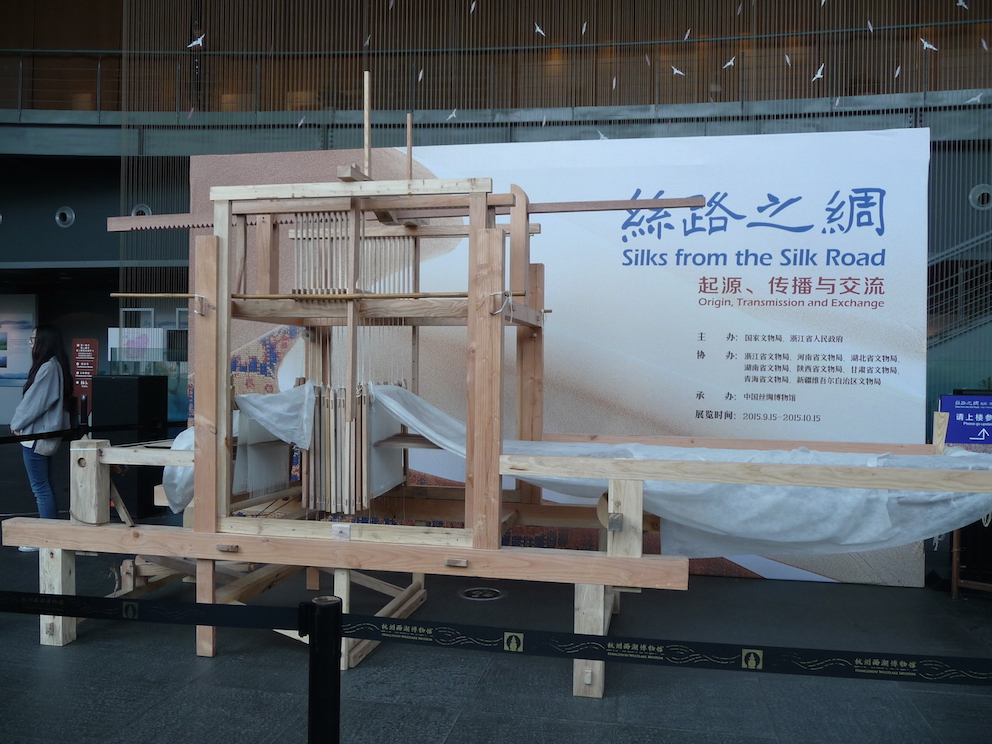
 Banner for the conference "Silks from the Silk Road". Photograph: Shelley AndersonTRC volunteer Shelley Anderson writes: There were many textile moments on a recent visit to China, where I attended the symposium “Silks from the Silk Road: Origin, Transmission and Exchange”, organized by the China National Silk Museum in collaboration with, among others, the Danish National Research Foundation’s Centre for Textile Research (CTR). The symposium opened with a weaver weaving damask silk on a large hook-shaft pattern loom, with a connecting rod. This sophisticated loom was built based on the remains of four model looms, made from wood and bamboo, uncovered in a Chinese tomb in 2012. This remarkable discovery included baskets of silk threads and dyes, and several wooden figurines that represent weavers. The artifacts have been dated to the Han dynasty, or late second century BCE. It’s a “truly exceptional” find, said CTR Director Marie-Louise Nosch. “It’s unique because finding organic matter so well preserved is rare. It bridges many gaps in our knowledge, as until now we did not know what type of looms were used. This shows the high technology of Han China, and will become a landmark in archaeology and textile research.”
Beautiful examples of silk fragments and textile tools were also on display in a special exhibition in the West Lake Museum (Hangzhou, China), where the symposium took place. Silk was a vital part of early Chinese economy, and the economies of other cultures that lived along the Silk Road. It was durable and light-weight, unlike dried fruits or gold, which were also traded up and down the Silk Road, along with jade, furs, spices and other commodities. You could buy camels, horses, slaves or servants with bolts of silk; soldiers’ salaries were paid in silk and debts settled with the textile.
One highlight of the exhibition for me was Yingpan Man. This richly dressed corpse was discovered in the abandoned city of Yingpan in 1995. Yingpan was an important Silk Road trading centre until it was destroyed by Genghis Khan’s troops. The arid desert atmosphere mummified the corpse and preserved the textiles he was buried in. And what textiles they are! He has a long double weave red woolen robe over purple silk trousers, another light yellow silk robe, and felt socks. He wears a funerary mask with a gold diadem, and a miniature silk caftan of embroidered damask silk had been placed on his chest. The motif of his red robe (of bulls and naked putti) leads some scholars to believe it was produced in the eastern part of the Roman empire. DNA tests, his brown hair and height (he is over six feet tall), and the non-Han Chinese custom of a funerary mask, point to European ancestry.
Shelley Anderson, 30 October 2015


