


On Wednesday, 25th March, 2020, Beverley Bennett wrote:
As we are unable to give our guided tours at the moment, I thought I would feature some of the quilts I find most interesting in the current American Quilts exhibition. The particular textile I want to discuss (TRC 2018.2629) dates from c. 1935. It was made by Margaret Smart, The Dalles, in Oregon, USA (1914-2006), and was donated to the TRC by Sherry Cook.
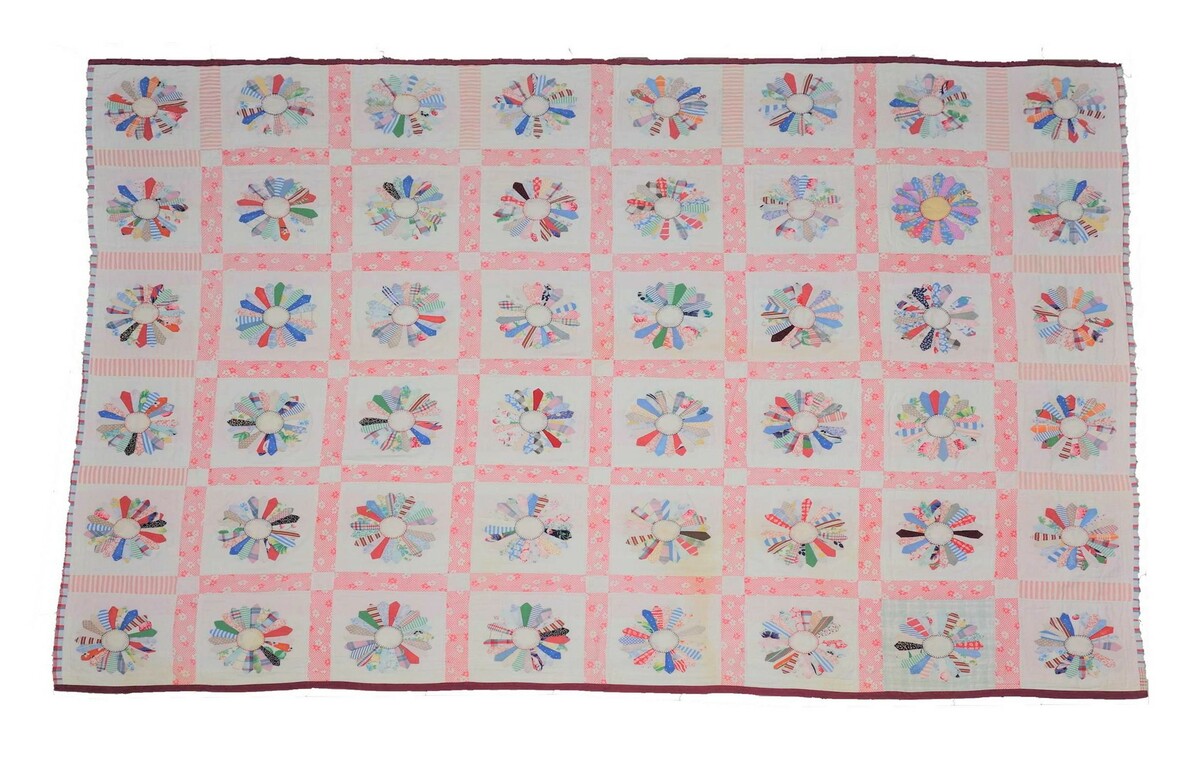 A Dresden Plate quilt from the mid-1930s, USA (TRC 2018.2629).It comprises a simple Dresden Plate block, made from feedsack prints and possibly clothing offcuts. The blocks are set side by side with a pink sashing and white cornerstones.
The Dresden Plate pattern was very popular in the 1930’s and consists of a number of ‘blades’ pieced together to form a circle. The finished circle is then appliquéd on top of a background square, with the outer edges of the blades either forming arcs or, as here, points. Obviously, the circle has to lie flat and that is often the challenge with this pattern – to fit in a circle easily, it is common to see 8, 12 or 20 blades in the circle. All of these numbers work well because they divide into the 360 degrees of a circle and give an easily drafted pattern.
The maker of this quilt, however, has used 22 blades for each circle – perhaps the size of her fabric scraps dictated it, or maybe her pattern or seams were inaccurate, but it requires some skill to get 22 blades to successfully lie flat!
The sashing for the centre blocks is a pink floral, but the two ends use a stripe – suggesting the maker ran out of fabric and used a substitute – we see this often in antique quilts.
The backing of the quilt is probably plain flour sack fabric, but the ‘batting’ here is an old flannel sheet – you can clearly see the stripes showing through the backing. It is quite heavy and has a different feel to a quilt filled with cotton batting, but it would have been warm.
The binding is quite worn – the quilt was obviously well used. There is a maroon fabric on the long edges and what looks like pyjama fabric on the short edges.
In short, it is a very nicely made, well used unassuming quilt made to be used in thrifty times.


