


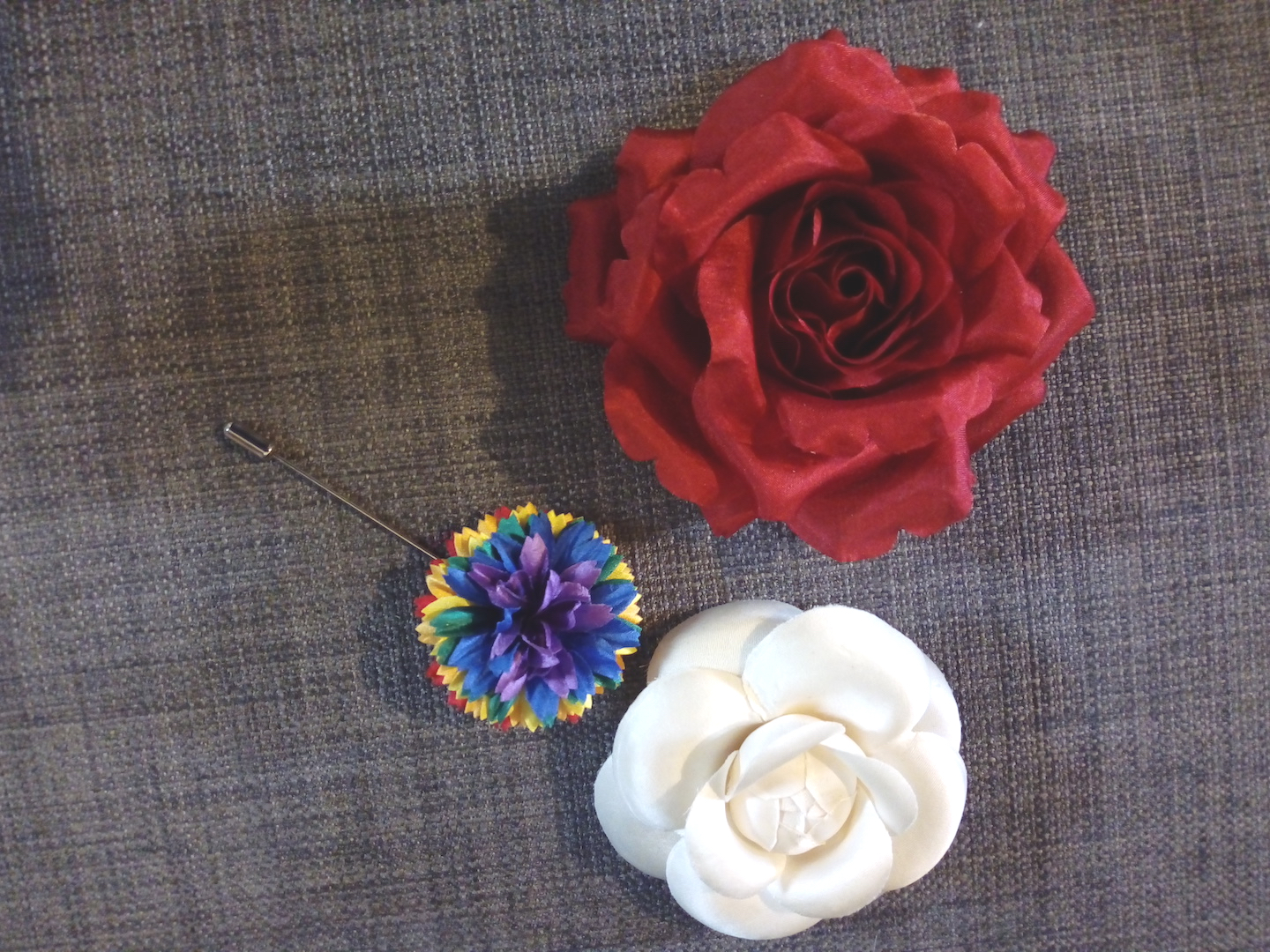
 Examples of silk flowers produced by the firm of Schmalberg, New York.On Sunday, 24 November 2019, Shelley Anderson wrote:
I recently made a donation to the TRC that reflects some prized textile history. The donation includes three hand-made artificial flower accessories. The red silk rose and white peony, shown in the accompanying photograph, can be worn as brooches, while the many coloured carnation (in honor of the 50th anniversary of LGBTQ+ Pride) is a stick pin for lapels.
All the flowers come from M. & S. Schmalberg Custom Fabric Flowers, a family-run operation that has been in business for 103 years. Schmalberg is located in New York City’s famous Garment District, where milliners, costume designers and tailors have shopped for fabrics for over a century. Some 400 textile wholesalers and shops still operate in the District.
Making silk flowers is an intricate process. Customers usually supply the fabric, often velvet or silk satin-faced organza. The material is treated with fabric stiffener and then dried on wooden racks. A cutting machine produces the flower shape from different molds, some of which are a century old. A hydraulic press then embosses the shapes with details like veins. The fabric is then folded and shaped by hand into different flowers.
Though fashion houses such as Oscar de la Renta and Vera Wang (who once ordered two hundred thousand silk petals) patronize Schmalberg, times are not easy. In a May 2019 article on M. & S. Schmalberg in the New York Times (read here), a manager noted that overseas competition has severely weakened the US textile industry. Years ago, he said, “Next door to us was a button man. The other side was a thread man. And a zipper guy. Now you walk the streets and everything’s coming in a box, off a boat, made in La-La Land,” the article quoted. Many small businesses such as Schmalberg have disappeared. The company also sometimes gets a small order from China, to find out later that the flowers in the order were copied, mass produced, and sold more cheaply elsewhere.
Reading about this history, I could not resist buying some M. & S. Schmalberg flowers for myself and for the TRC (the flowers are available over the internet, either from the company directly or via Amazon). And next time I visit New York I will take the company’s tour of their factory. I hope this piece of textile history, and the skills involved, exist for a long time.


