


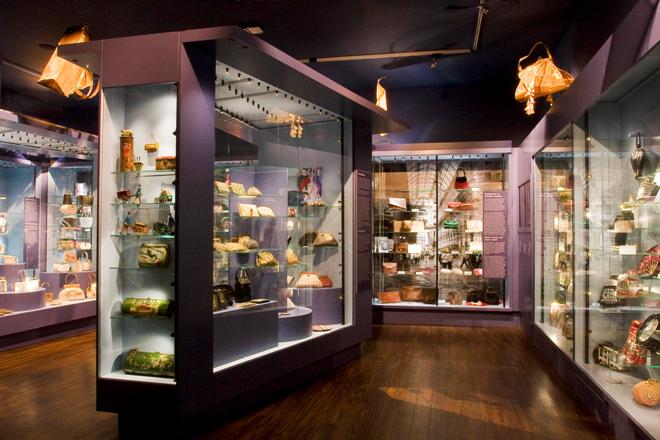
 The Tassenmuseum, AmsterdamIt’s always fun to sneak a peak inside someone else’s hand bag. Especially when the hand bag belongs to royalty. That is exactly what visitors get to do at the latest exhibit at Amsterdam’s Museum of Bags and Purses (Tassenmuseum). The exhibition “Royal Bags: Bags of European Royal Families” (on until 26 February) displays bags and purses that belonged to Queen Victoria and Queen Elizabeth I; Empress Sisi of Austria, Princess Grace of Monaco and Queen Elizabeth II.
Sisi had particularly well-stocked travel luggage; Princess Grace’s brown leather bag by Hermes is still produced and known by her last name: the Kelly bag. Queen Elizabeth II famously carries an ingenious little hook which is used to hang her bag from tables. Both these royals’ bags held or hold little except a handkerchief, glasses and lip stick. The Dutch Royal family is not neglected: on display are three handbags personally chosen by Queen Maxima from the former Queen Juliana’s collection. One of them, a golden handbag, has also been carried on different state occasions by Queen Maxima herself.
The display is an interesting statement on the role fashion plays in establishing status and authority. The Museum’s permanent display of bags and purses also makes a visit worthwhile. The Tassenmuseum is only one of three hand bag museums in the world, and the only one of its kind in Europe. Its collection of over 5000 bags and purses is amazing. The permanent display gives the history of the European purse from the 1500’s onwards, from a mediaeval English alms purse to an elegant Chanel hand bag. In its earliest form, mostly worn by men, leather bags with drawstrings were worn from belts to carry objects like coins, gaming pieces, combs or religious relics. The oldest bag in the collection is on display, a goatskin bag with 18 compartments (some of them secret), worn by a 16th century man in France.
By the 17th century pockets began to appear in men’s clothing, so it was women who mostly used bags, to carry money, sewing equipment, keys, combs and writing tablets. One of my favourite objects on display is a rare pair of stocking purses—beautifully embroidered pear-shaped bags (usually of cotton or linen), with strings so they could be tied around the waist. A woman would wear these bags under her skirt, on each hip. There were slits in her skirt to allow access to the bags. I also enjoyed the beautiful nineteenth century beaded bags. In the early nineteenth century these bags were knitted with glass beads (usually from Czech or Bavarian glass factories). Fifty thousand beads had to be strung in the right order before knitting began, so as to produce the right design. No wonder each bag took about two weeks to complete. By the end of the nineteenth century it became cheaper to weave such bags. The bags were still beautiful—and practical, just as today’s bag. The Tassenmuseum’s collection is on-line, with information in both Dutch and English: www.tassenmuseum.nl
Shelley Anderson, 19 February 2017


