


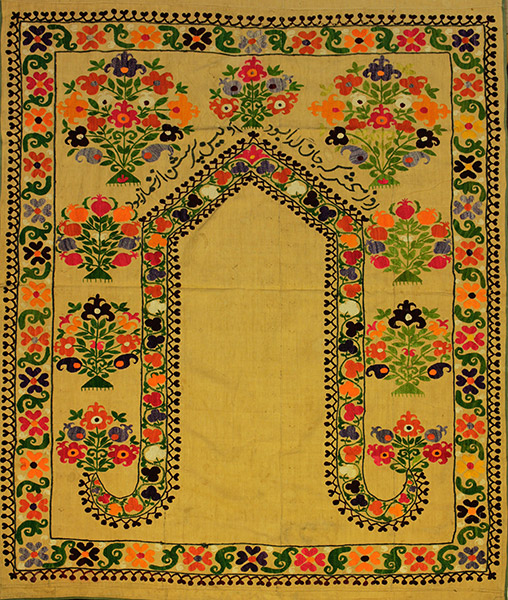
 Embroidered prayer mat from AfghanistanLast night (19th January 2017) Willem and I attended the official opening of a beautiful exhibition about embroidered and woven textiles and garments at the Brunei Gallery (SOAS) in London. The exhibition is called "Embroidered Tales, Woven Dreams" and was curatored by Marian Bukhari. It will be on display until the 25th March 2017. The exhibition includes a wide range of textiles and garments from Afghanistan, Central Asia, the Indian subconintent, as well as the Middle East. The chance to see such a wide range of objects in one location is worth an applause and a visit to the exhibition.
Many of the items on display come from Marian Bukhari's personal collection, as well as several other private collections. The exhibition is designed to show the lives of various groups whose ancestors lived along the famous Silk Road. The stated aim of the exhibition is to tell the story of these people (past and present) and how as their: "embroideries flourished, they became a record of their history, social customs, folk tales and myths as heredity wisdom and skills were passed down from mother to daughter in an attempt to guard their techniques and traditions in textiles."
The exhibition is displayed on three floors of the Brunei Gallery and includes a series of regionally dressed mannequins, a wide range of embroidered textiles (hanging and on panels), paintings, manuscripts, as well as stylised, life-sized cut-outs of camels and oxen (which may sound a little strange but they do add to the atmosphere of the exhibition). There is also a series of tableaus that depict various groups, such as a large 'orange' room with a tableau featuring what appears to be a wedding group. I say what appears to be with a degree of caution because when we were there there were no text boards yet in the exhibition that explain individual groups or objects, which was somewhat disappointing. Text boards with the very general line of "Afghanistan", "Indus" etc, are present, but nothing else.
As noted by Marian Bukhari in her opening speech, she wanted the individal embroideries to speak for the women who made the objects (although in some cases some of the items on display were probably made by men in professional workshops, rather than by women at home). There were also technical problems with the exhibition because of the delay in the arrival of essential display materials and many items that should have been displayed were not presented on the opening night. I understand that next week all the items will be displayed and information about the individal items will be added to all of the pieces as they are not only beautiful and a feast for the eyes, but, as stated by Marian Bukhari, they also have stories behind them and I would dearly love to 'hear' some of these stories as well.
Giliian Vogelsang-Eastwood, 20 January 2017


