


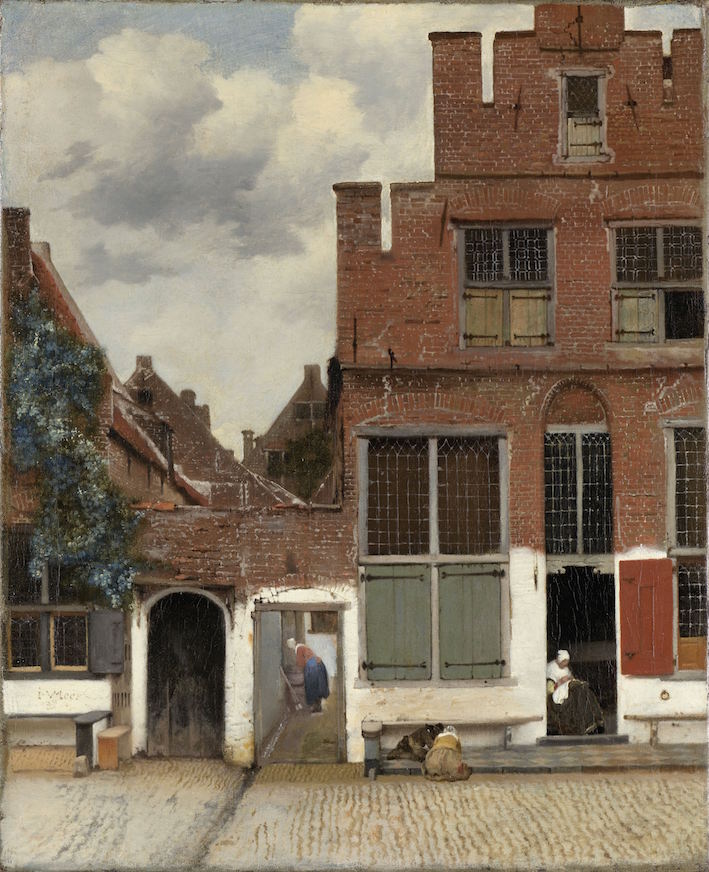
 The Straatje van Vermeer (1632-1675). Courtesy Rijksmuseum Amsterdam, acc. no. SK-A-2860.The last week has been very busy for various reasons. We have been running, for example, the October Intensive Textile Course. There were eight participants (the maximum we accept for each course), including colleagues from the London Museum, the Hermitage Museum (St. Petersburg, Russia) and Yale University (USA), as well some American and Dutch lovers of textiles.
The week went very quickly as we studied, investigated and discussed a range of practical subjects (fibre identification, spinning, dyeing, weaving, etc.), as well as looking at a wide range of textiles from Europe, India and Indonesia (and other regions and countries between). Because the current TRC exhibition is about European embroidery, we spent time really looking at the objects on display and discussing how they were made, worn and regarded. The course will be repeated from 13-17 March 2017 (three places left) and again from 10-14 April 2017 and from 16-20 October 2017. For more information, click here.
This week was made more complicated because we had a donation of Dutch urban clothing coming in from a family in Wassenaar. The items included many garments and accessories from the 1910’s to the 1950’s, including a number of 1920’s cloche hats, as well as a range of early 1940’s outfits, shoes and hats. One of the course participants, a specialist in European twentieth century fashion, proved a great help in selecting and identifying the garments !
Beacuse of this and other donations and acquisitions, the nature of the TRC collection has been changing tremendously over the last few months, and we are working hard on getting more and more items on-line (click here) so that people around the world can share this amazing and diverse collection.
We also reached the amazing number of 2200 entries for the digital needlework encyclopaedia, TRC Needles. Click here to have a look at this fascinating collection of brief articles on a wide range of subjects that relate to decorative needlework, from materials, tools, embroidery stitches, to books, films, poems, paintings, samplers, and regional styles from around the world. Read here for instance about the famous 'Straatje van Vermeer' painting, by Johannes Vermeer (1632-1675), now in the Rijksmuseum in Amsterdam. The woman to the right, in the door opening, is probably making bobbin lace! Or would you like to read about St Clare, the patron saint of embroiderers?
And last, but by no means least, the current TRC exhibition about European embroidery is attracting more and more visitors. And, if I may say so myself, it is a beautiful exhibition that will inspire you to find out more about the techniques, designs and history of European decorative needlework.
Gillian Vogelsang-Eastwood, 22 October 2016


