


Today, Saturday 11 June, we travelled to Bamberg, a large, medieval city in southern Germany, about two hours by train from Regensburg. Here we went straight to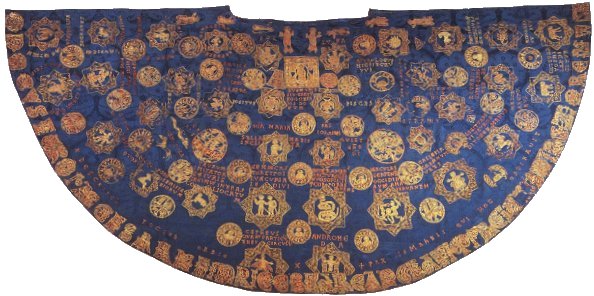 The Sternenmantel of Henry II, early 11th century. Bamberg. the Diözesanmuseum in order to see the mantles and other garments associated with the Holy Roman Emperor Henry (Heinrich) II and his wife, St. Kunigunde. They reigned in the early eleventh century. The museum also houses various papal garments associated with Pope Clement II who died in 1047 (his tomb is the only papal burial north of the Alps).
On display in a separate room in the museum there are three mantles and one cope (called a pluvale here in Germany), all related to Henry II and his wife, Kunigunde. These are the famous Sternenmantel, the so-called Knights mantle (Rittermantel), the Great Mantle of St. Kunigunde, and the Cope of St. Kunigunde. The same room also contains a bell-shaped chasuble and a tunic especially associated with St. Kunigunde. All the garments date to the early eleventh century, although they have been heavily restored over the centuries.
To actually go and see the Sternenmantel, as well as St. Kunigunde's Great Mantle, and the Knights mantle was something we had wanted to do for several years, and it was well worth it. The silk and gold thread embroidery is spectacular.
The Clement items, which were recovered from his sarcophagus in 1942, included various silk, silk damask as well as other woven textiles, such as a pair of stockings (better: buskins) made from a very fine damask silk, and a large, pontifical dalmatic. Many of these silks have been given a Byzantine origin.
And of course in the Bamburg treasury is the famous Byzantine wall hanging depicting two women flanking an emperor on horseback, which also comes from the tomb of Clement. The Bamburg museum also contains liturgical vestments from various periods, as well as an amazing collection of medieval wood and stone sculptures, wood carvings in general and metal items such as reliquies and items for on the alter. Well worth a visit.
Gillian Vogelsang-Eastwood, 11 June 2016


