


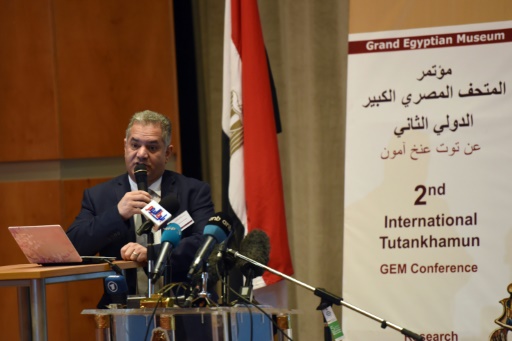
 Mamdouh al-Damati, former antiquities minister of Egypt, speaks at the Tutankhamun Grand Egyptian Museum, 8 May 2016.The last few days have been spent in Cairo. I was invited to attend the 2nd Grand Egyptian Museum (GEM) conference about Tutankhamun and to give a lecture about the embroidered and beaded garments from the tomb of the young king. Prof. Olaf Kaper (Leiden University) and I gave lectures on different aspects of the textiles and garments associated with Tutankhamun. There were also other lectures about the textiles, notably by Issam Ezzat, Hamza Nagm and Mie Ishii, who all discussed different aspects of the conservation of the textiles. There was also a very interesting talk by Christian Eckman on the damage and repair of the golden mask. And Jan Picton (UCL London) talked about the textiles from Gurob and how some of the 'missing' garments of Tutankhamun may have looked like.
The second day of the conference was dedicated to jewellery and other items from the tomb, such as the wide variety of plants. The third day was full of fireworks as it included Nicholas Reeves and Zahi Hawas (who was in combative mood). The basic upshot was that there is no conclusive evidence that there are more rooms associated with the tomb of Tutankhamun.
Yesterday, Monday, was spent looking at some textiles and talking with colleagues at GEM, and then a visit to the Egyptian Museum to look at the Tutankhamun textiles still on display there and to talk with conservation staff about their work. Most enjoyable, and it meant I had time to look at certain textiles in detail to check facts, confirm the (minute) size of the glass beads used for various garments and to ponder how to make replica garments, and indeed that always presents the question how to pay for them (a team of specialist weavers, embroiderers, etc is already in place). There then followed a short interlude in the academic thought process via an ice cold hibiscus drink in the garden of the Marriott hotel on Zamalek (as I said life can be so hard).
Today I go back to the Egyptian Museum to check even more details about the Tut textiles and to give a talk to the conservation staff about the Tutankhamun textiles and garments in general. And then a wander around the museum to look at some more textiles and beaded garments. Later in the day I will see a friend in Cairo who has the most amazing collection of Egyptian regional dress dating from the 19th and 20th centuries.
Gillian Vogelsang-Eastwood, 10 May 2016


