


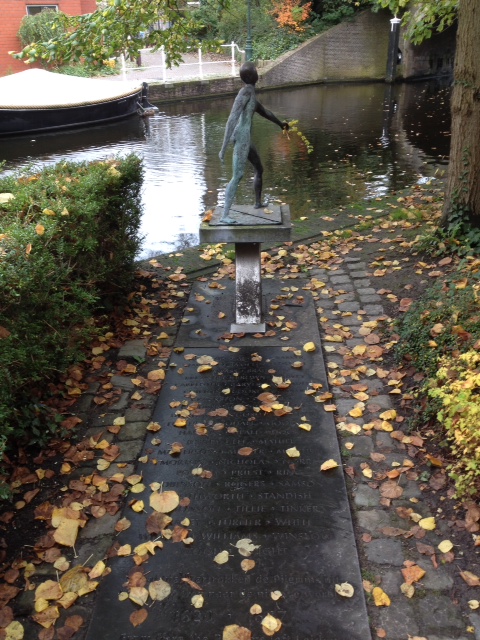
 Monument in Leiden along the Vliet, marking embarkation point of the Pilgrim Fathers leaving Leiden for Plymouth, and hence to America, in 1620.I have lived on and off in Leiden for more than forty years, and regularly take groups of foreign friends and colleagues through this beautiful town. Perhaps it helps that my office is right in the centre of town, along the magnificent Rapenburg canal. When doing so, I always tell people about the (English) Pilgrim Fathers who in the early seventeenth century fled to Leiden and lived here for some time before boarding the Mayflower and sailing to America. I show them the places where they lived, and died. I also show them the various plaques in Leiden dedicated by American descendants to commemorate the stay of their ancestors (real or imaginary) in my town.
Two weeks ago I walked with one of my colleagues along the canals. I noticed a new monument, marking the spot where in 1620 some 102 Pilgrim Fathers boarded a boat to take them to the nearby North Sea, and ultimately to America. The monument also bears the names of the families that were involved. I spotted one name in particular: Standish. I had been looking for references to that man for some time. I knew he was one of the Englishmen who stayed in Leiden and left for America. He was called Myles Standish, and he eventually became the military commander of the new colony, a function he held until his death in 1656. He is, you will be thrilled to know, the main character, although highly romanticised, of Longfellow's narrative poem, The Courtship of Myles Standish (1858).
But what has this to do with textiles? Myles Standish was the father of Loara Standish, who was born in America and died before 1655. Around 1640 she made a sampler which has become the oldest extant example in the USA (for more information, click here). It is now kept in the Pilgrim Hall Museum, Plymouth, Massachusetts. It is embroidered on fine linen (c. twenty threads per cm) using blue, green, pink and red silk thread. It is 60 x 18.5 cm in size. The sampler is decorated with bands of stylised flowers (roses and carnations), acorns and intertwined ‘s’ designs. Stitched at the
bottom is:
"Loara Standish is my name Lorde guide my hart that I may doe thy will also My hands with such Convenient skill as may Conduce to virtue void of Shame and I will give The glory to thy name."
Loara Standish is believed to have died young, but exactly when is unknown. She lies buried, as far as can be ascertained, in the Myles Standish Burial Ground, Duxbury, Massachusetts, USA. The sampler was kept in her brother Josiah’s family until it was donated to the Pilgrim Hall Museum in Plymouth, Massachusetts in 1844.
Willem Vogelsang, 28 October 2015


