


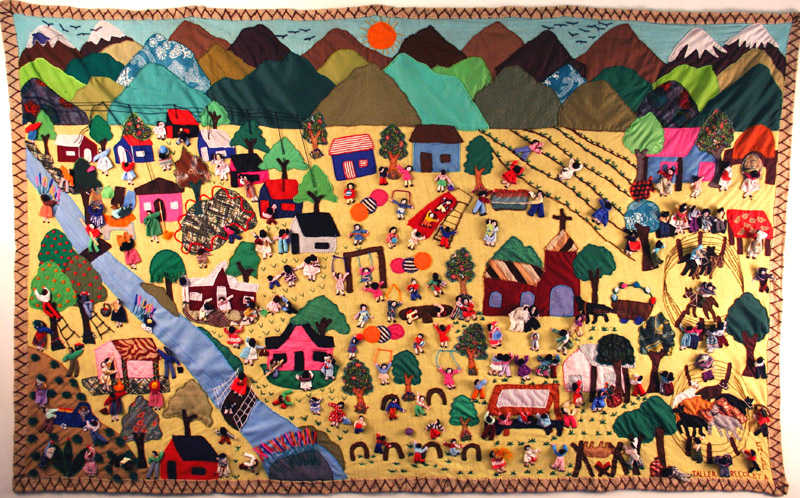
 Example of an arpilleraA workshop on arpilleras was offered recently during a festival on adult education, in Lelystad (the Netherlands). The festival also featured an exhibition of approximately 25 arpilleras, from Chile, Colombia, England, Northern Ireland, Peru and Zimbabwe. Workshop leader Roberta Bacic explained that arpilleras are a South American folk art, which uses colourful appliqués, patchwork and embroidery to depict scenes of everyday life. Small, three-dimensional cloth dolls are a common feature.
Arpilleras are not intended for practical use: the borders are blanket stitched or edged with crochet or a colourful fabric, so that the pictures can be hung on walls. The word arpillera comes from an old Spanish word for burlap, as most of these cloth pictures were originally sewn on a background cloth of burlap or flour sacking. The most famous arpilleras and arpilleristas (the women who make them) are from Chile. “Arpilleras are really an art of poverty,” Roberta explained. “They were originally made from scraps and pieces of used clothing. They were made by poor women working in groups. The conversations the women had while sewing together helped create a sense of sharing and of solidarity.” That solidarity was essential for survival.
In the 1960s there was a cottage industry in Chile of arpilleras depicting happy domestic scenes. These were made from colourful woolen yarns. The military coup of 1973 changed this. Unemployment grew, wool became scarce, and opponents of the Pinochet military dictatorship (1973-1990) began to disappear or be detained. Families of the disappeared (‘desaparecidos’) were banned from many jobs and refused hospital services. Poor women in and around Santiago began making arpilleras in an income-generating project organized by the Roman Catholic Church’s Vicaría de la Solidaridad. Church workers donated clothes as fabric for the appliqués, paid for the finished arpilleras and organized their sale. Many of the women were members of the group Agrupación de los Familiares de los Detenidos Desaparecidos (AFDD), an association for families of people illegally detained and made to disappear by the regime. The women gathered once a week at different workshops and chose a theme to embroider, which they began at the workshop and finished at home. There were rules: torture scenes could not be depicted; the Andes mountains were usually stitched in the background as a symbol of Chile; only one arpillera a week per woman was accepted. If a woman needed more money, she was allowed to make two arpilleras per week. Work was unsigned in order to protect the maker's identity
Over 250 women became involved in the project. The women talked in the workshops about the trauma of missing husbands, sons and daughters as they embroidered the stories of their lives: communal kitchens to feed the hungry; demonstrations in front of police stations or government buildings where women held photographs of their loved ones and demanded information as to where they were; police raids on homes; a family sitting around a table, with an empty chair. The Church smuggled thousands of arpilleras out of Chile for sale elsewhere. The textiles helped raise awareness of the human rights abuses taking place inside Chile. As criticism of Pinochet increased, the government made it illegal to own or publically show arpilleras.
Shelley Anderson, 28 September 2015


