


Can you believe it? Neither could we!
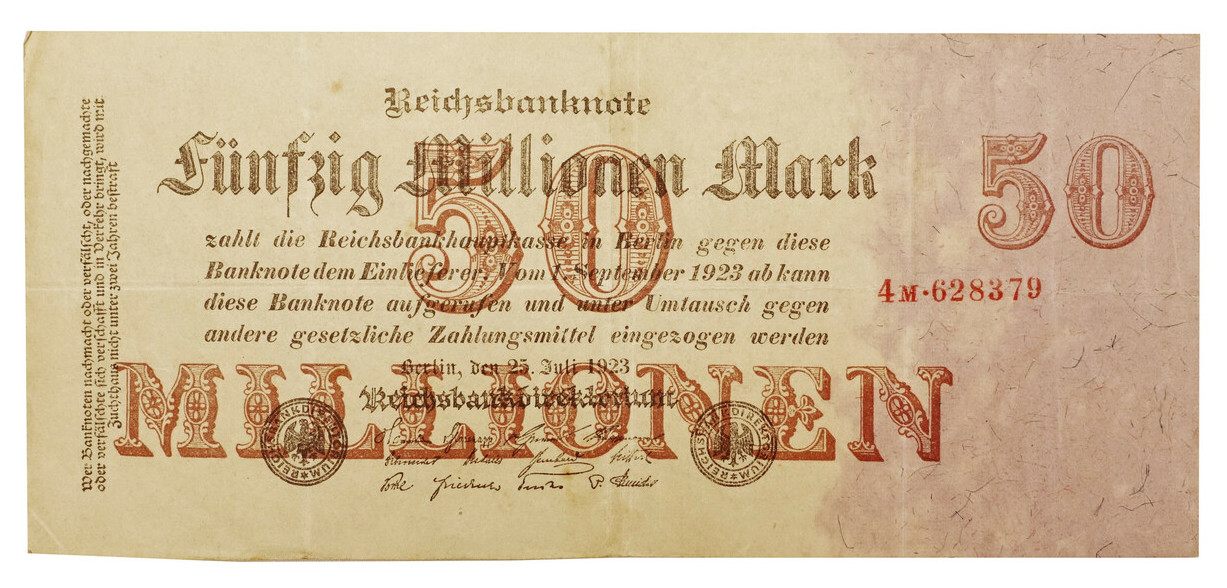 Obverse of paper 50,000,000 mark banknote, Bielefeld, Germany, 1923 (TRC 2022.2255).
We sometimes talk about the 'TRC effect', whereby the things we wish for tend to come through the door in a matter of days. Well, the fifty million was certainly on our wish list for some time. And there it was, in a fashion, on paper. And have you ever seen legal tender made from embroidered silk or printed linen before?
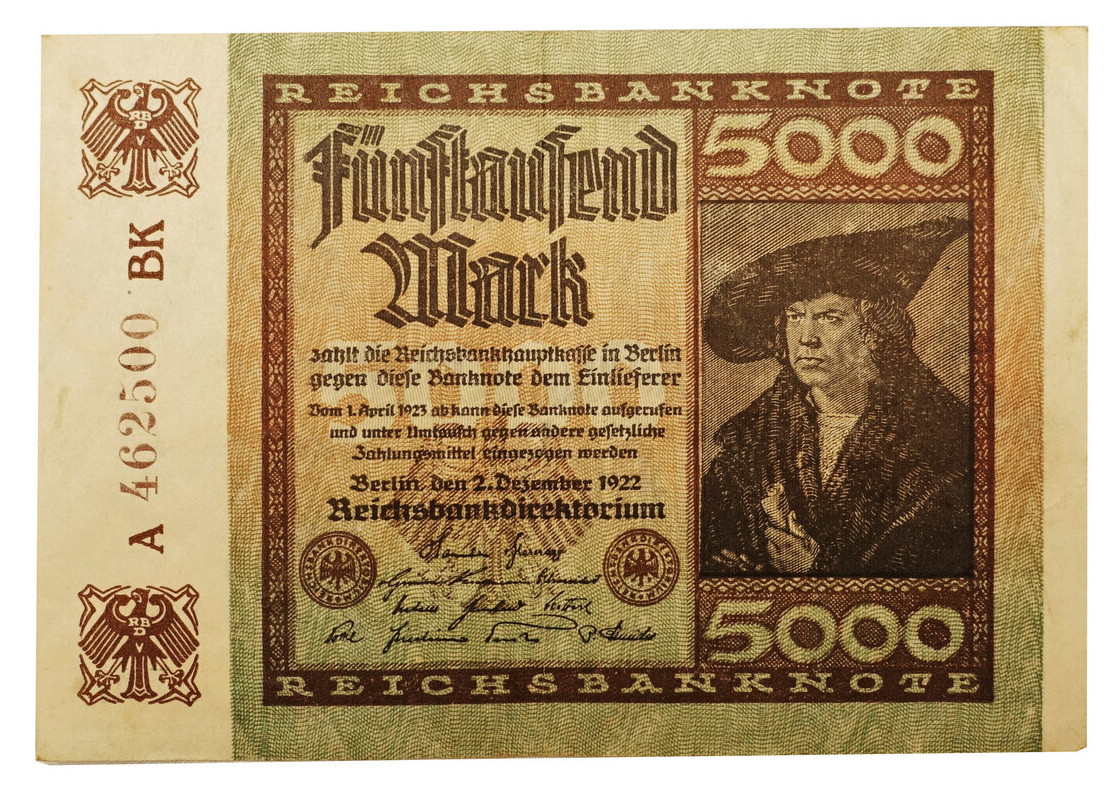 Obverse of paper 5,000 mark banknote, Bielefeld, Germany, 1922 (TRC 2022.2254).A recent donation by Professor Olaf Kaper to the TRC included two fabric banknotes minted by the Stadtsparkasse Bielefeld bank in Germany to celebrate the city's 700th anniversary, in 1921. There was also a 1923 paper German 50 million mark banknote and a 1922 paper 5000 mark banknote.
Kaper’s mother, Mrs Antje Terpstra - van der Veer, ran a curiosity shop in Amsterdam in the 1950s where she sold collector's items, and the banknotes now donated to the TRC were part of her stock.
After World War I, citizens of Germany faced a difficult period dealing with the various ramifications the war had on the economy, but also their sense of nationalism. Reparations demanded by the Allies caused serious inflation, and in 1921 Germany saw the beginning of a two-year period of hyperinflation where money became so worthless some used it as fireplace fuel. This means even fifty million mark banknotes would be useless.
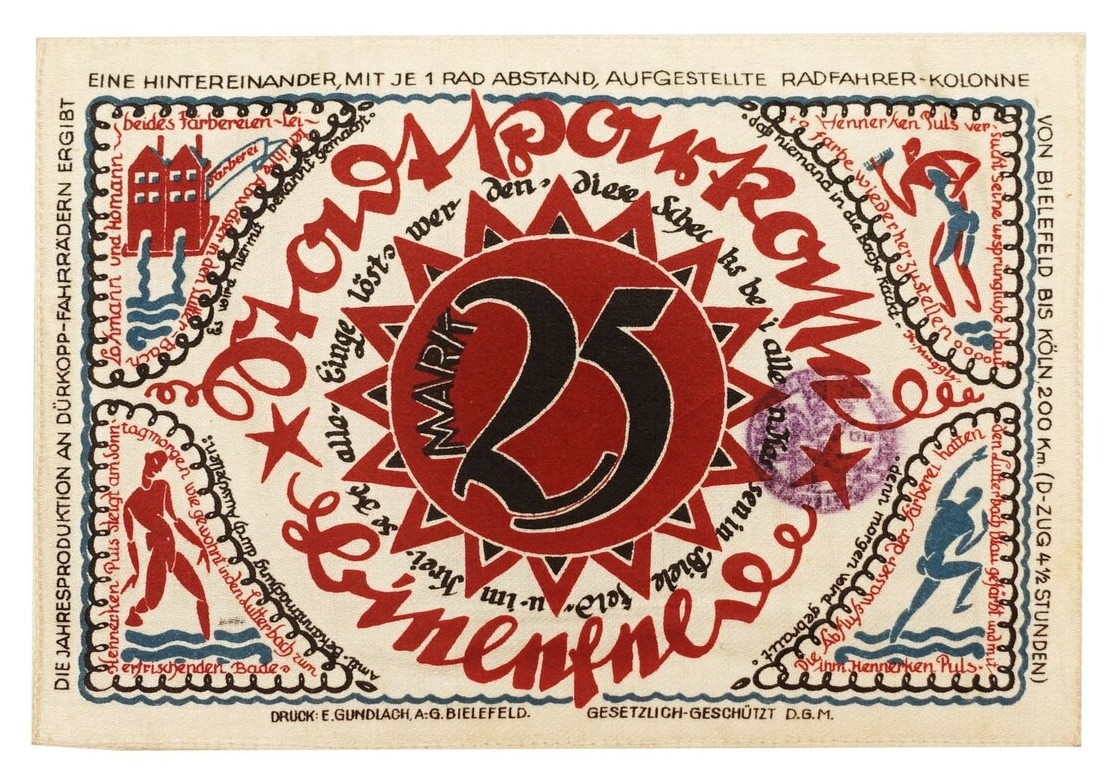 Obverse of cotton and silk 25 mark banknote, Bielefeld, Germany, 1921 (TRC 2022.2253).Locals in Germany began to produce their own currency called Notgeld even before World War I, but it did not catch on until afterwards. With inflation, coins became more valuable for their material than for their denominations, and metals were needed for war supplies which made banknotes more common. Notgeld is an emergency currency for when the state cannot provide enough banknotes for ever increased denominations. It usually has an expiry date either printed on the currency or announced publically.
Notgeld banknotes have hundreds of different colourful designs and many feature regional landmarks and folklore, which make the currencies appreciated by the local populations. The designs also often featured political propaganda and were one method for upper class elites to express discontent at the treatment of Germany by other countries.
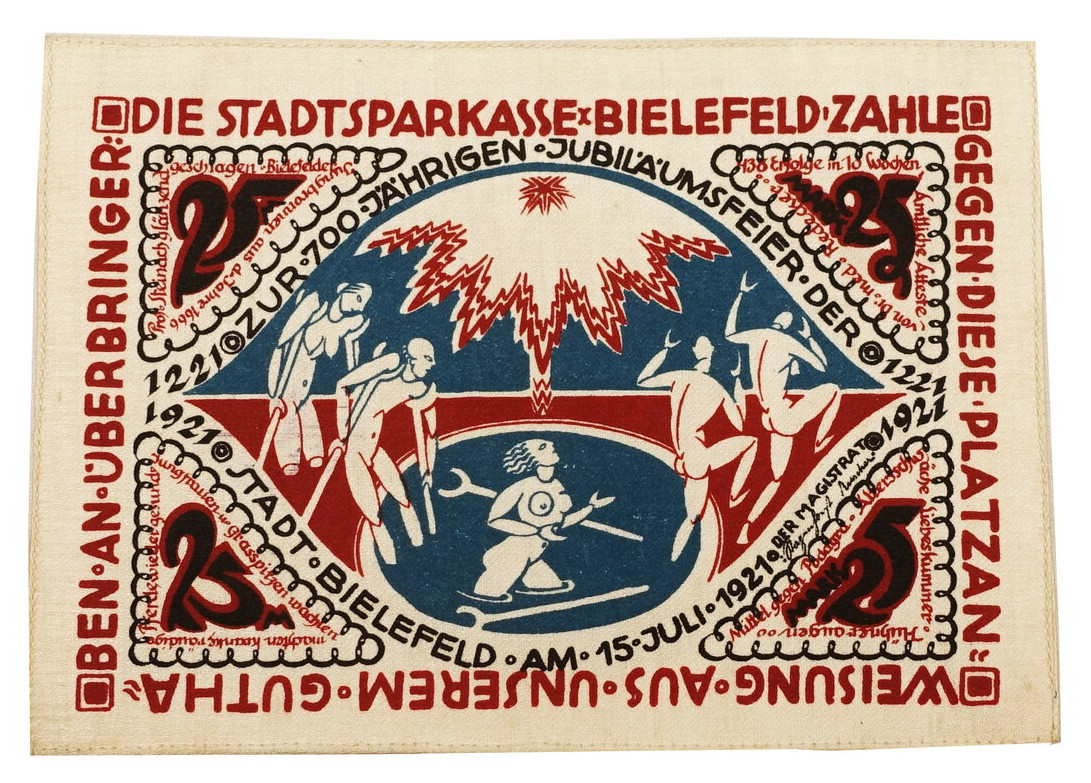 Reverse of cotton and silk 25 mark banknote, Bielefeld, Germany, 1921 (TRC 2022.2253).One such town that produced its own Notgeld was Bielefeld, a city in the Ostwestphalen-Lippe region in North Rhine-Westphalia.
Bielefeld is a city with a similar history to that of our own small town of Leiden. Bielefeld also has a large textile history and was mainly known for producing silk and linen. In the 1920s the Bielefeld bank produced a type of Notgeld called Stoffgeld ('cloth money') because it was made from fabrics such as linen, silk or velvet. The notes were factory produced and quickly flooded the market with more and more designs.
The linen 25 mark note in the TRC collection (TRC 2022.2253) on the obverse depicts the story of searching for the fountain of youth. On the reverse side on the upper left is a dyeworks factory pouring blue waste into the Lutter creek bordered by this red text in German: Lohmann und Homann - beides Färbereien - Leiten ihre Abwässer in den Lutterbach ('Lohmann and Homann - both dye works - direct their waste water into the Lutterbach').
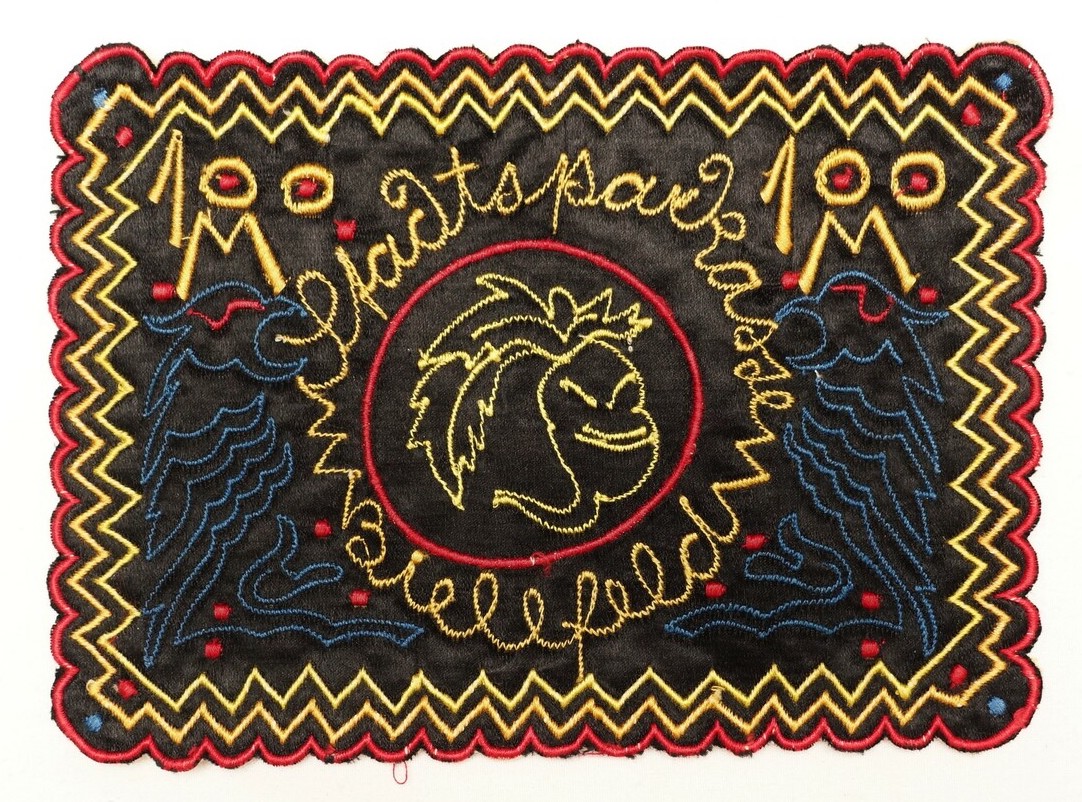 Obverse of cotton and silk 100 mark banknote, Bielefeld, Germany, 1921 (TRC 2022.2252).On the bottom left a red figure named Hennerken Puls steps into the blue waters of the creek with the text: Hennerken Puls steigt am Sonntagmorgen wie gewohnt inden Lutterbach zum erfrischenden Bade ('Hennerken’s pulse rises as usual in the Lutterbach on Sunday morning for a refreshing swim').
On the upper right the story continues and Hennerken’s body is now partially stained blue as he frantically tries to wash it off Th text says: Hennerken Puls versucht seine ursprüngliche Haut to farbe wiederherzustellen ('Puls tries to restore its original skin colour').
Finally on the bottom right the fully blue Hennerken now matches the Lutterbach creek. The German text tells: Die Abflusswasser der farbe hatten den Lutterbach blau gefärbt und mit ihm Hennerken Puls ('The runoff from the paint had turned the Lutterbach blue and with it Hennerken Puls').
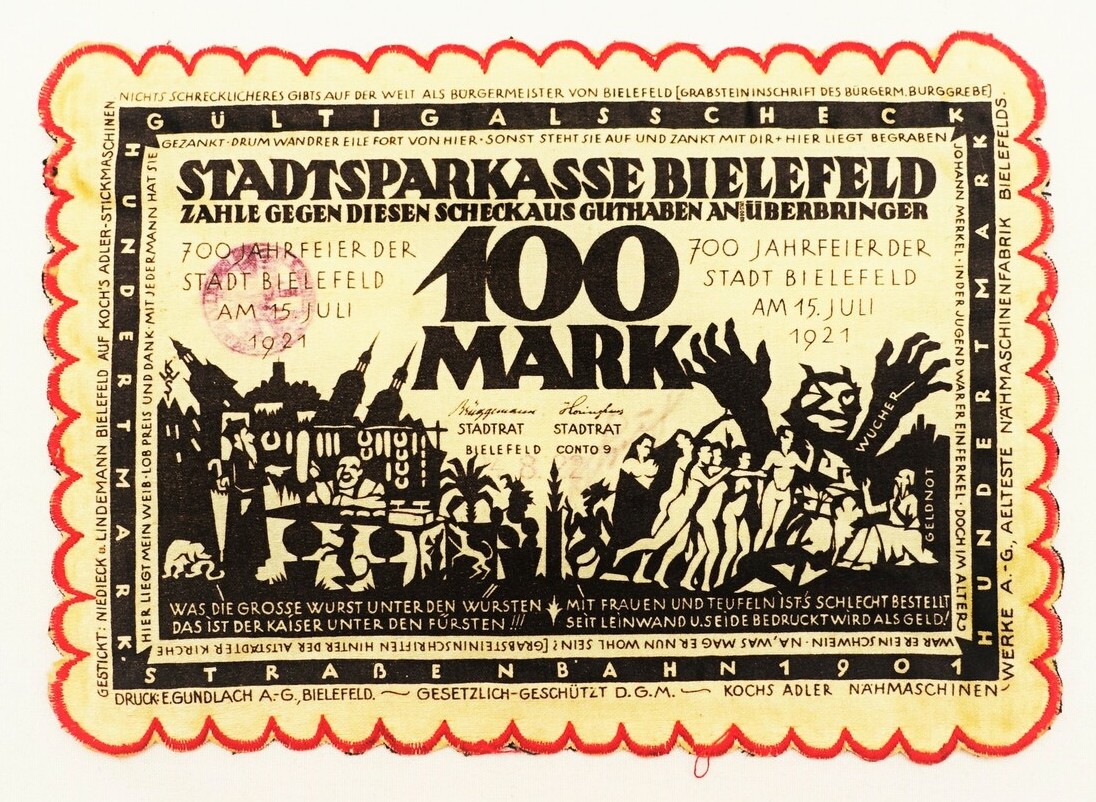 Obverse of cotton and silk 100 mark banknote, Bielefeld, Germany, 1921 (TRC 2022.2252).This note warns the dyeworks on the Lutter creek against the pollution of the water with their waste in another text in black. Es wird hiermit bekannt gemacht, daß niemand in die Bache ‚spuckt‘ denn morgen wird gebraut ('Let it be known, No one ‘spit’ in the creek. Tomorrow is brewing day').
A machine embroidered silken, one hundred mark banknote (TRC 2022.2252) shows a humanized turnip on the obverse. This symbolizes the turnips that grow widely in Bielefeld’s fields and which are also considered the most miserable food. It expresses how Germans felt crushed under the weight of the aftermath of World War I and it became a common symbol on Notgeld banknotes.
These fabric Stoffgeld banknotes were designed to be collector's items and are still popular with collectors today. The attraction of the bright and colourful Stoffgeld meant they were shipped to many countries outside Germany, a perfect medium for spreading German nationalist imagery in an easy way. After World War II, Notgeld continued to be produced in some areas due to its popularity despite the lack of economic demand. Another interesting look into the historical importance of textiles in culture, trade, and economy!
AJ Salter, 22 October 2022


