


Japanese fine glass beads are highly valued by fashion designers, artists and crafts enthusiasts worldwide. These minute beads are generally called ‘seed beads’ and were an important feature of 20th century Japanese fashion, being used for beaded bags made from the seed beads in a wide variety of colours.
The first Japanese company to produce beaded bags was Lumy Hashimoto in Osaka. Around 1920 their quality bags became popular among young women in high society who dressed in Western clothes - they were called ‘modern girls’ (moga). Beaded bags were also exported to the US and other countries. The older examples of Hashimoto bags were made using imported beads and decorated with patterns in the Art Deco style. This company kept producing beaded bags to go with both Western clothes and kimono until 2016, when they closed their business.
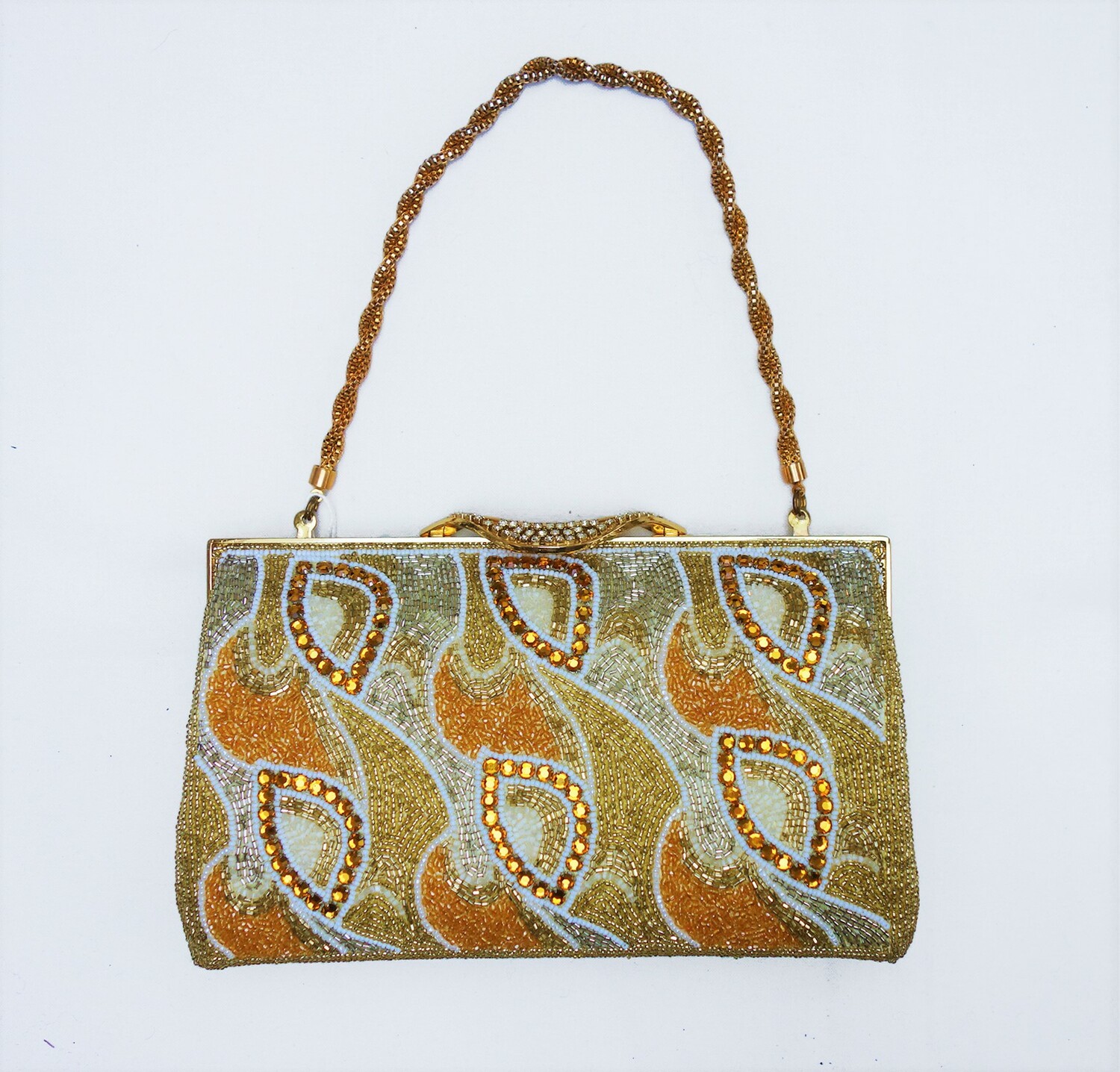 Art Deco style bag by Lumy Hashimoto, Osaka. 1960s-1970s (TRC 2021.0632).
Just after the Second World War (1939-1945) a large number of seed beads were still being bought from overseas (especially China, Czechia and India), and it was not until about 1950 that two Hiroshima-based companies, Miyuki and Toho Beads, started to produce their own seed beads. These were 1.4mm - 1.9mm in size with larger holes than the imported items, as well as being lightweight and uniform in size and shape. In general, the Japanese seed beads were regarded as being much easier to work with than the imported versions.
Making seed beads
To make these fine beads it is necessary for the glass workers to work with nearly molten glass rods that are quickly pulled and stretched into long and thin glass tubes. Then the tubes are cut into tiny bits, mixed with charcoal powder to prevent cohesion and heated again to round their edges. Finally they are washed and polished to smooth their surfaces. Some of the beads are then gilded or coloured to give more variation, depth of colour and shine. Nowadays, Japanese bead companies supply about 10,000 different types of beads.
Making a beaded bag
The embroidery on those bags was carried out by highly skilled kimono and obi embroiderers. They used the same frames for beading as they used for silk embroideries. They stitched two beads at a time, using two strings of waxed cotton threads to secure the beads firmly in place, contrary to practice in some other countries, whereby three to five beads are stitched together at a time, causing the beaded patterns to easily fall apart.
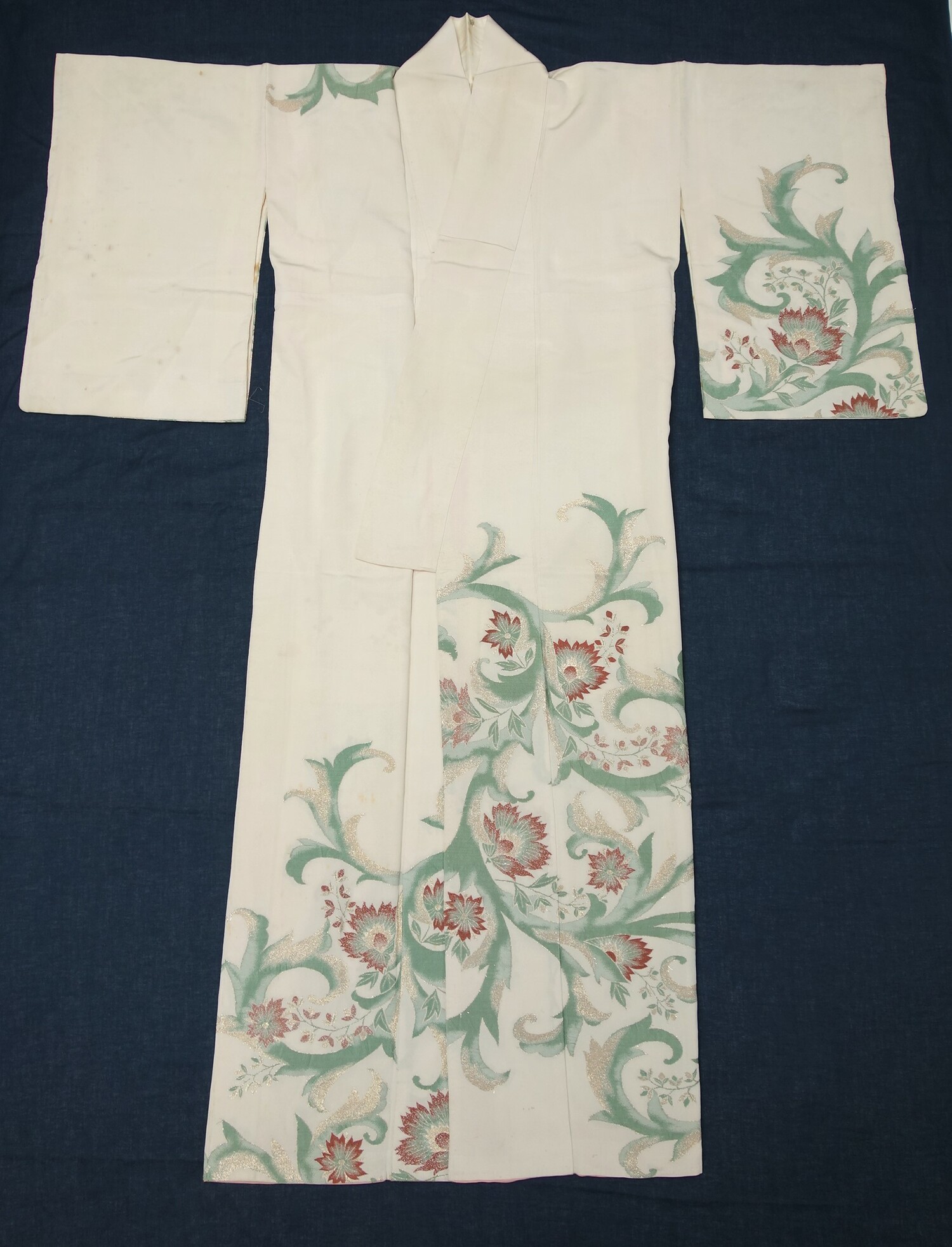 A Majolica Omeshi kimono inspired by Majorca porcelain patterns (TRC 2021.2145).
1950s and later bags
In the late 1950s, some other companies started to produce beaded bags to go with kimono for special occasions, such as weddings. These shiny, beaded bags became popular during the economic boom of Japan (late 1950s - early 1970s). By that time, most Japanese people were dressed in Western style clothing, and even some kimono were made with Western designs such as Majolica Omeshi that was inspired by Majorca porcelain patterns (see TRC 2021.2145; for a blog on this type of kimono, click here).
It is also said that Princess Michiko (the former Empress of Japan) set off a beaded bag craze by carrying one on her wedding day in 1959. Until then, Japanese did not use beads very much, apart from Buddhism prayer beads and accessories such as obi-dome (obi cord decoration) and kanzashi (decorative hair pin) .
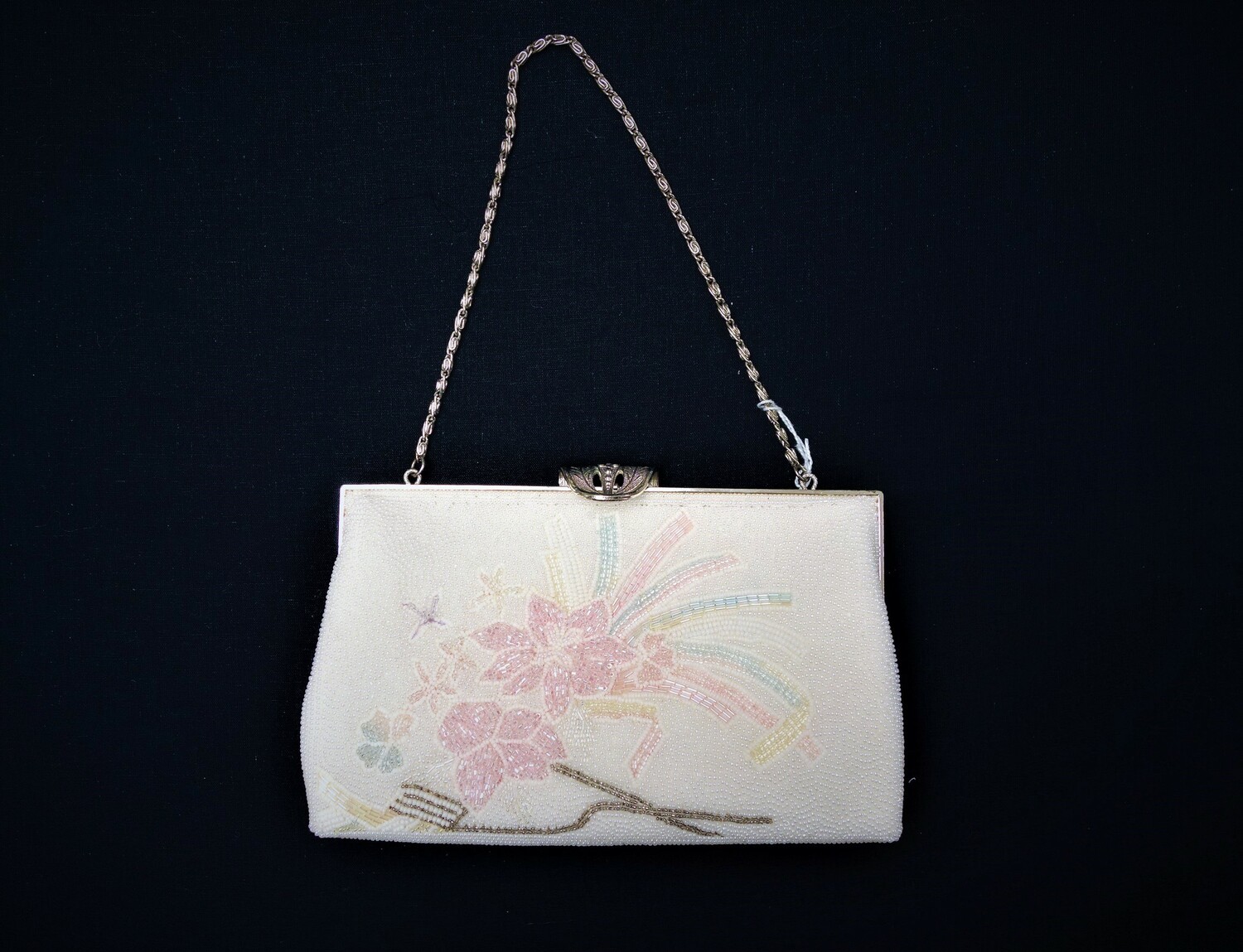 Beaded bag with a design of small flowers on a white ground, Japan, 1960s-1970s (TRC 2021.0635a).
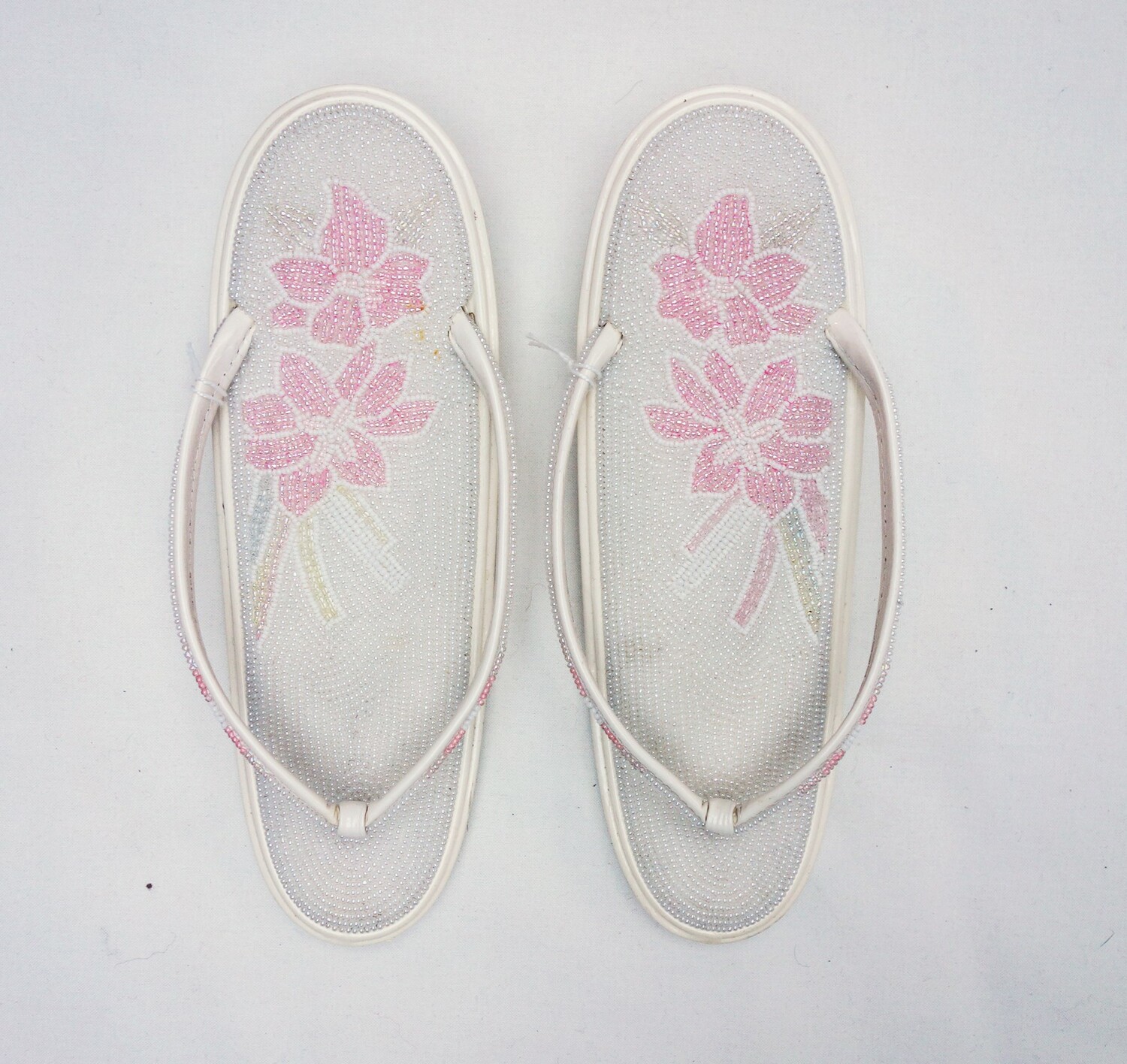 Pair of sandals with seed bead designs, Japan, 1960s-1970s (TRC 2021.0635b-c).
Patterns and motifs
The patterns of Japanese beaded bags often reflect traditional Japanese motifs for kimono and obi, as they were frequently designed by kimono/obi designers. It is noticeable that beaded bags have the main pattern in the front and a smaller one, or indeed none at all, on the back, while many obi have the patterns the other way around. Sometimes the front pattern on a bag extends to the back in the same manner as a formal kimono, hōmongi (visiting kimono) or tomesode (formal kimono for a married women). Also, zōri (kimono sandals) were often made in the same style to go with beaded bags (see TRC 2021.0635a, and TRC 2021.0635b-c).
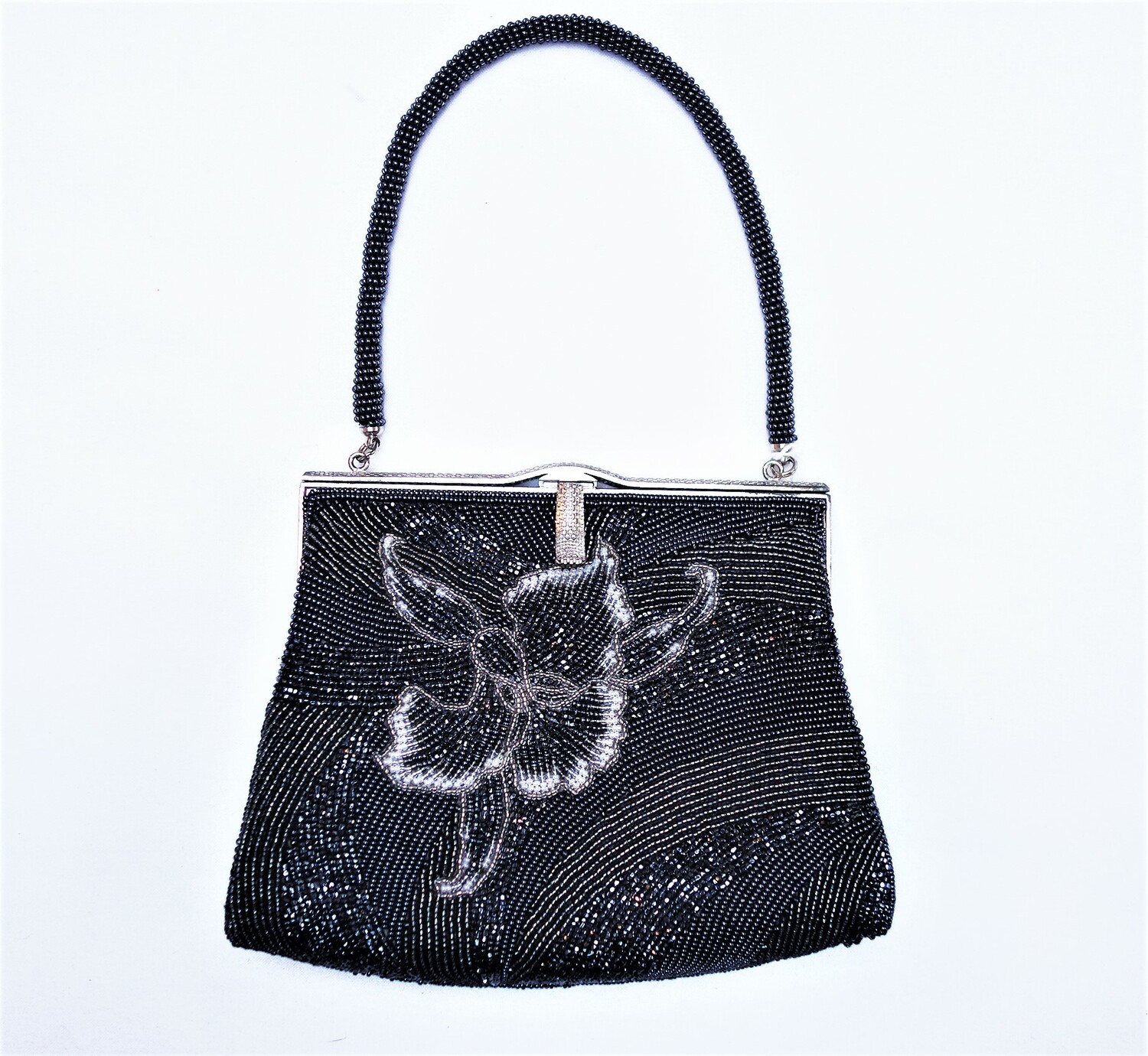 A beaded bag with a design of stylised flowers in black beads, Japan, 1960s-1970s (TRC 2021.0634).Decline of Japanese beaded bags
From the late 1970s, the demand for kimono sharply declined, and so did the demand for beaded bags. Still, some bead companies kept producing a small number of beaded bags with modern designs, such as geometric and abstract patterns or exotic flowers to go with Western dress.
Many bead companies have found new markets among crafts enthusiasts and fashion designers all over the world. In 1982, for example, a Hiroshima-based company Miyuki introduced a bead loom for ‘bead weaving’, for which Delica Beads with a cylinder shape and larger holes are used. This accessible loom gained popularity among crafts enthusiasts and fashion designers.
Today, there are only a few companies that produce beaded bags, as there are few people left who have the beading skills required for making such bags. Nevertheless, there are some Japanese embroidery ateliers who still offer classes on traditional Japanese bead embroidery for amateurs. And recently we see retro kimono come back and beaded bags to go with them are getting people’s attention.
So perhaps the skills will survive and come back in fashion!
Naoko Kikuchi, 1 April 2022


