


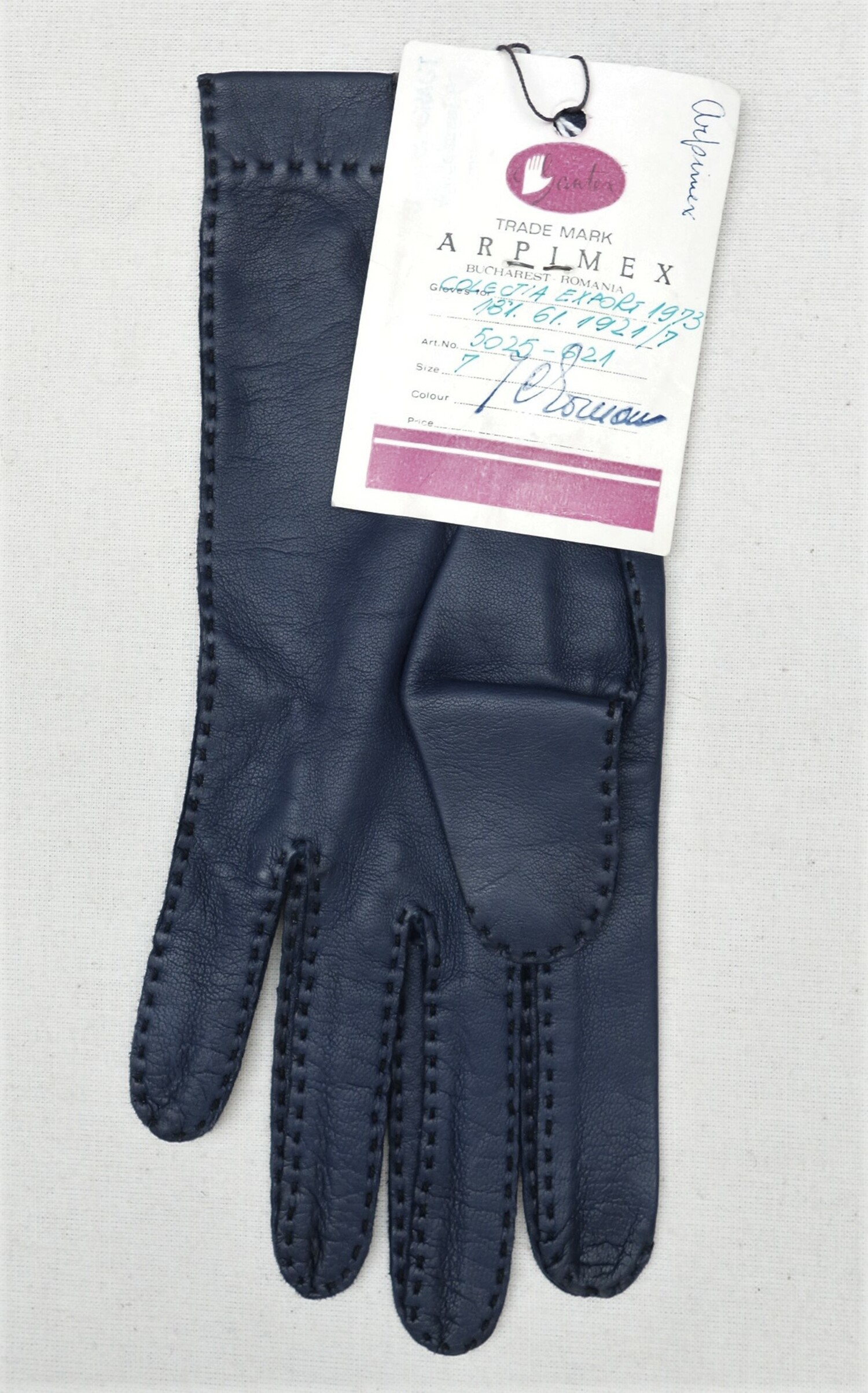
 Glove produced in communist Romania in 1973 for the West European market (TRC 2022.0820t).A few days ago the TRC was given a cardboard box filled with single gloves, not a pair in sight! The box was given by Mrs G.C. van der Poel, who is now in her 90s. Why did we accept the box and contents? Simple, because of its potential story!
The box was sent to Mrs van der Poel by the Dutch fashion company, Claudia Sträter, which is currently based in Diemen, near Amsterdam, The contents consist of 54 single gloves, most of which are made of leather in various colours, as well as being made and decorated in a variety of manners and forms. In addition, some of the glove cuffs have applied beads, embroidery (hand and machine) or inset shapes in contrasting colours. The gloves can be found on the TRC Collection database under nos. TRC 2022.0820 to TRC 2022.0823.
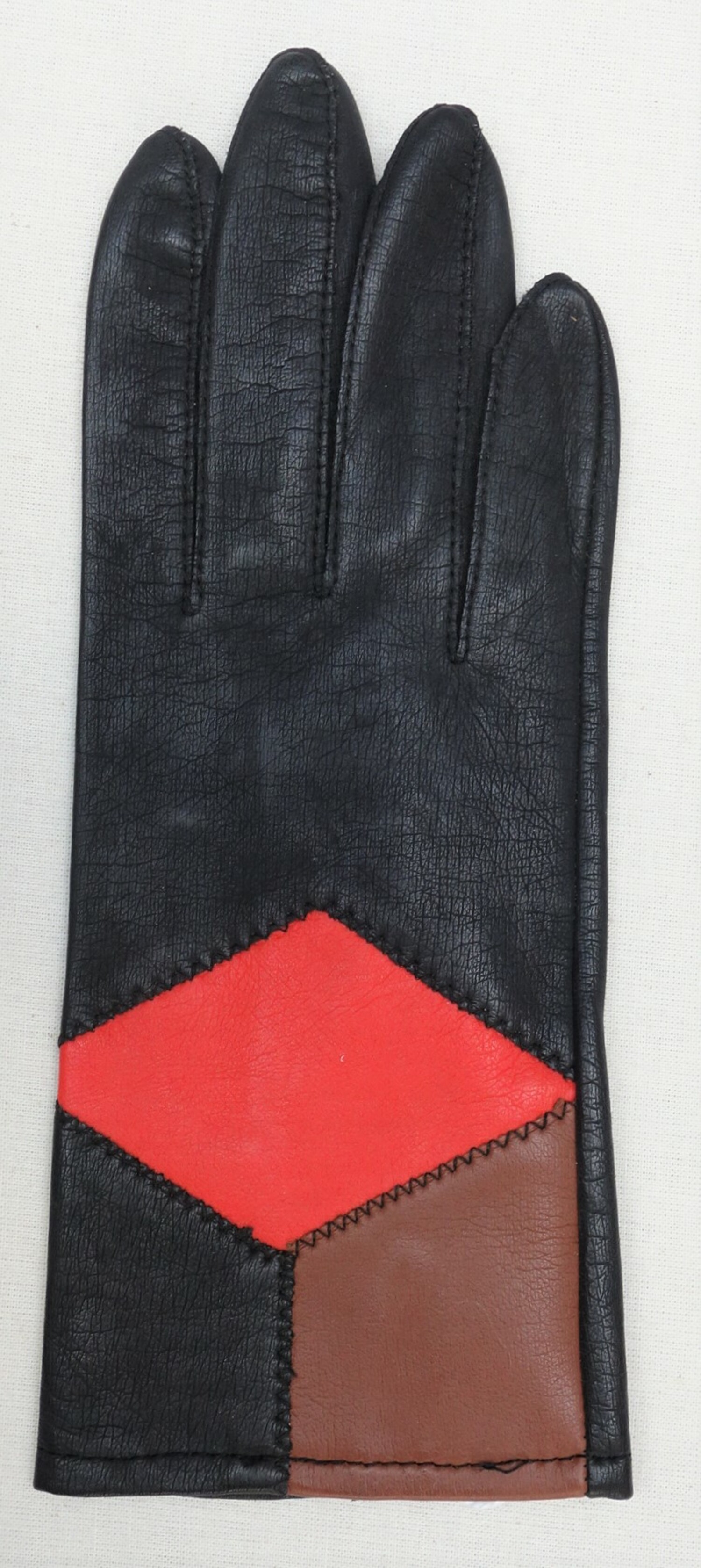 Glove with decorative inserts, produced in the early 1970s in communist Romania for the West European market (TRC 2022.0823l).Of particular interest for us, is the fact that many of the gloves have labels attached to them with the names of Gantex, a glove company in Bucharest, Romania (not to be confused with the American glove company of Gentex). The labels include hand written information, such as one of three dates, namely 1971,1972 and 1973, plus style and order numbers. The gloves come from the Arpimex, Colectia and Romano collections. On some of the labels there is a stamped name and address: ‘ C. v.d. Gragt, Vondelstraat 81, Amsterdam’.
It would appear that the gloves are a selection of trade samples illustrating a range of gloves that were sent to various fashion buyers and others with the aim of stimulating orders from Western European fashion companies and stores. They form a fascinating snapshot of the history of a fashionable accessory in the early 1970s, not only with respect to their appearance, but how they were made and how orders were generated.
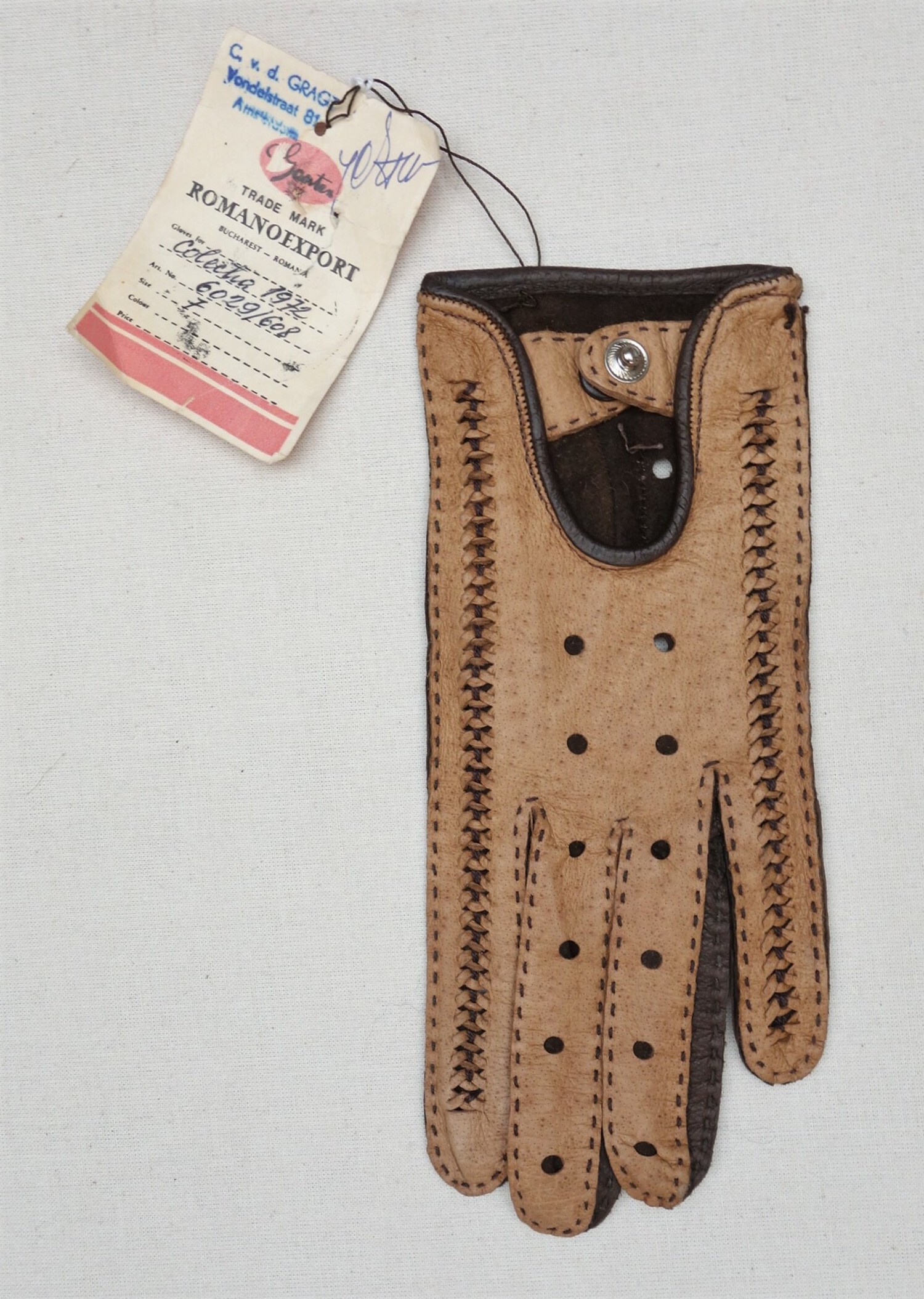 Glove from communist Romania made in the early 1970s for the West European market (TRC 2022.0821g).But there is another side to this story. Since 1944 Romania was a socialist (communist) republic and from 1955 a member of the Warsaw Pact and thus part of the Soviet (Russian) sphere of influence and behind the so-called Iron Curtain. In 1965 Nicolae Ceausescu became president of the country. He refused to allow his Romanian troops to participate in the Warsaw Pact occupation of Czecholowakia in 1968, and thus acquired much sympathy in the West, although his regime soon turned into a dictatorship with immense corruption and hardships for the people.
In the West, his regime was long seen as a weak spot in the Soviet bloc. His state visit to Britain in 1978 became a remarkable event whereby, allegedly, Queen Elizabeth hid in the bushes of Buckingham Palace gardens so as not to meet him, and when various items miraculously disappeared from Ceausescu's suite in the Palace.
When in 1989 other East European countries started the shed the Soviet Russian yoke, the Romanians rose against Ceausescu. He was eventually arrested and executed, together with his wife, on Christmas Day 1989. Romania became an independent country and eventually joined the EU and NATO, but it took years for the effects of the Ceausescu period to be healed.
It is ironic that in the 1970s a company in a strict communist country was making fashionable accessories for the decadent Western market. And, as all too often happens in many places around the world, it is likely that the people making the gloves would not have been able to afford to buy, let alone wear such items.
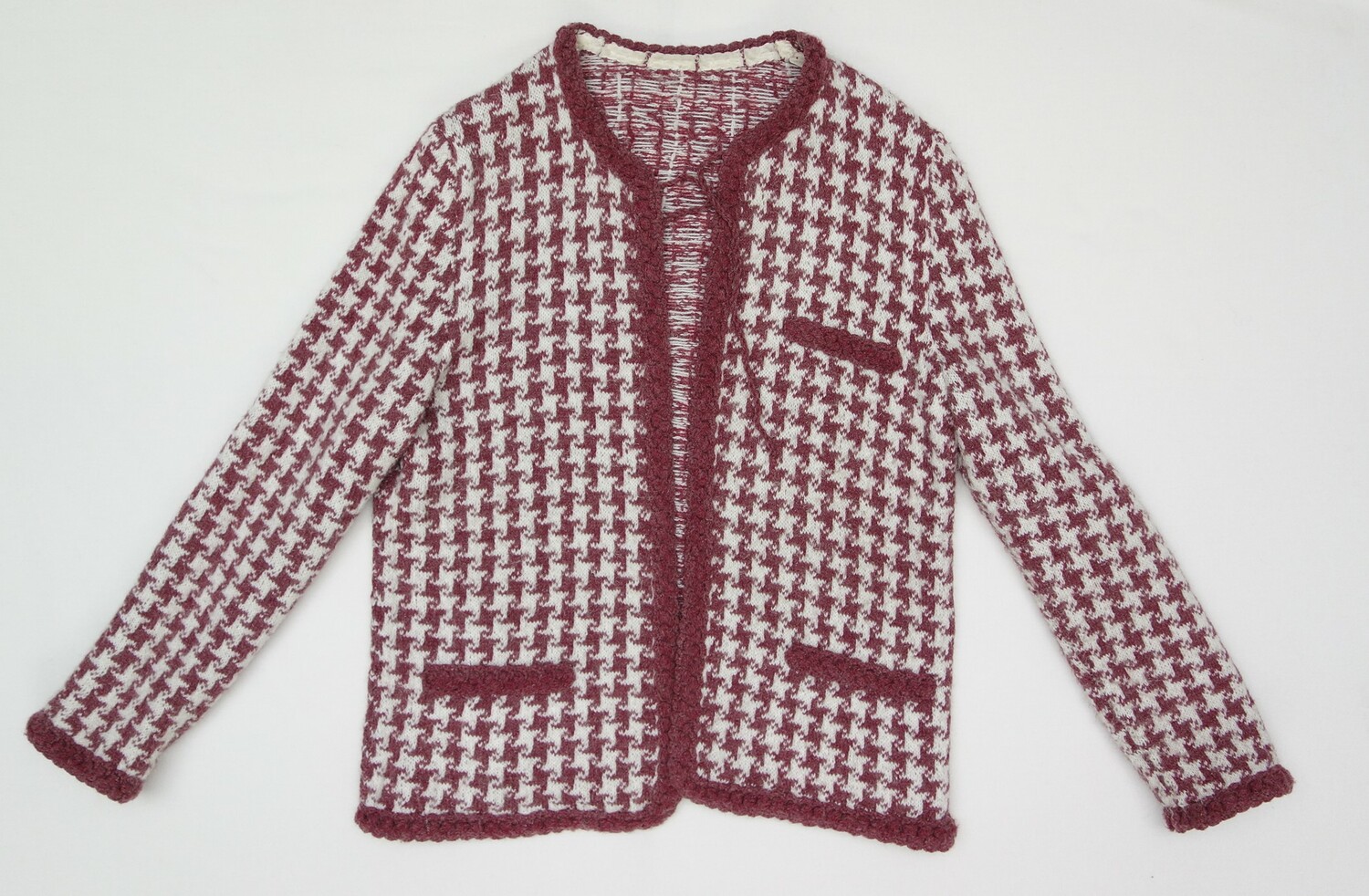 Knitted jacket produced in imitation of Chanel garment, early 1970s, Romania (TRC 2020.0347a).The Romanian situation is reflected by other textiles in the TRC Collection. In 2020 we were given a collection of hand knitted clothing by the Radu family originally from Romania, but now living in Amsterdam. By coincidence the garments date to the same period as the gloves.
The knitted garments were made by Eva Radu (1932-2019), a professional knitter who wanted to wear Western style fashionable clothing, but could not afford the prices in Romania. So she copied garments, including Chanel outfits (TRC 2020.0347a and TRC 2020.0347b) using fashion magazines that she acquired from the then equally communist countries of East Germany and Hungary. A TRC blog about these garments can be found here. So many social, political and economic stories in one box of gloves!
Gillian Vogelsang, Director TRC, 9 March 2022


