


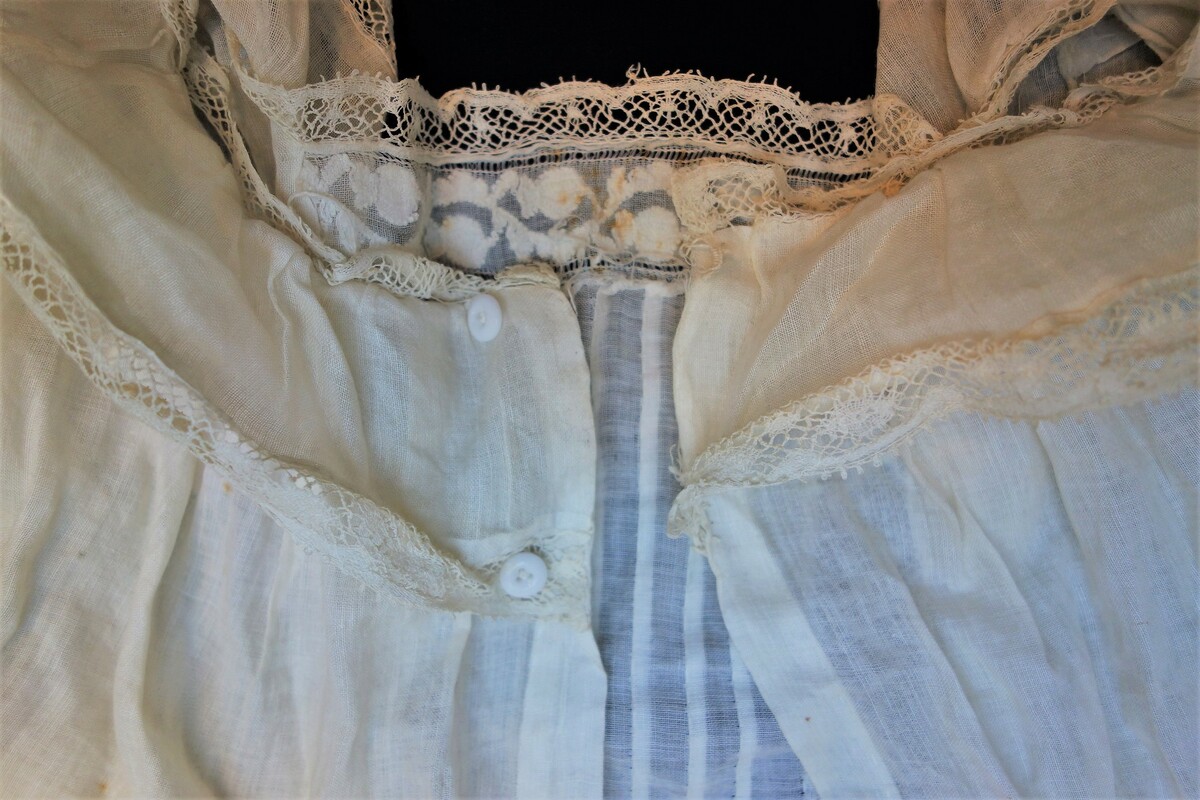
 Detail of an early 20th century baptismal gown from Friesland, the Netherlands, with shadow work embroidery in herringbone stitch along the collar (TRC 2019.0028).Shadow work is a form of needlework that is worked on the reverse side of the ground cloth and leaves a 'shadow' on the obverse, 'top' side. In order to obtain the best effect a sheer (transparent or semi-transparent) material is needed for the ground, such as chiffon or a fine batiste cotton.
There are three basic forms of this type of needlework, namely (A) embroidered, (B) appliqué and (C) padded shadow work. In addition, there are combined forms, such as shadow work embroidery with appliqué.
Shadow work started to appear in Europe in the early 18th century. The Victoria and Albert Museum, London, for example, has various examples of early and mid-18th century shadow work that was used for women’s fichus (scarves), sleeve ruffs and aprons.
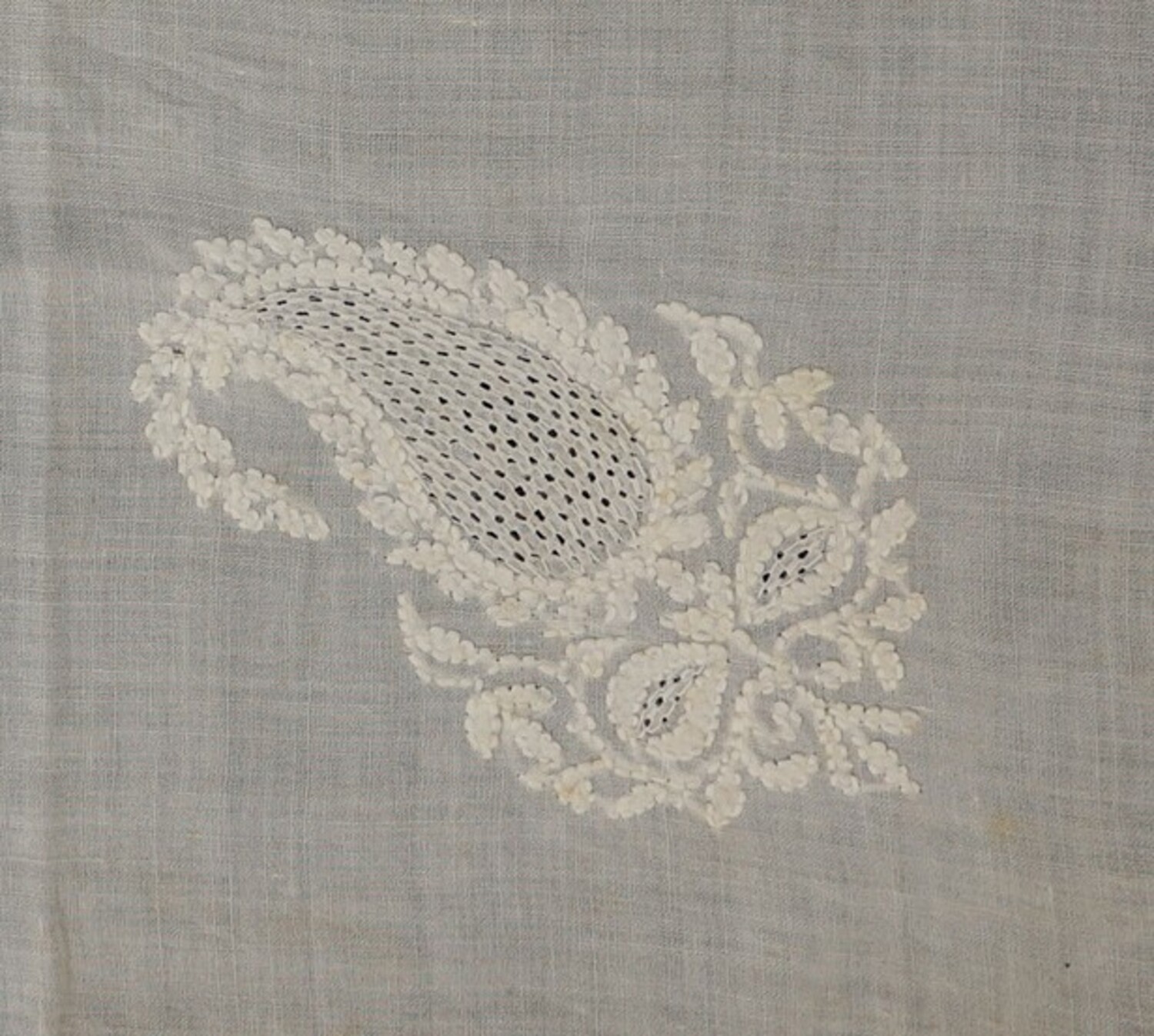 Detail of a handkerchief of chikan shadow work from Lucknow, northern India, mid-20th century (TRC 2018.2869). The rows of herringbone stitches worked on the reverse side of the cloth, create the appearance of parallel rows of back stitches on the front side.All of these examples are whitework (white stitching on a white ground) forms, using a fine cotton ground and worked in either cotton or silk embroidery yarns.
Shadow work was also a popular form in the 19th and the early 20th century. Since then, however, shadow work has lost its popularity in the West, perhaps it is time for a revival!
It is likely that shadow work was introduced to Europe from India, notably from the northern Indian city of Lucknow, where it is still made and is often known as chikan or chikankari (compare TRC 2018.2869).
Traditional Lucknow shadow work used to be worked in white on the reverse side of a white ground, but by the early 21st century variations started to appear, such as with white thread and a purple ground, or purple thread and a white ground.
By the 20th century shadow work is also being made in other parts of the world, including, for example, the Philippines where it is known as simbrado. Here instead of cotton, fine pineapple (piña) cloth is often used. It is likely that this type of work was introduced by Catholic nuns who taught it in convent and local schools.
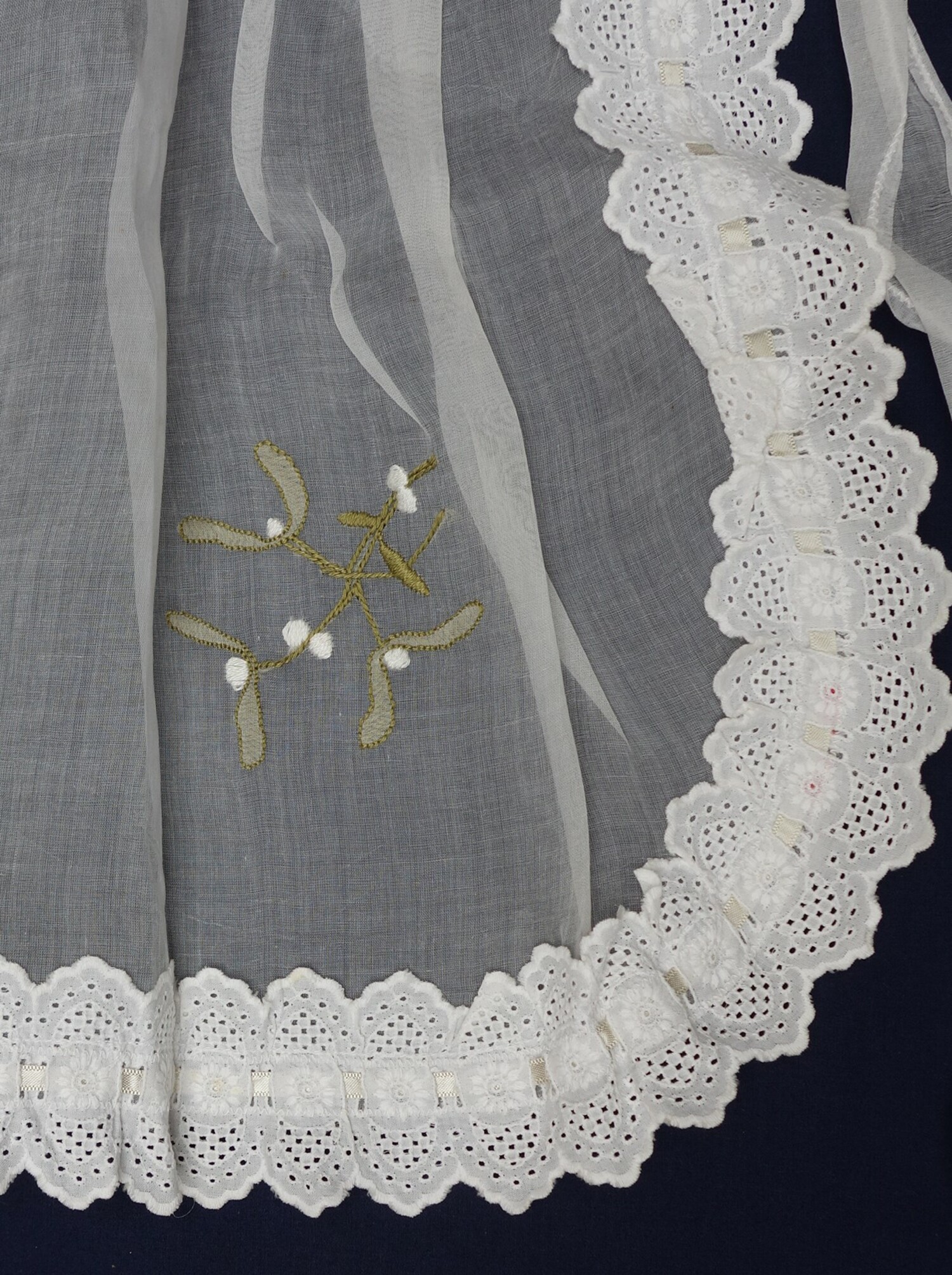 Detail of an apron with the leaves of the mistletoe worked in shadow work with herringbone stitch and the berries worked in satin stitch on the front of the cloth, Australia,1930s (TRC 2018.0303).(A) Embroidered shadow work
The main stitches used for embroidered shadow work are closed herringbone stitch (which is also sometimes known as shadow stitch), back stitch and running stitch. Of these forms, the closed herringbone stitch is the most commonly used, as it creates a decorative criss-cross effect.
Sometimes embroideries can be found that are a combination of stitches worked on both the back and front of the cloth. An example of this is an apron (TRC 2018.0303) from Australia that has mistletoe leaves worked in closed herringbone stitch on the back, but with the berries worked in satin stitch on the front.
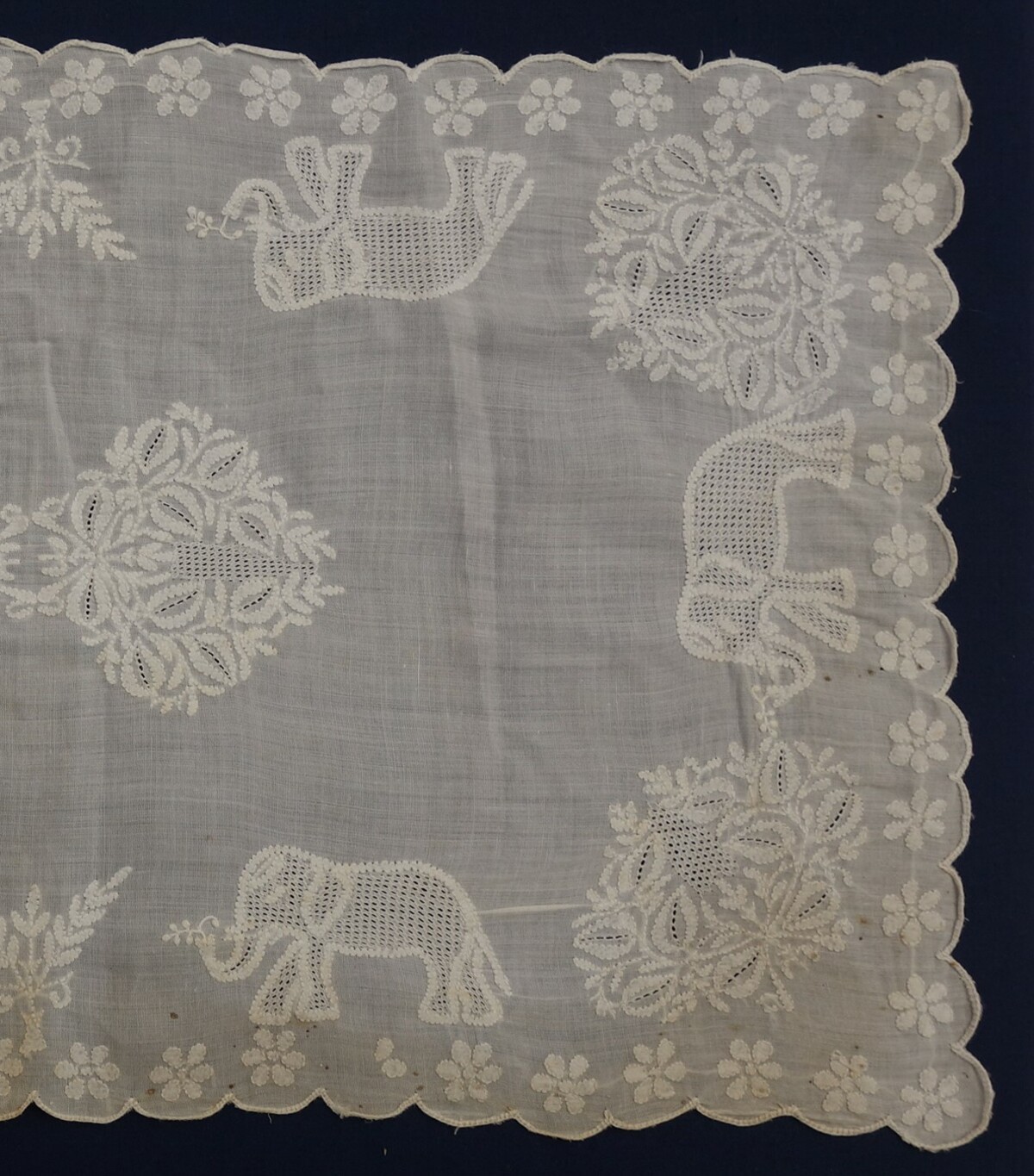 Detail of a mat from Lucknow, northern India, mid-20th century, with shadow work created by closed herringbone stitch and pulled thread work (TRC 2018.2780). Another form of combination shadow work (TRC 2018.2870) is a particular technique whereby pulled thread work or drawn thread work is used in combination with shadow work. Sometimes cutwork, generally in the form of eyelets, can be found together with shadow work (TRC 2019.2812).
(B) Appliqué shadow work
Appliqué is where two or more pieces of cloth are stitched on top of each other. There are two main types, (i) using small individual pieces of cloth and (ii) with double layers of cloth.
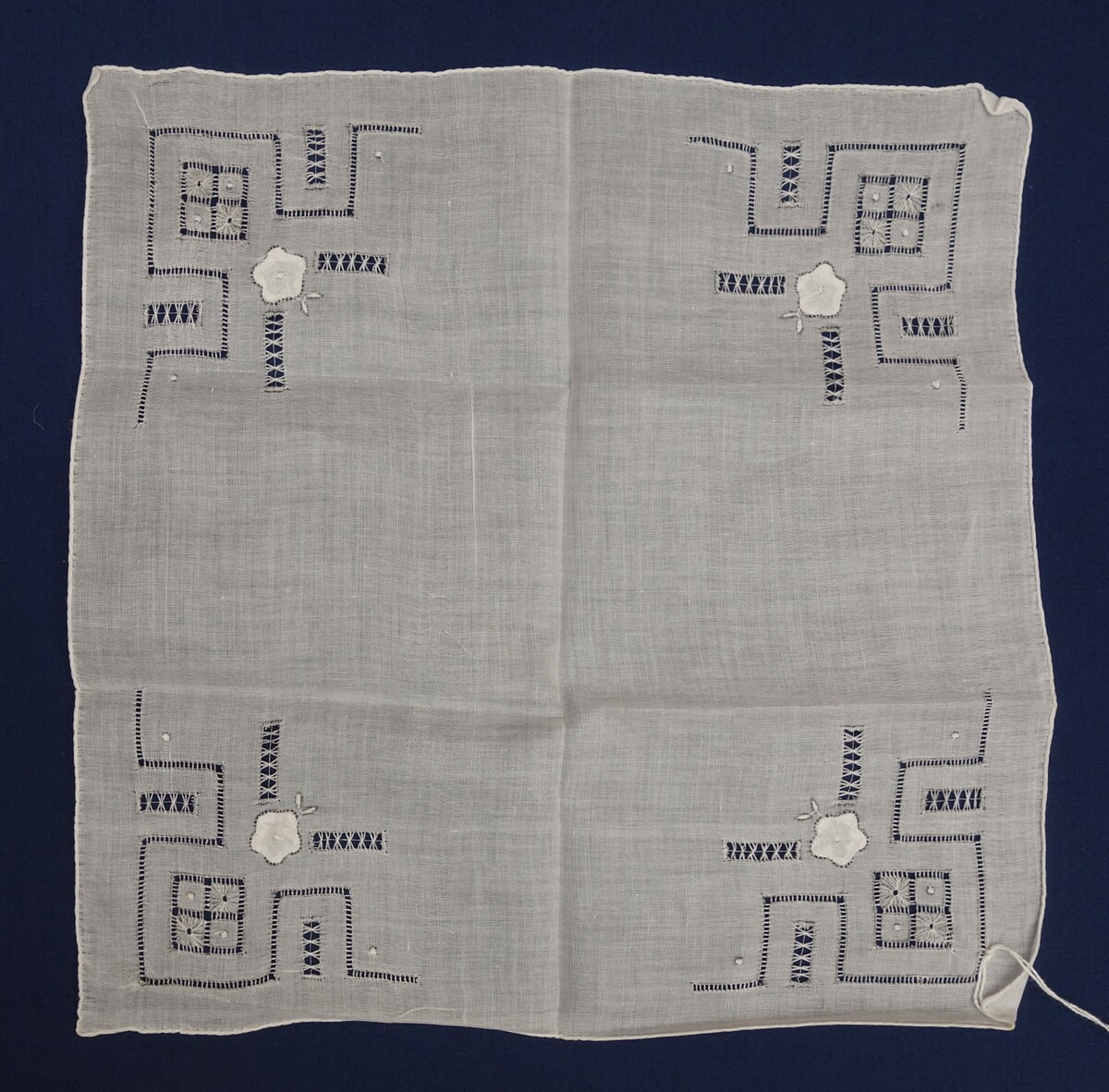 Detail of a handkerchief decorated with a combination of drawn thread work, ‘positive’ embroidery and shadow work appliqué, 1930s, the Netherlands (TRC 2018.3003).
(i) Individual pieces: this is where discreet areas of a pattern are created using individual pieces of cloth that are sewn to specific places in a pattern. An example of this is a handkerchief (TRC 2018.3003) that has a stylised flower head sewn onto the back of the ground cloth. Each flower head is surrounded by geometric pattern in pulled thread work.
(ii) Double layers of cloth: sometimes an effect of depth is created by having two layers of cloth flanking the single layer of cloth used for the shadow work. An example of this is a small sample of cloth (TRC 2021.0846) with a central curvy band with shadow work embroidery. The edges of the ‘wave’ have been fastened in place with C-scrolls in shadow work using closed herringbone stitch.
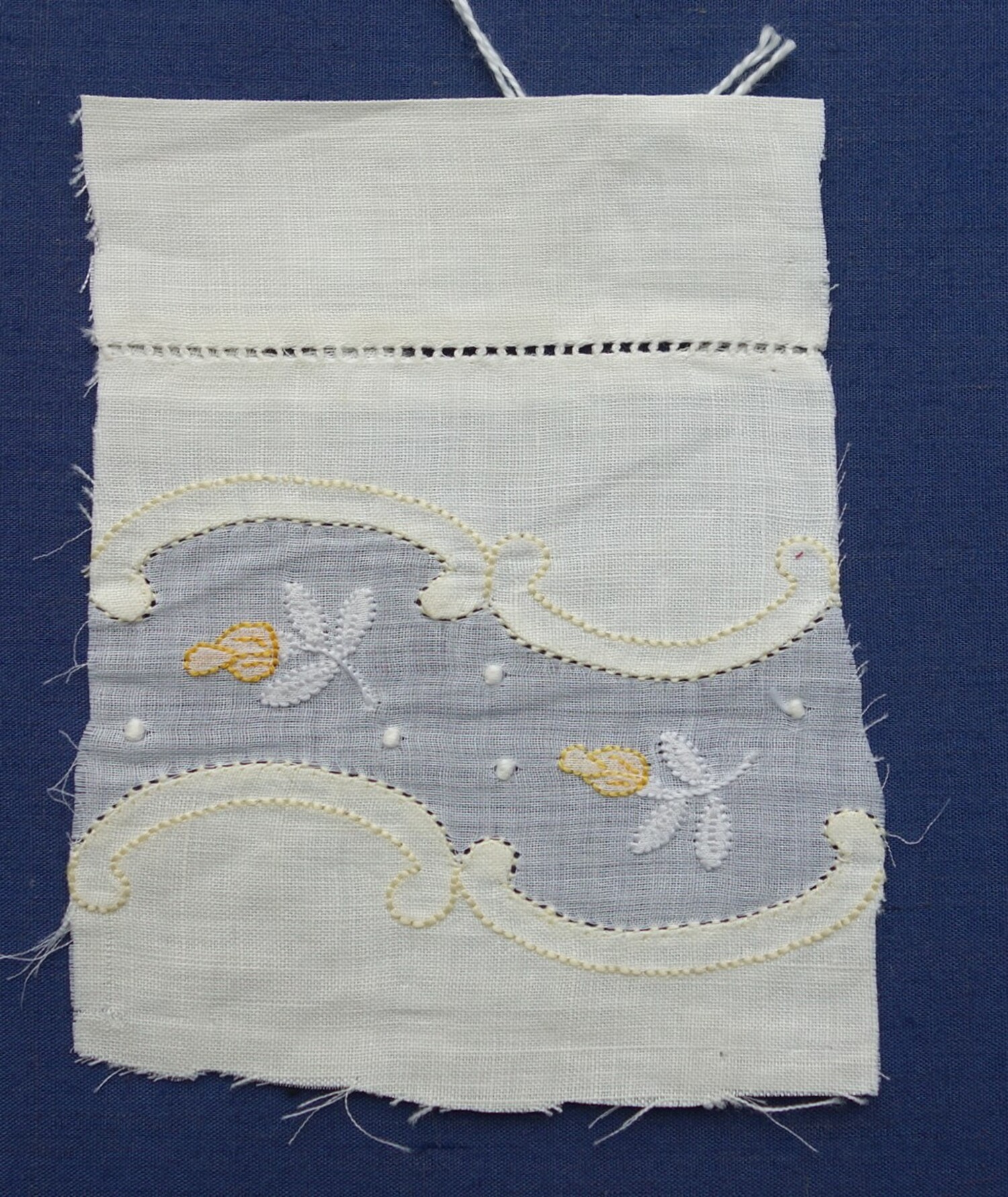 Sample of shadow work on a single layer of cloth flanked by double layers of cloth, Europe, early 20th century (TRC 2021.0846).(C) Padded shadow quilting
Padded shadow quilting uses two layers of material with the top layer being made from a sheer piece of sheer cloth. There are two main forms of padded shadow quilting, namely corded quilting and (ii) trapunto quilting:
(i) Corded quilting: this is where parallel lines of running stitch are worked and then a thick, coloured yarn or cord is threaded between the two lines.
(ii) Padded shadow quilting: this is where coloured raw wool, silk or cotton is either placed within an area that has been defined by a line of running stitches (trapunto quilting) or the fibres are placed in the desired pattern and then stitched in place.
An example is a woman's blouse from Indonesia which was made in the 1930s (TRC 2020.1082). It is made from a very pale cream coloured material. The front is decorated with pulled thread work, and padded shadow work is applied to create raised areas.
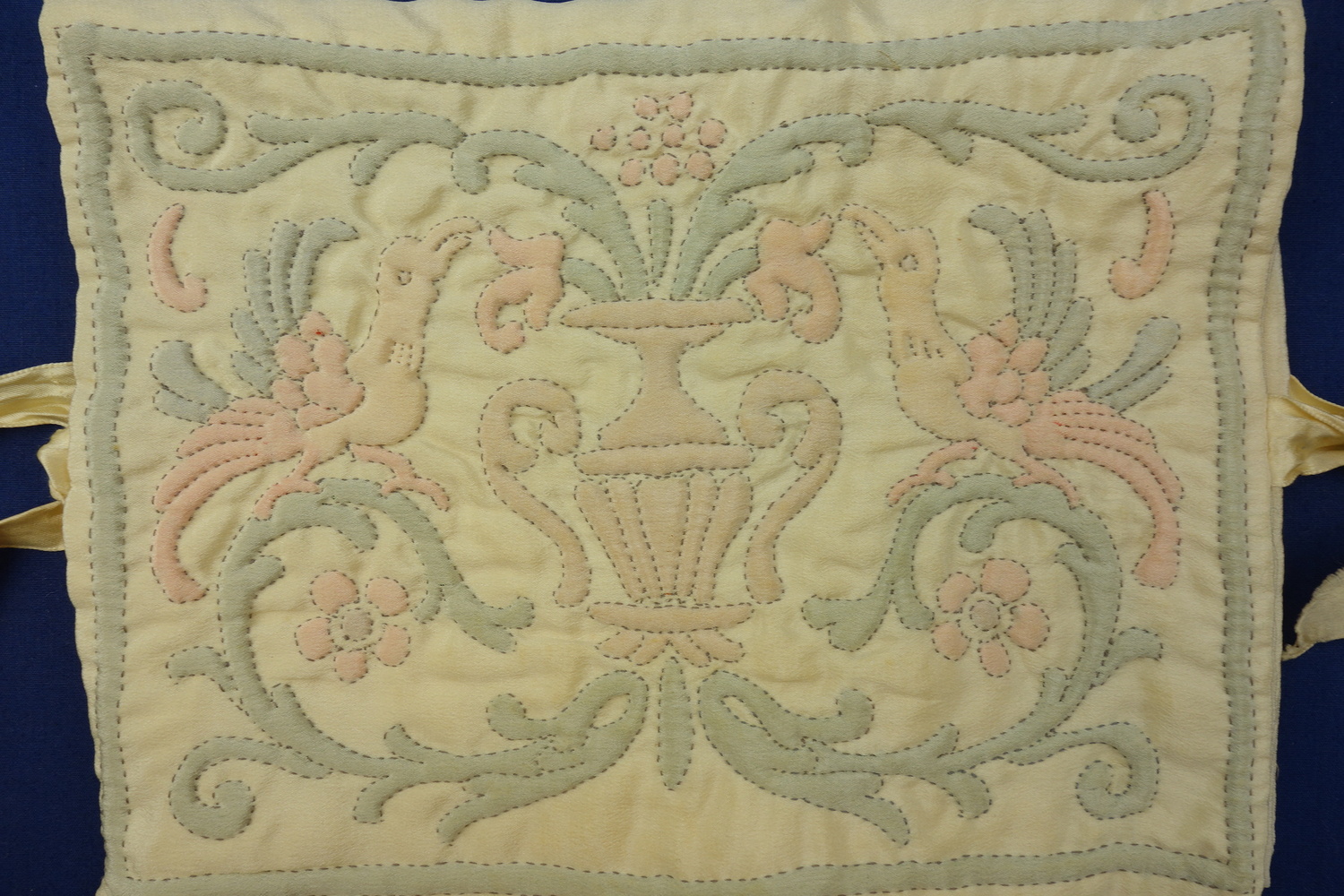 Detail of a cover decorated with padded shadow work, the Netherlands, early 20th century (TRC 2016.2372).Another example is a cover (TRC 2016.2372) dating from the early 20h century, which comes from the Netherlands. It is made from fine, cream coloured silk cloth that has a scene of a pair of stylised birds flanking an urn with foliage. The various motifs were outlined in black running stitch and then padded with raw fibres in yellow, red, blue and beige.
Gillian Vogelsang, 30 October 2021


