


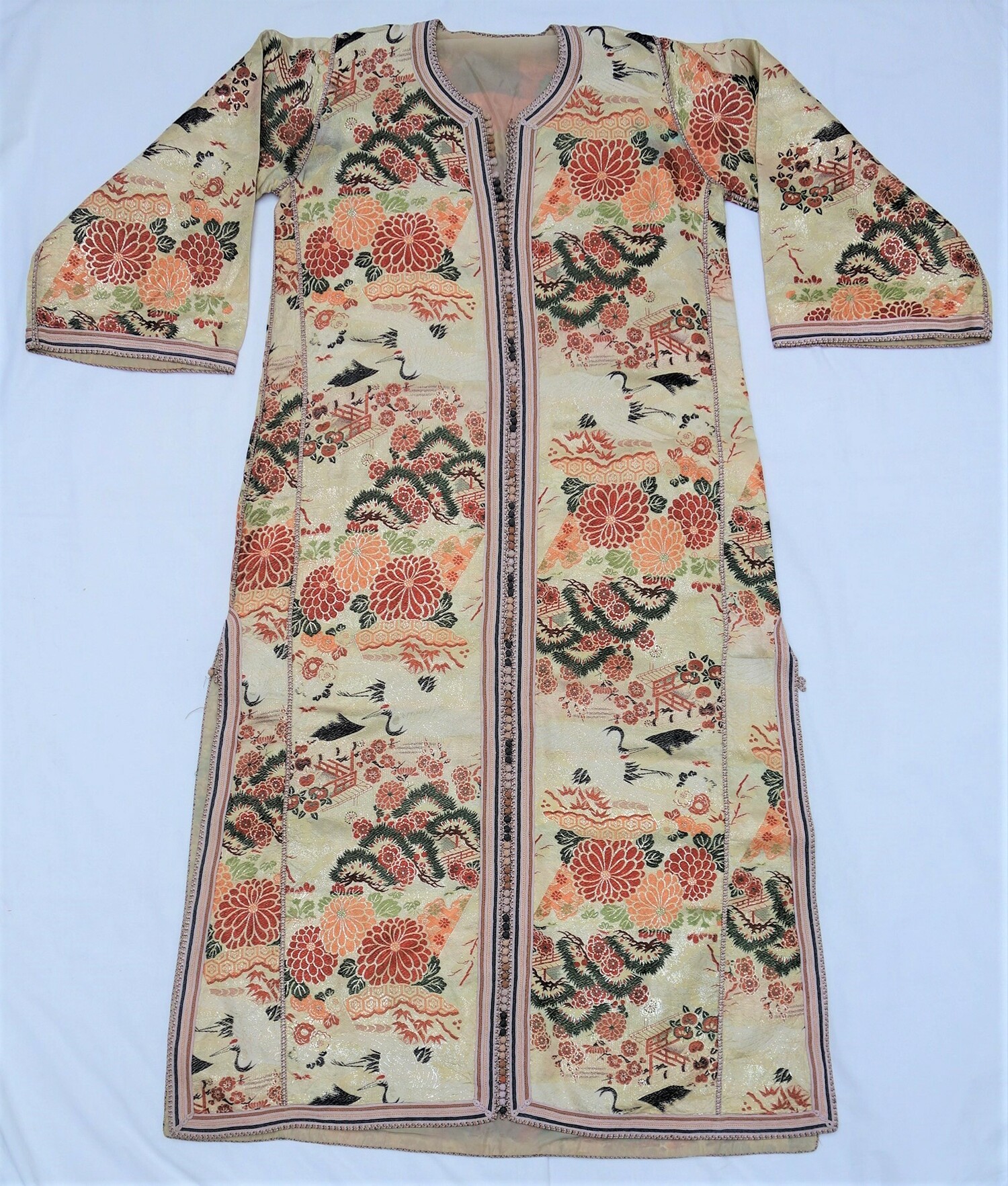
 Moroccan woman's kaftan made from a Japanese obi, 1950s (TRC 2001.0074).Contemplating the some 34,000 textiles in the TRC collection, Gillian Vogelsang, the TRC director, writes about the close relationship between historical and modern textile designs and production methods, and the ages-old, continuous and global process of adoption and adaption of forms, motifs and techniques.
***
I am currently busy working on the Cuvelier collection of 20th century textiles – as mentioned in an earlier blog, this is a very large donation to the TRC of twentieth century, printed, woven and machine embroidered textiles that were collected by Prof. Yves Cuvilier (1913-2005). He was closely involved with the Parisian fashion industry in the decades after the Second World War. The textiles eventually came to the TRC Leiden via Pepin van Rooijen, the Amsterdam publishers.
There are about 10,000 textiles in the donation and we have already catalogued and put online over 6,000 of them. They are mainly 1930’s, 1950’s to 1980’s printed samples of various sizes, mainly designed and produced in Europe, although there are numerous items from the 1900’s, 1920’s and 1940’s, and some samples were produced outside of Europe.
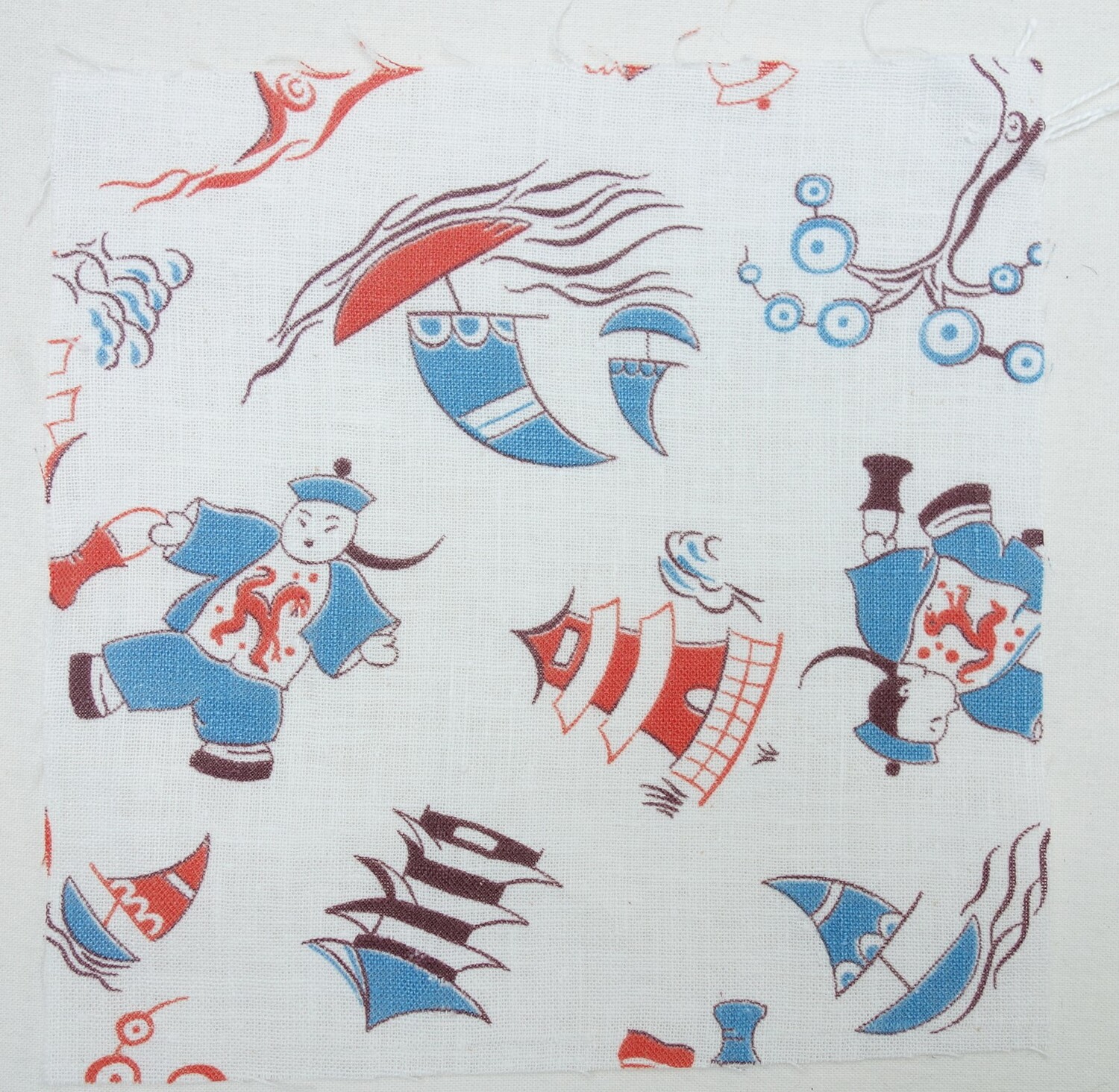 Detail of a feed sack cloth with Chinese-style design, USA 1930's (TRC 2019.1277).It’s a lot of work cataloguing, photographing and storing all of these textiles in the TRC Collection, but well worth while.
Looking at these 'modern' machine-produced textiles, in the context of the long and chequered history of textile production world-wide, it is clear that the inspiration for many of these modern designs and the techniques being used can be found in the near and distant past, and among different cultures from around the world.
There are examples in the Cuvelier collection that have clearly been influenced, directly or indirectly, by Japanese, Chinese, Indian, African as well as American (North, Central and South) patterns. Sometimes with sensitivity and sometimes, I must admit, with a degree of crassness that in its day was acceptable, but now would raise some eyebrows.
The samples, and also other 'modern' industrial textiles in the TRC Collection, also reflect a multitude of spinning, dyeing, weaving and printing techniques. Some of these are a modern invention, but most of them were developed centuries ago.
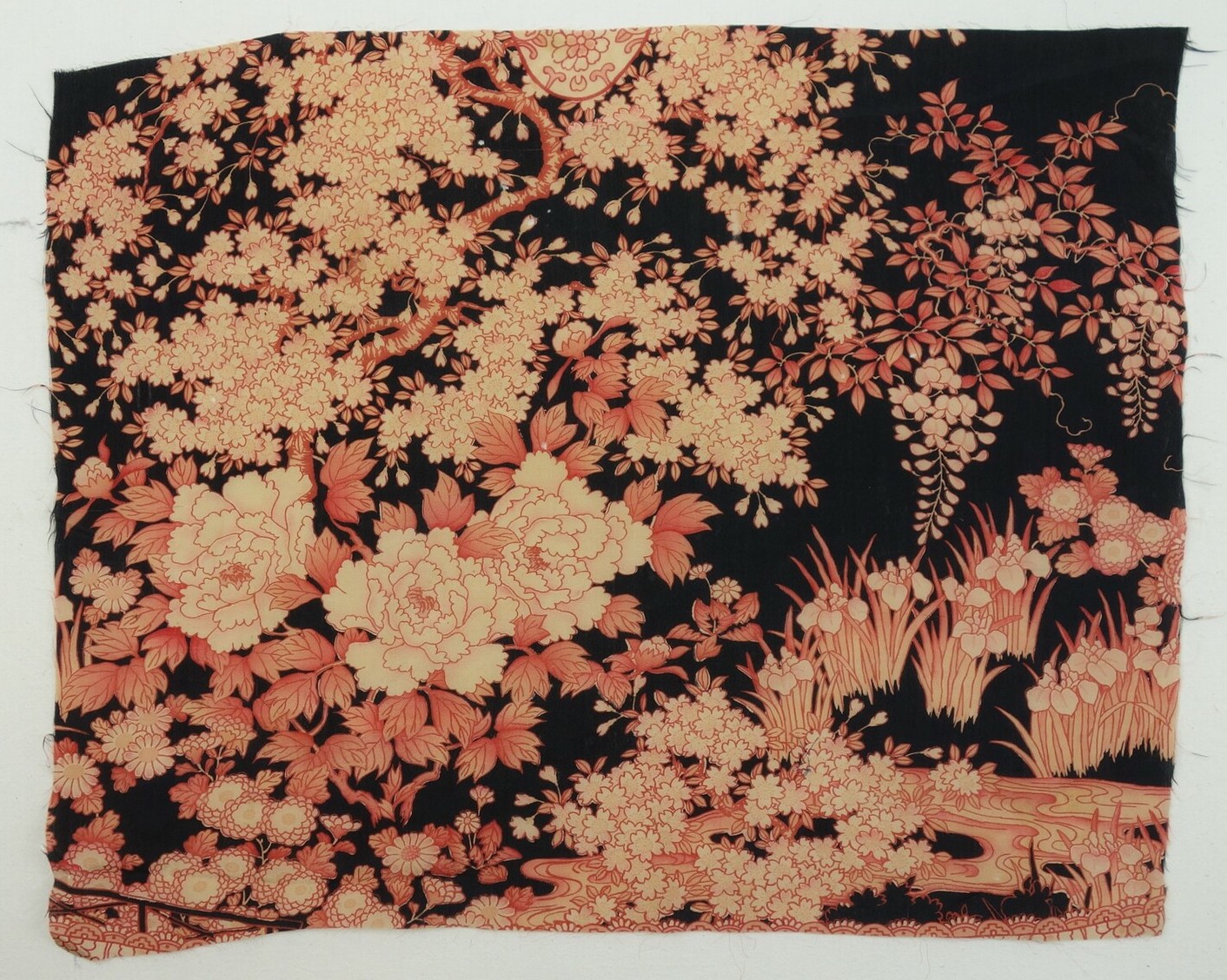 Sample of cloth with Orientalist motifs, Cuvelier/TRC collection, mid-1920's (TRC 2017.2797).All of these textiles are a culimation, and at the same time celebration of a long process of adoption and adaption, a creative process used for thousands of years by crafts people and artists. That is why there are Western motifs in Japanese guises (see a recent TRC blog about Japanese embroidered jackets), and the other way around. Is it not wonderful to see conservative Taliban from Afghanistan, with long beards and baggy tunics and trousers, almost invariably wearing on top a very Western style waistcoat, which they call a waskat?
And that is how it should be. I never did understand an (American) movement against 'cultural appropriation' of dress forms. Globalisation is not a new phenomenon, but has been going on for centuries, albeit perhaps at a slower pace. Modern textile industry, not only in Europe but also far beyond, is resting upon a mountain of knowledge and creativity that was built up over the centuries, and with construction blocks from everywhere.
Modern, industrially produced textiles may therefore tell much about the earlier history and origins of the techniques and designs that were being used. On the other hand, the study of earlier designs and techniques put modern textiles into a different, and sometimes fascinating context. Together, old and new, they tell the story of textiles, of their decoration, their technques, their cut, their colours. And it is a story that affects us all; few people go through life without textiles and clothing!
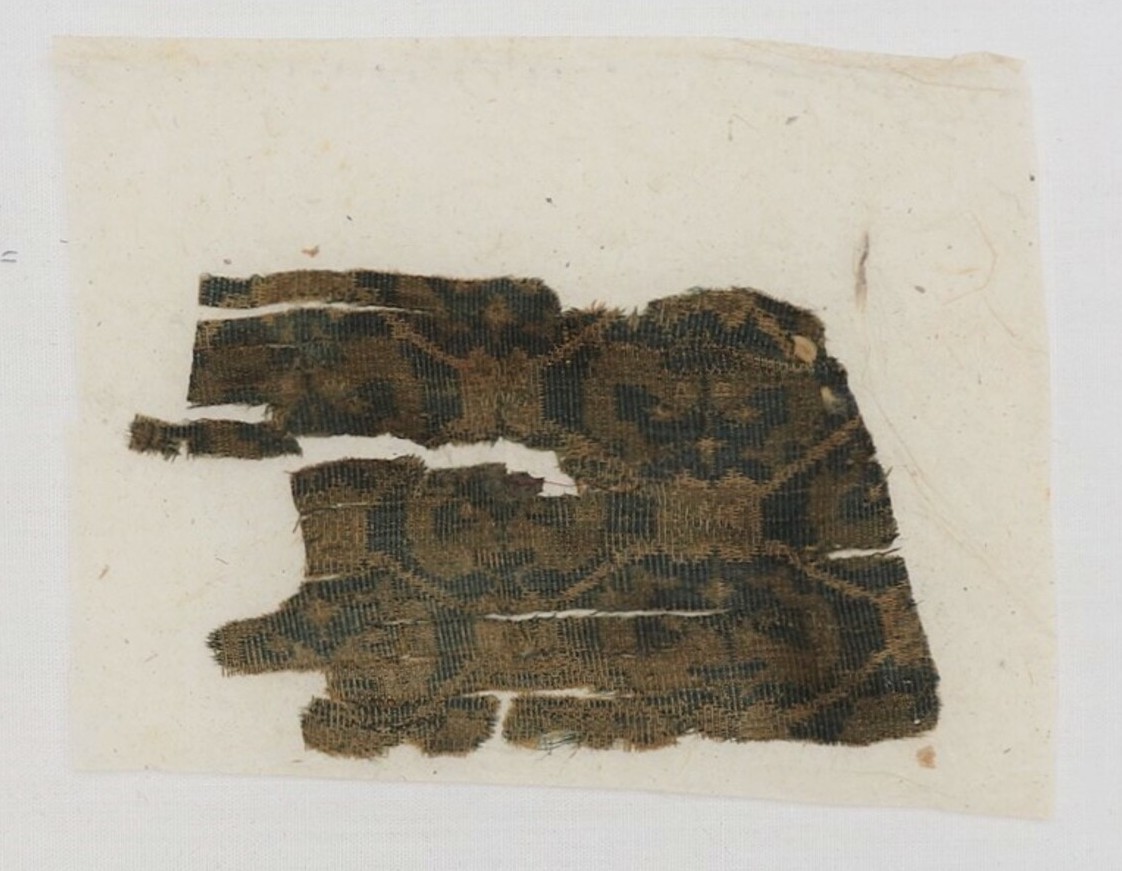 Fragment of a warp-faced compound tabby in silk, from Niya, Xinjiang, China, 2nd century AD (TRC 2000.0012). From some 2000 years ago, designs and techniques spread from east to west and from west to east between China and the Mediterranean along what since the late 19th century came to be called the Silk Road.Unfortunately, there is within the museum and art world often a separation, sometimes even a degree of snobbism: some argue that only handmade, pre-industrial textiles really matter; others regard pre-modern textiles as old-fashioned and of little practical relevance and better left to historians and archaeologists. But what I want to argue is that the study of textiles and dress, and with it the study of one of the most important aspects of human material culture, can only be properly conducted when the full history and development of textiles is taken into account.
The process of adoption and adaption was not always forced upon people. People are naturally interested in other cultures and, in particular, other forms of textiles and dress. People seem to be continuously looking for new styles, new fashions, new technques, and a new cut for their garments. But then: could globalisation, which in the textile world has been going on for so long, be in the end self-defeating? If all over the world we wear the same types of clothes, made with the same techniques and decorated with the same motifs, would that satisfy our deep-felt wish to use dress to show who we are and who we want to be?
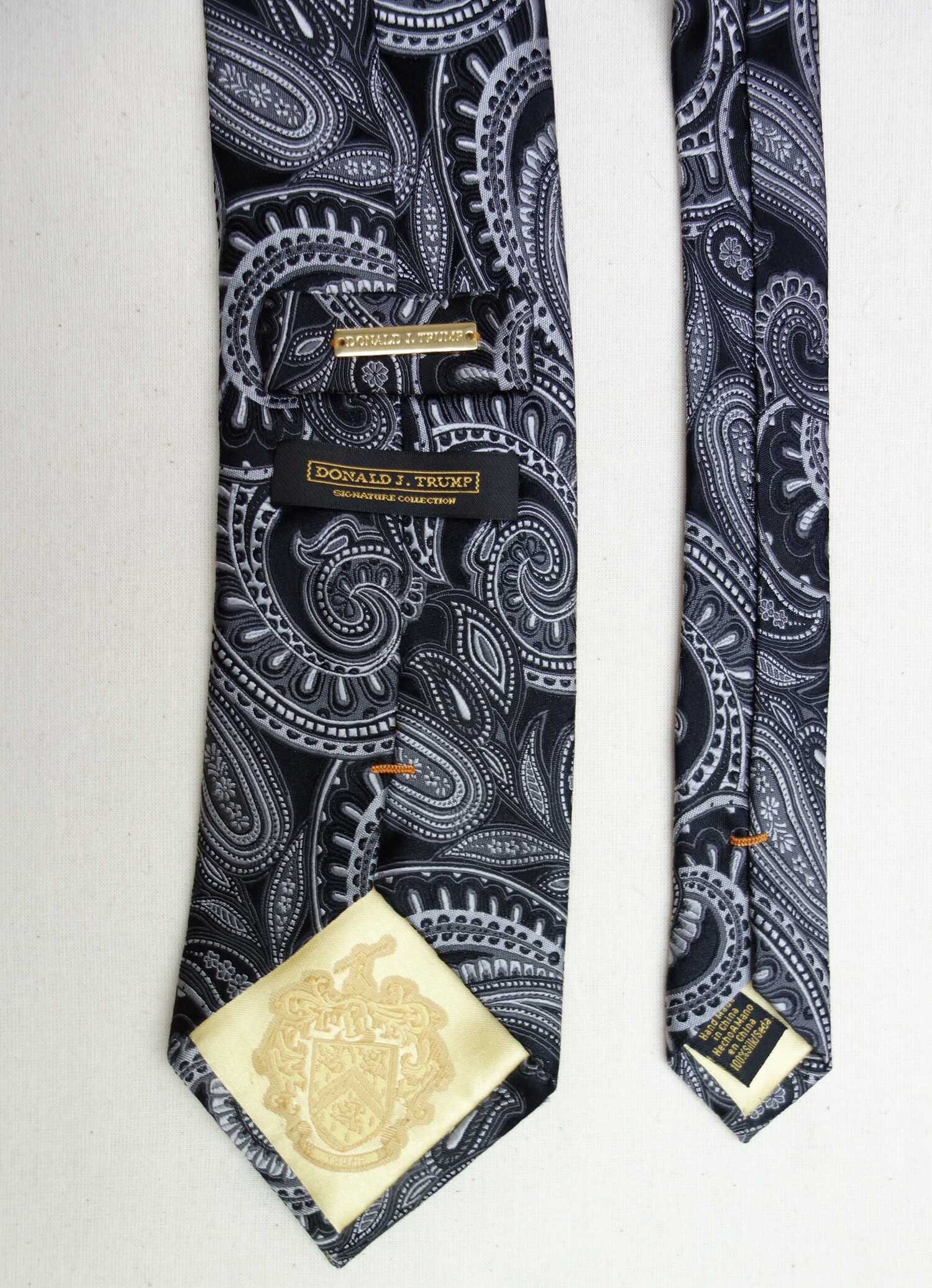 Man's tie from the Donald J. Trump Signature Collection, produced in China (TRC 2020.0395). This tie is not only of interest because it was produced in China to officially support (President) Trump, it also is decorated with the paisley motif. This motif is named after the Scottish town of Paisley where it was produced since the early 19th century. The motif originates from Iran/India where it is generally known as the buteh motif.Perhaps we should all encourage more diversity, more different techniques being used, diverse materials being used, and more local production centres and more localised forms that give people a feeling of belonging and being different from those living elsewhere. Don't we all want to stand out, somehow? Don't we all want to wear what we want to wear, and only adopt those 'foreign' forms that we voluntarily accept, rather than them being forced upon us by mega factories in China?
Perhaps we should promote the regionalisation of textiles and garments, always bearing in mind what other cultures can teach us, but stressing the importance of diversity. Don't we need many different genes for a healthy population?
Together with other national organisations, the TRC is seriously thinking about the setting up of a textile artisan/craft centre where knowledge is collected and promoted, and where a variety of textile skills, such as hand embroidery, quilting, sewing, lace making, etc. is taught at a range of different levels. If you know your textiles, you can develop your own style and a better product.
Such a centre will help the regionalisation of textile crafts and stimulate regional and industrial textile production to create a distinctive style, avoiding the need to ship any cheap T-shirt against enormous environmental costs half across the world through a choked-up Suez canal to end up at Zeeman's. It's an idea at the moment, but one that needs to be explored.
Gillian Vogelsang, Director TRC, Leiden, 15 May 2021


