


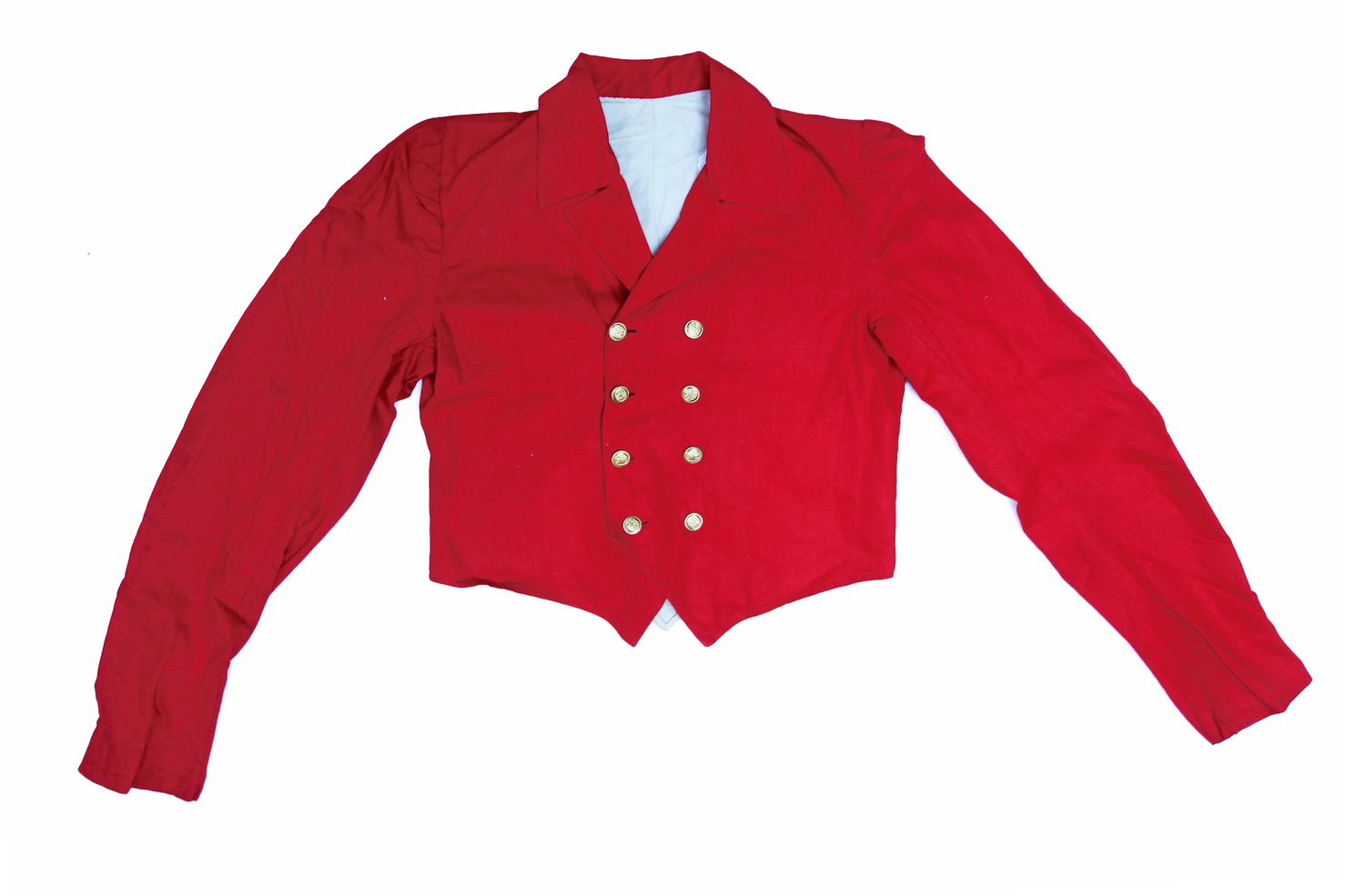
 Late 19th century military style jacket for a young woman, the Netherlands (TRC 2021.0191).The TRC in Leiden recently received from the Van Lonkhuijzen family in Haarlem, the Netherlands, a lovely late-19th century red cotton jacket (TRC 2021.0191). It is lined with white cotton and is fastened with buttons that sport a crown and anchor motif. The jacket has a military cut to it. Along with the naval inspired buttons, the jacket might have been worn by a Dutch woman or girl to show their patriotism.
Military-style clothing worn by civilians has a long, and lasting history. The TRC’s Dutch jacket might have been influenced by the British spencer, a short-waisted jacket worn by men and women in the late 18th and early 19th century. The name comes from George, the 2nd Earl Spencer (1758-1834), who reportedly started the style after the long tails on his jacket were burnt when he stood in front of his fireplace, so he cut them off. The style was adopted as a mess jacket for semi-formal occasions by the British military, and soon spread to other countries. It is still part of the uniform in many militaries today.
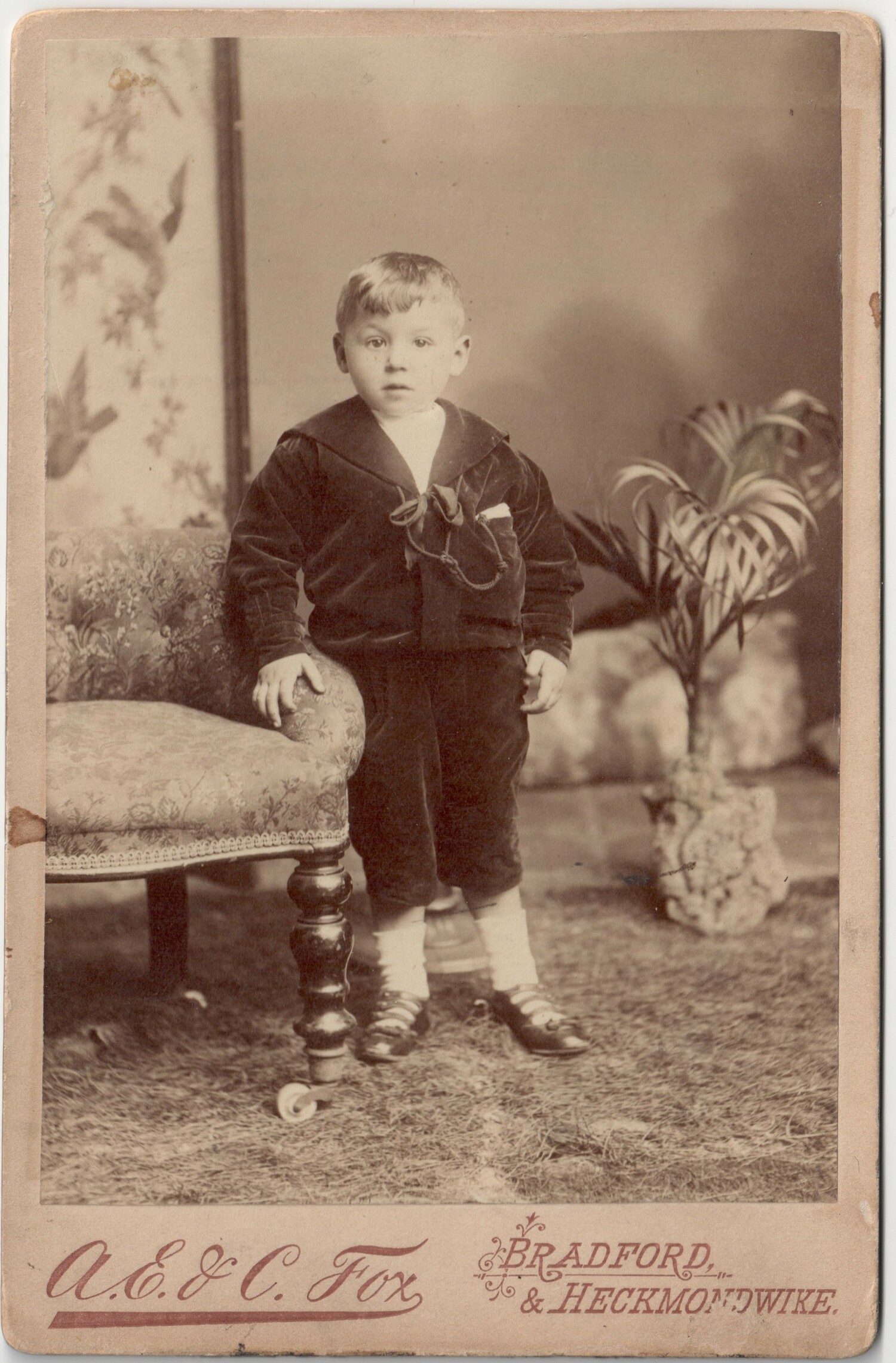 Late 19th century studio photograph of a young boy in sailor's costume, Bradford, Yorkshire, UK (TRC 2019.0001).Another style also popular today travelled from the British Navy into civilian life. This is the sailor suit for children. Sometimes called the Jack Tar suit or the Man-o’-war suit, the adoption of this garment for both boys and girls coincided with new ideas about the importance of freer movement for children. The suit was a combination of a short jacket, an open-necked blouse (sometimes called a ‘middy’), with long or short trousers for boys and a skirt for girls. A wide brimmed straw sailor’s hat completed the look. The suit became very popular after Queen Victoria dressed her eldest son, Prince Albert Edward, in it during a Royal visit to Ireland in 1846. In 1883 one British manufacturer, Redfern of Cowes, even sold Navy-inspired accessories such as a lanyard with bo-swain’s whistle with their sailor suits.
The style was still popular up into the 1920s, and remains a classic today, inspiring everything from Japanese school uniforms for girls to a 1968 couture day dress by fashion designer Norman Norell (1900-1972) (Indianapolis Museum of Art, acc. no. 80.264A-C).
Shelley Anderson, 28 January 2021


