


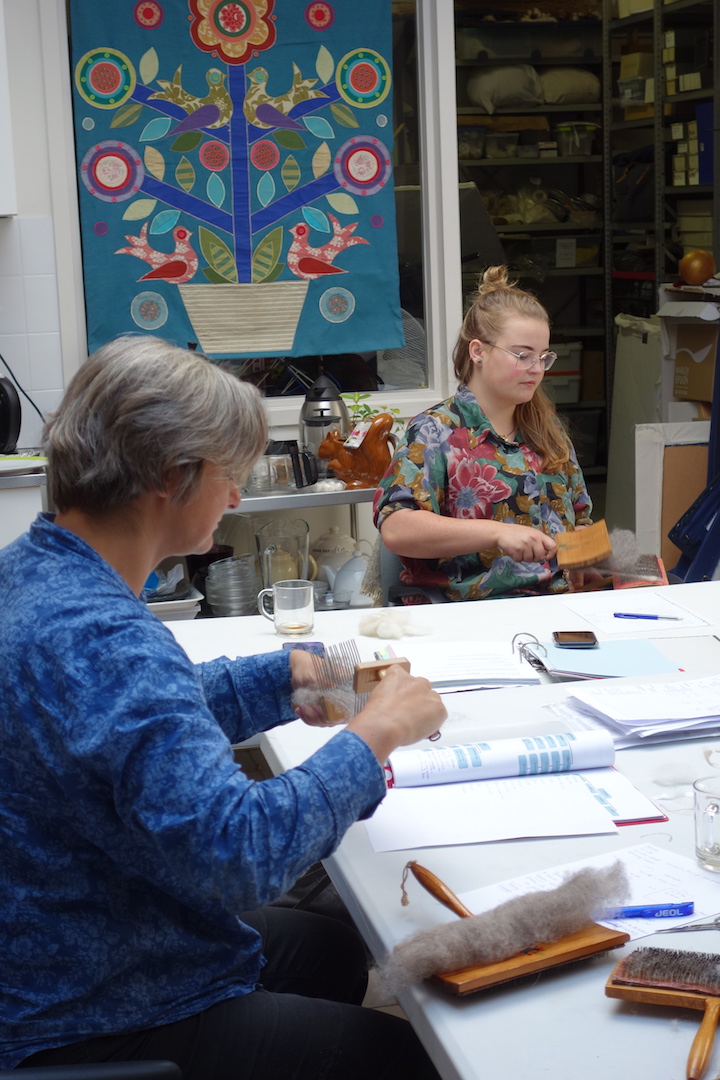
 Carding and combing at the September 2020 edition of the five-day TRC Intensive Textile Course. Photograph: Augusta de Gunzbourg. The author of this blog is sitting to the left.I am still recovering from the Intensive Textile Course at the TRC in Leiden! What a week!
As a researcher at the Rijksdienst van het Cultureel Erfgoed (Cultural Heritage Agency of the Netherlands), I am often confronted with small pieces of textiles, sometimes from an archaeological context.
I analyse a few fibres taken from the textile with an electron microscope (SEM) to study their condition and whether they have been dyed or stained. These small pieces and fibres are, of course, part of a larger piece of cloth! But what does the resulting information actually tell us about the larger cloth, the previous owner, what was the original colour (s) and how was the cloth used?
To gain more insight into textiles in general, I registered for the five-day Intensive Textile Course at the TRC. Under the inspiring supervision of the director of the TRC, Gillian Vogelsang, we identified fibres, we spun them into threads and we used weave frames to turn threads into cloth. Because of the corona virus we did so in a small group with six people, which enabled us to spend more time on practising and discussing the various techniques.
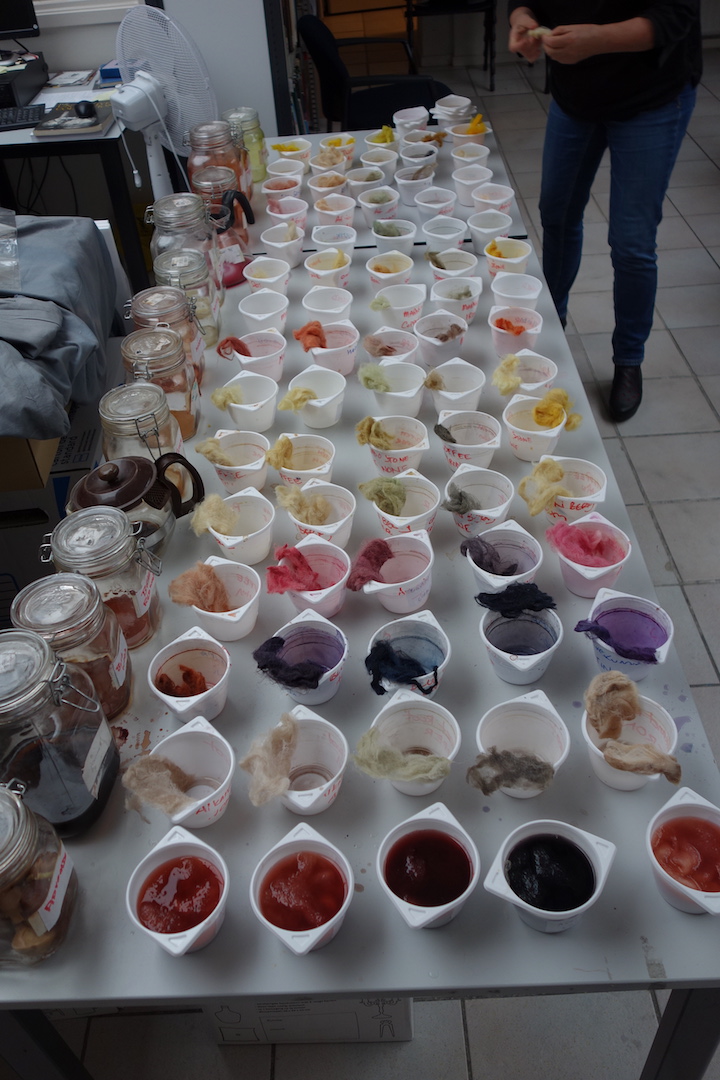 About sixty different dye baths made from natural dyes, producing a plethora of colours, at the September 2020 edition of the five-day TRC Intensive Textile Course. Photograph: Augusta de Gunzbourg.First of all, my respect for spinners and weavers: you need a well-trained 3D insight to be able to produce various types of cloth!
It was also a week of multi-tasking. On Monday we prepared different dye baths for natural animals and plant dyes (literally from cochineal to tumeric), and we immersed pieces of wool, dyed or not, into small bowls. Naturally, this resulted in a range of beautiful (and sometimes unexpected) colours.
During the week it was also possible to experiment with various dye stuffs that we brought from home: fresh walnuts were ‘cooked’ in the form of husks, whole nuts and cracked ones, to see what the difference would be when using them for dyeing. I also made a delicious onion soup from the peeled, yellow onions whose skins were used to produce a lovely range of yellows!
With the knowledge gained during the spinning and weaving workshops, we were soon able to identify various textiles from the inexhaustible collection of the TRC (with a little help from Gillian). Then we were introduced into the different printing techniques. So many possibilities, and so many ways to combine various techniques. Unbelievable.
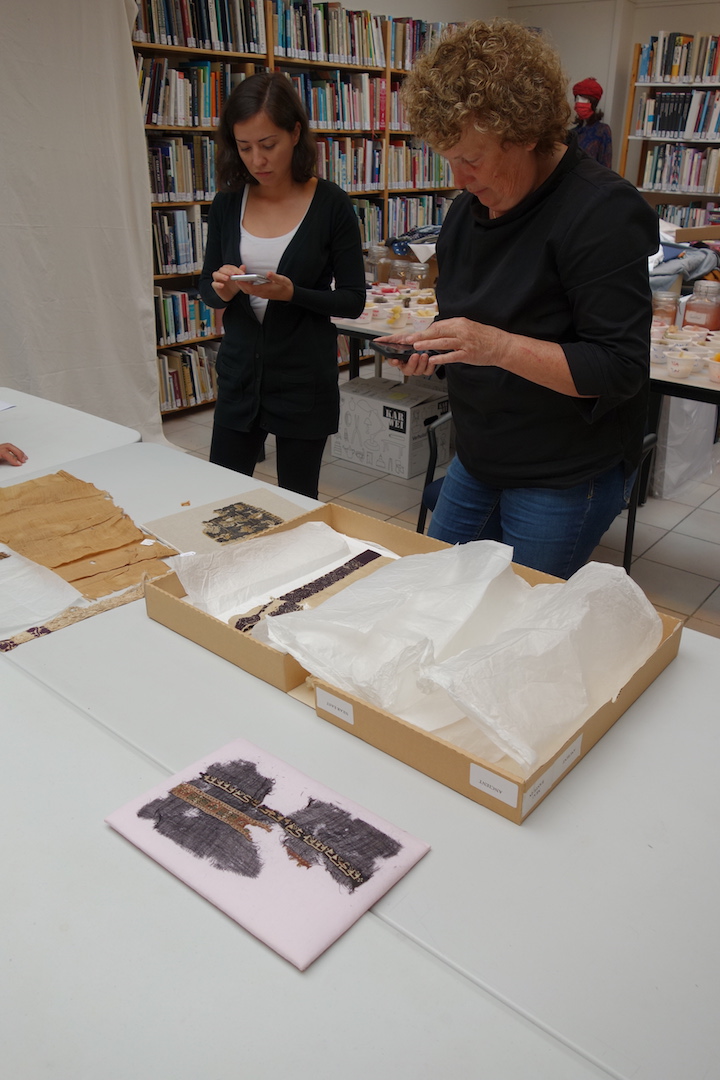 Examining archaeological from Egypt, at the September 2020 edition of the five-day TRC Intensive Textile Course. Photograph: Augusta de Gunzbourg.Finally, we got a comprehensive overview of embroidery, a speciality of Gillian. And again some of the most beautiful examples of embroidered textiles from all over the world came onto the table for us to look at and learn from. What a wonderful experience to be able to compare all those pieces.
At all stages we were encouraged to analyse items amd to make sample collections that included raw fibres, spun threads, dyed fibres (wool and silk), metal threads, woven and non-woven textiles of many diverse forms, as well as a printed examples.
An important lesson I learned during the week is that textiles are an example of 'form follows function' (which starts with the way how the fibres are prepared), and good planning at all stages. This insight is very important in my research.
Now I can (hopefully) better interpret the fibres and small bits of cloth I am being asked to study for my work. In the coming period I hope to analyse with a microscope the reference collection that I have taken home, as well as regarding it as a reminder of a very interesting and varied course.
Ineke Joosten, 2 October 2020.
The next TRC Intensive Textile Course is planned for 16-20 November 2020.


