


On Monday, 13 April 2020, the two co-curators of the TRC American Quilts exhibition, Beverley Bennett and Susan Cave, wrote:
When a quilt arrives at the TRC it usually comes with some provenance. The Starburst quilt (TRC 2018.3119) arrived labelled “pre-Civil War”. When we examined it we could see the brown calicoes from the 1840’s and the soft early pinks of the 1850’s. From a distance it looked amazing, but on closer inspection it told a different tale!
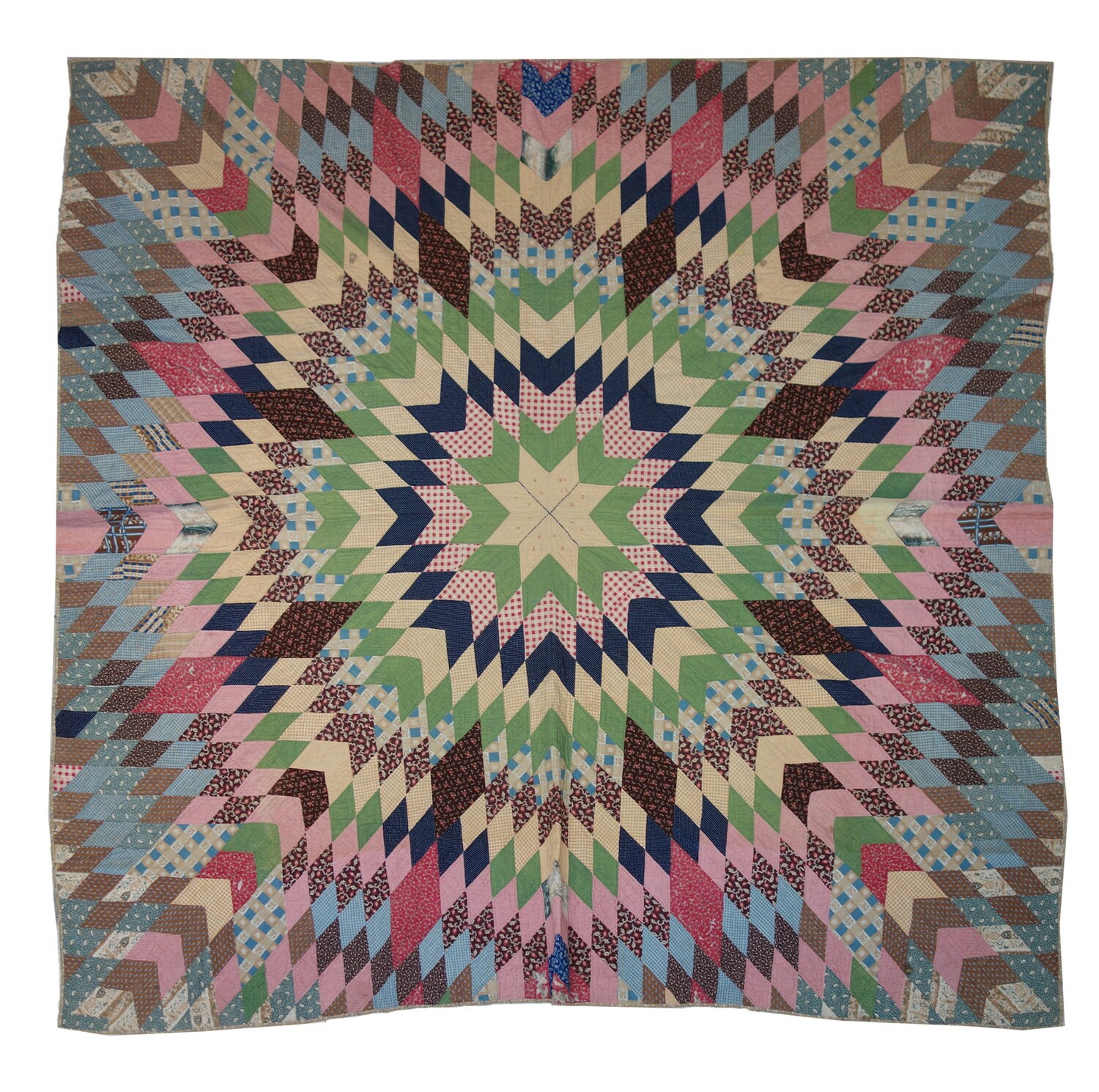 Starburst quilt, USA , c. 1860's (TRC 2018.3119).
Yes, the bulk of the quilt was early, the pattern was a common one of the time, but one of the brown fabrics was too bright, too uniform and too ‘new’. Serendipitously, we even had a blue version of the exact fabric in our reference section, dated 1988! Someone had found the old quilt, then mended it with a fabric that vaguely looked like the original.
What is more, mending an old quilt is an art and not particularly easy. The mender might have tried at first to do it by hand, but soon abandoned her efforts, reached for the zigzag button in her sewing machine and put her foot down hard! Yes, she zigzagged new brown diamonds to mend the worn ones and the stitches are there for all to see.
We call these quilts that reflect the generations a ‘time-span’. They are not as valuable, but they give all sorts of messages. 'Waste not want not' is one example, preserving a family heritage, another. In the Depression years particularly, many women unearthed patchwork blocks their grandmothers had made and added new blocks to make a quilt. We will feature these in another article as we have some examples in the TRC collection.
This quilt, dating from about 1860, is made from many diamond shaped pieces stitched in a radiating star design. The central star however, and the ‘ribs’ radiating directly from it, are composed of ‘twin diamonds’, chevron shapes. Equally unusually, the centre has piping inserted between the diagonal seams. This would have been difficult to sew and construct – indeed, the quilt, which is very well used and worn in places, does not lie flat and it may never have.
The central star bears seven sets of initials, M.H., E.I., E.R., N.R., R.I., C.V. and A.K. and ‘No. 12’ worked in red cross stitch. This part is interesting, as in our reference books we found exactly the same idea in a quilt made in 1840. It is possible that someone kept the early magazine, or knew someone who had a quilt with that tradition.
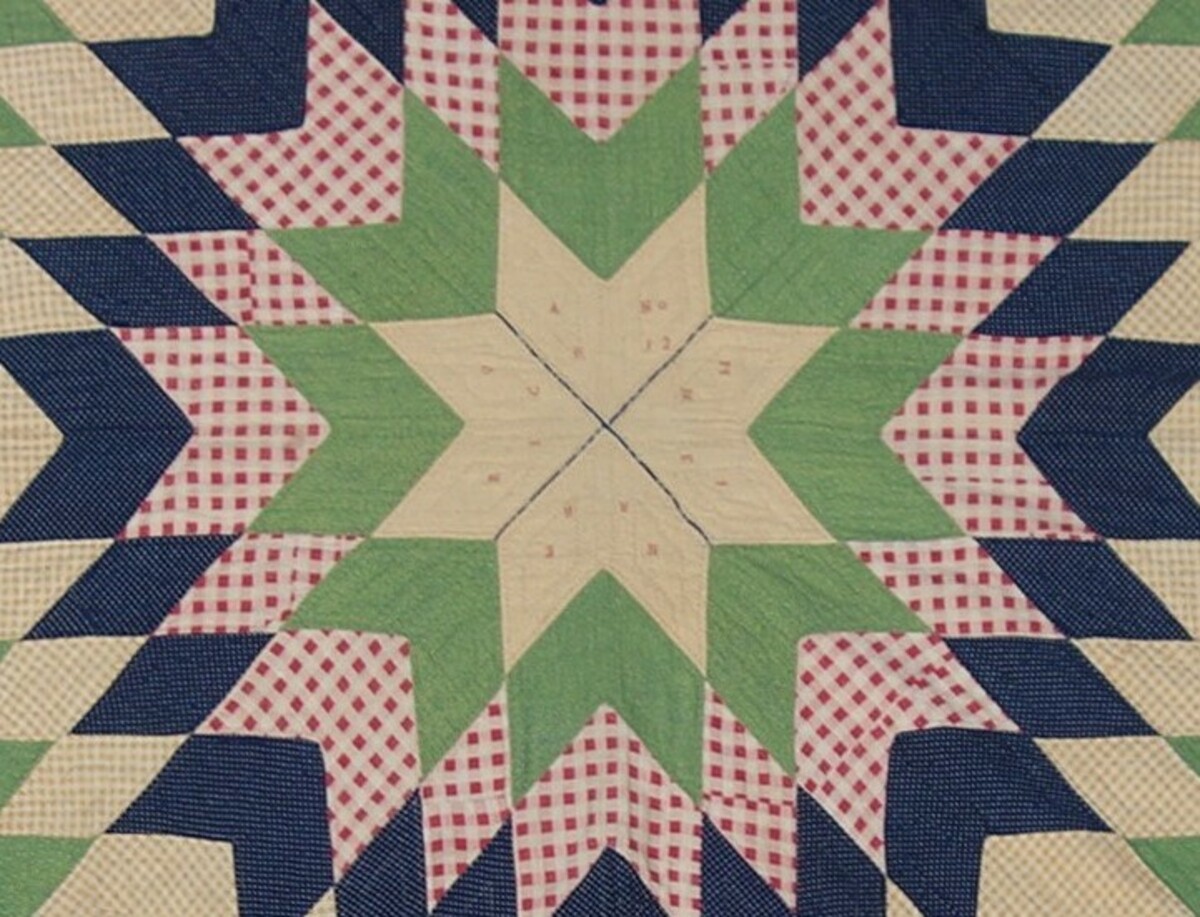 Deatil of a Starburst quilt, USA , c. 1860's (TRC 2018.3119).
There are many traditions associated with quilt making, one being that a girl should make twelve quilts before she married – this quilt being labelled ‘No.12’ supports this. The initials, we believe, would be those of the friends and family that helped her with the quilting and she would probably have pieced the top herself.
The next part of the tradition seems to vary from region to region. Some would say the thirteenth quilt, the wedding quilt, should be designed and made by the bride alone and only she would quilt it. Then the pattern would be destroyed as it ‘belonged’ only to the couple for whom it was made. Others say that the bridal quilt would be made by the bride’s friends for her and she would not take part in the construction of the quilt top. Since quilting is full of folklore, this makes it even more fascinating.
The quilting of the top, often in a social gathering known as a ‘quilting bee’, could also have been the formal ‘engagement announcement’ for the couple. Wedding quilts were often ‘best’ quilts and were kept for special occasions. They often feature hearts in the piecing or appliqué, or in the quilting stitches, but we haven’t been able to find any on this one.
It seems a tall order to us today to hand piece twelve quilt tops before marriage, especially when you consider girls would marry quite young back then. However, they would have started learning to sew as soon as they were able to hold a needle, maybe even aged four or five, and would piece a simple quilt soon after. Domestic arts were highly valued in the nineteenth century, and by the time a young woman was capable of making a quilt like the Starburst, she would be well equipped to make clothes and household items for her entire family.


