


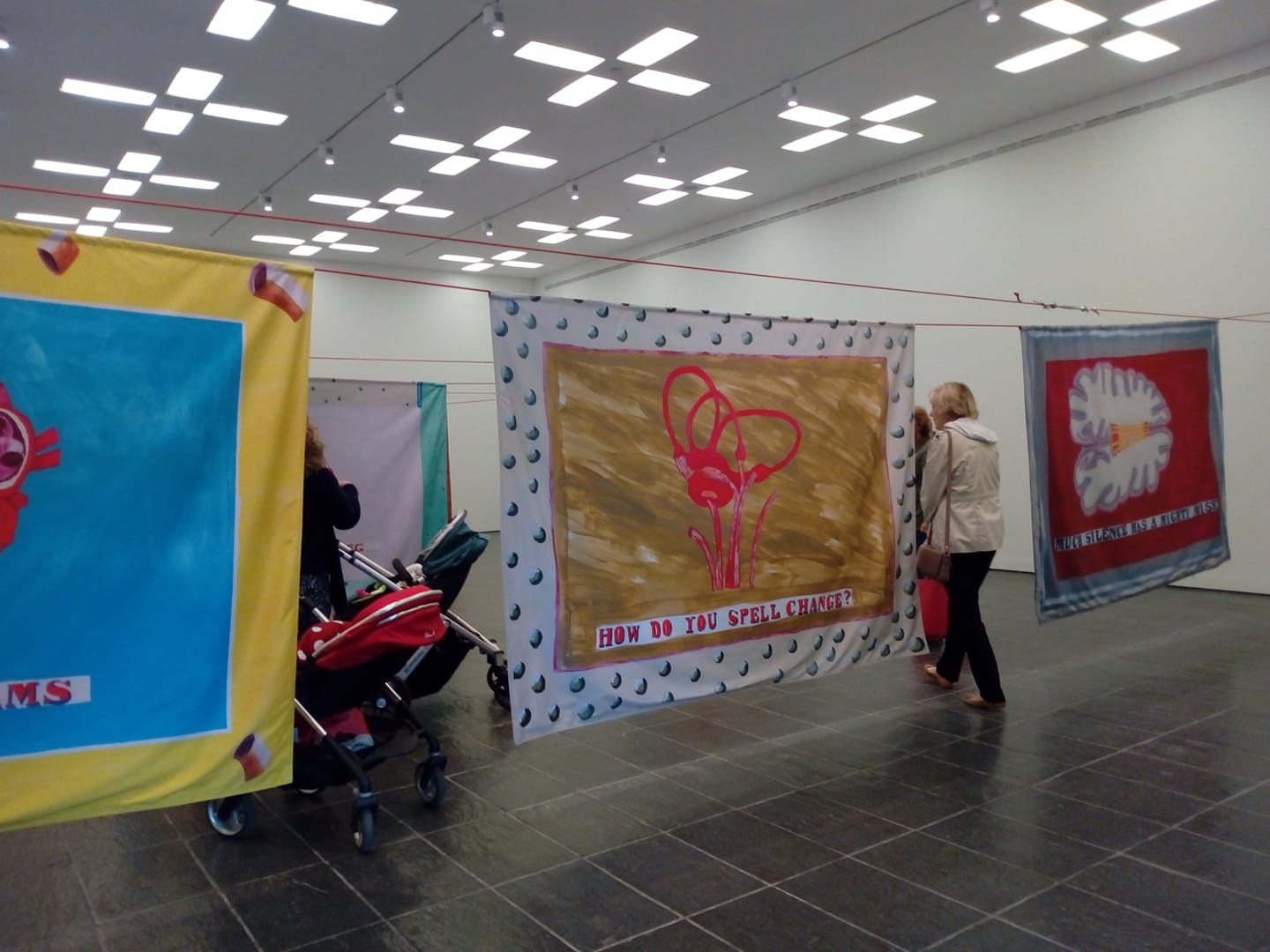
 Kangas at the exhibition “Our Kisses are Petals’, at Newcastle’s BALTIC Centre for Contemporary Art. Photograph: Shelley Anderson.Shelley Anderson, volunteer at the TRC, writes about a recent visit to England:
The words ‘textile’ and ‘art’ caught my eye, of course, on a recent visit to the city of Newcastle in northern England. The exhibition “Our Kisses are Petals’ was on at Newcastle’s BALTIC Centre for Contemporary Art.
The artist was Lubaina Himid (born 1954, in Zanzibar), who won last year’s prestigious Turner Prize for modern art. The exhibition consisted of over a dozen large, banner-like canvases, attached to a system of pulleys. Each canvas depicted a part of the body, for example, the eyes, tongue, or heart, and a line of poetry by a black British or American poet.
Himid herself is the first black woman to win the Turner Prize. She is also the oldest, at 63, winner in history. Visitors were encouraged to rearrange the order of the quotes on the canvases by pulling on the pulleys. The paintings were based on the East African textile known as kanga. Also worn in Oman, the kanga is a versatile garment used by women as a dress, a head wrap, and sometimes a baby carrier.
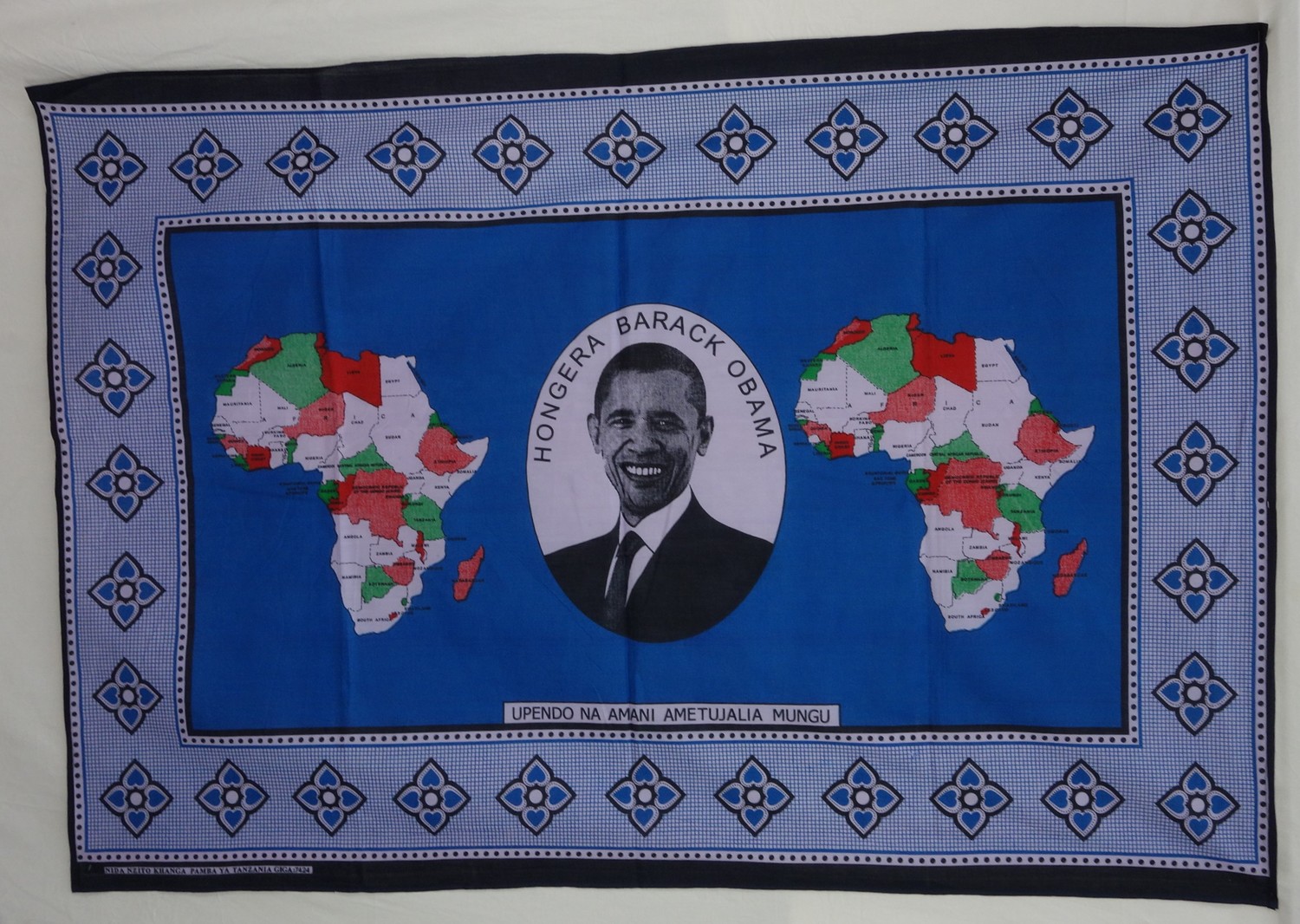 Kanga from Kenya, acquired in 2010, with a central design showing former USA President Obama (TRC 2013.0132).Kangas, usually of printed cotton, have a central motif and a phrase or proverb in Swahili printed around the borders. These words can be very pointed—sometimes criticizing a husband, a politician or other members of the community.
The artist has said that she wants to continue the tradition of expressing opinions about community life through this installation. I knew about kangas from the TRC’s large collection of kangas, including early 21st century examples from Zanzibar and Oman. In fact the first exhibition staged at the TRC in 2009 after it moved to its current location was devoted to kangas.
It was interesting to see how this traditional African textile is being used by Himid to encourage conversations around very topical issues like race and gender. The title of the exhibition comes from a poem by the British poet, Essex Hemphill, about the unrecorded joys and work of ordinary people. Himid has asked viewers to take a moment and remember the women and men in their lives whose work and words may be forgotten by history. I stood and thought of those countless women and men, who through their often invisible work of spinning, weaving, dyeing and sewing, made human civilisation possible.
Shelley Anderson, 2nd July 2018


