


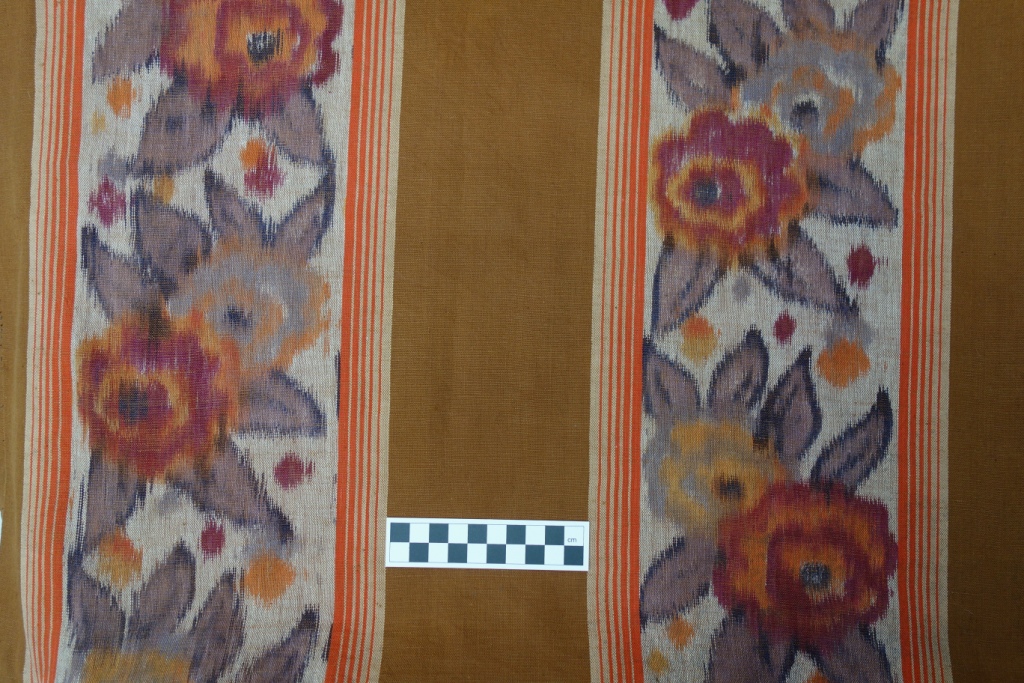
 Detail of a French Chiné á la chaîne, early 20th century. TRC collectionThe TRC has recently been given some textiles, which include a length of brown cotton cloth with white vertical stripes embellished with stylised (and fuzzy) flowers. The flowers were made in some form of, what appears to be an ikat technique, since the colours of the design were added to the warp/weft threads before the cloth was woven. Ikat textiles are usually associated with India and Indonesia, but this textile looks European. It has taken a little time to find out what the textile is and where it comes from. It turns out it is French and dates to the 1930s and 1940s. It was used for upholstery.
The question that doggedly followed this piece was how the design was made? It turns out there are two possibilities, Chiné à la branche or Chiné à la chaîne. The word Chiné refers to China, but while the technique used to make this piece is Asian in influence, it is certainly not Chinese. In addition, both terms seem to be used interchangeably in English, especially on the internet. So we thought that this new item to the TRC collection could be used to highlight the differences between these two forms.
- Chiné à la branche is a technique for dyeing silk that became popular in the early 18th century. This form is closer to the Asian ikat, as it involves binding off areas of the warp thread and then (resist) dyeing it in various colours until the required design is achieved. In the 18th century, this type of cloth was particularly associated with the French court, as it was an expensive manner of decorating textiles. It was even known as Pompadour silk or Pompadour taffeta, after the mistress of King Louis XV of France, Madame de Pompadour (1721-1764).
- The second method, Chiné à la chaîne, was developed in the mid-19th century and involved hand painting the required design onto the warp threads (of any fibre) and then weaving the cloth. It was not long, however, before the hand painted designs were replaced with screen, and later, roller printing techniques of dyeing the threads.
Sadly, the TRC collection does not include any examples of Chiné à la branche, but we now have an example of Chiné à la chaîne!
Sources: “Printing of Silk Warps for the Manufacture of Chiné Silk”. Posselt’s Textile Journal. December 1907.
Available at:
- http://www.cs.arizona.edu/patterns/weaving/articles/ptj_01_3_15.pdf [retrieved 22nd September 2015].
- http://fastesdecour.chateauversailles.fr/content/pdf/Glossary.pdf [retrieved 22nd September 2015].
Gillian Vogelsang, 22 September 2015


