


A few days ago, Gillian and I returned from a quick drive to Nice in southern France to see our dear friends Rolando and May Schinasi. Sharing my fascination with Afghanistan, and Gillian’s interest in textiles (or should I say: obsession?), they kindly gave us a number of original, mid-19th century prints of Afghanistan showing local people and their clothing, drawn by foreign artists. I want to discuss a number of them, not so much because of the people depicted, but mainly because of the garments they are wearing.
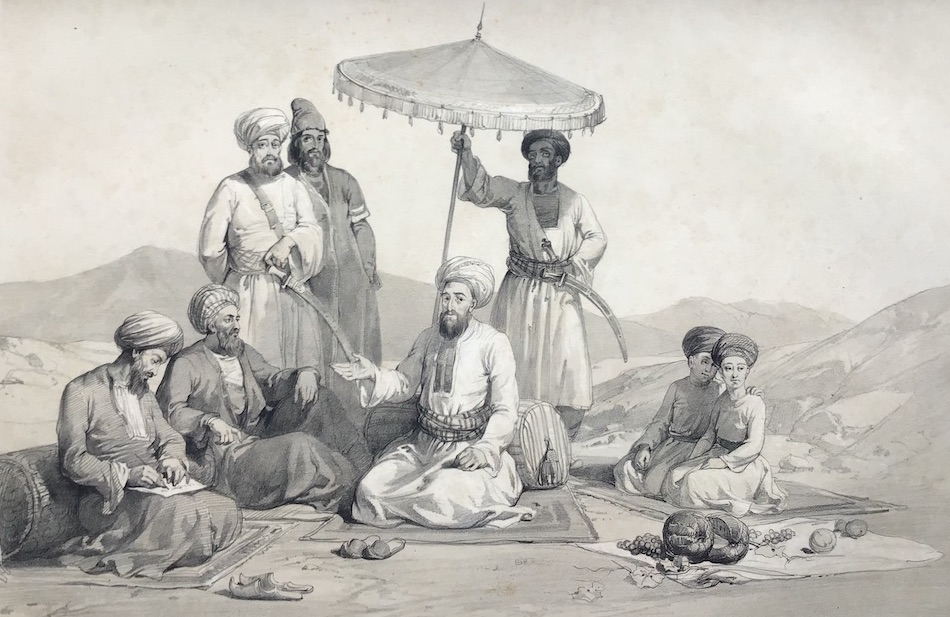 Fig. 1: "Umeer Dost Mahomed Khan”.Tinted lithograph. Plate XII in Hart and Atkinson 1843. TRC 2025.0194.
The first is a tinted lithograph, titled “Umeer Dost Mahomed Khan”, which is included in Character & Costumes of Afghaunistan. From Original Sketches by Dr James Atkinson, Superintending Surgeon of the Army of the Indus. The other print is from the same album, and is titled "A Dooranee Noble & his Attendant at the Palace, Candahar." A third print, also from this album, is "Fort of Killeh Abdooleh. Troopers of the Auchukzye Horse."
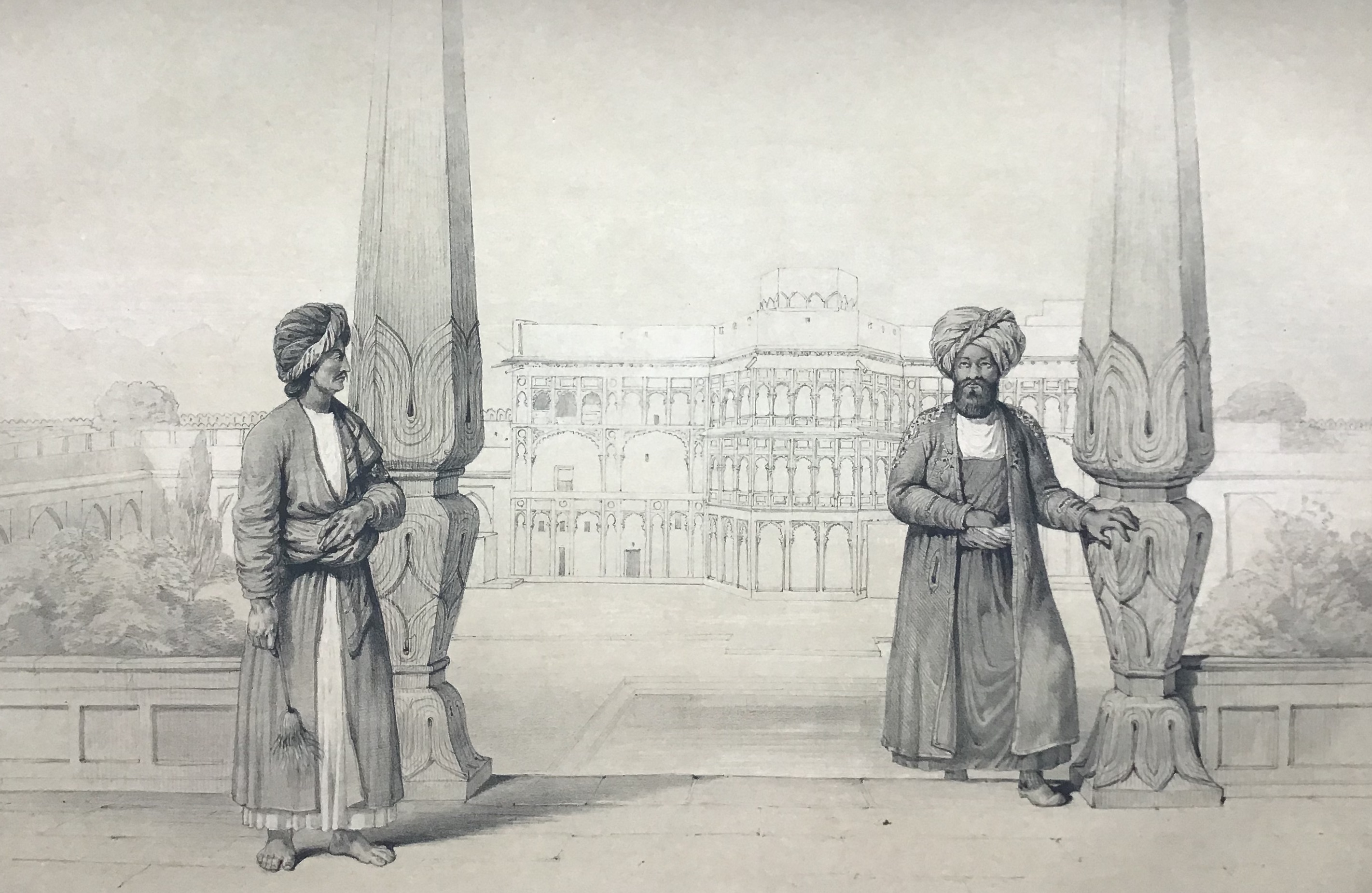 Fig. 2: "A Dooranee Noble & his Attendant at the Palace, Candahar." Tinted lithograph. Plate VI in Hart and Atkinson 1843. TRC 2025.0193.
The album was put together by Captain Lockyer Willis Hart (1804-1847), together with James Atkinson (1780-1852) and was published in London in 1843. A deluxe edition, with hand-coloured illustrations, came out the same year,
Both authors were veterans of the First Anglo-Afghan War (1839-1842), which had ended so disastrously, at least for the British, with the 'Retreat from Kabul' in the harsh winter of 1842. Of the c. 16,500 soldiers and followers that left the British caantonment in Kabul on 6th January1842, only a few survived and made it back to British India.
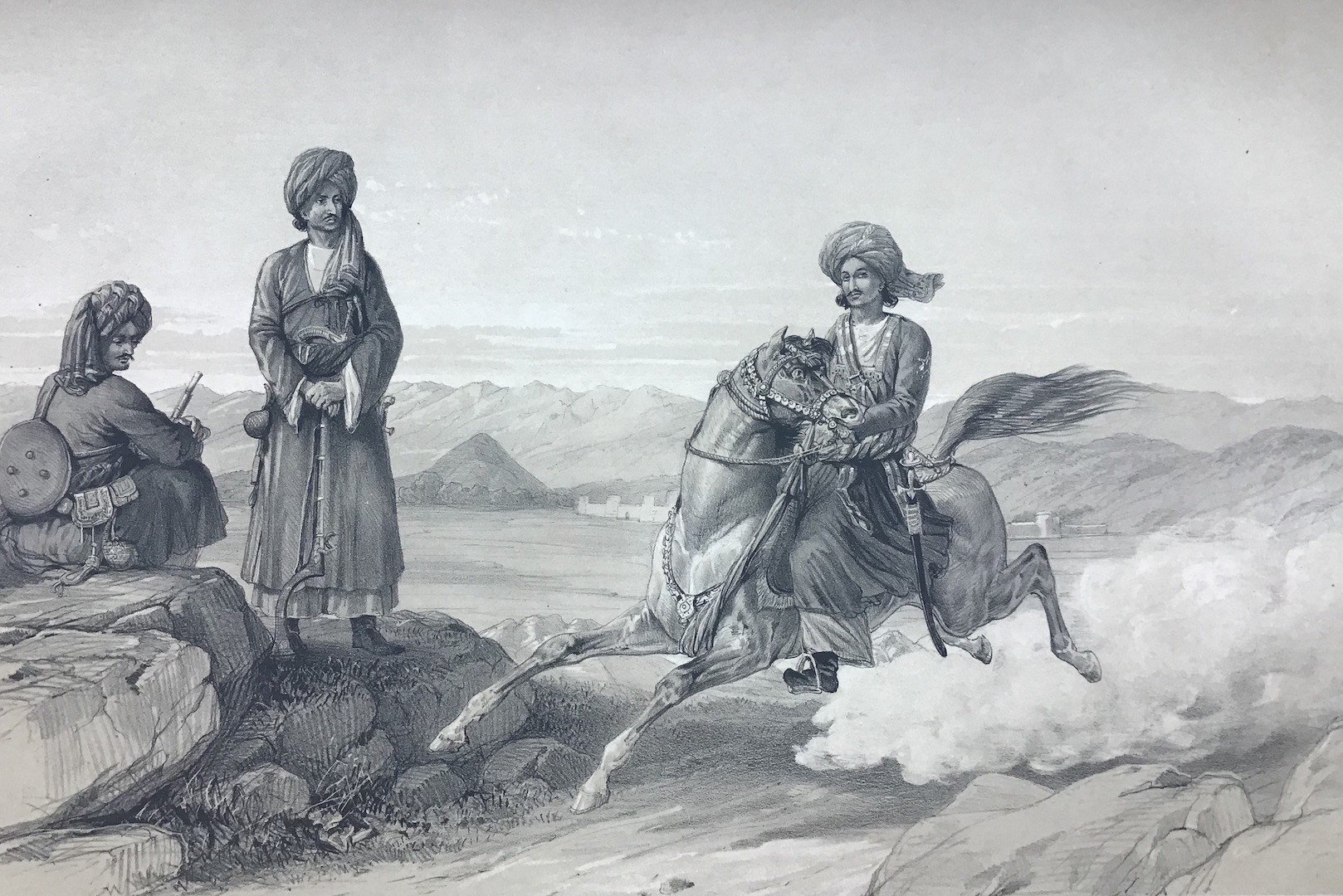 Fig. 3: "Fort of Killeh Abdooleh. Troopers of the Auchukzye Horse." Tinted lithograph. Plate V in Hart and Atkinson 1843. TRC 2025.0192.
I don’t want to discuss the political aspects of these three illustrations, but instead focus on the clothing, which is shown in an exceptionally detailed manner. The man sitting in the centre of Fig. 1 is Dost Mohammad Khan (1793-1863). He is also depicted in Fig. 4, which is a steel engraving from the same period, and also donated to the TRC by May and Rolando Schinasi.
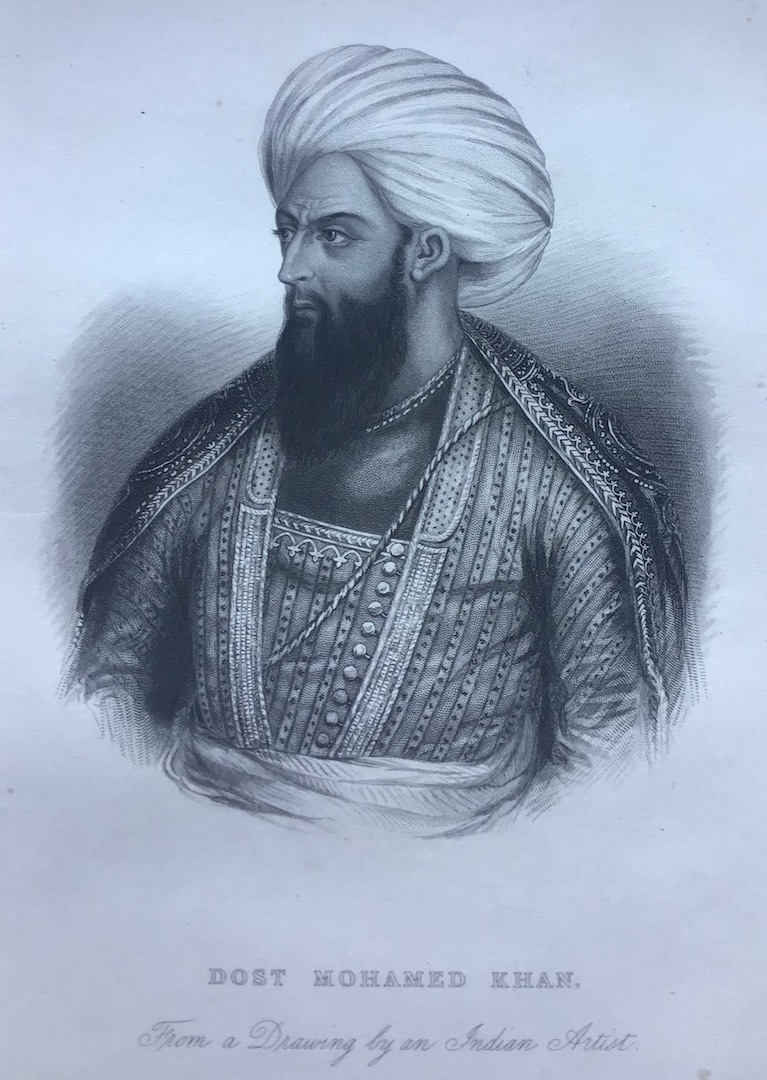 Fig. 4: “Dost Mohamed Khan.” “From a drawing by an Indian artist.” Steel engraving. London. Virtue & Co. Ltd. C. 1840. TRC 2025.0190.Dost Mohammad Khan was the Amir of Afghanistan from c. 1826 until 1839, when he was deposed by the invading British forces. He was allowed to return to Kabul from exile in British India in 1843 and he dominated Afghan politics, no longer bothered by the British, until his death in 1863. Please note that the setting of this scene, like in Fig. 2, is imaginary. It never took place. But that does not matter here.
James Atkinson was a multi-talented man. He was journalist, a surgeon, a Persian-language scholar, and an artist. He sketched numerous dignitaries and others while serving in Afghanistan. In this and another album of his work, some of his original sketches were used to fill up more complicated scenes, such as in his three lithographs shown here (Figs. 1-3). Actually, Atkinson reworked a number of sketches for yet another publication, but these were lost while en route to Britain.
Back to the dress of the Afghans: Foreign observers often commented upon the Amir’s simple, white clothing (he was often positively compared to Shah Shuja, who was put on the Afghan throne by the British in 1839. Shah Shuja was very fond of ostentatious clothing). In Fig. 1 he is wearing a long, apparently white gown, with a rectangular front opening, and with a kamarband wrapped around his waist. His head is covered with a turban.
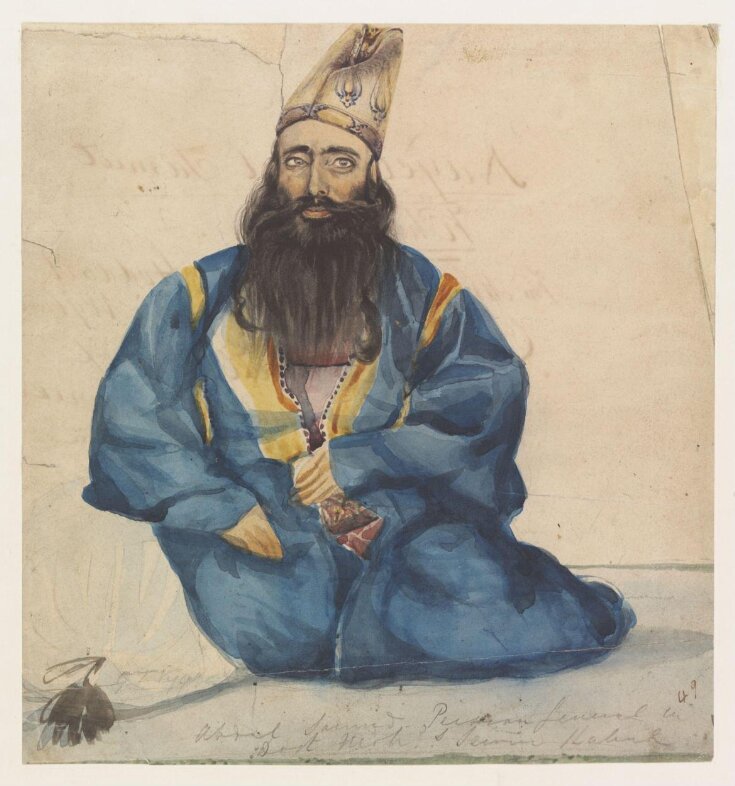 Fig. 5: ‘Abdul Samud - Persian General in Dost Mohd.s. Service Kabul'. Water colour by Godfrey Thomas Vigne 1836. V&A SD 1126. Public domain.In the foreground are his slippers (often known in Europe as babouches, from Persian pâposh, ‘foot covering’) with the characteristic upturned tips. Another pair of slippers, but with pointed sides, is shown to the left.
A servant stands behind the Amir and holds a parasol, often used in Afghanistan and beyond to indicate high status. The same man is wearing a talwâr sabre with its clearly recognisable disk-shaped pommel, in those days a common weapon in the Indian subcontinent and the Indo-Afghan borderlands. It is also carried by the Pashtun Achakzai horseman in Fig. 3. This type of sabre is very different from the more Persian-style shamshir sabre, with the pistol-shaped pommel, as carried by Mohammad Akbar Khan (1816-1847), one of the sons of Dost Mohammad Khan and the main adversary of the British during the First Anglo-Afghan War (Fig. 6).
To the right (and to the Amir’s left), are two of his children, Abdul Ghani Khan and Abdul Ghaffar Khan. Both of them are wearing simple tunics and a turban.
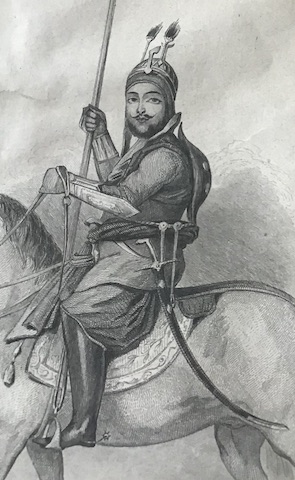 Fig. 6: “Mahomed Akbar Khan. Favourite Son of Dost Mohamed Khan, and Commander of His Cavalry.” (Godfrey Thomas Vigne 1840,). TRC 2025.0191.The two men standing to the left (to the Amir’s right), in Fig. 1, are particularly interesting. One of them, armed with the talwâr, is wearing a tight tunic, very different from the loose and baggy tunics normally worn by Afghan (Pashtun) people. It is more Indian in character. It has a side front opening, fastened on the left shoulder. He is in fact Amir Khan, a Pashtun of the Lohani tribe, who lived along the right (western) banks of the Indus, very close to the Indian cultural orbit.
The other man is the notorious (at least, in British eyes) Abdul Samad, who was described in 1842 by the American Quake, somewhat quirky, Josiah Harlan, as “of Persian descent and a schismatic Sheah, whose vindictive soul ever moved with enthusiastic hatred of the English.”
The adventurer Joseph Wolff (1795-1862; he was just as weird as Harlan. He roamed this part of the world in search of the Ten Lost Tribes of Israel) wrote in 1861 about him as a “villain, a murderer, and a blackguard.”
Abdul Samad had successively been in the service of the British in India, and afterwards in that of the Afghan leaders in Kabul. He was sketched by the indefatigable wanderer (and cricketer) Godfrey Vigne, who traversed the Indo-Afghan borderlands together with Afghan/Pashtun nomads in the 1830s. In the early 1840s,
Abdul Samad joined the service of the Amir of Bukhara, in modern Uzbekistan, and he was subsequently widely held responsible for the decapitation, in 1842, of two British prisoners, Colonel Charles Stoddart and Captain Arthur Conolly. Harlan was right in his statement that he was not particularly fond of the British.
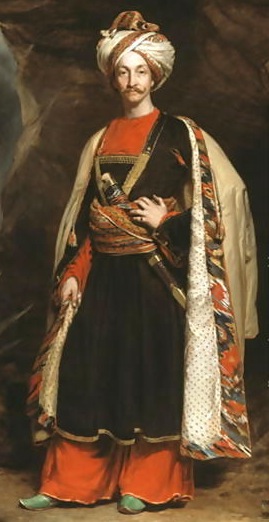 Fig. 7: “Captain Colin Mackenzie, Madras Army, lately a hostage in Caubool, in his Affghan dress.” Oil on canvas painting by James Sant (1820-1916). Courtesy National Army Museum, London, NAM. 1961-10-61-1. Public domain.What is interesting is his headdress, which resembles the kolâh-ye Qâjâri, the pointed cap popular in Persia in the early 19th century. The same type of headdress is shown in his portrait by Godfrey Vigne (1801-1863), sketched in 1836. Also remarkable is his coat, open down the front, with short sleeves, worn over a long-sleeved tunic of some kind.
The two men sitting to the Amir’s right are his half-brother, Mohammad Jabbar Khan, and a scribe (mirzâ). The latter is wearing the same type of long gown with rectangular neck opening as that worn by the Amir. Jabbar Khan seems to wear a coat-like garment with a chest piece, comparable to that worn by the man holding the parasol.
Such a garment was worn by many elite Afghans in those days, and resembles similar coats worn by early 19th century Persians. The same type of coat is worn by the nobleman in Fig. 2, the (Pashtun) Achakzai horseman in Fig. 3 to the right, and by Amir Dost Mohammad Khan in Fig. 4, Contemporary observers frequently mention the Persianate fashion that dominated the wardrobe of the upper class Afghans in those days.
A comparable coat, with chest piece, was worn by Colin Mackenzie (compare Fig. 6), a British officer held captive by the Afghans in 1842, and in later days, after his release, was portrayed in England, by James Sant (1820-1916), proudly wearing Afghan clothing.
The coat he is wearing is actually still extant and now housed in the Dumphries Museum in Scotland (I wrote about this coat in another blog some time ago).
Willem Vogelsang, 21 February 2025.


