


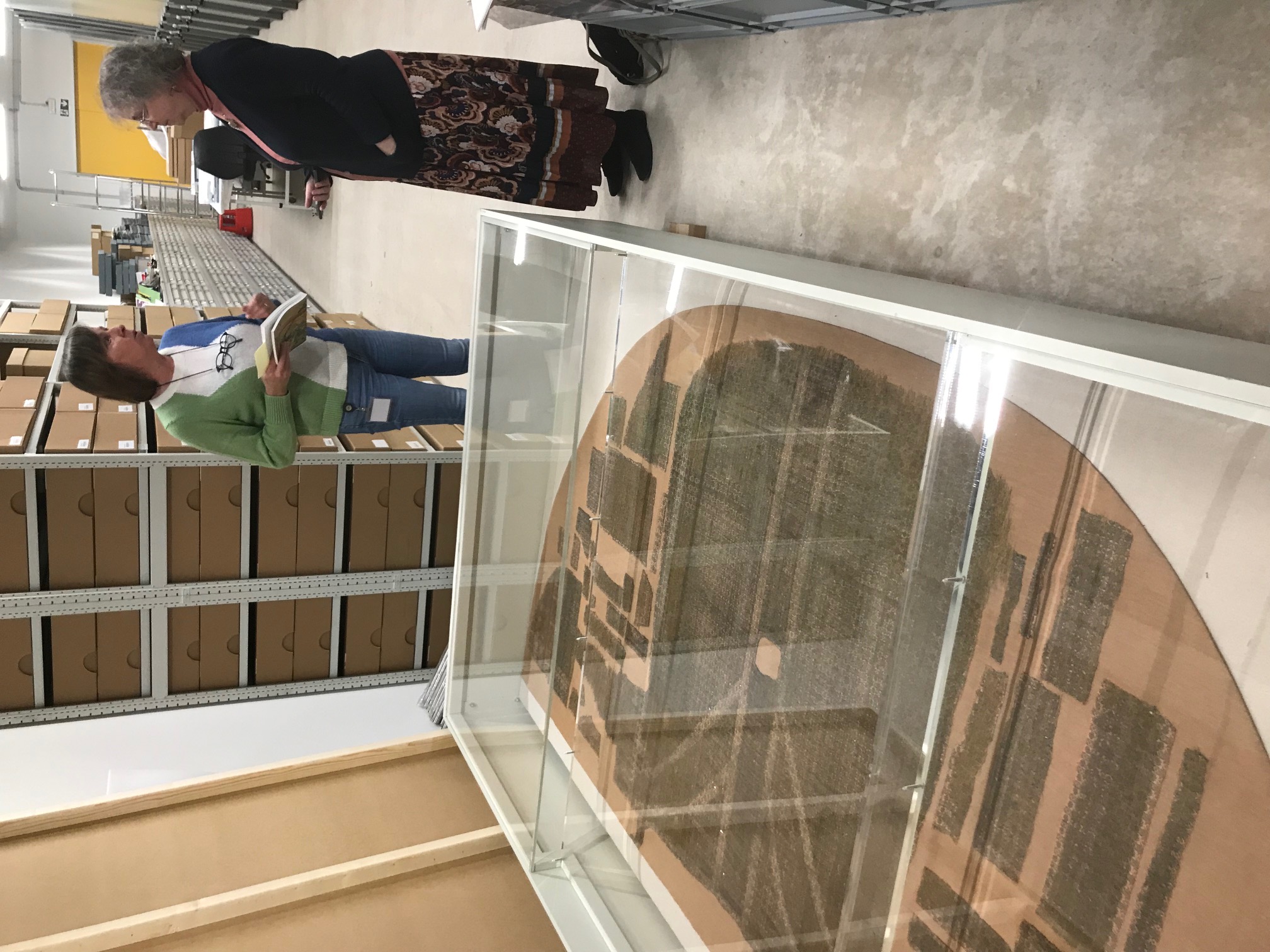
 Greet Verschatse and author in the Trezoor in Kortrijk, Belgium, discussing the chasuble in the foreground, attributed to Thomas Becket. Photograph by Willem Vogelsang.Willem and I have just come back from a visit to Kortrijk (Courtrai) in southwestern Belgium, a town with a long and fascinating medieval and later history. More specifically, we were there to see a late 12th century chasuble that is directly associated with the cult of Saint Thomas Becket, the British archbishop murdered in Canterbury on 29 December 1179 on the implied orders of King Henry II of England (reign: 1154-1189), which led to the famous Canterbury Tales by Geoffrey Chaucer.
Last year we went to see another collection of Thomas Becket garments, namely in Sens in France. As a result of our examination of the Sens pieces, we were kindly invited by Greet Verschatse of the local Museum Texture to come and see the chasuble in Kortrijk. Their Becket chasuble is actually stored at Trezoor, a large municipal storage depot and study centre for cultural heritage, on the outskirts of the city.
Greet Verschatse is a Becket ‘fanatic’ who has been investigating for many years Becket textiles and related items that spread all around Europe as part of a huge, medieval cult of the saint. All of this resulted in an exhibition at the museum called Thomas Becket in Vlaanderen: Waarheid of legende ('Thomas Becket in Flanders: Truth or Legend') in 2000. There is a book with the same title edited by Raoul Bauer, which gives a wide range of historic and technical details.
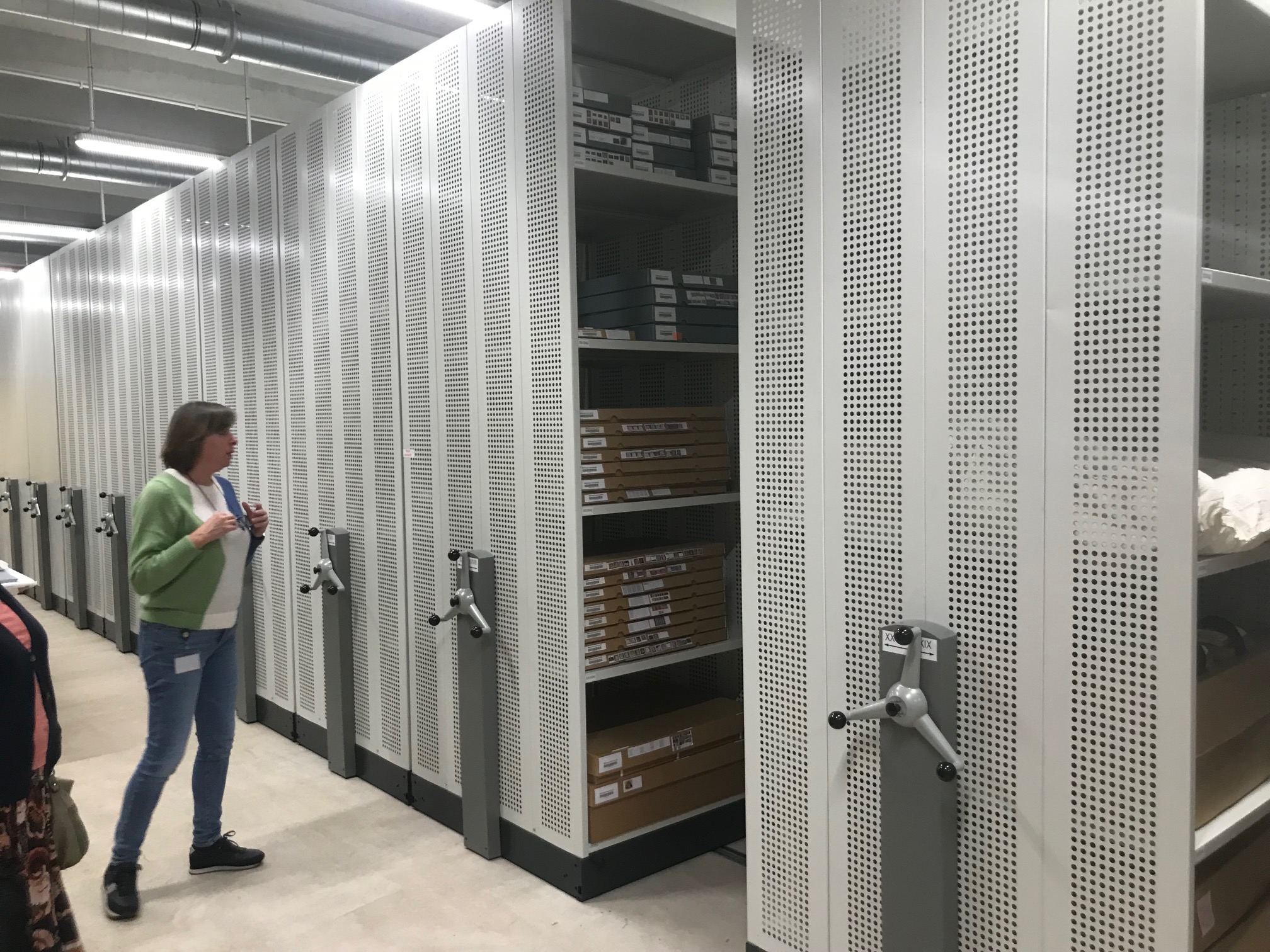 Greet Verschatse at Trezoor, Kortrijk, showing part of the huge depot of local cultural heritage. Photograph by Willem Vogelsang.The Becket chasuble in Kortrijk was unfortunately cut into various parts and re-styled many centuries ago, but the original construction and shape are still well-recognisable. It is made from a 12th century woven silk cloth that appears to be Hispanic-Moresque in origin and may even have the remains of a Kufic Arabic inscription on one piece. The technical details of the cloth were studied and reported by the Belgian textile historian, Daniel de Jonghe.
Seeing the chasuble was one of those moments when you feel you are directly and physically confronted with the past, and in this case with European religious, political and of course textile history.
We were then shown other sectons of the Museum’s depot, including their amazing collection of damasks that date from the 15th century and later, and their wide variety of Belgian laces, most of which were made from linen.
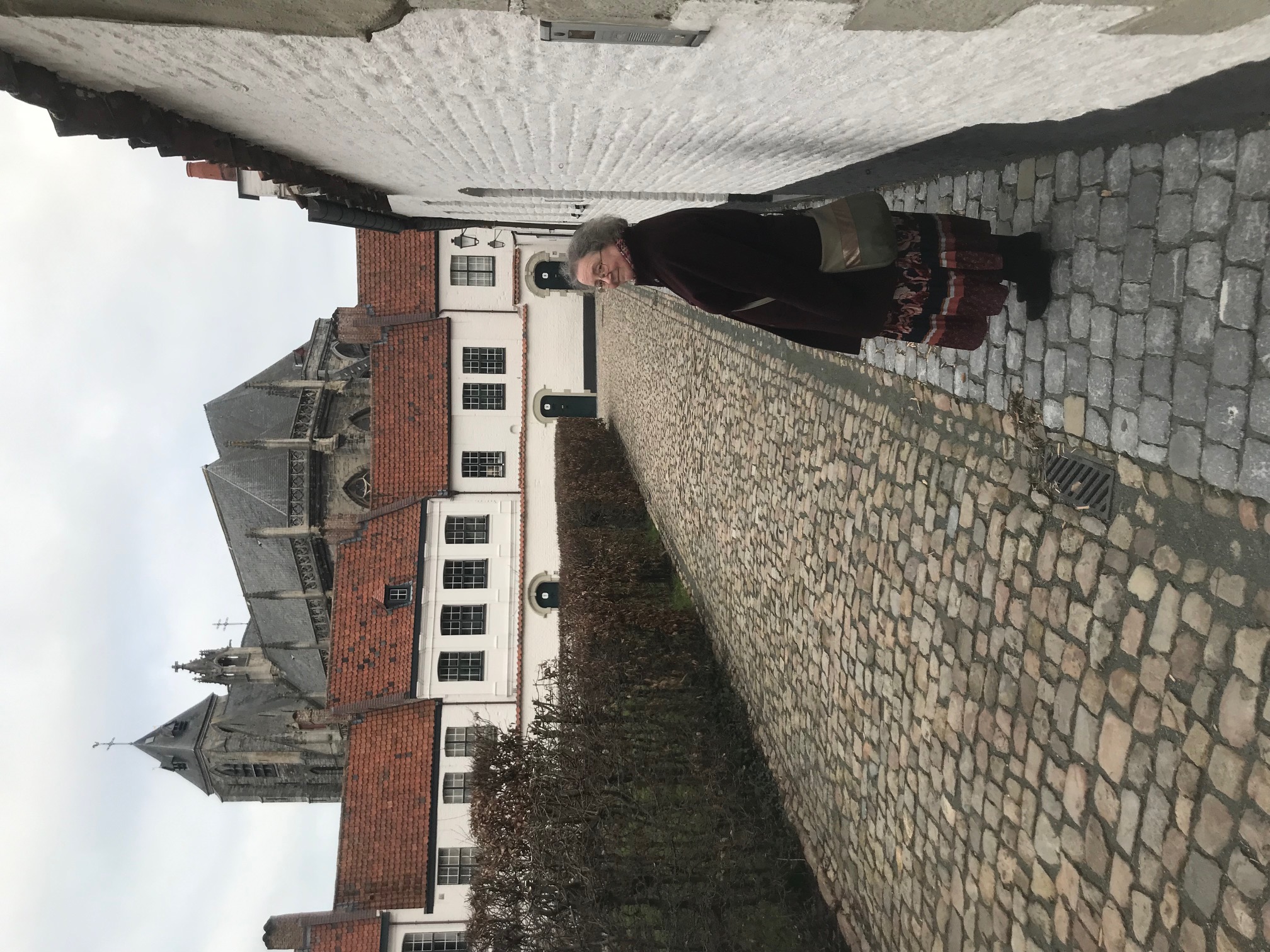 Author at the medieval 'begijnhof' in Kortrijk, where many women used to be engaged in textile production.The next day we visited a medieval gated community. It is a Begijnhof, where groups of women ('begijnen' or the diminutive 'begijntjes') used to live together, living a semi-religious life without becoming nuns. Such communities could be found all over northwestern Europe; they have now all disappeared, but many of the buildings are still extant. A famous 'begijnhof' can be found right in the centre of old Amsterdm. The last 'begijn' in Kortrijk, and indeed in Europe, died in 2013 at the ripe old age of 93. Some of the begijntjes in Kortrijk earned a living with textiles, especially bobbin lace. The complex is certainly worth a visit.
We then went onto the Museum Texture, which is dedicated to the history of flax growing and processing, and linen production and use in this part of Belgium and in western Europe in general. The museum has depicted the history of flax and linen on three floors. The ground floor looks at what are flax and linen, and in comparison also shows other textile fibres.
For many centuries the growing of flax and the production of linen was one of the mainstays of Flanders' economy, and the first floor includes some amazing items of small and large types of tools and machinery used in the processing of flax, from heckles to looms, as well as sample books, videos, photographs and explanations.
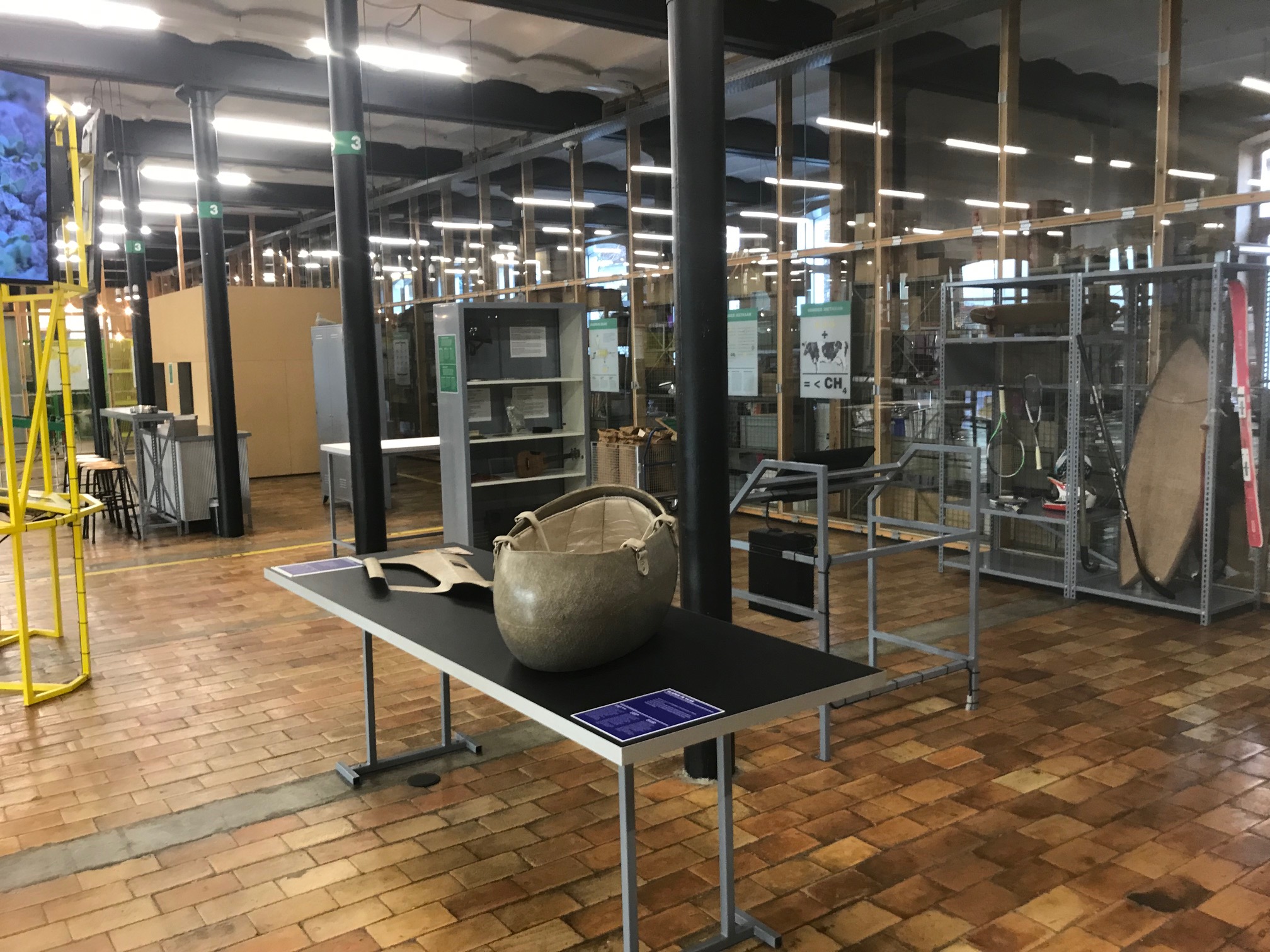 Ground floor of the Museum Texture in Kortrijk, with a plethora of tools and instruments, and types of fibres and other materials, related to the flax and linen production in Kortrijk and Flanders from the medieval period onwards. Photograph by Willem Vogelsang.The second floor is dedicated to the uses of linen, from christening robes to other garments and lace. There were also four historic linen damask serviettes with complicated depictions of Biblical and historical events. The patterns, otherwise difficult to discern because of the characteristic white-on-white character of damask, were explained by the use of computer-generated imagery and a voice-over explanation. The final effect was impressive.
We bought several books in the museum shop, including Damast and Damast 2, which include illustrations of a wide selection of damask textiles in the museum’s collection, with a range of detailed technical and historical information. We will be able to identify and expand a number of TRC damask textiles as a result of these books!
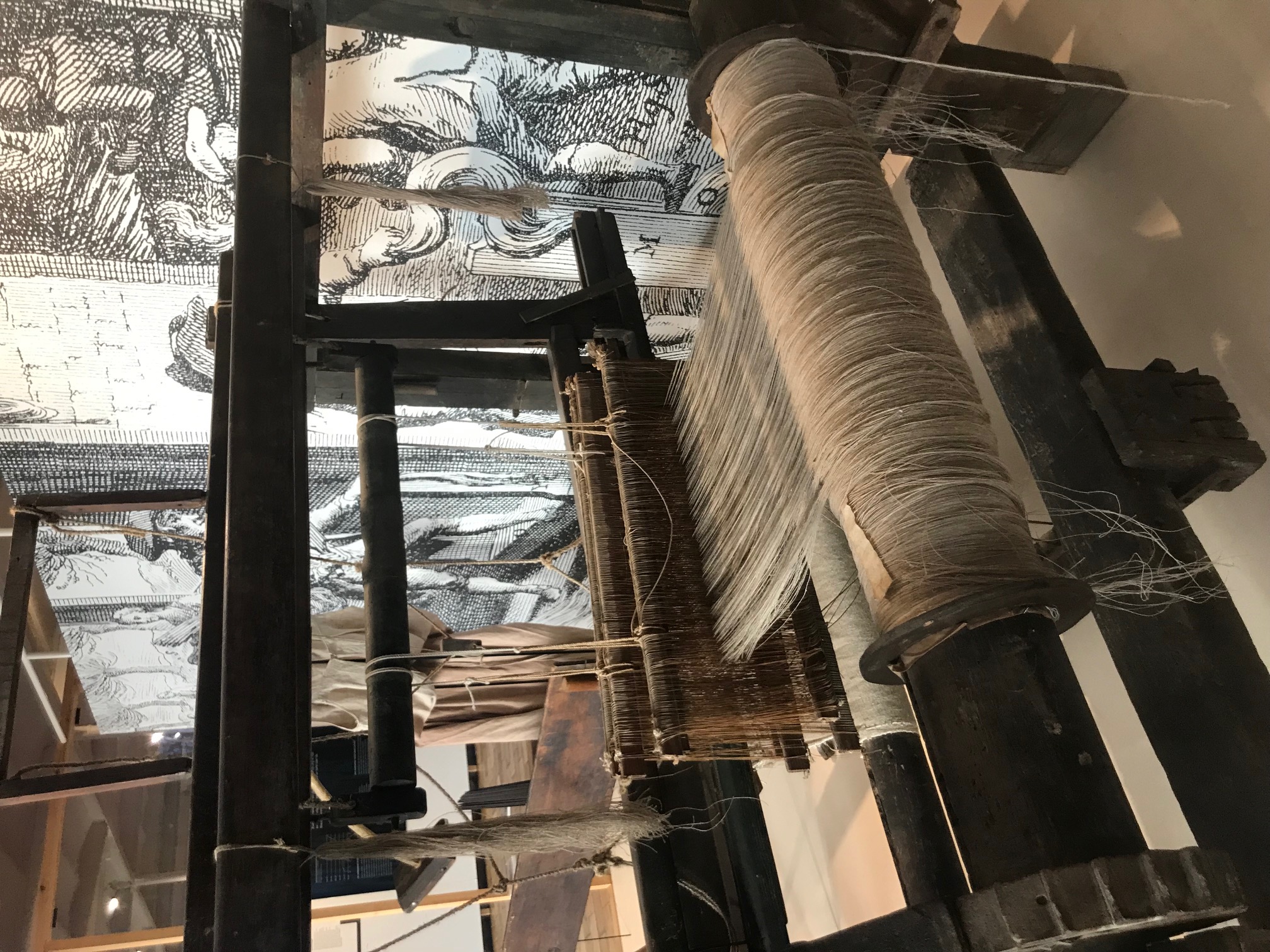 An historic loom for linen production, now in Museum Texture, Kortrijk. Photograph by Willem Vogelsang.Which brings me to one final point about our Kortrijk visit. How can the Kortrijk Museum and Depot and the TRC, both established in a city with a rich textile history, work together? Not surprisingly, we already have a number of ideas how we can support and help each other. These will be the subject of another blog in a week or so’s time!
Gillian Vogelsang-Eastwood, 30 January 2023


