


October is LGBTQ+ History Month and the TRC was recently given a cheeky textile memento of American lesbian life (TRC 2022.2570).
The object is a square-shaped appliquéd panel, approximately 48 cm x 38 cm, with a plain white backing. The front depicts a beach scene. Five couples are kissing and cuddling on beach towels, under big umbrellas. Strewn around them are four palm trees (including one with coconuts), sandals, bags and a beach ball. There are mountains in the background, birds in the sky, and a bright yellow sun.
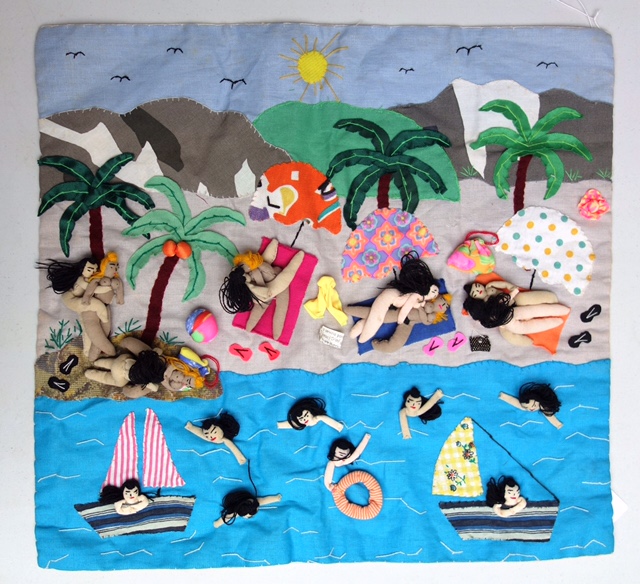 Appliqué cloth from Hawai'i, early 2000s (TRC 2022.2570).
We also see the upper torsos of six figures swimming in the sea, and another two in sailboats. All the figures are nude and female, judging by their breasts and long, yarn-like hair. Care has been taken to show some individuality, as there are different hair and skin colours.
This appliqué, according to the donor, was purchased second-hand in Honolulu, Hawai’i (USA) in the early 2000s. The donor further said that the textile was made to commemorate Sandy Beach in Honolulu, where lesbians gathered every Sunday for many years in the late 1990s to at least 2010. Hawai’i, a Polynesian archipelago in the Pacific Ocean, has been a very popular tourist destination for decades. Honolulu is the state capital and port of entrance for most tourists.
Waikiki is the most popular, thus famous, beach near Honolulu. Given the fact the figures are nude, which is generally illegal on American beaches, and the affection the couples are expressing, it’s possible this is a private, women-only, beach.
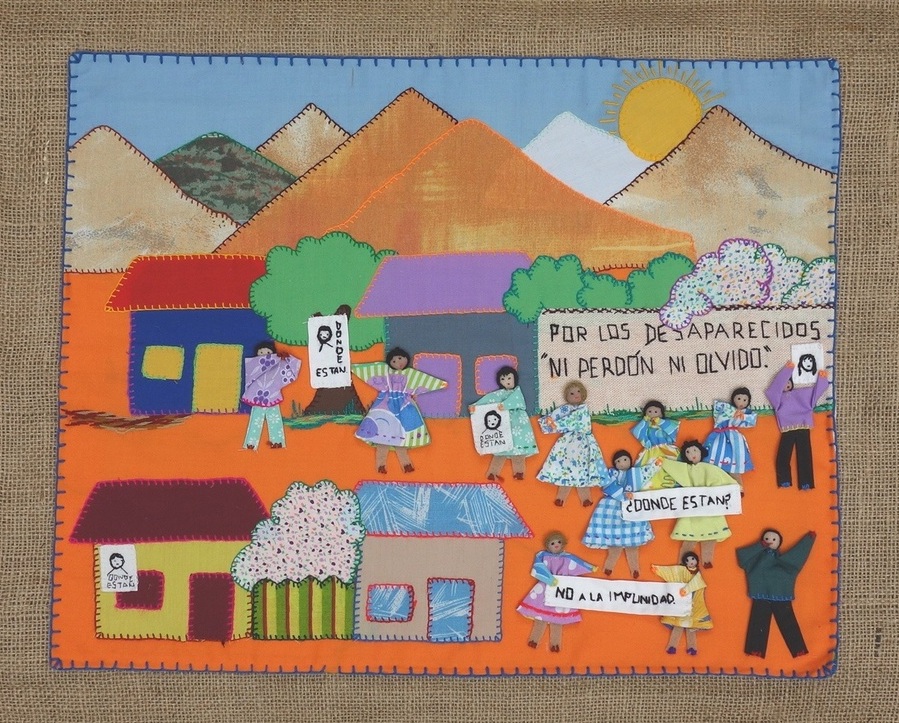 Arpillera from Chile, 2015, Made to mark the disappearance of Chilean men and women (TRC 2015.0401).
The panel’s appliqué style is reminiscent of arpilleras from Chile (compare TRC 2015.0401). Both examples use appliqué, including small, three dimensional cloth dolls; are made from scrap fabric; and show normally invisible scenes from women’s lives.
In Chile, arpilleras were made by women, and while the maker of the lesbian panel is unknown, it was likely made by a woman, too. In the case of Chilean arpilleras, the makers showed scenes of human rights violations by the Pinochet military dictatorship (1973-1990). Smuggled out of Chile, arpilleras raised international awareness of the dictatorship’s abuses—which is why it was made illegal to own or publicly show arpilleras inside Chile.
Chilean arpilleras made during the dictatorship had a political message. While the scene depicted on the appliqué from Hawai’i is far more playful, the fact that it portrays lesbians enjoying themselves without shame or secrecy is also political. It is a statement of visibility and pride by a minority whose lives are still criminalized in many countries.
You can see more textiles about LGBTQ+ lives in the TRC’s digital exhibition Rainbow People.
Shelley Anderson, 24 Octobeer 2022


