


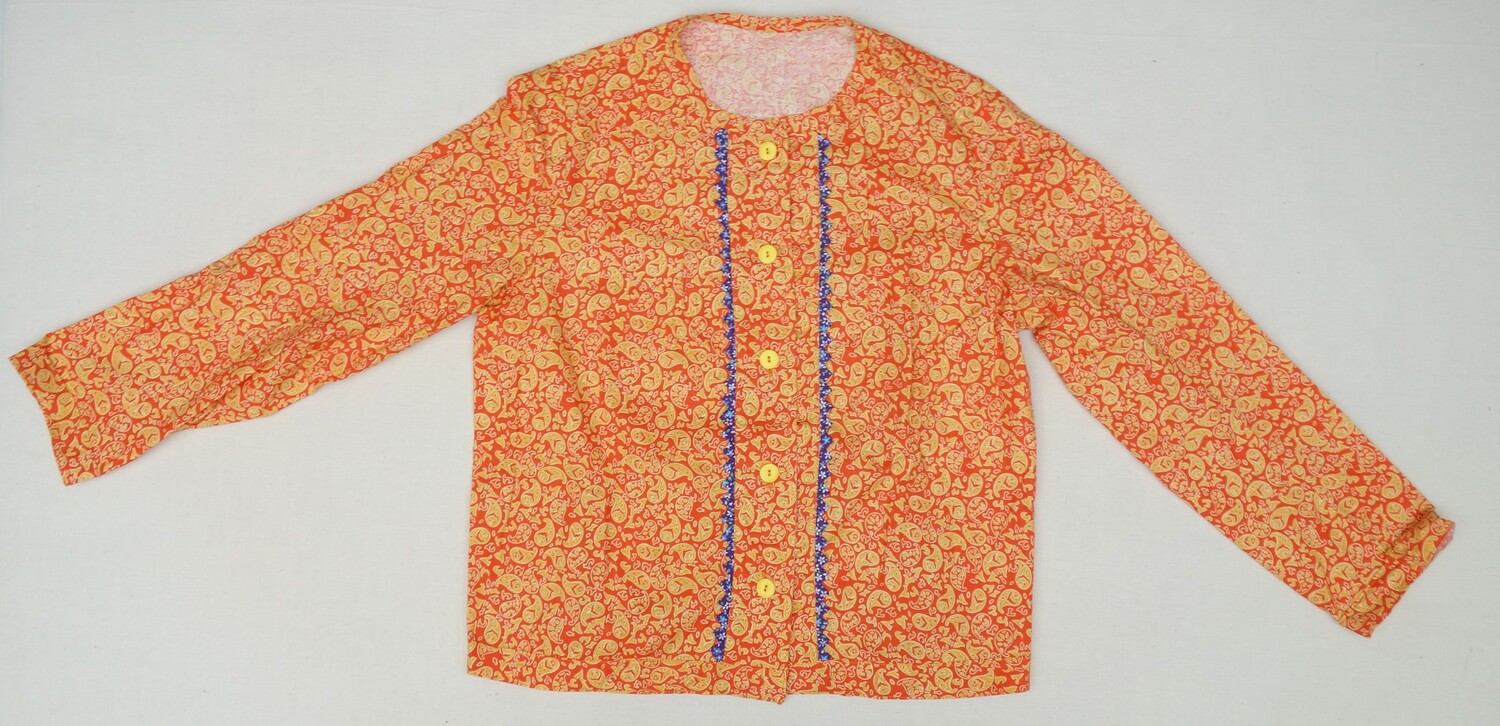
 Long-sleeved everyday blouse decorated with paisley motifs, Kihnu island, Estonia, early 21st century (TRC 2021.0408c).Kihnu island is a unique place, situated in the Baltic Sea along the western coast of Estonia. Kihnu was described as having Europe’s last remaining matriarchal society and featured in a film and article by the BBC.
As part of the TRC’s current exhibition about the buteh, which is better known in the West as the paisley motif, we were given a woman’s daily outfit from Kihnu island, Estonia (click here). The donation was made by Merle Ernits, who is originally from Estonia but now lives in the Netherlands. The following description about Kihnu dress is written by Heidi Stanionyte, Merle Ernits’s daughter, who lives in Estonia.
About Kihnu costumes for women
Men had to work on ships or as fishermen in order to earn money to support their families. As a result the women were left behind to be in charge of their households and community life. Gradually, the role of women became increasingly pivotal in Kihnu’s culture and society, which has since been included in the UNESCO List of the Masterpieces of the Oral and Intangible Heritage of Humanity.
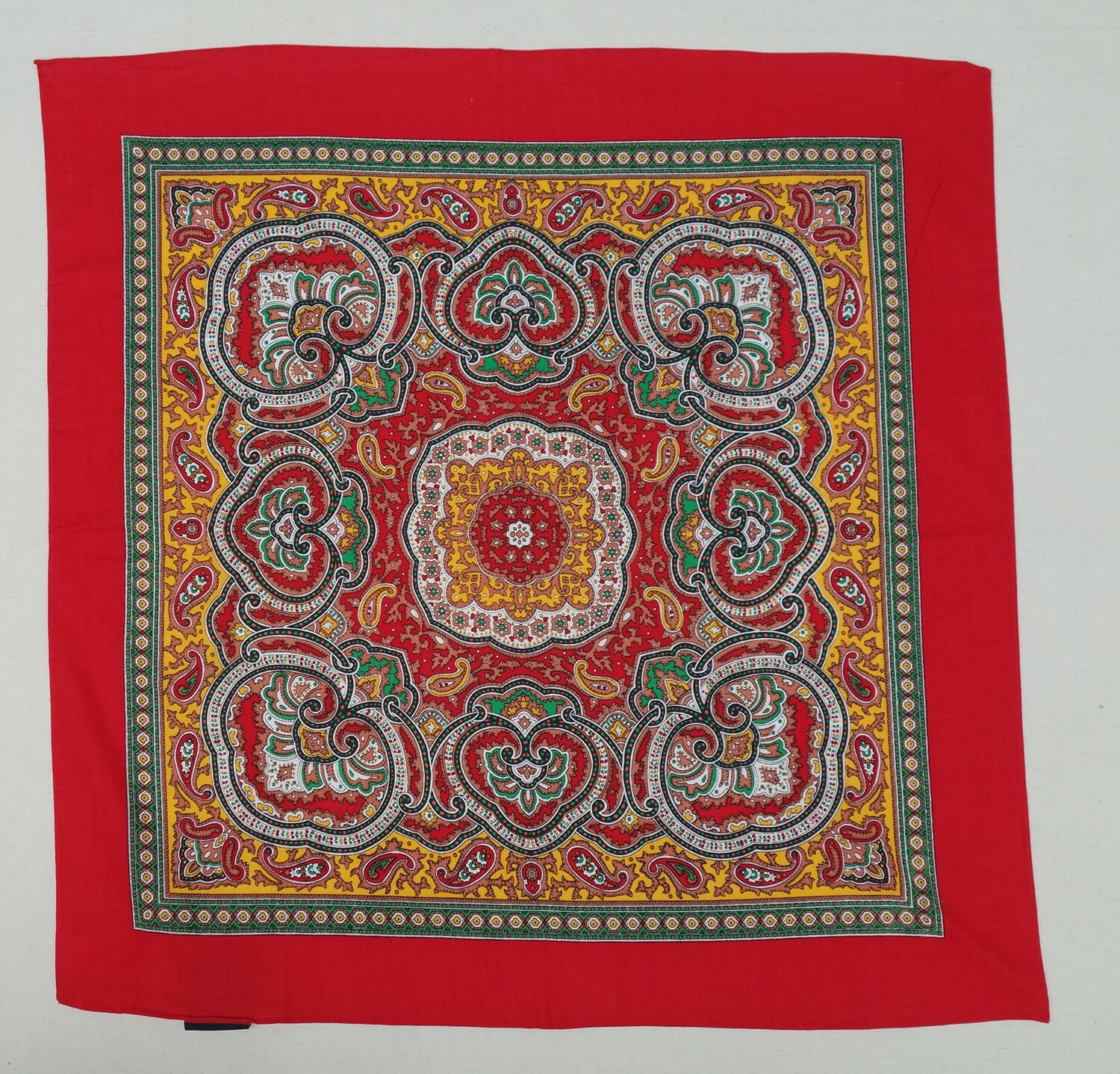 Everyday woman's headscarf from the island of Kihnu, Estonia, early 21st century (TRC 2021.0408d).Regional women’s dress on Kihnu is well-known in Estonia, but less familiar further away. The current design of Kihnu clothing can be traced back to the beginning of the nineteenth century when the communication between the island and the mainland intensified. Many of the printed textiles were produced in Russia, while the embroidery and woven pieces (striped skirt and narrow belt) were local.
Daily version
The daily version of the regional outfit are still frequently worn and consist of locally woven, woollen, striped skirts (kört, TRC 2021.408b), an underskirt (alusseelik, TRC 2021.0408a), a cotton blouse (sitsijakk, TRC 2021.0408c), an apron (pöll, TRC 2021.0408e) and a scarf (rätik; TRC 2021.0408d). The apron is only worn by married women. Kihnu's daily clothes are often decorated with paisley patterns that make the aprons and scarves very attractive, with their additional range of floral and geometric patterns.
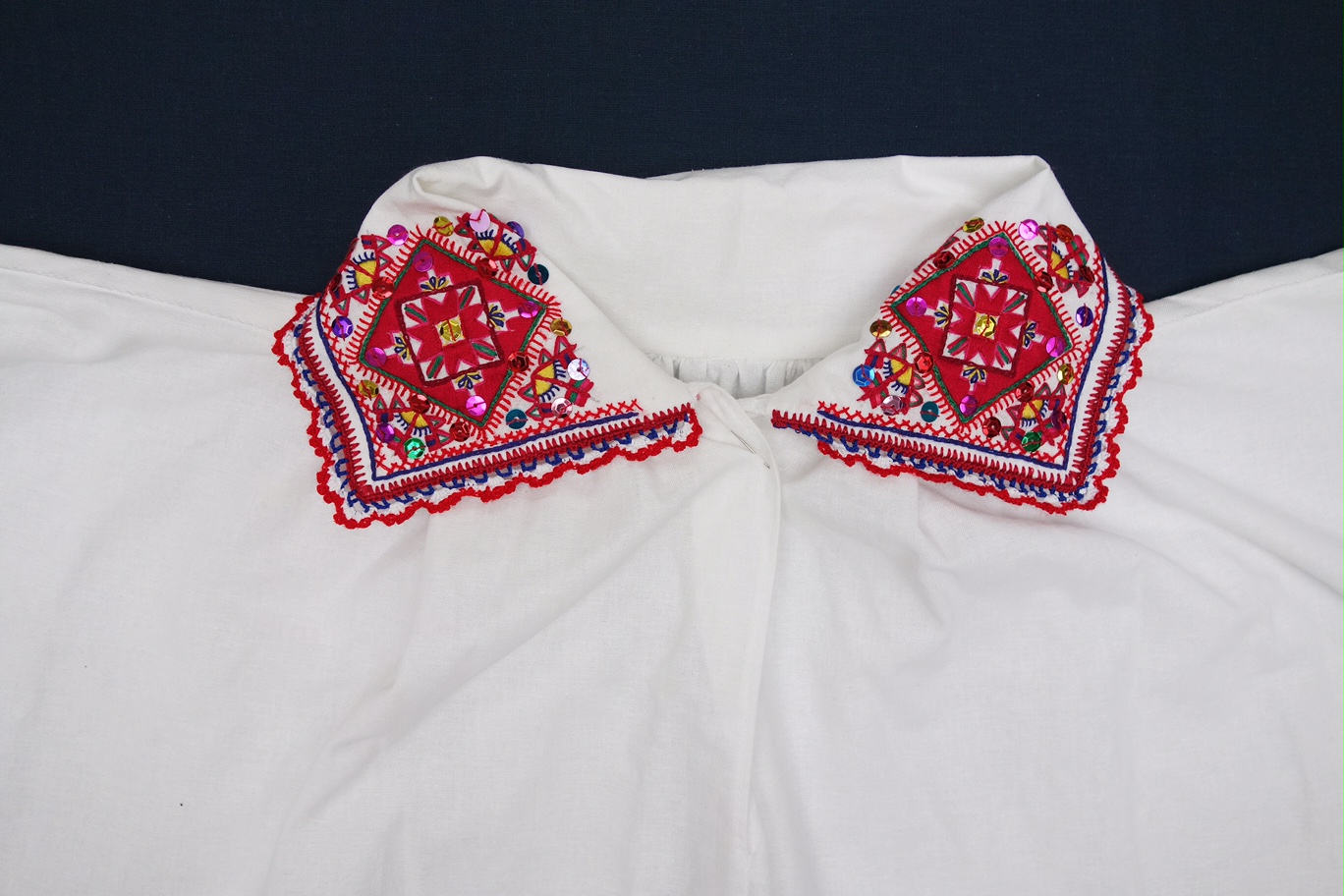 Detail of a festive woman's blouse with embroidered collar, from the island of Kihnu, Estonia, early 21st century (TRC 2021.1829).The women's headwear worn on a daily basis is normally a printed headscarf decorated with floral designs. The colour of the headscarf depends on the shade of the skirt stripes: dark and without red if the wearer is in mourning. Most printed cotton scarves could also symbolise the pride and wealth of the person. The scarves are being collected and preserved for future generations.
The headscarves worn on Kihnu have different names and origins, but one of the most well-known is the kallisseltsi scarf. These scarves have patterns printed on a red background and are decorated with floral patterns in yellow, green, blue, black and white.
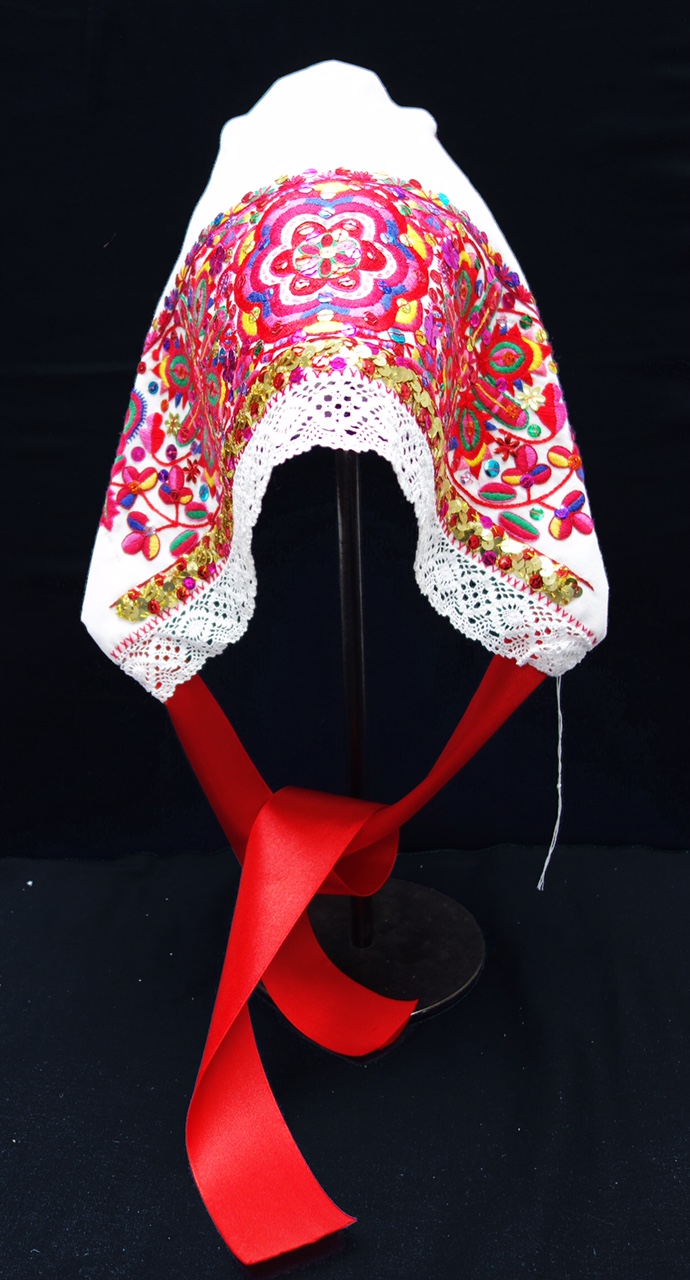 Coif or festive cap for a woman from the island of Kihnu, Estonia, early 21st century (TRC 2021.1830).The woollen, striped skirt (kört) is regarded as an essential part of both the Kihnu daily and festive outfits. The pattern and colours of the skirt can vary considerably, but the most dominant colour is red, but some skirts can be black. The black indicates that the woman is in mourning. For example, when the husband dies, the widow will wear a black skirt for at least a year.
In the case of the death of a mother, the mourning period lasts six months. A skirt that has black (dark blue), white, green, etc. stripes but no red ones, is also considered to be a mourning skirt. This kind of skirt is also worn after the death of a more distant relative and in the months that follow she will change her skirts to blue and red colours. The colour of the skirt also determines the colours of the blouse and the apron.
Festive version
The full festive outfit is worn nowadays on special occasions, such as weddings, festivals and religious holidays. It consists of an embroidered blouse, an embroidered cap or coif, a printed shawl, a woollen striped skirt of the type described above, a locally woven sash and, if the wearer is married, an apron, as well as jewellery of various forms.
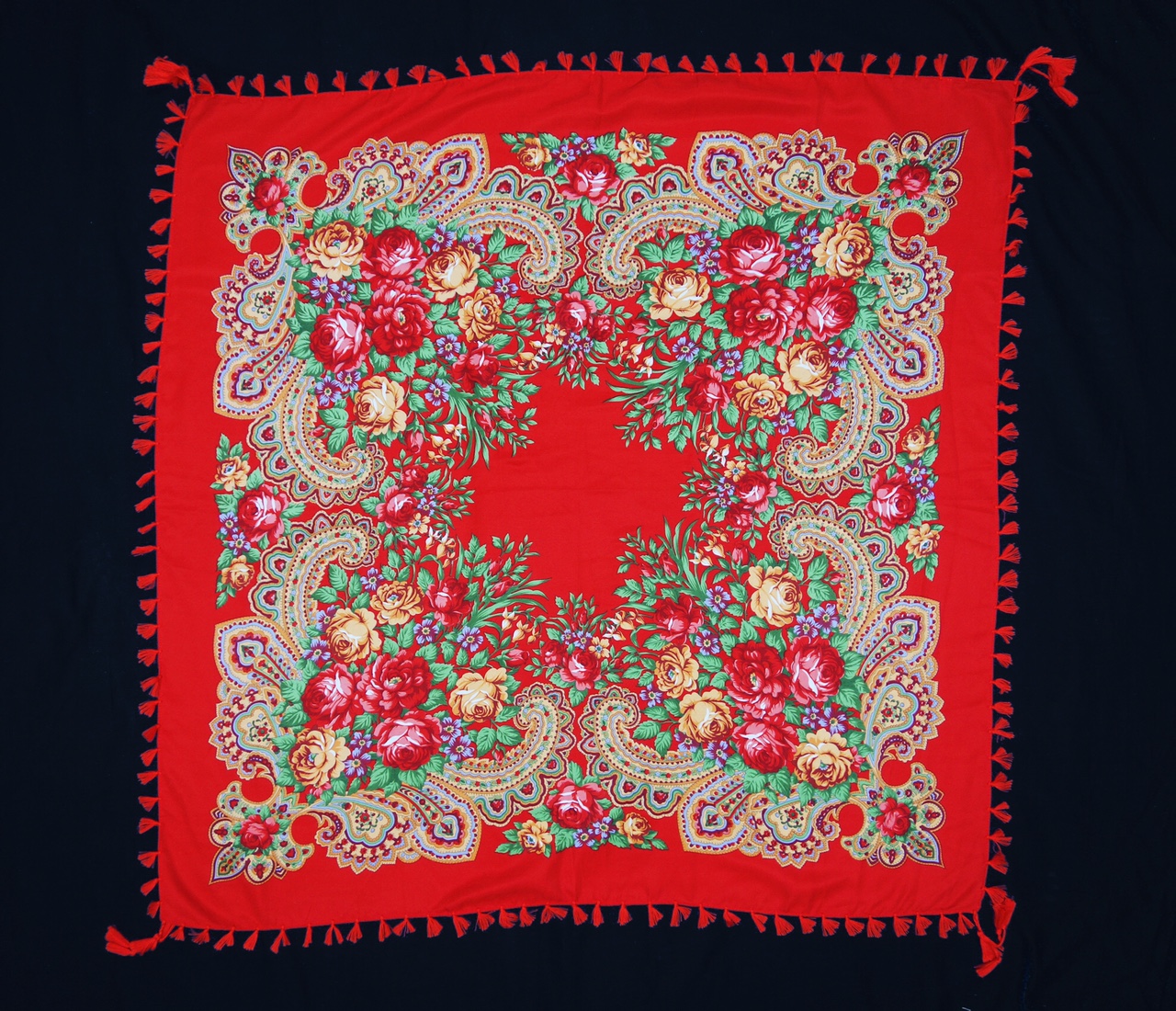 Festive woman's shawl from Kihnu, Estonia, early 21st century (TRC 2021.1830).The elements of Kihnu festive costume that have just been given to the TRC Leiden include an embroidered blouse (TRC 2021.1829), an embroidered cap (TRC 2021.1830) and a printed shawl (TRC 2021.1831). The short, festive blouse (käused) has long sleeves and an elaborate and colourful embroidered band around the hem and sleeve cuffs, and on the collar. The embroidery consists of geometric and stylised floral motifs in red, purple, dark blue, green and yellow.
Another important attire is a richly embroidered cap that is worn by married women. The coifs are made from white cotton and embroidered with large, stylised flowers.
Heidi E. Stanionyte, 25 May 2021.


