


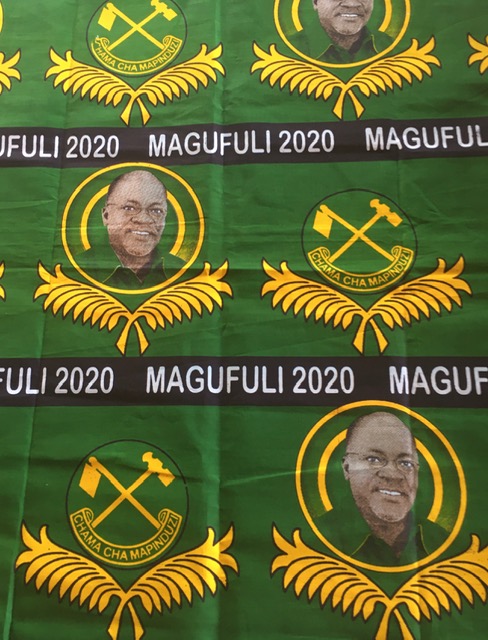
 Kanga from Tanzania, bought in January 2021, in support of John Magufuli who won the presidential elections in Tanzania on 28 October 2020 (TRC 2021.0289).The first exhibition at the TRC in its premises along the Hogewoerd in Leiden was about an iconic garment from Kenya and Tanzania: Kangas: An East African garment for women (November 2009 - February 2010). Below is an account of the kanga, written by Caroline Stone, a distinguished textile historian based in Cambridge, UK, and currently in Tanzania.
Kangas are lengths of cloth, 100% cotton and generally brightly patterned, worn by women in East Africa, especially Tanzania and Kenya, since the mid-19th century, and are a very typical element in Swahili culture. Sold as a pair of identical panels c.160 x 110 cm, kangas were traditionally worn with one half knotted above the breasts or over one shoulder, while the other half served as a shawl or head covering, or to carry a child slung on the back. More recently, probably because of religious influence, Muslim and Christian, it has become normal to wear the kangas over a blouse or other garment, to avoid leaving arms and shoulders bare. In the past, when kangas were less highly decorated, they were also worn by men, tied round the waist.
Characteristic of the kanga, is a panel with a phrase in Swahili. A woman selecting a kanga will often consider the text first and the design only in second place. This expression is of great social importance: it can indicate the wearer's state of mind: "I am satisfied with my condition"; offered as a gift, it may contain advice or warning: "Arrogance is not good" or "Even if you hate me, my heart is clean."; or be used to spread a social or political message, advocating education for women, for example, or as political propaganda, such as this one for the election of the current President of Tanzania. It was customary to wear the kanga so that these sentiments showed, but I have been told that younger women now often prefer to hide them.
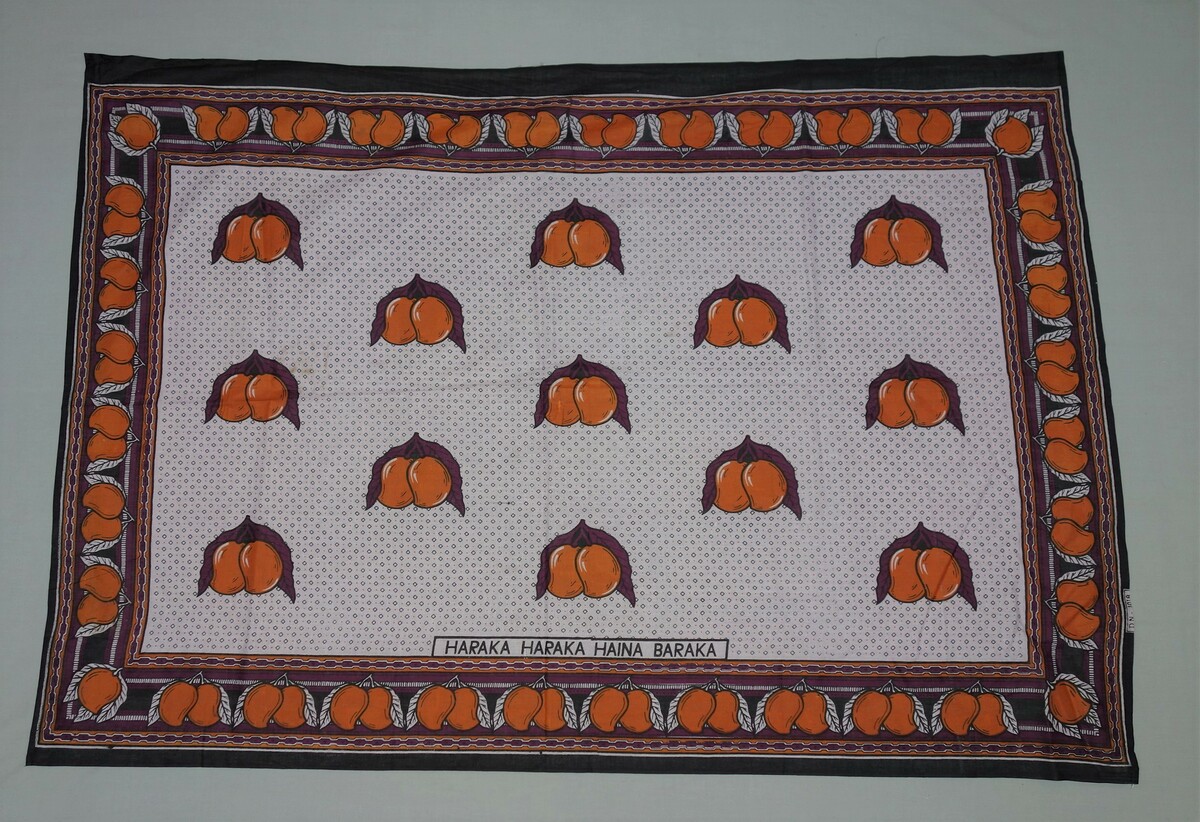 Kanga from Ibra in Oman, 1995, with the text: "Haraka haraka haina baraka" ('Hurry hurry has no blessing') (TRC 2005.0219). Kangas are also worn in Oman, reflecting the historical relations between East Africa (and in particular the island of Zanzibar), and Oman.Kanga design has changed over the decades, The earliest seem to have little spots or speckles, like the guinea fowl - kanga - hence perhaps, the name. The commonest basic design today is a border with the expression in Swahili above it and a large central motif, sometimes with extra decorative elements filling in the corners, or with lines of motifs. Bold designs and bright colours are currently very popular and fruit and flowers, often with their own symbolic meanings, are perhaps the commonest motifs. Also popular are household items, such as the coffee pot, representing hospitality, or the latest desirable consumer goods, for example mobile phones, or again ships and fish, referring to East Africa's maritime heritage.
Another perennial favourite is paisley or "Botah", the shape often being conflated with the mango, as in India a symbol of fertility, or the cashew nut - korosho - which is of great economic importance, hence prosperity. Chieko Orimoto, in her excellent book Kanga Collection, suggests that some of the arabesque borders reflect the wood carvings on the doors of traditional Omani-style houses, found especially in Zanzibar.
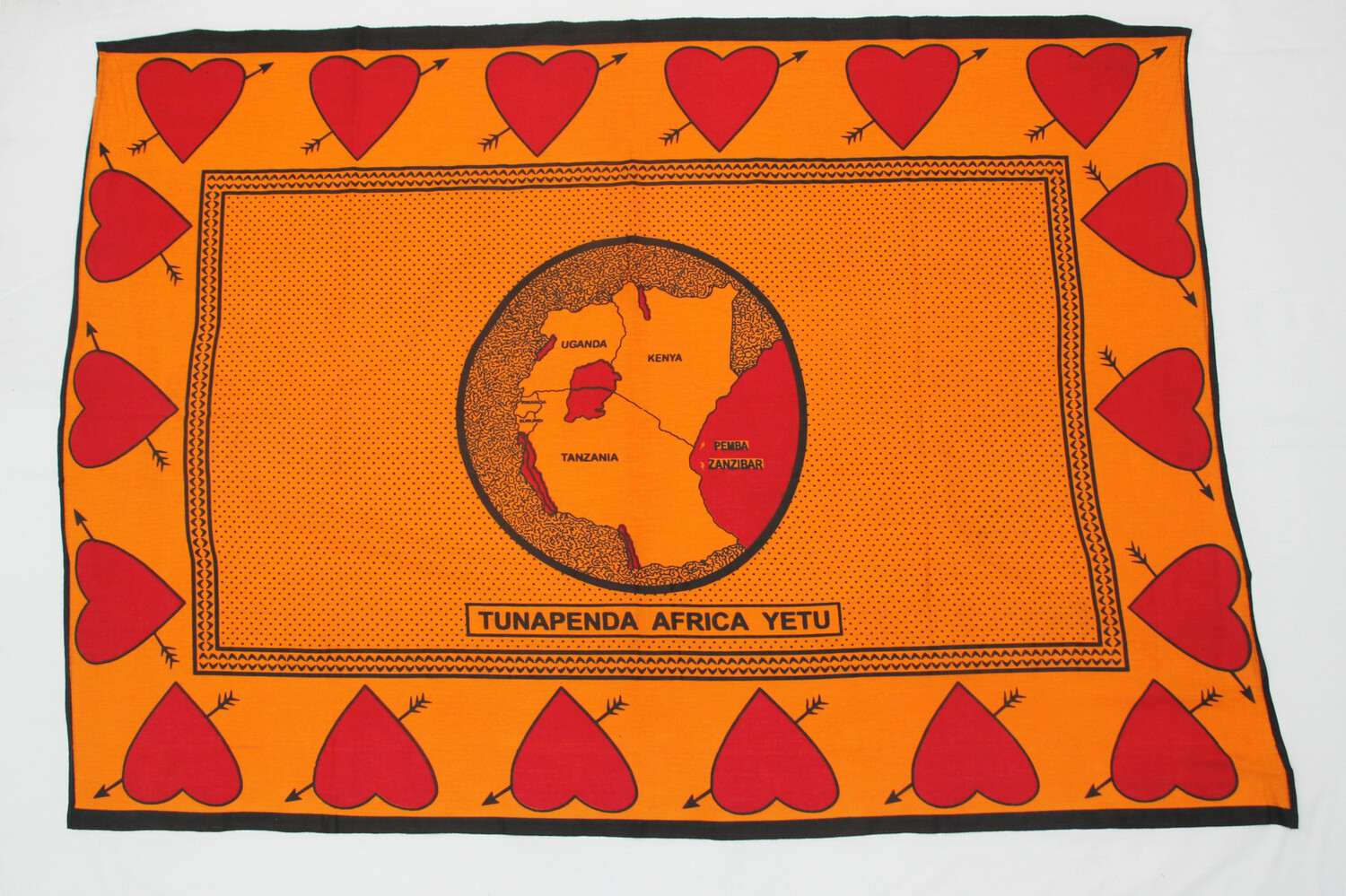 Kanga from Kenya, 2010, with the text: "Tunapenda Africa yetu" ('We love our Africa') (TRC 2013.0123).The earliest kangas were woodblock printed, but they soon came to be produced industrially. Many early-mid 20th century kangas were made in Japan and a textile factory where I worked in Osaka fifty years ago had a magnificent collection, the result of collaboration between Japanese and East African designers. Many of these were simple and elegant, with only two colours and much use of geometric designs. They were considered very high quality and were greatly sought after.
In a parallel tradition, lambas, often with elaborate pictorial scenes, came to East Africa from Madagascar, some being made there, while others were imported from Holland through much of the 20th century. The lamba (which means cloth or clothing) is the traditional wear from northern Madagascar, and consist of a large rectangular cloth that is wrapped around the body.
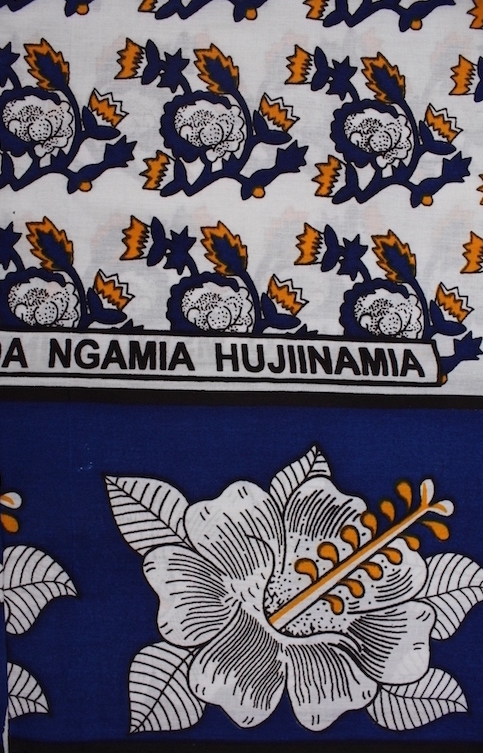 Detail of a 2009 kanga from Kenya. The full text is: "YALIYO MSIBU PUNDA NGAMIA HUJINAMIA", which means 'If something bad happens to the donkey, the camel will also suffer'. In other words, if you hurt me (the wife), you (the husband) will suffer'(TRC 2010.0002)At the earlier period many of the imported kangas came from the UK - good quality cotton, usually printed in two colours - but the trade died out in the 1950s. Some of the earliest still have the Swahili phrase in the Arabic script, which was then in use.
Kangas seem to have been printed in China in the late 60s and 70s. According to Chieko Orimoto, many of these did not have the characteristic phrase in Swahili, probably because, unlike the Japanese, they were not in touch with their East African counterparts. On the other hand, as a clever marketing device, each kanga was apparently packed individually with a scent sachet, so that, by the time it reached Africa, the cloth would be perfumed.
In recent years, the kanga has become less ubiquitous, as other forms of dress have gained in popularity, but they are still to be found everywhere. Some, often not very good quality, are imported from India, but many are now made locally, especially in Tanzania.
See also other blogs on the subject: Shopping for Kangas in East Africa, by Kate Kingsford (20 September 2015), and Kisses and Kangas, by Shelley Anderson (2 July 2018).
Caroline Stone, Kilwa Masoko, 5 February 2021


