


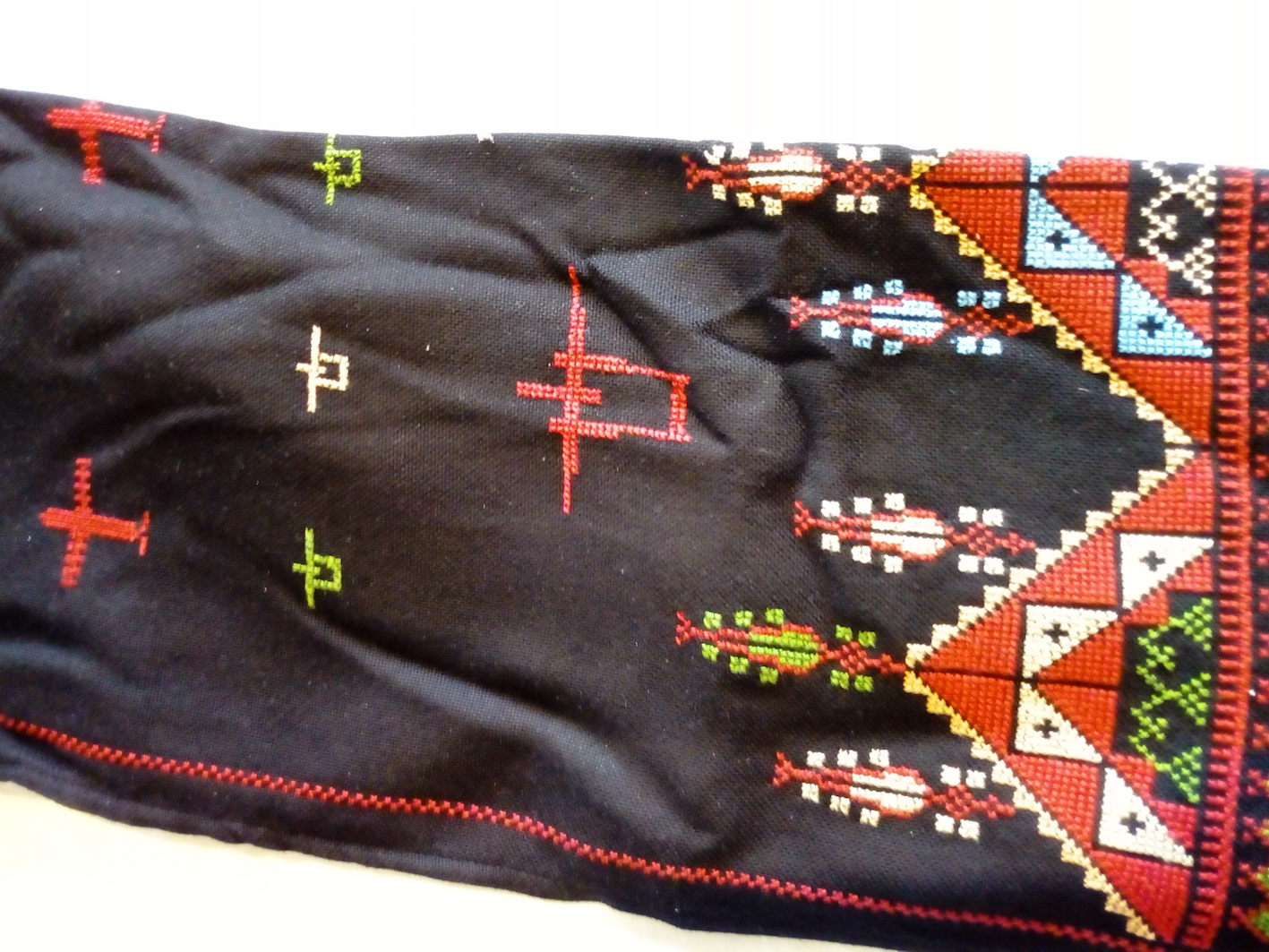
 Scarf with a depiction of drones, Gaza, Palestine (TRC 2021.0282).A recent donation to the TRC reflects the changing nature of tradition. The donation is a lovely black cotton scarf, 150 x 40 cm, from Palestine (TRC 2021.0282). The ends are embroidered in a traditional pattern from Gaza with stylized flowers, worked in cross stitch in red, light blue, yellow and green colours. Hovering above the flowers however, are the silhouettes of something new—surveillance drones.
The scarves are stitched as an income generating project by women who are hard of hearing, working in the Open Studio of the Red Crescent Hospital in Khan Younis. The scarf was designed by an innovative Palestinian group called Disarming Design, which also makes gowns out of keffiyehs and other ingenious designs.
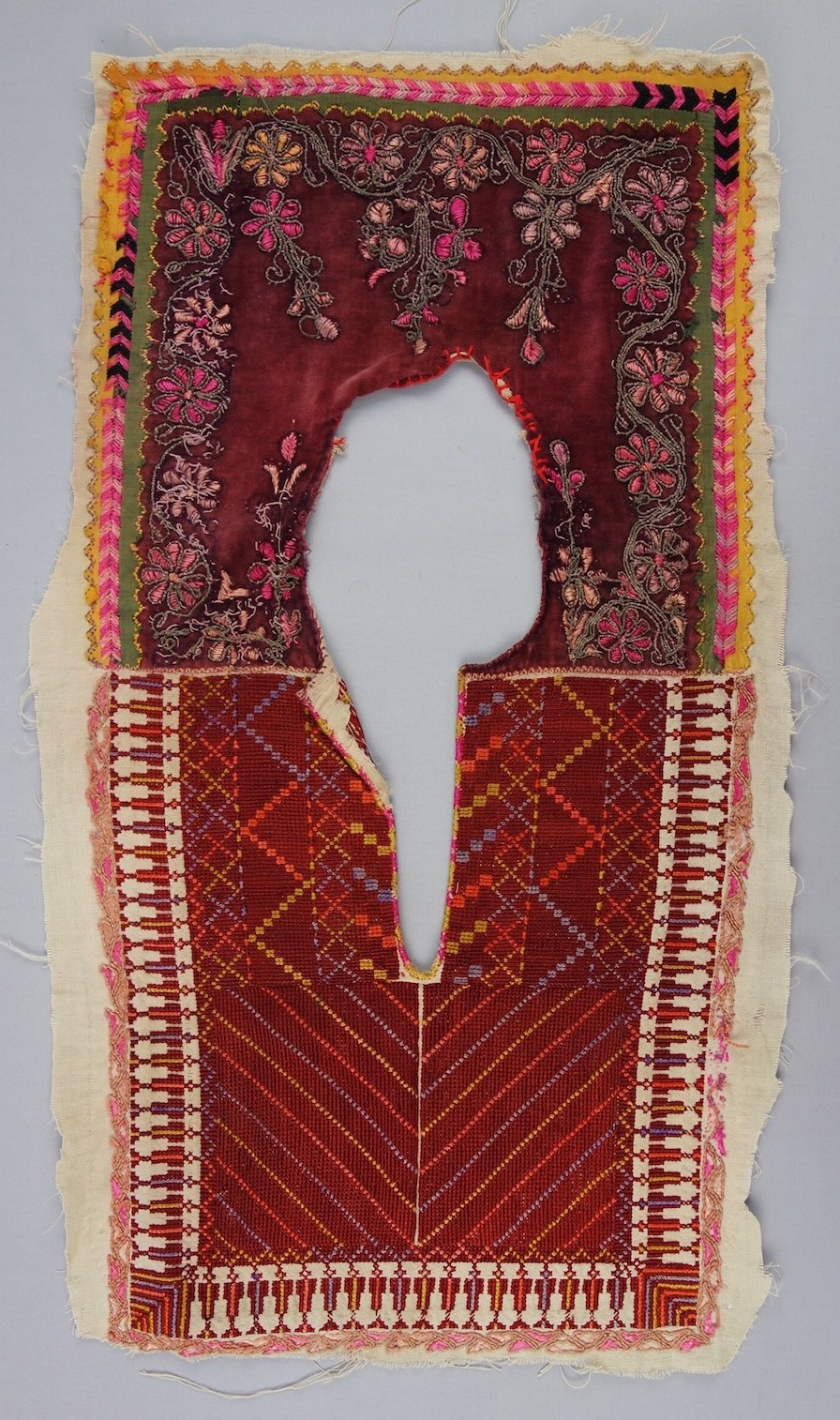 Front and back panel of a Palestinian dress from Hebron, early 20th century (TRC 2016.2035).Palestinians have a long tradition of embroidery, especially for women’s dresses, with embroidery being the main decorative element after the second half of the 19th century. The TRC collection includes many examples of richly embroidered traditional women’s dresses, which reflect a girl’s background and social status.
Specific areas developed their own styles, such as Bethlehem, Ramallah and Bayt Dajan. My favourite example (TRC 2016.2035) comes from Hebron: it’s the front and back yoke of an early 20th century women’s dress. Worked in cotton and silk, the front features a design of squares and triangles worked in cross stitch, while the back applied purple velvet panel is a couched design of stylised flowers, highlighted with pink and purple silk in satin stitch.
Embroidery remains an important aspect of Palestinian identity, and a means of political protest. You can learn more about Palestinian embroidery and dress, plus that of other communities in the region, like the Druze, Copts, Bedouin, Orthodox Jews, Samaritans, Kurds and the Zoroastrians, in the TRC’s digital exhibition “From Kaftan to Kippa: Dress and Diversity in the Middle East”.
Shelley Anderson, 31 January 2021


