


Yesterday (26th September) was a busy and very interesting day at the TRC Leiden as we had a guest speaker from Switzerland, Maria Friesen. She gave a talk about Mennonite quilts and the many roles of the Mennonite Central Committee (MCC) in relief work in general. Lynn Kaplanian Buller will be writing a blog about the day's events that will be published very shortly.
Because of the corona crisis we had an audience of eight in order to ensure social distancing! One of the visitors brought a bag with some interesting donations for the TRC Collection. They included some handiwork books published in the late 19th century here in Leiden (Sijthoff Press) and in Alkmaar with the firm of Kluitman. There is also a booklet with instructions on how to adapt Western style clothing for wearing in the Dutch East Indies.
Rather intriguing are ten card sheets (just larger than A4 size) upon which were sewn various samples and samplers. These are in the process of being published in the TRC Collection database under the accession number TRC 2020.3838a-j.
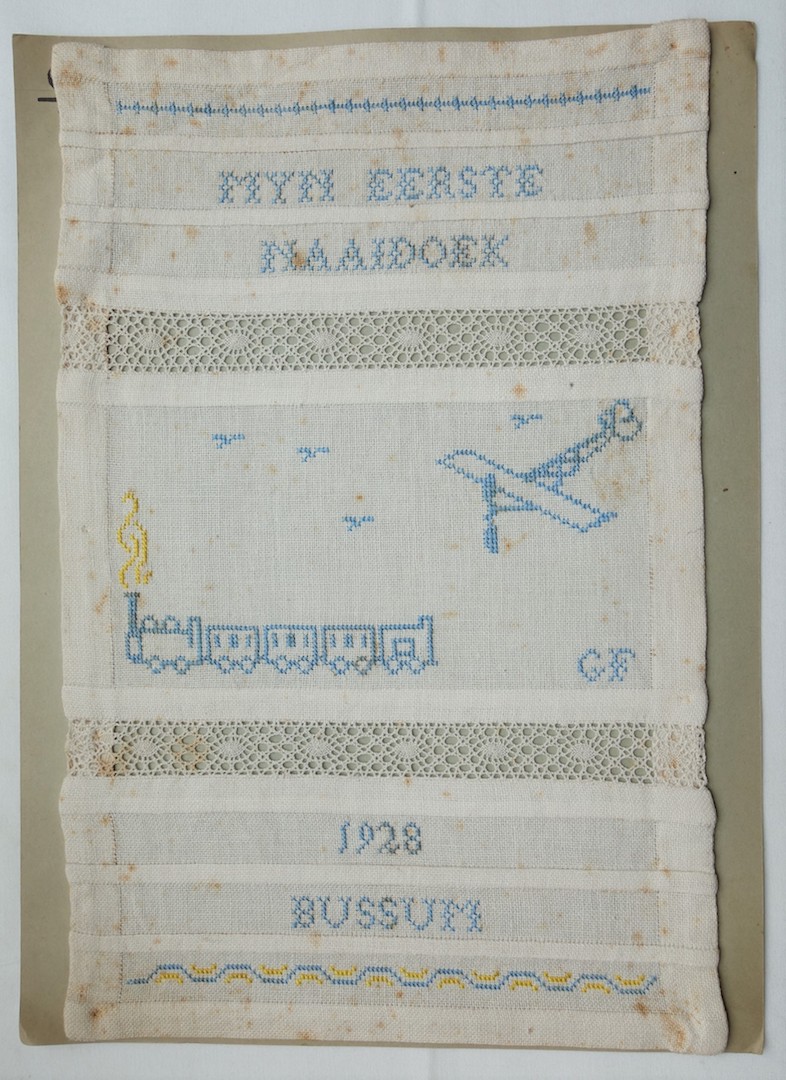 First sampler ('naaidoek') worked by G. Filbry in 1928 (TRC 2020.3838a).
All of the sheets had the name G. Filbry hand written on them. The first item was dated 1928 and had the initials G.F., the name of Bussum (a town that lies southeast of Amsterdam) and the text Mijn eerste naaidoek (My first 'sewing cloth’ (lit.) or sampler). The sampler also included a 19th century steam train and that oh so modern form of transportation, a single propellor plane! There are some strange motifs in the background that may be stylised birds, or perhaps planes in the distance.
The last sheet had an item with the date of 1930 and is a more complicated, mending sampler. So it would appear the sheets represent various school needlework projects that took place over a two year period.
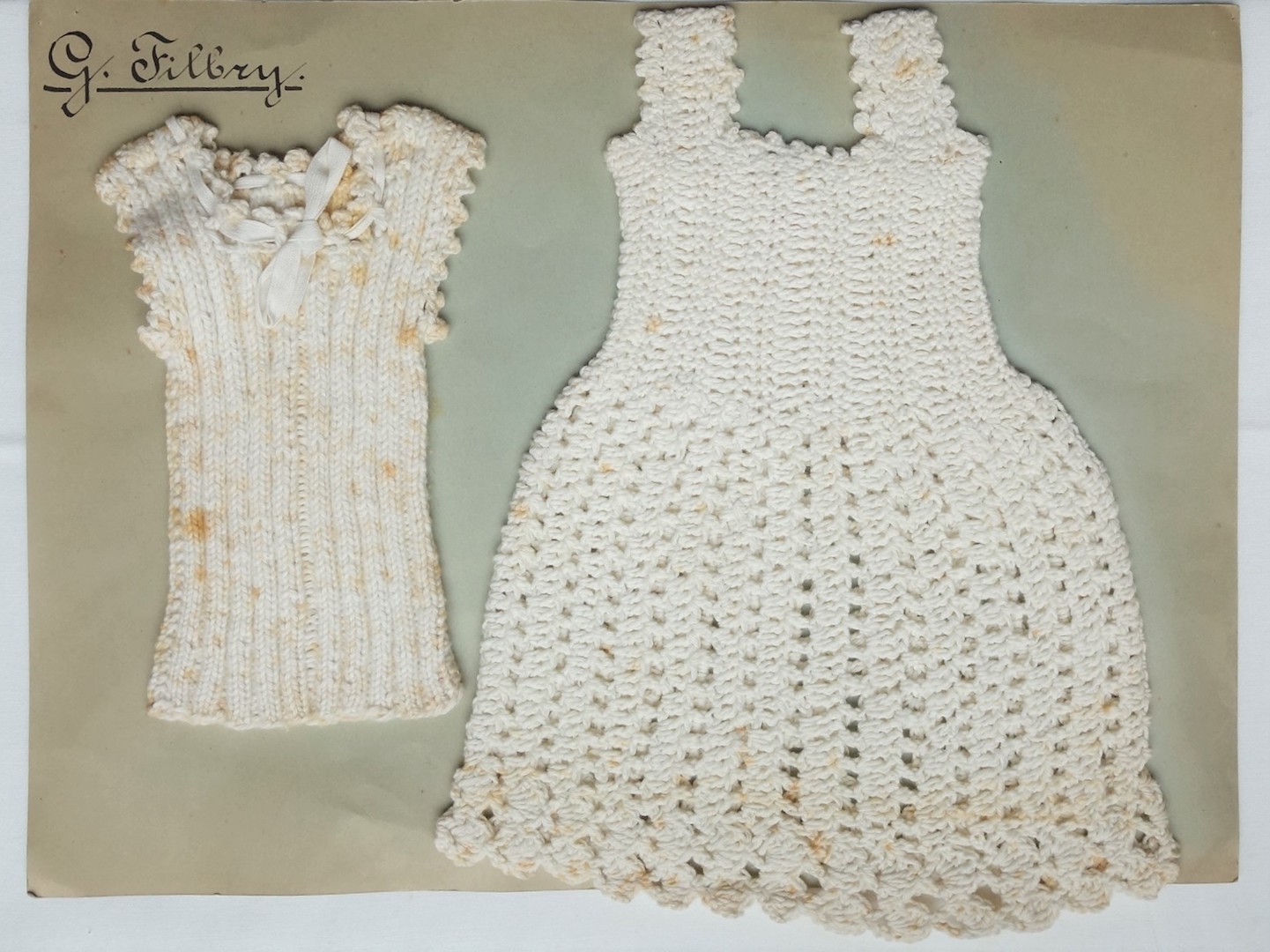 Knitted miniature vest and petticoat, worked by G. Filbry, between 1928 and 1930 (TRC 2020.3838f).
In addition to the two samplers, the sheets display a variety of miniature garments made by the same person with the initials G.F. These include a hand stitched chemise, skirt and apron, all in a white cotton material. There are also hand knitted and mended items, including socks, a vest, chemise and dress. Some of these miniature garments have fastenings such as ties and buttons.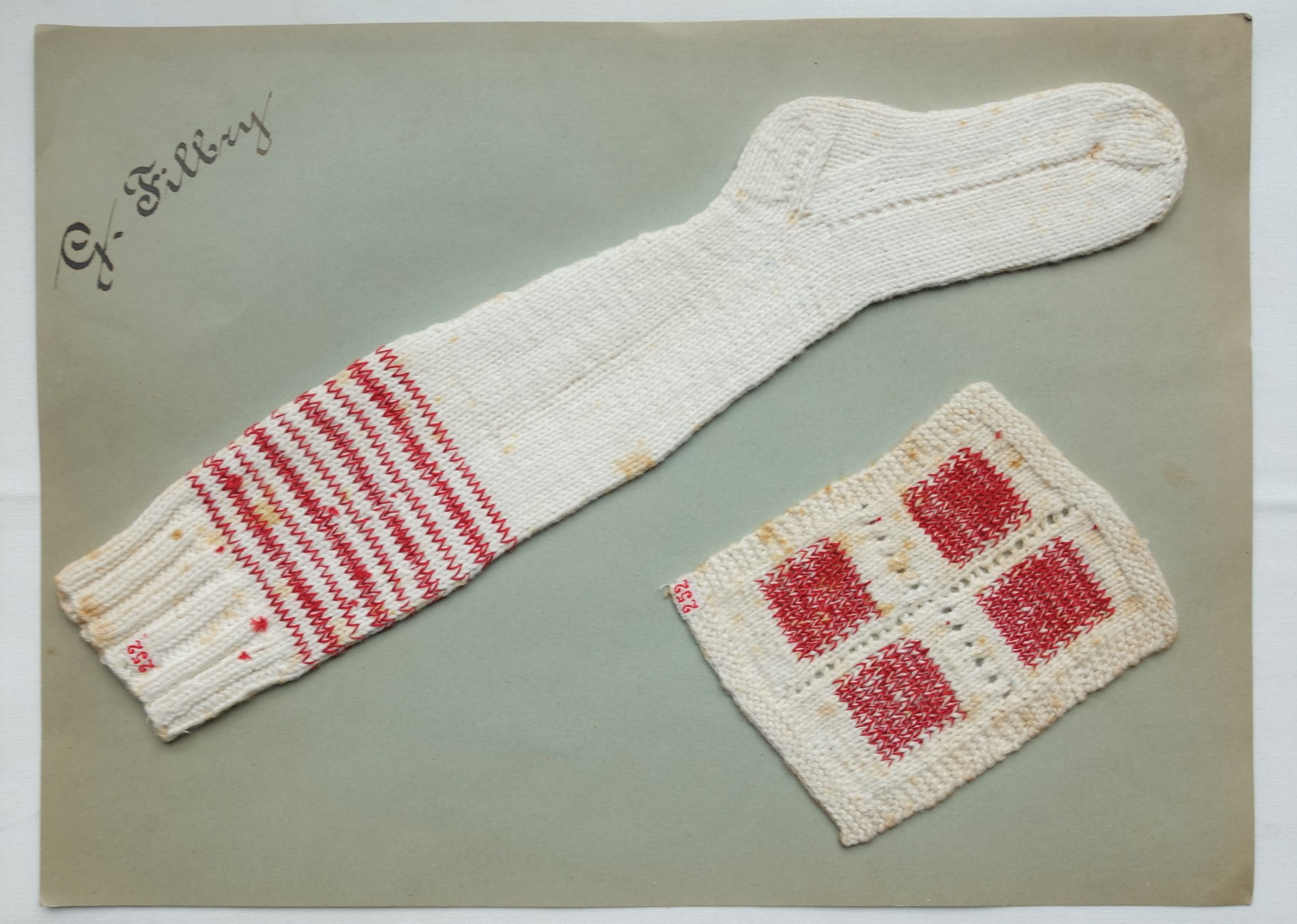 Knitted miniature sock and mending panel, worked by G. Filbry between 1928 and 1930 (TRC 2020.3838d).
The skills learnt by the making of these garments, including the sewing on of buttons, and how to mend and patch garments, were considered essential for a girl as part of her developing the ‘life skills’ needed to help clothe herself and her potential family in years to come.
Who was the little girl working these samplers and miniature garments? We have some ideas, but want to be sure. If you know anything, please let us know.
Gillian Vogelsang, 27 September 2020.


