


The TRC in Leiden has a small collection of tapestry woven textiles, among which some early examples from Coptic Egypt. Tapestry weaving has a long and fascinating history, and we are pleased to publish a blog about contemporary tapestry weaving, written by Charles Knobler from Los Angeles. He writes:
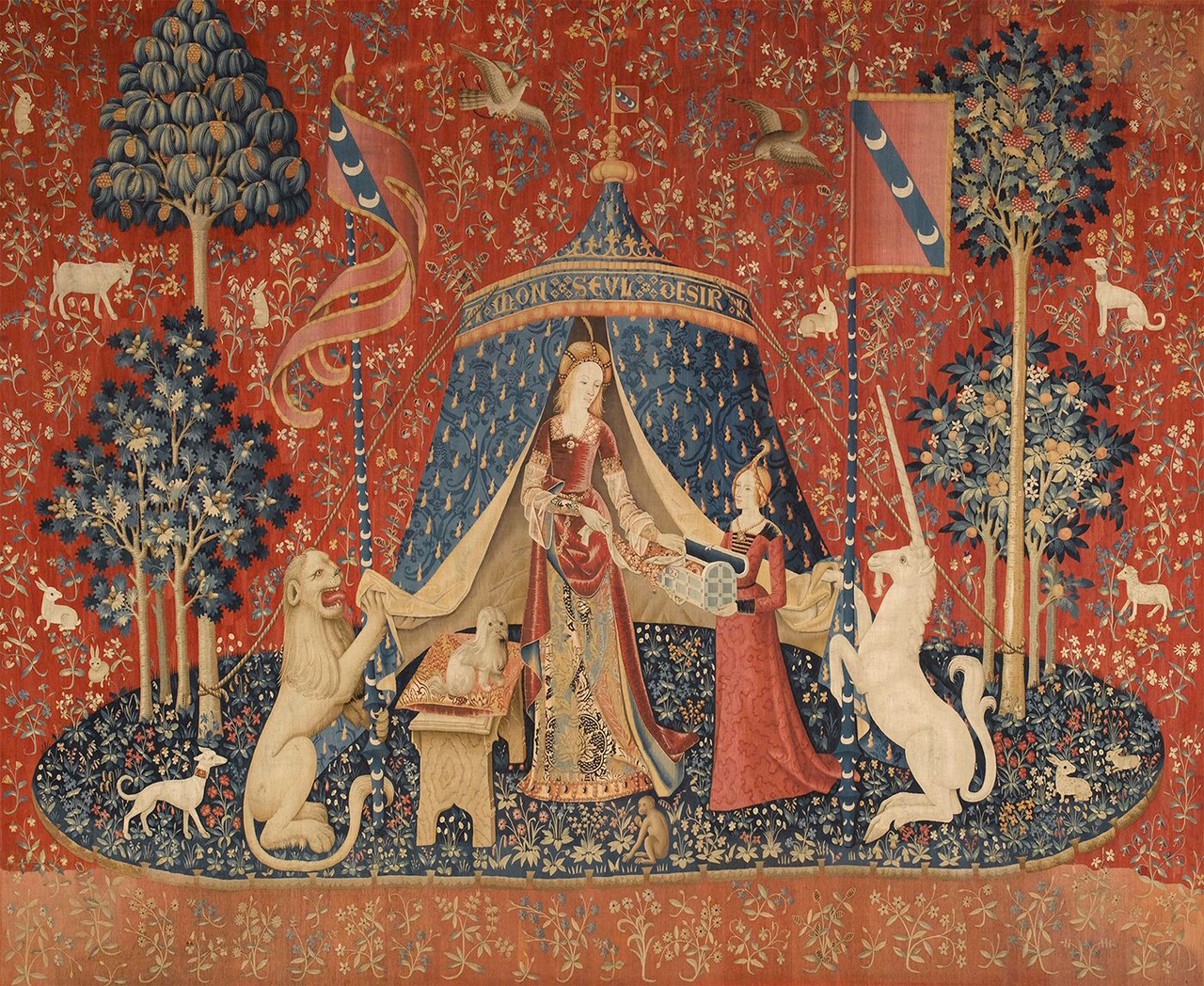 "The Lady and the Unicorn: Desire." Tapestry in the Cluny Museum, Paris.
To most people the term “tapestry” likely brings to mind the monumental medieval and renaissance woven wall hangings, such as “The Lady and the Unicorn”, which fills a room in the Cluny Museum in Paris. Such tapestries were designed by an artist and woven by teams of artisans.
To weavers the term tapestry has another connotation, however: It refers to the method of weaving in which the weft is not carried across the array of vertical warps but is discontinuous, made up of patches of a single colour, forming a weft-faced fabric. While large tapestries are still being created by teams of weavers in workshops such as the Gobelins Manufactory (founded in 1604!) in Paris, they are today rare, an exception being the thirty-seven 2 m-wide by 7 m-long Communion of Saints panels that hang in the Cathedral of Our Lady of the Angels in Los Angeles. They were designed twenty years ago by the artist, John Nava, and woven near Bruges, Belgium, but are not in the weavers’ sense tapestries, having been woven on computer-controlled Jacquard looms.
But tapestry weaving still thrives, albeit usually on a smaller scale. The American Tapestry Alliance, founded in the 1980’s, counts 1000 tapestry artists, who design and weave their own tapestries. One of them is Michael Rohde, a Southern Californian weaver. Michael was trained as a biochemist. When he was carrying out his studies he was intrigued by a hand-woven linen shirt he received and thought that it would be fun to learn how to make one. Thus began his infatuation with weaving. After earning his doctorate he studied drawing, colour and design at the Glassel School of Fine Art of the Houston Texas Museum of Fine Arts. Then, for nearly twenty years, he balanced careers as a weaver and as a research biochemist in the laboratory of a California pharmaceutical company, until becoming a full-time weaver in 1998.
Capitalizing on the rectangular geometry of the loom, Michael’s tapestries are based on pixelated images drawn from photographs, many of them taken by him on extensive travels to places such as Tibet, Morocco, Papua New Guinea and Oaxaca in Mexico. The pixels differ subtly in colour, with in some instances 150 different colours in a single weaving. Most of the fiber is wool and the dyes are natural, with the variations between them the result of carefully controlled and documented experimentation.
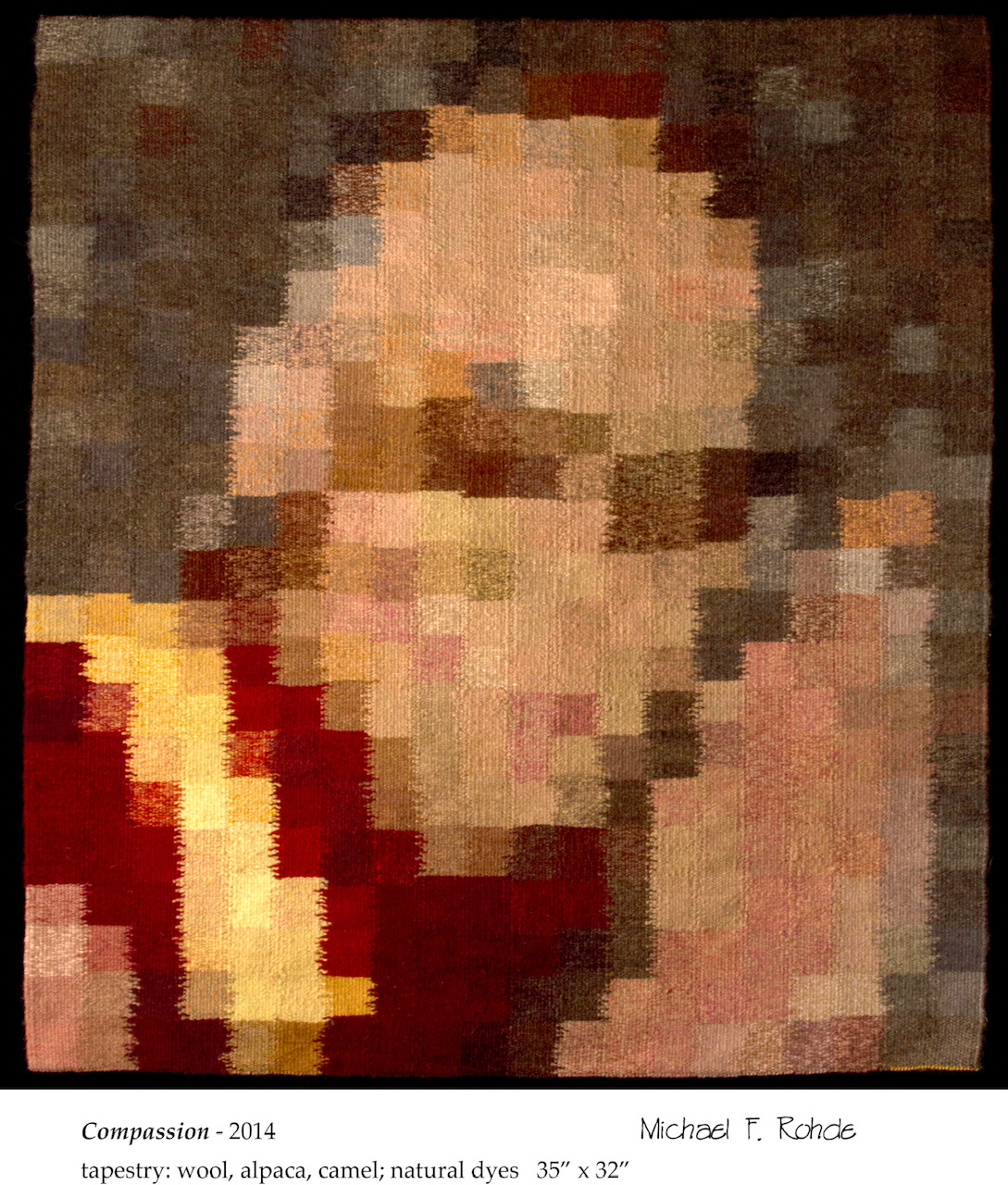 Tapestry weave by Michael Rohde, dated 2014, called Compassion. A careful observer may detect an image of the Dalai Lama.
Michael’s weavings can be found in the permanent collections of the Art Institute of Chicago, the Textile Museum in Washington, D.C. and the Mingei International Museum in San Diego. “Empathy of Patience”, a catalogue of a recent exhibition of his work at The San Luis Obispo Museum of Art, contains thirty colour plates of his work.
Recently Michael described the way in which he achieves the subtle variations in colour in his textiles and showed examples of his most recent work in a presentation to the Textile Council of the Fowler Museum of the University of California, Los Angeles. His talk has been recorded and can be accessed using the link: https://vimeo.com/452256266 with the password: fowlermember.
Charles Knobler, 6th September 2020.


