


On Wednesday 30 April 2020, Shelley Anderson wrote:
In the 18th century embroidery known as needle painting was immensely popular. Needle painting reproduced famous works of art in thread, often against a painted background. I highlighted one famous needle painter, Mary Delany, in a recent TRC blog. The embroideress Mary Linwood (1755-1845) was even more famous.
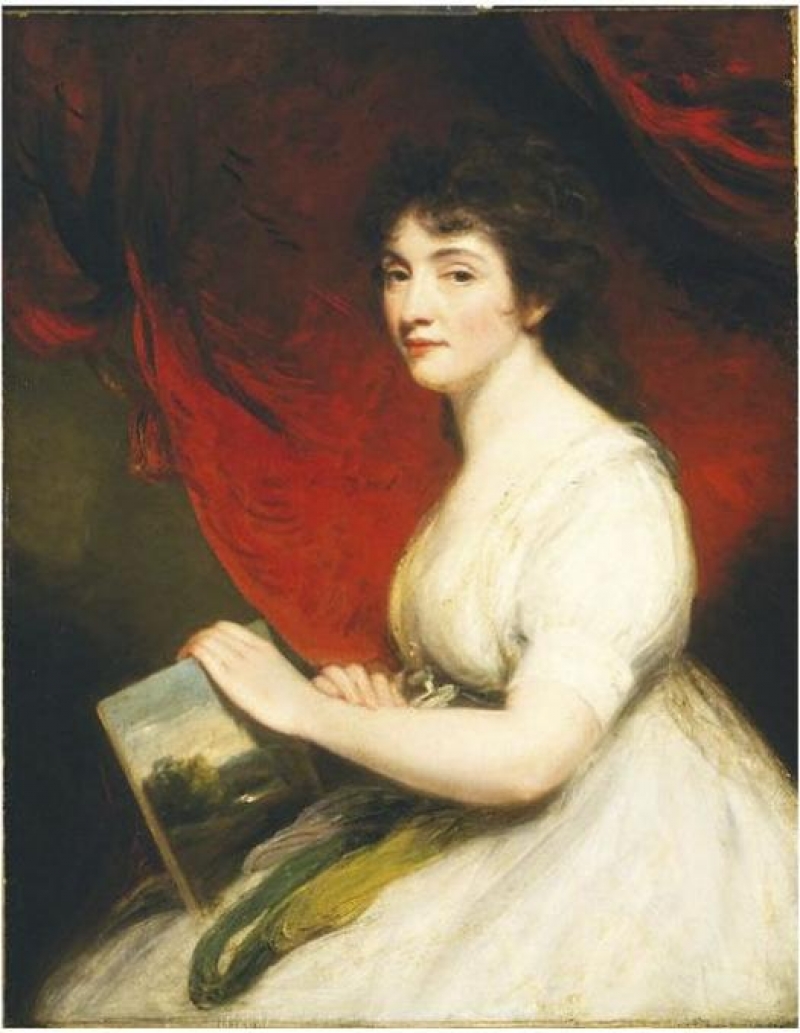 Mary Linwood, 1755-1845, painted c. 1800 by John Hoppner. Courtesy Victoria & Albert Museum, London, acc. no. 1439-1874.Mary completed her first embroidered painting when she was just thirteen years old. Within a few decades her reproductions of works by artists like Gainsborough, Raphael, Reynolds and Rubens were making her famous. She worked in crewel wool, in shades especially dyed for her paintings, adding silk floss for lustre. Among landscape artist John Constable’s earliest commission was the painting of a background to one of Mary’s embroideries. She won a medal from the Society for the Encouragement of Arts for her “excellent imitation of pictures in needlework” and in 1785 was summoned to Windsor Castle by King George III (1738-1820) to show her work, which was praised by Queen Charlotte (1744-1818). By around 1800 she commissioned John Hoppner, a favourite of the Prince of Wales (later King George IV), to paint her own portrait (see illustration). She is depicted with wool yarn in her lap, holding one of her own paintings.
The British King and Queen were not the only royals to be impressed by her skill. The King of Poland admired her paintings and Catherine the Great of Russia offered her the huge sum of GBP 40,000 for her entire body of work. Mary declined, saying she wanted her paintings to stay in England. Napoleon, whom Mary met in person in 1803, so admired her embroidered paintings of him that he honoured her with the Freedom of Paris.
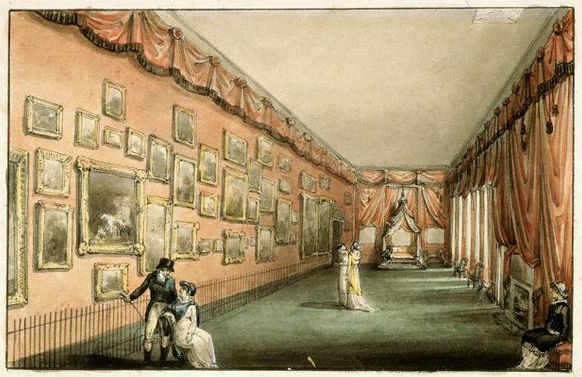 View of Mary Linwood's Gallery, watercolour c. 1810. Courtesy V&A acc. no. P.6 - 1985.
Mary opened a permanent public exhibition of over sixty of her embroidered paintings in Leicester Square, London, in 1809. It was the first exhibition to be lit by gas light, allowing visitors to see the paintings both by day and by night. The exhibition, arranged in rooms draped with scarlet, silver and gold cloth, drew some 40,000 visitors a year and rivaled Madame Tussaud’s.
Sadly, tastes changed. Before her death, Mary offered the British Museum her remaining work. They declined, as did the House of Lords. In 1846 Christie’s Auction House sold her remaining collection of one hundred embroideries for only GBP 300. Her most acclaimed work The Judgement of Cain, which had taken her ten years to complete, sold for GBP 64. Fortunately the V & A Museum (London) retains some of her masterpieces in thread.


