• F2
  • F1
  • F3
  • F4

In June we had an intense time at a special TRC study-day looking at the various basic types of velvet and how to identify them. One of the participants, Monika Gimblett, has a Polish/Dutch background and when we were talking about natural red dyes - cochineal, kermes, lac, madder - she started talking about the name for the month of June in many Central European countries, and the link with cochineal. It's a story that we thought that a lot more people would like to know. Monika sent us the following blog. More information about Polish lac or Polish cochineal can be found in the relevant Wikipedia pages.

****

Life cycle of the Polish cochineal, as portrayed in Breyne's 'Historia naturalis Cocci Radicum...', published in 1731.Life cycle of the Polish cochineal, as portrayed in Breyne's 'Historia naturalis Cocci Radicum...', published in 1731.Some stories are hidden deep in language, in words that we use every day but the origins of which have long been forgotten. Such is the case with Polish cochineal, also known as Polish lac or Polish grain, produced by a small insect known in Polish as Czerw.

Here is how it happened: this small bug known as Porphyrophora Polonica or Margarodes Polonicus was once common in central and eastern Europe, from Lusatia along the German border, through present-day Poland to the Baltic countries, Belarus and Ukraine to the northern borders of Romania and Moldova.

The insects (the females in their late larva state) were collected and boiled in water with vinegar, then dried in ovens or in the sun, and ground with some bread acid. The dye prepared this way could be used to dye cotton, flax, silk and wool. To dye 1 kg of silk, 15-20 gr of red powder was needed, but to dye the same amount of wool, 50 gr was used. However, to produce 1 kg of dye it was necessary to collect as much as 155 thousand of insects!

No wonder that Polish cochineal was very expensive, and only monarchs, nobility and high clergy could afford to buy cloth dyed with this substance. To some extent this explains why red was reserved for secular rulers and bishops for many centuries. Colour symbolism is another matter entirely.

Long length of leheria cloth with a colourful design of diagonal stripes in various widths and bright colours. Udaipur, Rajasthan, India, 1980 (TRC 2022.2119).Long length of leheria cloth with a colourful design of diagonal stripes in various widths and bright colours. Udaipur, Rajasthan, India, 1980 (TRC 2022.2119).A few weeks ago a collection of Indian and Indonesian textiles was given to the TRC Leiden by Mies Spée, from the small village of Noord-Beemster in the western part of the Netherlands.

She is a textile artist and designer who, when she was a student, became fascinated by resist-dying techniques, especially batik from Indonesia. She went to various places in South and Southeast Asia to learn more about the technique by working in various batik ateliers.

It is not surprising, therefore, that her collection of textiles includes many pieces of batik, ikat, leheria, plangi and tritik, which were bought in India and Indonesia in the 1970s, 19080s and 1990s. We have nearly finished cataloguing the 170+ items and they should all be online within a couple of weeks.

Mid-20th century, hand embroidered postcard from Greece with a man in a Greek fustanella outfit with red cap standing in front of the Acropolis (TRC 2019.2145).Mid-20th century, hand embroidered postcard from Greece with a man in a Greek fustanella outfit with red cap standing in front of the Acropolis (TRC 2019.2145).Who hasn’t seen them, either in real life in Athens, or in films, photographs or postcards (TRC 2019.2145)? The strikingly dressed guards in front of the presidential palace and the Tomb of the Unknown Soldier in the Greek capital.

And what strikes most people (and is made into a popular tourist attraction, something like the Scottish kilts), is the fact that the guards are wearing a pleated skirt. I remember first seeing them in the summer of 1974, at the time that a military regime (the colonel's junta) was pushed aside and replaced by a democratically elected government. I recall joining a demonstration against the regime in the streets of Athens, and how I lost my sandals when we were chased by the police, by that time still protecting the junta.

The Dutch flag, red-white-blue, hanging upside down just outside of Leiderdorp, 1 August 2022 (photograph Willem Vogelsang).The Dutch flag, red-white-blue, hanging upside down just outside of Leiderdorp, 1 August 2022 (photograph Willem Vogelsang).The TRC Collection includes a somewhat banal, typical farmer's kerchief from the Netherlands (TRC 2019.1998). Such cloths have always been linked to the Dutch countryside. They are used as handkerchiefs, cloths to contain all sorts of goods, and also to affix to objects that may cause accidents, such as long protruding bars or pipes loaded onto a truck. But for the last few weeks they have taken a very different role, namely as a symbol of protest.

For hundreds of years many people have used textiles and garments as a symbol of protest. Just think of the purple/green of the women’s suffragette movement in Britain the early 20th century, the white garments and the hand spinning of cotton (TRC 2021.2619) associated with Mahatma Gandhi in India in the 1940s, or the wearing of red, white and blue garments and accessories during the Second World War and the German occupation of the Netherlands (TRC 2020.3711).

Hand-made brooch in red-white-blue, the colours of the Dutch flag, worn during the German occupation of the Netherlands, 1940-1945 (TRC 2020.3711).Hand-made brooch in red-white-blue, the colours of the Dutch flag, worn during the German occupation of the Netherlands, 1940-1945 (TRC 2020.3711).

We can also point at the use of traditional, sal sepik outfit (1998.0284a and TRC 1998.0284b) currently worn by some Kurdish men in parts of Turkey and Iran.

An example of textiles used for sending a silent, yet very loud, message is taking place in the Netherlands at this very moment. During the last few weeks more and more Dutch flags can be seen throughout the Netherlands hanging from street lights, motorway bridges, as well as tractors and bales of hay. Why?

The last week has been a little strange. We heard ten days ago of the unexpected death of Lisa van Meerten, who has been a long-term friend and supporter of the TRC, as well as a dedicated textile enthusiast who attended many TRC workshops. We attended her funeral on Monday and flowers were sent in the name of everyone at the TRC. All very sad.

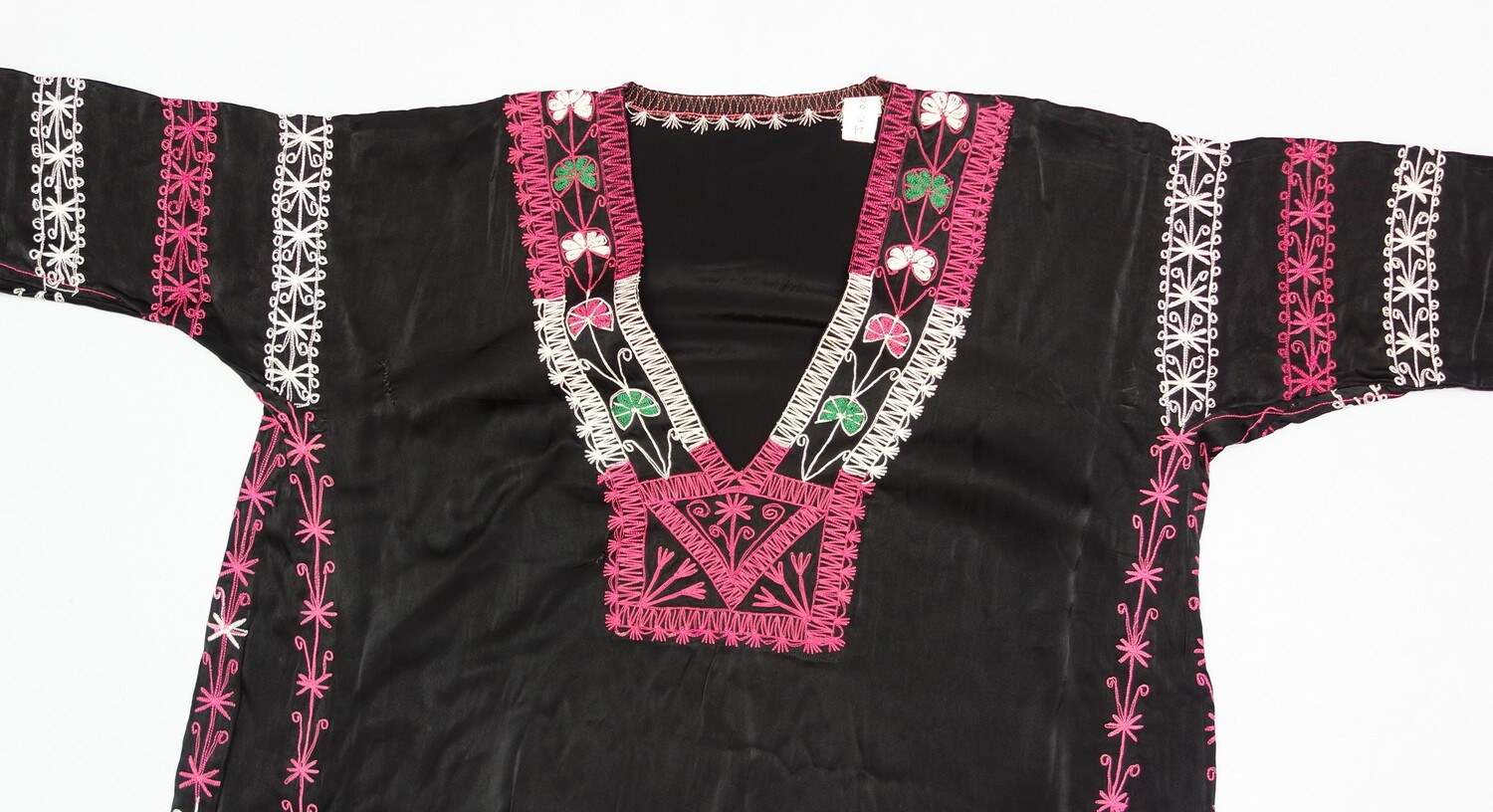
Detail of an embroidered girl's dress, Kabul, Afghanistan, early 21st century (TRC 2008.0044b).Detail of an embroidered girl's dress, Kabul, Afghanistan, early 21st century (TRC 2008.0044b).

On Tuesday we went to a refugee camp in the province of Groningen, in the far northeast of the Netherlands, to take new and second-hand clothing to an Afghan couple with seven children between the ages of two and twelve. They had arrived from Afghanistan only a few weeks ago. All the Afghan refugees housed in the camp were especially invited and brought over to the Netherlands because of their links with the Dutch presence in the country between 2001 and 2021.

Willem had known and worked with the family when he was based in Uruzgan, in southern Afghanistan, between 2008 and 2011. Both the father and elder brother of the man had been killed during the war. We were struck by the sheer happiness of the Afghans and their children and their relief of being 'safe', and by the many activities that were organised to entertain them, including Dutch language sessions.

In an earlier TRC blog I discussed various medieval, embroidered bags in the Sens Museum, France. I also noted that one of the bags (B320) was decorated with geometric patterns and that I would provide charts for the various designs. This blog is specifically about the bag and the promised charts.

Front of an embroidered bag (B320) dating to the 13th century now in the Sens Museum, France. Photograph by author.Front of an embroidered bag (B320) dating to the 13th century now in the Sens Museum, France. Photograph by author.

Back of an embroidered bag (B320) dating to the 13th century now in the Sens Museum, France. Photograph by author.Back of an embroidered bag (B320) dating to the 13th century now in the Sens Museum, France. Photograph by author.


The bag is 14 x 12 cm in size and made from a linen ground covered with four different patterns (see below). These were worked mainly in rows of long and short cross stitch and the occasional cross stitch to finish a line or detail, which were worked in various combinations of white, red, green, purple, bronze, dark blue, light blue and yellow silk floss.

Cross stitch (drawing by Martin Hense).Cross stitch (drawing by Martin Hense).

Long and short armed cross stitch (drawing by Martin Hense).Long and short armed cross stitch (drawing by Martin Hense).

Dino-lite image of the silk band used as a bag strap.Dino-lite image of the silk band used as a bag strap.

In addition, the bag has a single tassel attached to one lower corner and presumably there had been a corresponding tassel on the other corner. It also has a narrow strap made from silk threads in red, green and white.

The four different, geometric patterns associated with the bag made me initially think they were relatively simple and tile-like in construction. However, two of them proved to be more complicated in construction than I had thought due to various colour changes and combinations (see charts and descriptions below).


Pattern 1: Rows of stripes, bars and ‘hammers.' Photograph by author.Pattern 1: Rows of stripes, bars and ‘hammers.' Photograph by author.Pattern 2: Rows of squares enclosing ornate X shapes in various colour combinations. Photograph by author.Pattern 2: Rows of squares enclosing ornate X shapes in various colour combinations. Photograph by author.


Pattern 3: Diagonal rows of zig-zags. Photograph by author.Pattern 3: Diagonal rows of zig-zags. Photograph by author.

Pattern 4: Rows of squares with X-shapes in various colour combinations. Photograph by author.Pattern 4: Rows of squares with X-shapes in various colour combinations. Photograph by author.

The geometric patterns worked on the bags are the following:

Pattern 1: Rows of stripes and bars in red/white and green/yellow, alternating with hammer shapes in green/white, brown/white, brown/green and purple/white.

Pattern 2: Square quatrefoils enclosing smaller quatrefoils with crosses in the interstices, worked in various combinations of red, white, and green, with crosses in mainly yellow.

Pattern 3: Series of zig-zags worked in dark blue, light blue (or green), red and white, in a bargello-style pattern (we will shortly publish another blog, on this particular pattern).

Pattern 4: Rows of squares enclosing indented squares set in an X pattern. Each square is made using two or three colours, such as a red X on a white ground, or a red and pale yellow X on a green ground. There are very few repeats of the various colour combinations.

The charts below can be used (and enlarged) by anyone wishing to do so. If you click on the illustration, you will get a PdF version. Please acknowledge this TRC blog and its author when copying the charts.

Gillian Vogelsang-Eastwood, 24 July 2022

Chart of Pattern 1: Rows of stripes, bars and ‘hammers’ in green, bronze, purple and white (chart by Gillian Vogelsang-Eastwood).Chart of Pattern 1: Rows of stripes, bars and ‘hammers’ in green, bronze, purple and white (chart by Gillian Vogelsang-Eastwood).

***

Chart of Pattern 2: Three rows of squares with ornate X-shapes worked in bronze, purple, red, white, green and yellow (chart by Gillian Vogelsang-Eastwood).Chart of Pattern 2: Three rows of squares with ornate X-shapes worked in bronze, purple, red, white, green and yellow (chart by Gillian Vogelsang-Eastwood).

Chart of  basic pattern unit of Pattern 2 (chart by Gillian Vogelsang-Eastwood).Chart of basic pattern unit of Pattern 2 (chart by Gillian Vogelsang-Eastwood).

***

Chart of Pattern 3: A diagonal zig-zag pattern in green, bronze, dark blue, and white (chart by Gillian Vogelsang-Eastwood).Chart of Pattern 3: A diagonal zig-zag pattern in green, bronze, dark blue, and white (chart by Gillian Vogelsang-Eastwood).

***

Chart of Pattern 4: Three rows of the completed squares worked in various combinations of red, white, green and pale yellow (chart by Gillian Vogelsang-Eastwood).Chart of Pattern 4: Three rows of the completed squares worked in various combinations of red, white, green and pale yellow (chart by Gillian Vogelsang-Eastwood).

Chart of  basic unit of Pattern 4 (chart by Gillian Vogelsang-Eastwood).Chart of basic unit of Pattern 4 (chart by Gillian Vogelsang-Eastwood).


While writing the medieval section of the Bloomsbury World Encyclopedia of Embroidery, vol. 4, Scandinavian and Western European Embroidery, I came across an article by Christine Sciacca (2010), ‘Stitches, sutures, and seams: “Embroidered” parchment repairs in medieval manuscripts’, in: (eds) Robin Nethertong and Gale R. Owen-Crocker, Medieval Clothing and Textiles, Vol. 6, Woodbridge: the Boydell Press, pp. 57- 92.

A parchment gap strengthened and decorated with open buttonhole stitch with Cretan stitch, which are worked in pink and yellow silk threads (Engelberg, Stiftsbibliothek / Cod. 22 – Gregorius M., Moralia in Job, t. III / f. 54r).A parchment gap strengthened and decorated with open buttonhole stitch with Cretan stitch, which are worked in pink and yellow silk threads (Engelberg, Stiftsbibliothek / Cod. 22 – Gregorius M., Moralia in Job, t. III / f. 54r).

Search in the TRC website

Contact

Boerhaavelaan 6
2334 EN Leiden.
Tel. +31 (0)71 5134144 (office hours)  
office@trcleiden.org 

The TRC is open every day from 10.00 to 15.00

facebook 2015 logo detail 

instagram vernieuwt uiterlijk en logo


Bank account number

NL39 INGB 0002 9823 59, in the name of the Stichting Textile Research Centre.

Donations

The TRC is dependent on project support and individual donations. All of our work is being carried out by volunteers. To support the TRC activities, we therefore welcome your financial assistance: donations can be transferred to bank account number (IBAN) NL39 INGB 000 298 2359, in the name of the Stichting Textile Research Centre. BIC code is: INGBNL2A.

 You can also, very simply, if you have an iDEAL app, use the iDEAL button and fill in the amount of support you want to donate: 


Since the TRC is officially recognised as a non-profit making cultural institution (ANBI), donations are tax deductible for 125% for individuals, and 150% for commercial companies. For more information, click here